
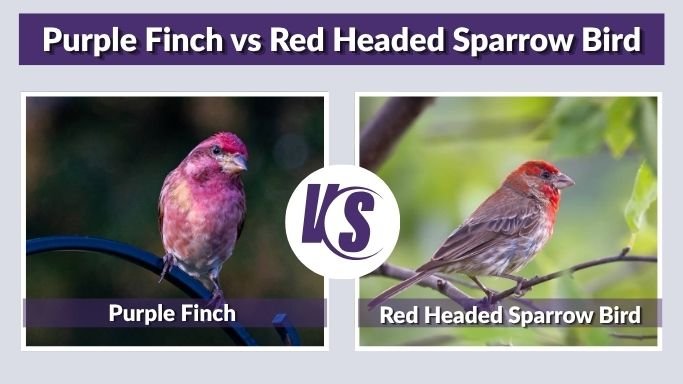
A purple finch and a “red headed sparrow bird” can look confusingly similar at backyard feeders. Both are small, seed-eating birds with brown markings, and the males may show red or rosy color on the head and chest. However, the bird many people call a red headed sparrow is usually not a sparrow at all. In most North American yards, it is often a male House Finch. Purple Finches and House Finches are both true finches, but they differ in color, shape, markings, habitat, and behavior.
Purple Finch vs Red Headed Sparrow Bird Overview
The biggest difference is that a Purple Finch looks more evenly washed with raspberry-red, while the common “red headed sparrow” or House Finch usually has red mainly on the head, throat, chest, and rump. Cornell describes male Purple Finches as pink-red on the head and breast, mixed with brown on the back and cloudy white on the belly. Female Purple Finches are brown and heavily streaked, with strong facial markings.
A male House Finch, on the other hand, often has red on the face and upper chest but keeps a browner, more streaked body. Cornell notes that House Finch males can vary from red to orange or yellow because their color comes from pigments in food during molt.
| Feature | Purple Finch | “Red Headed Sparrow” / House Finch |
|---|---|---|
| Bird family | Finch | Finch, often mistaken for sparrow |
| Male color | Raspberry-red wash | Red, orange, or yellow on head/chest |
| Back | Reddish-brown | Brown and streaked |
| Belly | Whitish, cleaner | Heavily streaked |
| Face | More evenly rosy | Brown face patches often visible |
| Bill | Thick, conical | Shorter, curved seed bill |
| Habitat | Forest edges, conifers, feeders | Towns, yards, farms, feeders |
What Is a Purple Finch?
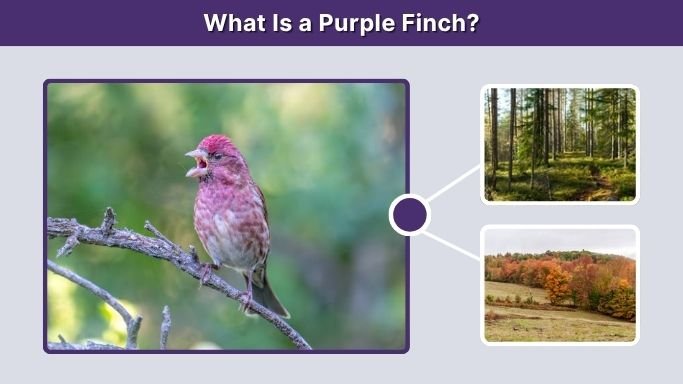
The Purple Finch is a chunky, seed-eating finch found mainly in forests, woodland edges, and some backyard feeding areas. Despite its name, it is not truly purple. Adult males are more raspberry-red or wine-red, especially across the head, breast, and back. This rich color can make the bird look as if it has been dipped in berry juice.
Purple Finches have a strong, conical bill made for cracking seeds. Their body is fairly stocky, and their tail is short and notched. Females do not have red plumage. Instead, they are brown and white with bold streaks below and a strong facial pattern, including a pale eyebrow line and a darker line near the throat.
Purple Finch Identification
- Male has rosy-red or raspberry color on head and breast
- Red often spreads onto the back and sides
- Belly looks cleaner and less heavily streaked
- Female has bold face pattern and strong streaking
- Bill is large, thick, and cone-shaped
- Body looks chunky compared with many sparrows
- Often found near trees, forests, and winter feeders
Cornell’s Purple Finch overview says the species is often a winter visitor to feeders and can be separated from House Finches by careful observation.
What Is a Red Headed Sparrow Bird?
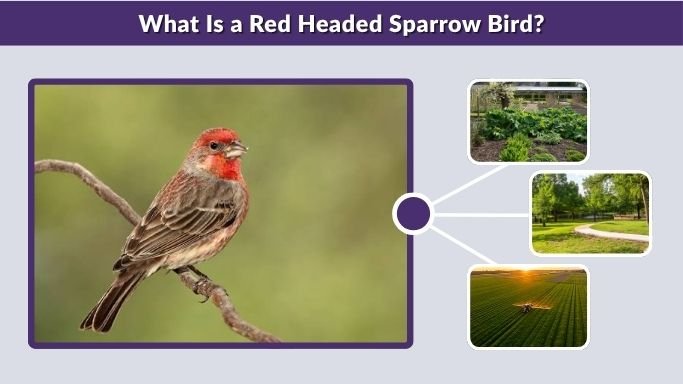
“Red headed sparrow” is not usually a formal bird name. Most of the time, people use the phrase for a small brown bird with red on the head. In backyards, this is often a male House Finch. A true House Sparrow does not have a bright red head. Male House Sparrows have gray heads, white cheeks, and a black bib instead.
House Finches are common around homes, gardens, parks, farms, and feeders. Males usually show red on the forehead, eyebrow area, throat, upper breast, and rump. The exact shade can vary. Some males look bright red, while others look orange or yellowish.
House Finch Identification
- Male has red, orange, or yellow on head and chest
- Brown streaking remains visible on belly and sides
- Back is brown, not fully red-washed
- Female is plain brown and heavily streaked
- Often seen in towns, yards, and feeders
- Song is cheerful, jumbled, and musical
- Usually travels in small groups
If the bird looks like a sparrow but has a red face and breast, it is probably a House Finch rather than a true sparrow.
Color Differences
Color is the easiest starting point, but it can also be misleading. A male Purple Finch has a softer raspberry-red wash that spreads more evenly over the head, chest, and upper body. It often looks rosy across the back as well. This gives the bird a smoother, richer look.
A male House Finch usually has brighter red concentrated on the head, throat, and upper breast. Its back and wings remain more brown. The belly and sides often show clear dark streaks. Cornell’s comparison notes that adult male Purple Finches have more red on the face and neck, while House Finches have brown streaking on the back and some brown on the face.
Quick Color Clues
- Purple Finch: raspberry wash over head, breast, and back
- House Finch: red head and chest with brown back
- Purple Finch: cleaner whitish lower belly
- House Finch: stronger streaking on belly and sides
- House Finch: color may look red, orange, or yellow
A simple way to remember it: the Purple Finch looks more “washed” in red, while the House Finch looks more “patched” with red.
Face and Head Differences
The face is one of the best places to compare these birds. A male Purple Finch usually has a fuller rosy face without obvious brown patches. The color wraps around the head and blends into the breast and back.
A House Finch often has a red forehead and throat but still shows brownish areas around the cheek, ear, or side of the face. This makes the head look less evenly colored.
Females are different. Female Purple Finches have a bold face pattern, especially a pale eyebrow stripe and dark cheek/throat markings. Female House Finches look plainer, with less contrast on the face.
Body Shape and Bill
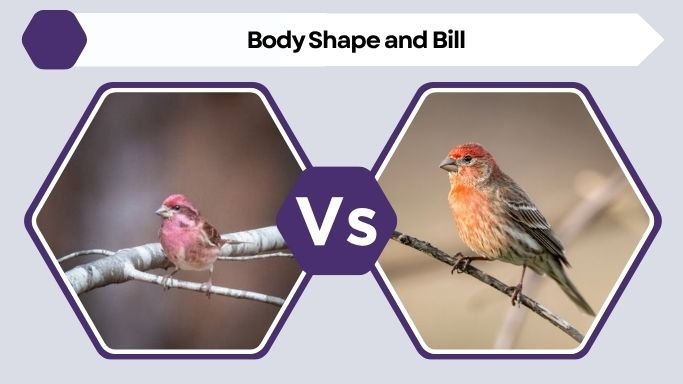
Purple Finches often look slightly chunkier and heavier-headed than House Finches. Their bill looks larger and more powerful. This thick bill helps them crush seeds.
House Finches are also seed eaters, but they tend to look slimmer and slightly longer-tailed. Their bill is conical but often appears smaller and more curved than the Purple Finch’s bill.
| Body Part | Purple Finch | House Finch |
|---|---|---|
| Head | Larger, rounded | Smaller, smoother |
| Bill | Thick and strong | Shorter and curved |
| Body | Chunkier | Slimmer |
| Tail | Short, notched | Longer-looking, notched |
| Posture | Compact | Upright and active |
These shape differences are helpful when lighting makes color hard to judge.
Wing, Back, and Belly Markings
The back and belly provide strong clues. A male Purple Finch often has reddish color on the back, not just on the head. The belly tends to look cleaner, with less obvious streaking toward the lower parts.
A male House Finch has a brown, streaked back. Its belly and sides usually show clear dark streaks. Even when the head is bright red, the lower body still looks streaked and brownish.
Female Purple Finches are bold and contrasty, with strong streaks and a noticeable face pattern. Female House Finches are more uniformly brown and streaked, with a softer, less dramatic face pattern.
Habitat and Range
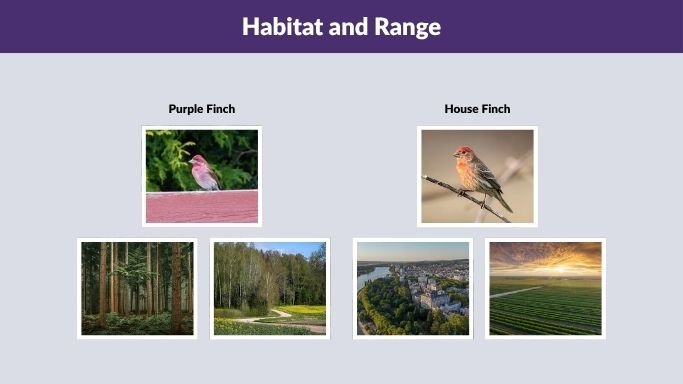
Purple Finches are more connected to forests, coniferous areas, mixed woods, and edges. They may visit feeders, especially in winter, but they are less tied to cities than House Finches.
House Finches are very comfortable around people. They are common in neighborhoods, gardens, parks, farms, parking lots, and building edges. If you see a red-headed finch nesting near a porch, feeder, or town street, House Finch is more likely.
Habitat Clues
- Purple Finch: forests, woodland edges, conifers, winter feeders
- House Finch: towns, yards, farms, parks, buildings, feeders
- Purple Finch: less common in many urban areas
- House Finch: one of the most common backyard finches
Habitat alone should not be the only clue, but it helps support identification.
Song and Behavior
Both birds sing musical finch songs, but House Finches are especially common singers around neighborhoods. Their song is a lively, jumbled series of notes, often ending with a rising or wheezy note. They perch on wires, rooftops, trees, and feeders.
Purple Finches also sing rich, warbling songs, often from trees. They may seem a little less urban and more tied to wooded surroundings. At feeders, both species eat seeds, especially sunflower seeds.
Purple Finch vs Red Headed Sparrow: Best Identification Tips
If you only have a few seconds to identify the bird, focus on color spread, streaking, and habitat.
- If the bird looks raspberry-red all over the head, breast, and back, it is likely a Purple Finch.
- If the bird has a red head and chest but a brown streaked back and belly, it is likely a House Finch.
- If the bird has a gray head, black bib, and no red, it may be a male House Sparrow.
- If the female has bold white eyebrow markings, consider Purple Finch.
- If the female is plain brown and heavily streaked, consider House Finch.
The most common mistake is calling a male House Finch a red headed sparrow. In reality, most “red headed sparrows” at feeders are House Finches.
FAQs
Is a red headed sparrow the same as a Purple Finch?
No, a red headed sparrow is not the same as a Purple Finch. In many cases, the bird people call a red headed sparrow is actually a male House Finch. Purple Finches have a richer raspberry wash, while House Finches usually show red mainly on the head and chest.
How can I tell a Purple Finch from a House Finch?
Look at the color and streaking. A male Purple Finch looks more evenly raspberry-red, including the back. A male House Finch has a red head and chest but a brown streaked back and belly. Female Purple Finches also have stronger face markings than female House Finches.
Do true sparrows have red heads?
Most common true sparrows do not have bright red heads like male House Finches. Male House Sparrows have gray heads, pale cheeks, and a black bib. If a backyard bird has clear red on the face and breast, it is more likely a finch than a sparrow.
Which bird is more common at backyard feeders?
House Finches are usually more common at backyard feeders, especially in towns, suburbs, parks, and farms. Purple Finches can visit feeders too, but they are more often associated with forests, woodland edges, and seasonal winter movements.
Why is it called a Purple Finch if it looks red?
The Purple Finch is called “purple,” but adult males usually look raspberry-red, wine-red, or rosy rather than true purple. The color spreads across the head, breast, and sometimes the back, giving the bird a richer tone than the brighter red patches of a House Finch.
