
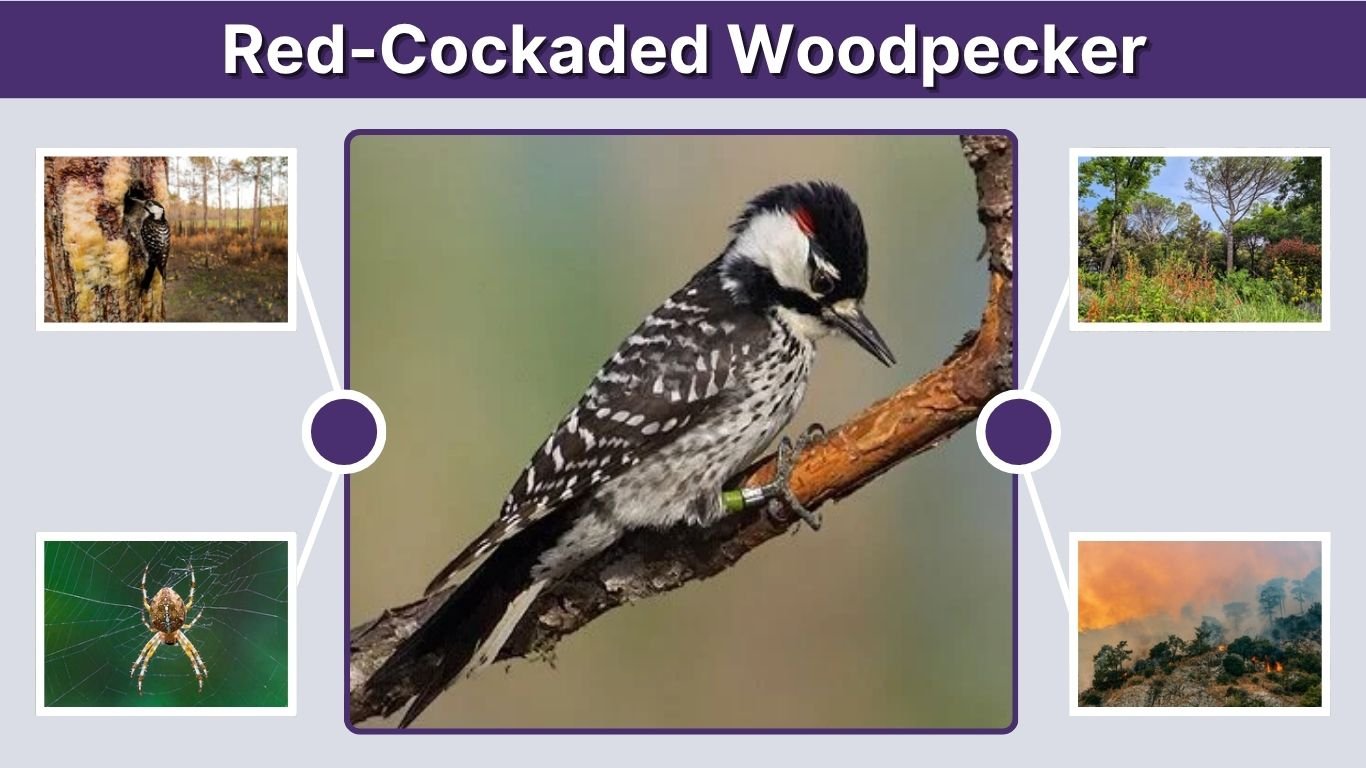
The red-cockaded woodpecker is a rare black-and-white bird living in mature pine forests of the southeastern United States. Unlike most woodpeckers, it excavates nesting and roosting cavities in living pine trees. It also lives in cooperative family groups whose members help defend the territory and raise young. Although habitat destruction caused a severe historical decline, decades of forest restoration have improved its population. This guide covers its identification, habitat, range, food, call, nesting behavior, adaptations, and current conservation status.
What Is a Red-Cockaded Woodpecker?
The red-cockaded woodpecker is a small, nonmigratory woodpecker scientifically known as Dryobates borealis, formerly classified as Picoides borealis. Its name comes from the male’s tiny red “cockade,” or streak of feathers, beside the head. However, this marking is usually concealed, so the bird does not appear noticeably red from a distance.
Identification and Characteristics
Important identification features include:
- Length of approximately 7–9 inches
- Weight of about 1.4–1.8 ounces
- Black crown and back of the neck
- Large white cheek patches
- Black-and-white barred back
- White underparts with dark flank spots
- Strong, straight bill
- Short, stiff tail feathers
- Slightly undulating flight pattern
The bird’s white cheeks are surrounded by black feathers, creating a bold facial pattern. Its back has narrow horizontal bars rather than the single broad white stripe seen on a downy woodpecker.
Male vs. Female Red-Cockaded Woodpecker
Male and female red-cockaded woodpeckers are nearly identical in size and general appearance. Adult males have a tiny red line, called a cockade, along each side of the black crown. The marking is located behind the eye but is often hidden beneath other feathers.
Adult females lack these red markings. Because the cockade is difficult to see, behavior or close photographs may be needed to identify a bird’s sex confidently.
Red-Cockaded vs. Downy Woodpecker
A downy woodpecker has a broad white stripe running vertically down the center of its black back. The red-cockaded woodpecker instead has narrow black-and-white bars across its back.
Male downy woodpeckers have a noticeable red patch on the back of the head, while the male red-cockaded woodpecker’s red marking is extremely small. Red-cockaded woodpeckers also possess larger, cleaner-looking white cheek patches and are strongly associated with mature southern pine forests.
Habitat and Geographic Range
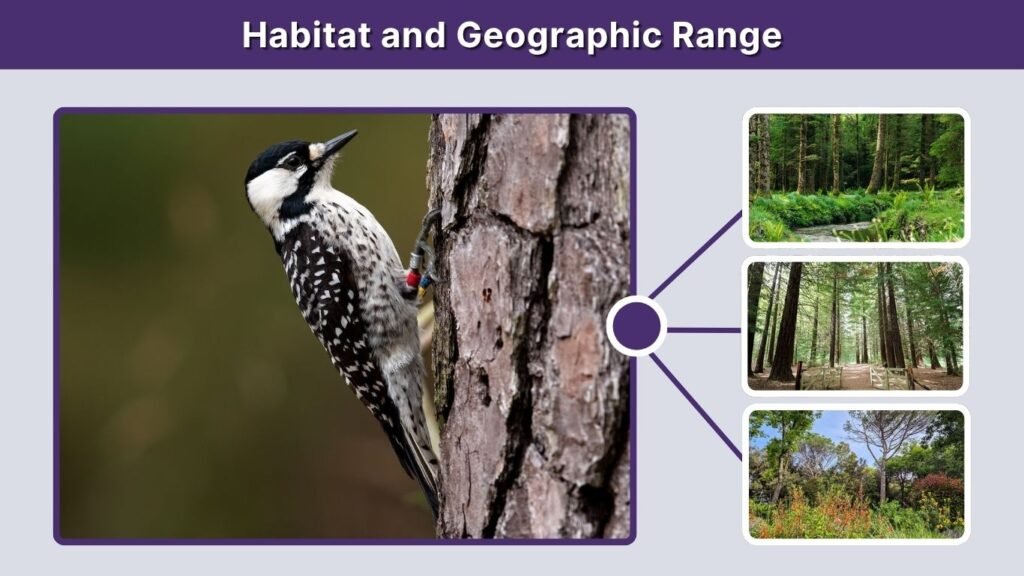
The species depends on open pine woodland containing mature living trees and relatively little hardwood vegetation in the middle layer. Historically, lightning-caused fires regularly maintained these forests. Frequent, low-intensity fires limited dense shrubs and hardwoods while allowing fire-adapted longleaf pines, grasses, and wildflowers to flourish.
Preferred Habitat
Suitable red-cockaded woodpecker habitat usually contains:
- Mature or old longleaf pine trees
- An open pine canopy
- Little hardwood midstory growth
- Native grasses and low ground vegetation
- Regularly burned or carefully managed woodland
- Large pines that provide abundant foraging surfaces
- Several suitable cavity trees located together
Longleaf pine forest is its characteristic habitat, but it may also occupy stands of loblolly, slash, shortleaf, pond, Virginia, or pitch pine. Fire suppression allows hardwood vegetation to become dense, making the area less suitable for nesting and foraging.
Red-Cockaded Woodpecker Range
The historical range extended from New Jersey and Maryland south to Florida and west through the southeastern states to Texas and Oklahoma. The modern range is much more fragmented.
Remaining populations occur primarily in Virginia, North Carolina, South Carolina, Georgia, Florida, Alabama, Mississippi, Louisiana, Arkansas, Oklahoma, and Texas. Significant populations survive on national forests, wildlife preserves, military installations, and specially managed private properties. The birds generally remain in their territories throughout the year.
Red-Cockaded Woodpeckers at Peachtree Rock
Peachtree Rock Heritage Preserve in Lexington County, South Carolina, contains restored longleaf pine habitat. After being absent from the area for decades, red-cockaded woodpeckers were observed there again in 2025.
Conservation workers have used prescribed fire, planted longleaf pines, and installed artificial cavities to encourage the birds to establish family groups. The return demonstrates how careful habitat restoration can reconnect isolated populations.
Food and Foraging Behavior
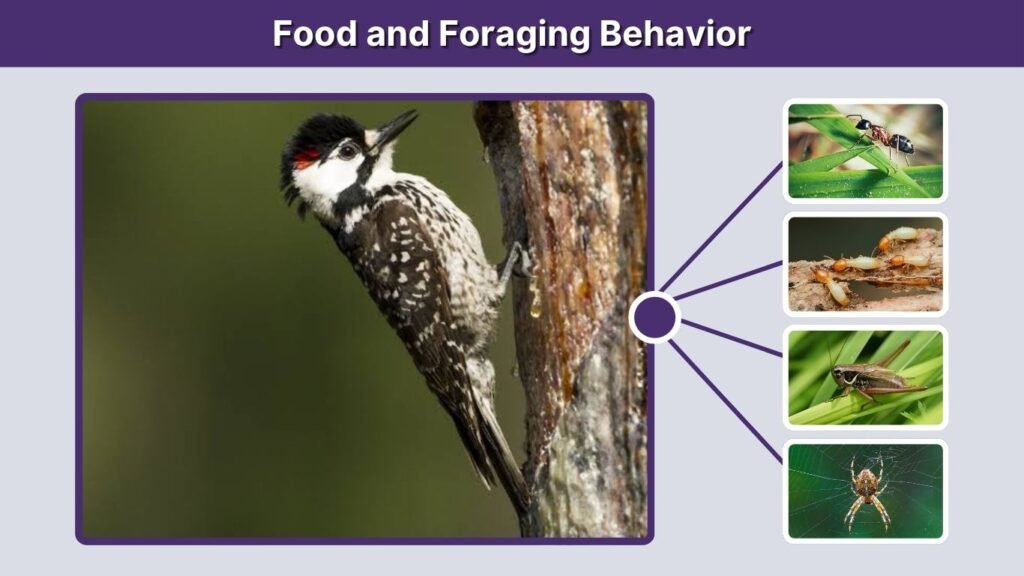
Red-cockaded woodpeckers obtain most of their food from the trunks and branches of living pine trees. They climb along the bark, searching beneath loose scales and inside crevices. Family members frequently forage together, sometimes joining mixed groups of bluebirds, nuthatches, and other woodland birds.
What Do Red-Cockaded Woodpeckers Eat?
Their food includes:
- Ants and termites
- Beetles and beetle larvae
- Wood roaches
- Crickets and moths
- Spiders and centipedes
- Insect eggs and pupae
- Pine seeds
- Wild grapes and cherries
- Blueberries and blackgum fruit
- Magnolia, wax myrtle, and poison ivy berries
More than 75% of their diet consists of insects and other arthropods. Fruits and seeds form a smaller portion, while nestlings are fed primarily protein-rich arthropods.
Male and Female Foraging Differences
Males generally forage on branches and the higher sections of pine trunks. Females spend more time searching the lower trunk below the lowest branches.
This division may reduce competition for food between members of a pair. Large, mature pines provide particularly productive feeding sites because their broad trunks and loose bark support numerous insects.
Nesting, Reproduction and Social Behavior
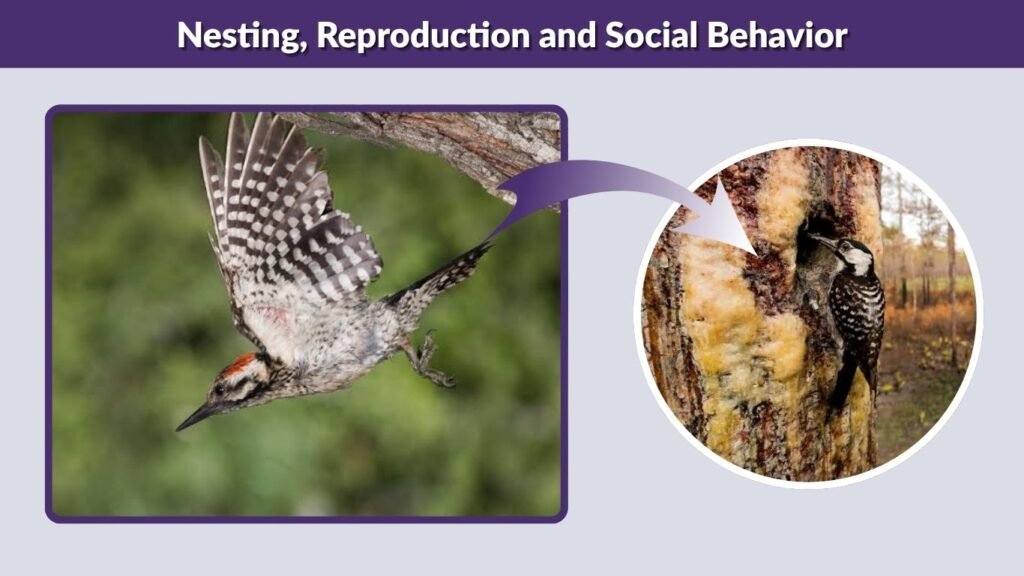
Red-cockaded woodpeckers are cooperative breeders. A family group generally includes a breeding pair and one or more helpers, which are commonly sons from previous nesting seasons. Helpers assist with excavating cavities, incubating eggs, feeding chicks, and defending the group’s territory.
Living-Pine Nest Cavities
These birds routinely excavate their cavities in living pine trees. They favor older pines whose heartwood has been softened by fungal decay while the outer sapwood remains alive.
Excavating one cavity may take several years. After reaching the heartwood, the bird creates an enlarged chamber with a round entrance. Several nearby cavity trees form a “cluster,” and each adult group member typically uses a separate cavity for sleeping.
Resin Wells and Predator Protection
The birds drill small resin wells around the cavity entrance. Sticky resin then flows down the tree trunk, creating a barrier that can discourage climbing rat snakes and other predators.
Group members regularly reopen the wells to maintain the resin flow. A recently active cavity tree can often be recognized by its shiny, pale coating of hardened resin. This specialized defense is one of the bird’s most remarkable adaptations.
Eggs and Life Cycle
The breeding female generally produces one clutch containing three or four white eggs. Parents and helpers share daytime incubation, while the breeding male usually incubates at night.
The eggs hatch after approximately 10–11 days. The helpless chicks remain in the cavity and receive insects from multiple group members. Young birds normally leave the nest about 26–29 days after hatching. Sons may remain as helpers, while daughters are more likely to disperse and join another group.
Calls and Sounds
The red-cockaded woodpecker produces a sharp, nasal call often described as “yank-yank” or “sklit.” It also uses rattling scolds, soft communication notes, and alarm calls.
Family groups can be especially vocal around their cavity cluster. Birds also drum on resonant branches or dead wood to communicate and defend their territory.
Conservation Status and Threats
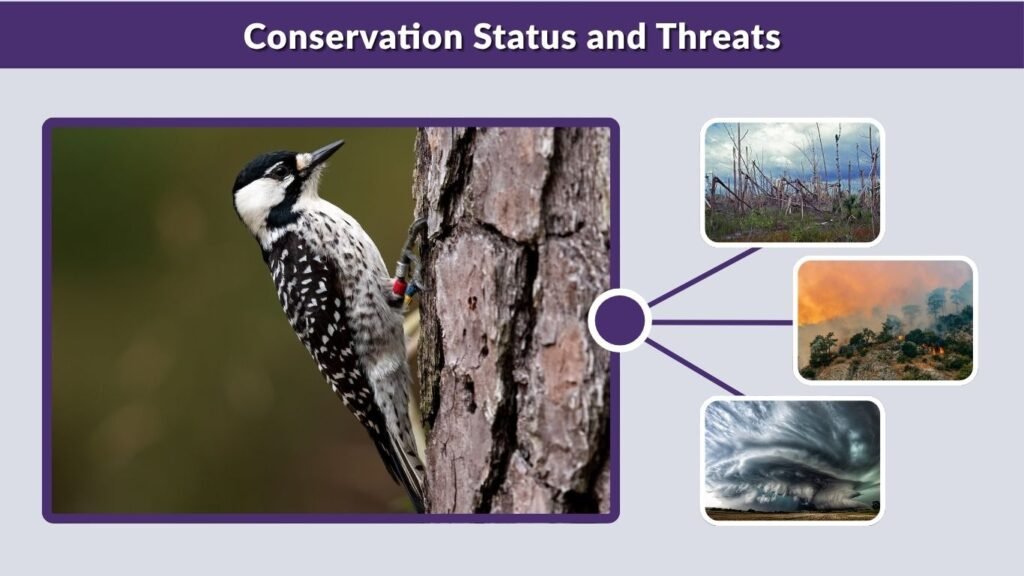
The red-cockaded woodpecker was federally listed as endangered in 1970 after logging, land conversion, and fire suppression destroyed much of its mature pine habitat. Following decades of conservation progress, the U.S. Fish and Wildlife Service changed its federal classification from endangered to threatened in 2024. It remains protected and has not fully recovered.
Why Did the Species Decline?
Its major threats include:
- Destruction of old longleaf pine forests
- Removal of mature cavity trees
- Conversion of natural forests to plantations
- Fragmentation between family groups
- Suppression of natural fires
- Dense hardwood growth in the midstory
- Hurricanes, storms, and wildfires
- Small, isolated populations
Because constructing a natural cavity can take years, the loss of even a few cavity trees may seriously disrupt a family group.
Conservation and Recovery Efforts
Conservation programs use prescribed burns, hardwood removal, longleaf pine restoration, cavity-tree protection, and artificial cavity inserts. Biologists may also relocate young birds to establish new breeding groups or improve genetic diversity.
Military properties such as Fort Bragg in North Carolina—officially renamed Fort Liberty in 2023 and restored to the name Fort Bragg in 2025—have managed large pine forests for both training and woodpecker recovery. Private landowners also participate through voluntary conservation agreements.
FAQs
Is the red-cockaded woodpecker still endangered?
It was reclassified federally from endangered to threatened in 2024. However, it remains protected and may still be classified as endangered under some state laws.
Why is it called red-cockaded when it looks black and white?
Adult males have a tiny red streak beside the crown. The marking resembles a decorative cockade but is usually hidden and difficult to observe.
Where do red-cockaded woodpeckers live?
They live in scattered mature pine forests across the southeastern United States, from Virginia and the Carolinas south to Florida and west to Oklahoma and Texas.
What kind of tree does the bird nest in?
It excavates cavities in mature living pine trees, especially longleaf pines with heartwood softened by fungal decay.
Why are red-cockaded woodpeckers important?
Their abandoned cavities provide shelter for bluebirds, nuthatches, flying squirrels, reptiles, insects, and other animals. This makes the woodpecker an important keystone species in southern pine ecosystems.
