
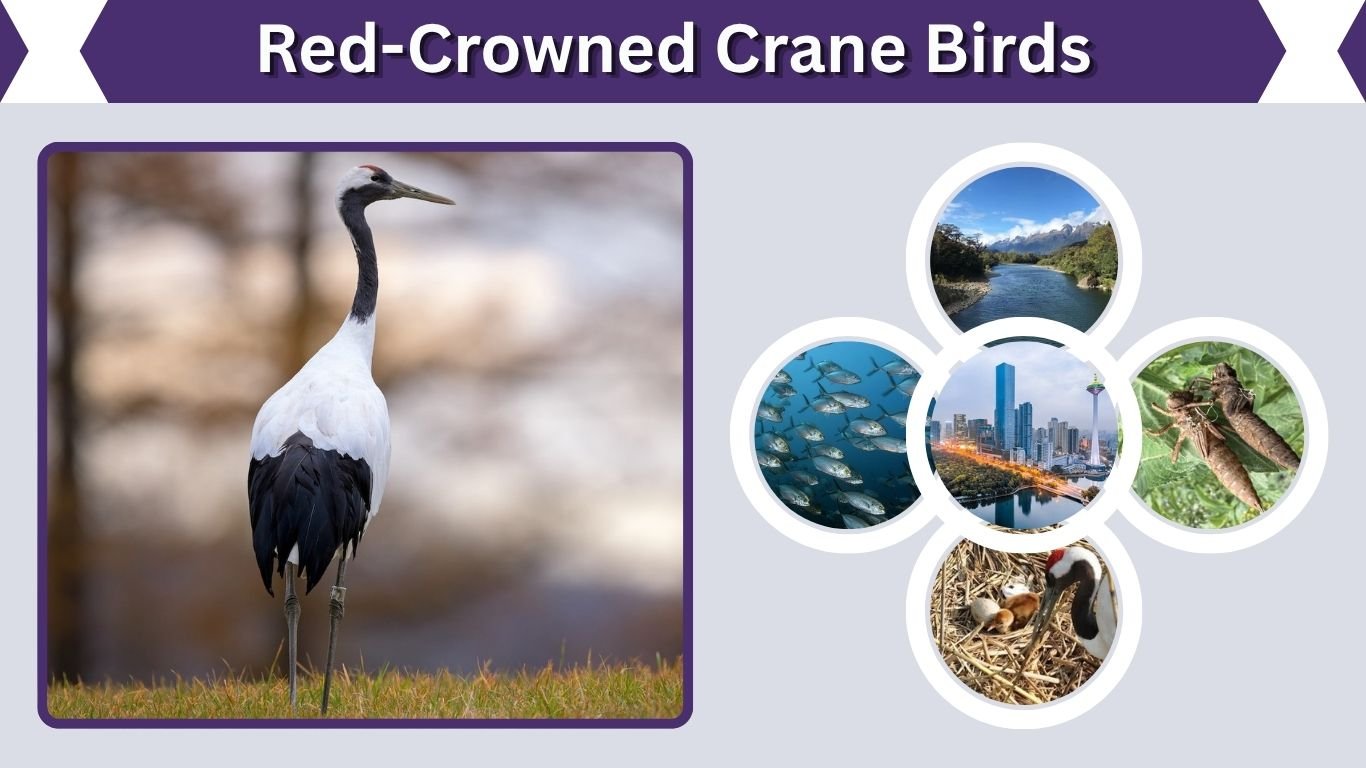
The red-crowned crane is one of the rarest and most recognizable cranes in the world. Adults have a snowy-white body, a black neck and secondary wing feathers, and a bright red patch of bare skin on the head. Also called the Japanese crane or Manchurian crane, this elegant bird lives in the wetlands of East Asia. It is especially important in Japanese, Chinese, and Korean culture, where it commonly represents fidelity, good fortune, peace, and longevity.
Red-Crowned Crane Quick Facts
Red-crowned cranes are exceptionally tall, heavy birds with long legs, long necks, and powerful wings. They spend much of their time walking through marshes and wet grasslands while searching for food.
| Feature | Description |
| Scientific name | Grus japonensis |
| Other names | Japanese crane, Manchurian crane |
| Height | Up to approximately 5 feet |
| Wingspan | Up to approximately 7.9 feet |
| Weight | About 17–22 pounds |
| Adult coloring | White, black, and red |
| Diet | Omnivorous |
| Habitat | Marshes, wetlands, rivers, and fields |
| Conservation status | Vulnerable |
| Estimated population | Approximately 4,500 birds |
The International Crane Foundation currently estimates a global population of about 4,500 and lists the species as Vulnerable, with an increasing overall trend.
How to Identify a Red-Crowned Crane
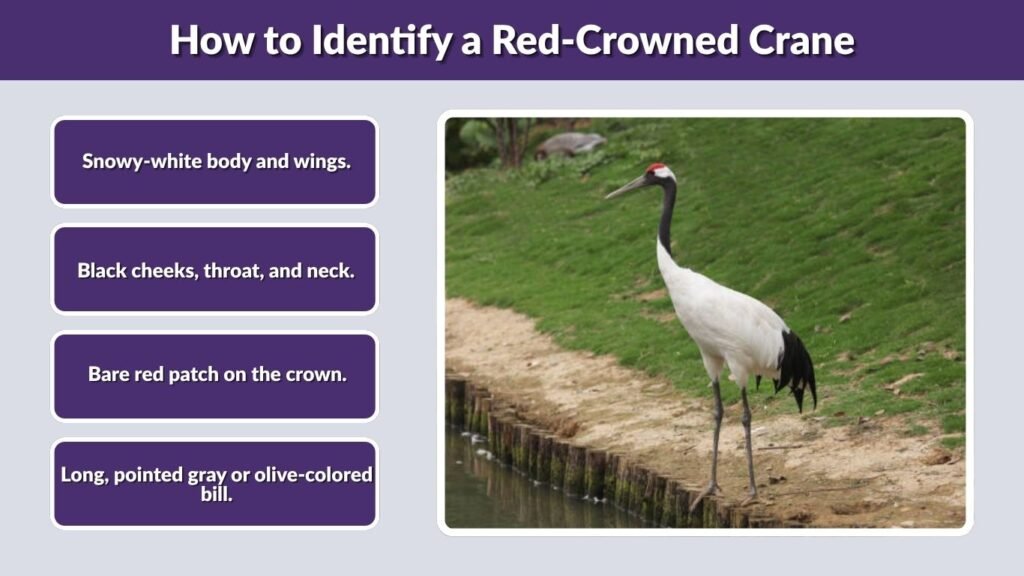
The combination of white plumage, a black neck, and a red crown makes an adult relatively easy to recognize. However, the black feathers that appear to form the tail are mainly elongated secondary wing feathers resting over the actual white tail.
Identification Features
- Snowy-white body and wings
- Black cheeks, throat, and neck
- Bare red patch on the crown
- Long, pointed gray or olive-colored bill
- Long, dark legs
- Large, heavy body
- Black secondary feathers covering the tail area
- Neck held straight while flying
The red crown is not made from red feathers. It is a patch of bare, textured skin. Its color and size may appear more intense when the crane is excited, displaying, or defending its territory.
Juvenile Appearance
Young red-crowned cranes do not initially have the dramatic black-and-white pattern of adults. Juveniles display a mixture of cinnamon-brown, gray, tan, and white feathers, with a light brown head.
Their adult coloring develops gradually as they mature. This means a large brown bird walking beside two black-and-white cranes may be their young offspring rather than a different species.
How Big Is a Red-Crowned Crane?
Red-crowned cranes are among the largest members of the crane family. An adult may stand approximately five feet tall, with a wingspan approaching eight feet.
Despite their height, they generally weigh only around 17–22 pounds. Their hollow bones, long legs, extended neck, and broad wings allow them to fly efficiently despite their large appearance. Japan’s Ministry of the Environment reports a body length of about 140 centimeters and a wingspan reaching roughly 240 centimeters.
Where Do Red-Crowned Cranes Live?

Red-crowned cranes occur in East Asia. Their natural range includes parts of Russia, northeastern China, the Korean Peninsula, and Japan.
Mainland Migratory Population
The mainland population breeds mainly in extensive wetlands in northeastern China and southeastern Russia. These birds migrate south before winter.
Different groups spend the colder months along rivers, coastal mudflats, agricultural areas, and freshwater marshes in China and on the Korean Peninsula. Yancheng’s coastal wetlands in eastern China are a particularly important wintering area, receiving hundreds of wild red-crowned cranes between November and March.
Resident Hokkaido Population
A separate population lives year-round on Hokkaido, Japan’s northernmost main island. These cranes breed around eastern Hokkaido’s wetlands and remain on the island through winter instead of making a long seasonal migration.
Their distribution has expanded into areas such as the Tokachi River basin, Sarobetsu wetlands, and Lake Kutcharo. However, many birds still concentrate in the Kushiro region during winter, making the population vulnerable to disease, food shortages, and habitat changes in one location.
Red-Crowned Crane Habitat
Red-crowned cranes depend on large, open wetlands. They need shallow water for nesting and roosting, along with nearby grasslands or agricultural fields for feeding.
Preferred Habitats
They commonly use:
- Freshwater marshes
- Reed beds
- Wet meadows
- Riverbanks
- Coastal mudflats
- Shallow lakes
- Agricultural fields
- Open grasslands
Wetlands provide food, nesting vegetation, and protection from many land predators. The cranes generally avoid heavily forested areas because their height and long wings are better suited to open landscapes.
What Do Red-Crowned Cranes Eat?
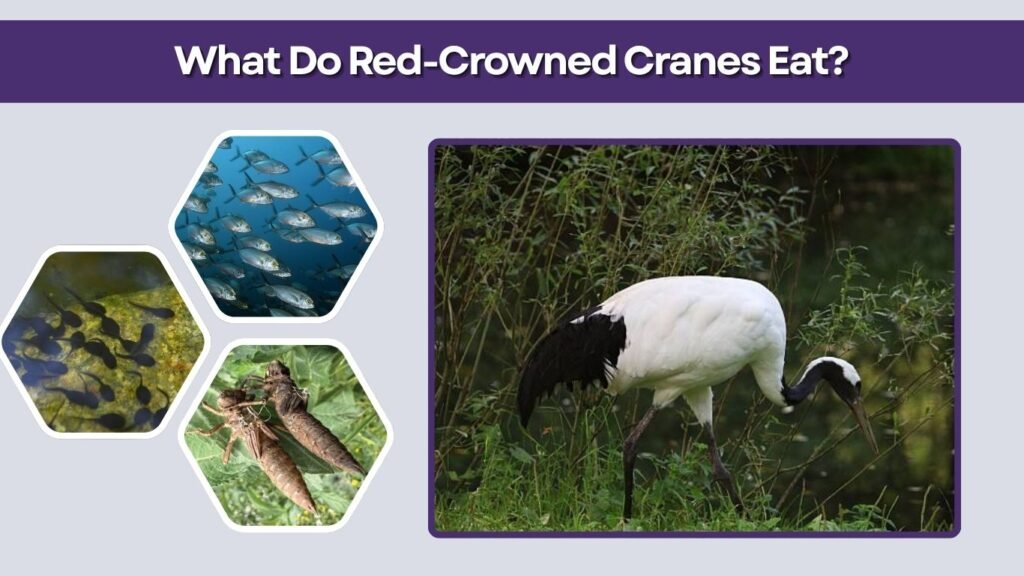
Red-crowned cranes are omnivores. They consume both plant and animal foods, adjusting their diet according to season, habitat, and availability.
Common Foods
Their diet may include:
- Fish
- Frogs and tadpoles
- Aquatic insects
- Shrimp and other crustaceans
- Snails and shellfish
- Small rodents
- Plant roots and tubers
- Seeds and grains
- Rice
- Other wetland vegetation
A crane usually walks slowly through shallow water or grass while watching the ground. It may probe mud with its bill, pick food from the surface, or quickly strike at moving prey. Chinese government environmental information describes fish, shrimp, shellfish, and plant roots as important foods.
Breeding and Nesting Behavior
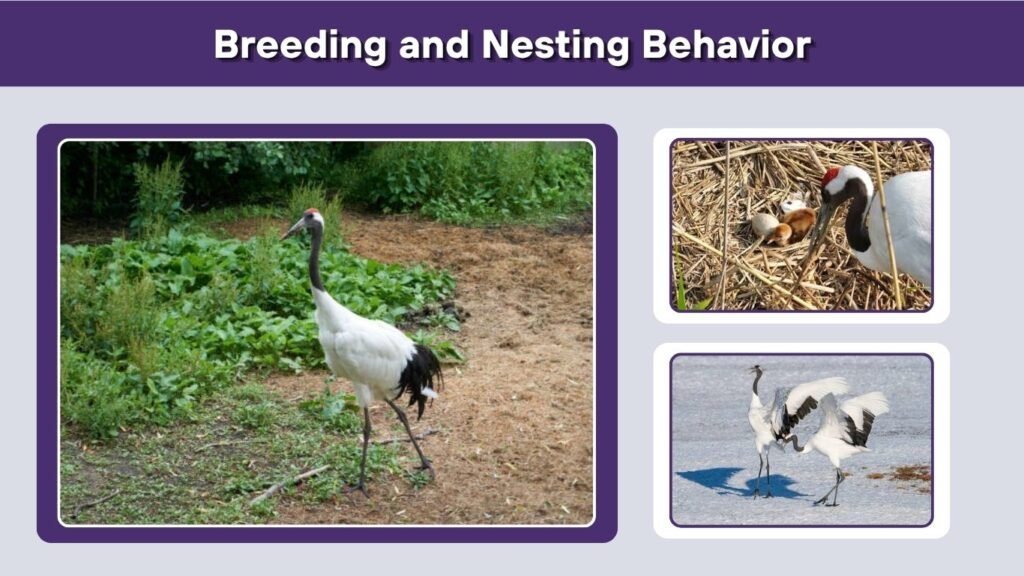
Red-crowned cranes commonly form lasting pair bonds. Mated birds defend breeding territories and communicate through coordinated calls and elaborate displays.
Courtship Dance
Their courtship display may involve bowing, running, tossing grass, spreading the wings, and leaping high into the air. Although strongly associated with courtship, dancing may also strengthen pair bonds, relieve excitement, and help young cranes develop social skills.
Pairs perform loud unison calls by raising their heads and pointing their bills upward. The male and female produce calls in a coordinated pattern that can travel over long distances across an open wetland.
Nest and Eggs
The pair builds a large nest from reeds, grasses, and other wetland plants. It is usually placed in shallow water where surrounding marsh vegetation offers concealment.
A female commonly lays two eggs. Both parents protect the territory and participate in incubation, which lasts approximately one month. After hatching, the chicks can leave the nest and follow their parents, although they remain dependent on them for protection and guidance.
Are Red-Crowned Cranes Japan’s National Bird?
The red-crowned crane is an important Japanese cultural symbol, but it is not Japan’s designated national bird. Japan’s national bird is the green pheasant, selected in 1947.
The crane remains strongly associated with Japan because of the resident Hokkaido population and its frequent appearance in art, textiles, ceramics, celebrations, and stories. It traditionally represents longevity, loyalty, marital happiness, and good fortune.
Is the Red-Crowned Crane China’s National Bird?
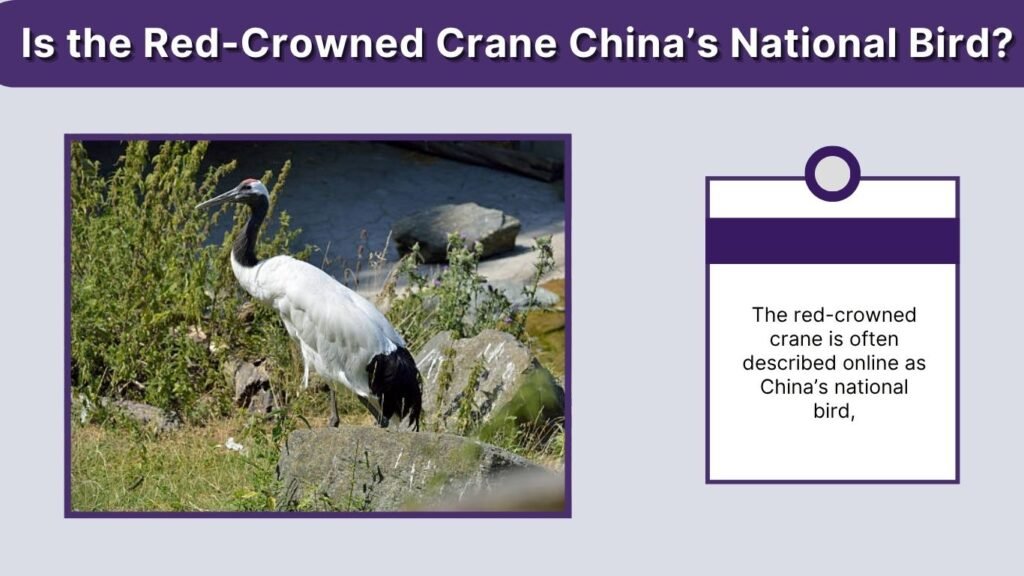
The red-crowned crane is often described online as China’s national bird, but that description requires caution.
It won a large public poll and became the leading candidate during a national bird selection process in the early 2000s. In 2007, the result was reportedly submitted to China’s State Council for final approval. However, available government information continues to describe it as a nationally protected wild animal rather than clearly identifying it as an officially approved national bird. It is therefore more accurate to call it an important Chinese cultural and conservation symbol, not a confirmed official national bird.
Cultural Meaning of the Red-Crowned Crane
The crane is deeply connected to East Asian art and traditional symbolism. It is frequently shown beside pine trees, clouds, mountains, or the rising sun.
In China, the bird has long represented dignity, nobility, good fortune, and a long life. In Japan, it symbolizes happiness, fidelity, peace, and longevity. In Korea, cranes also appear in paintings and decorative arts as symbols of purity and lasting life.
The biological bird does not live for a thousand years, despite its association with extreme longevity. Its symbolic meaning comes from mythology, elegant appearance, stable pair bonds, and historically long lifespan compared with many smaller birds.
Conservation Status and Threats
The red-crowned crane remains threatened despite recent population growth. Its dependence on large wetlands makes it particularly sensitive to environmental change.
Main Threats
Major concerns include:
- Wetland drainage and development
- Agricultural expansion
- Pollution and pesticide exposure
- Collisions with power lines
- Human disturbance near nests
- Changes in river and coastal systems
- Concentration at artificial winter feeding areas
- Disease outbreaks
- Climate-related habitat changes
Protected wetlands in China, Russia, Korea, and Japan are essential to the crane’s survival. Important areas include Kushiro Shitsugen in Japan, Xianghai and Zhalong in China, and wintering wetlands along the Yellow Sea.
FAQs
Why do red-crowned cranes have red heads?
The red area is exposed skin rather than feathers. Blood flow can make it look brighter or larger when the bird is calling, displaying, excited, or defending its breeding territory.
Do red-crowned cranes migrate?
Mainland cranes migrate between breeding wetlands in Russia and northeastern China and wintering areas in China and Korea. The Hokkaido population generally remains in Japan throughout the year.
Do red-crowned cranes mate for life?
They commonly form long-lasting monogamous pair bonds. Partners perform coordinated calls and dances, breed together, and defend a shared nesting territory.
How long do red-crowned cranes live?
Wild individuals may live for several decades when they survive early-life dangers. Lifespan varies because of disease, weather, habitat quality, food availability, collisions, and other environmental risks.
Are red-crowned cranes dangerous?
They usually avoid people but are large, powerful birds. A crane defending its nest or chicks could strike with its bill or kick. People should observe from a respectful distance and never approach a nesting pair.
