
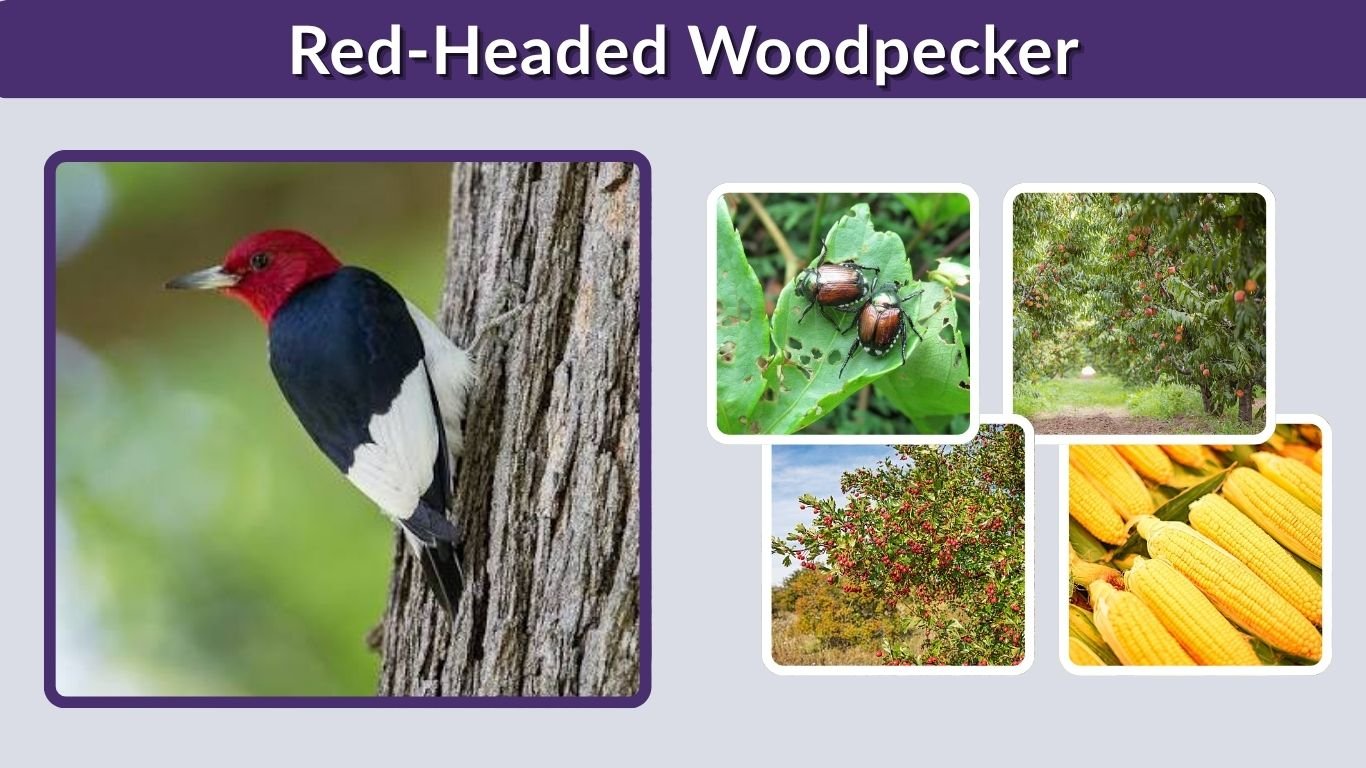
The red-headed woodpecker is one of North America’s most striking birds, recognized by its completely red head, bright white underparts, and bold black-and-white wings. Unlike several other woodpeckers with only small red patches, adults of this species have an unmistakable crimson head. Red-headed woodpeckers inhabit open woodlands, farms, parks, and areas with standing dead trees. They eat insects, fruits, seeds, and nuts, use tree cavities for nesting, and communicate through sharp calls and rhythmic drumming throughout their range.
What Is a Red-Headed Woodpecker?
The red-headed woodpecker, scientifically known as Melanerpes erythrocephalus, is a medium-sized member of the woodpecker family. It occurs across portions of central and eastern North America and is especially associated with open woodland containing mature or dead trees. Its bold plumage makes adults easy to identify, although juveniles look noticeably different before developing their characteristic red heads.
Red-Headed Woodpecker Identification
- Scientific name: Melanerpes erythrocephalus
- Length: About 7.5–9 inches
- Wingspan: Roughly 16–17 inches
- Head: Entirely bright red in adults
- Underparts: Clean white
- Back: Mostly black
- Wings: Black with large white patches
- Bill: Strong, straight, and pale gray
- Tail: Mostly black
- Body shape: Compact with a relatively large head
The dramatic red, white, and black combination makes this species one of the easiest adult woodpeckers to recognize.
Male vs Female Red-Headed Woodpecker
Male and female red-headed woodpeckers are unusual among many birds because they look extremely similar. Both sexes develop the same bright red head and bold black-and-white body pattern. This makes visual sex identification difficult in the field. Behavior during courtship or nesting may offer clues, but plumage alone normally cannot reliably distinguish an adult male from an adult female.
Male Red-Headed Woodpecker
An adult male has a deep crimson head and neck, white belly, black back, and large white wing patches. Males participate actively in establishing territories, excavating cavities, incubating eggs, and feeding nestlings.
Female Red-Headed Woodpecker
The female has nearly identical plumage. She also has a fully red head rather than the limited red markings seen on female red-bellied woodpeckers. Females participate in nesting and feeding young alongside their mates.
Because both sexes look alike, photographs labeled male or female may not always reveal an obvious visual difference.
Juvenile Red-Headed Woodpecker
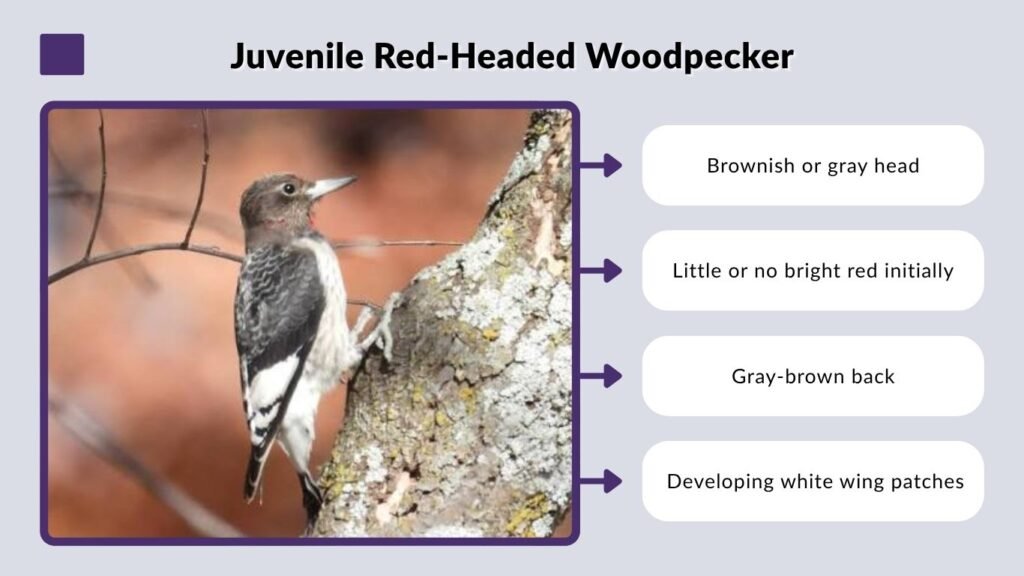
Juveniles can easily confuse people expecting to see the brilliant red head of an adult. Young birds leave the nest with grayish-brown heads and duller bodies. Over time, they gradually molt into adult plumage. During this transition, a young red-headed woodpecker may show a mixture of gray, brown, red, black, and white feathers.
Juvenile Identification
- Brownish or gray head
- Little or no bright red initially
- Gray-brown back
- Pale underparts
- Developing white wing patches
- Strong woodpecker-shaped bill
- Increasing red coloration with maturity
Young birds may appear surprisingly different from their parents, but their overall body proportions and wing pattern provide useful identification clues.
Red-Headed Woodpecker Habitat and Range
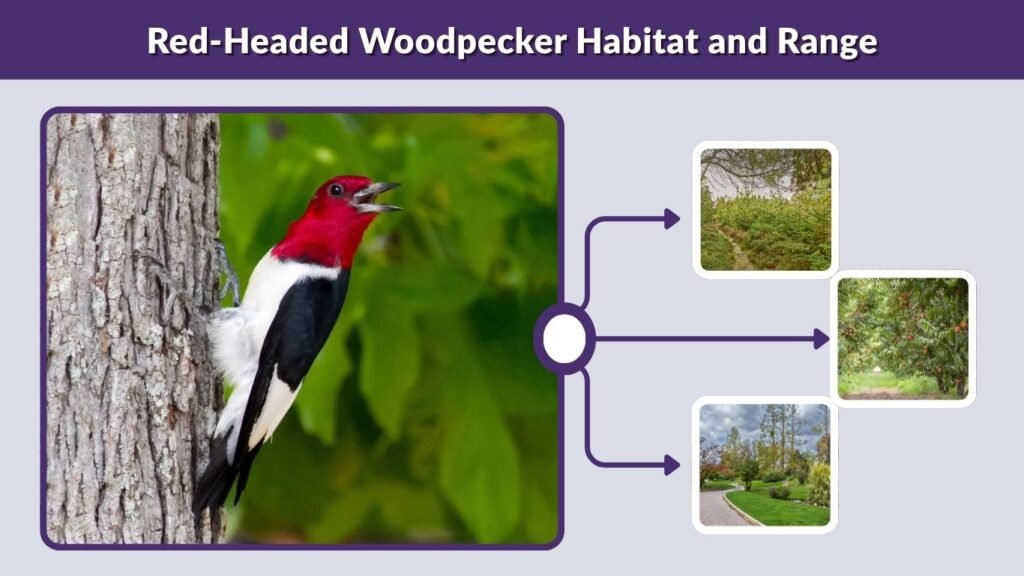
Red-headed woodpeckers prefer relatively open habitats rather than dense, continuous forest. They depend heavily on trees that provide nesting cavities, perches, and food-storage sites. Their distribution covers much of central and eastern North America, although abundance varies considerably from place to place. Local populations can change as woodland structure, dead-tree availability, agriculture, and land management practices change.
Where Red-Headed Woodpeckers Live
They may occur in:
- Open deciduous woodland
- Oak savannas
- Forest edges
- Orchards
- Farms with scattered trees
- Parks
- Burned woodland
- Areas containing standing dead trees
- Utility corridors with suitable habitat
They occur in states including Michigan, Ohio, Wisconsin, Indiana, Illinois, Virginia, Georgia, Texas, Florida, North Carolina, and other parts of their broader range.
Do Red-Headed Woodpeckers Migrate?
Some populations remain in the same general area throughout the year, while others move seasonally. Food availability strongly influences these movements.
In years when acorns and other tree seeds are abundant, birds may remain farther north. When natural food becomes scarce, some individuals move south or search for more productive habitats.
What Do Red-Headed Woodpeckers Eat?
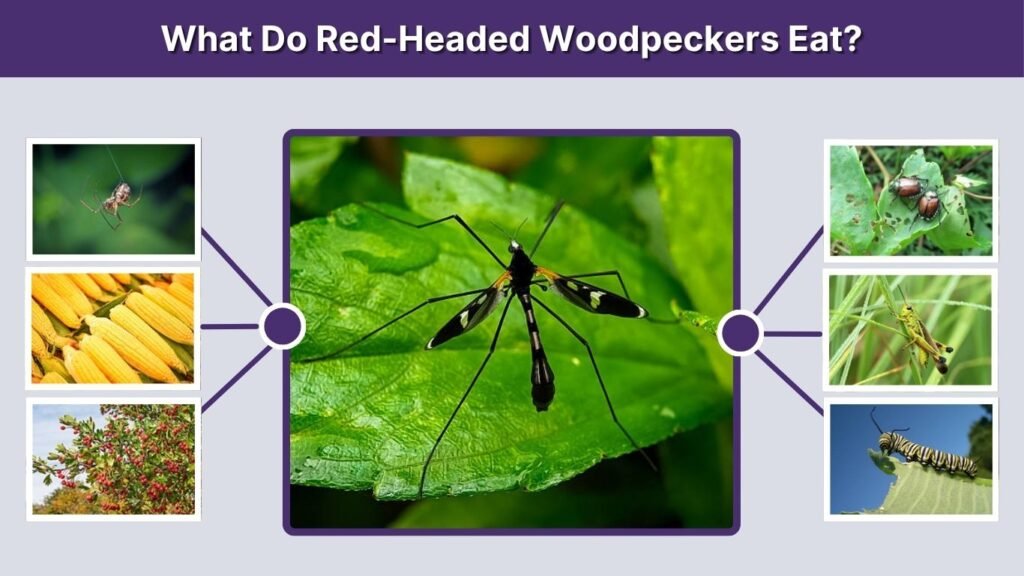
Red-headed woodpeckers have one of the most varied diets among familiar North American woodpeckers. They forage on trees, capture insects in the air, collect food from the ground, and gather fruits and nuts. They are also known for storing food in cracks, tree cavities, and other protected locations so it can be eaten later.
Red-Headed Woodpecker Diet
Common foods include:
- Beetles
- Grasshoppers
- Ants
- Caterpillars
- Spiders
- Flying insects
- Acorns
- Beechnuts
- Seeds
- Corn
- Berries
- Grapes
- Cherries
- Other fruits
Unlike woodpeckers that mainly probe bark, red-headed woodpeckers sometimes catch flying insects from exposed perches.
Food Storage Behavior
These birds frequently cache food. Nuts, insects, and other items may be wedged into cracks in bark or hidden inside tree crevices.
Stored food becomes particularly valuable when insects are less abundant. Their ability to use both animal and plant foods helps them adapt to seasonal changes.
Red-Headed Woodpecker Call and Sounds
Red-headed woodpeckers communicate using vocal calls as well as drumming. Their sounds may be heard around nesting territories, feeding locations, and interactions with neighboring birds. Calls are generally sharp and somewhat harsh rather than musical. Drumming serves as another important form of communication and is especially noticeable during periods of territorial and breeding activity.
What Does a Red-Headed Woodpecker Sound Like?
A common call is often described as a sharp “queer,” “churr,” or “tchur” sound. Birds may repeat calls when excited or communicating with a mate.
The exact sound varies with situation, so listeners may hear single notes, repeated calls, or more agitated vocalizations.
Why Do They Drum?
Drumming helps woodpeckers advertise territory and communicate with potential mates.
A bird may select a resonant dead branch, hollow tree, pole, or occasionally a human-made structure because these surfaces amplify the sound.
Drumming should not be confused with slower tapping used while searching for food or excavating wood.
Red-Headed Woodpecker Nesting
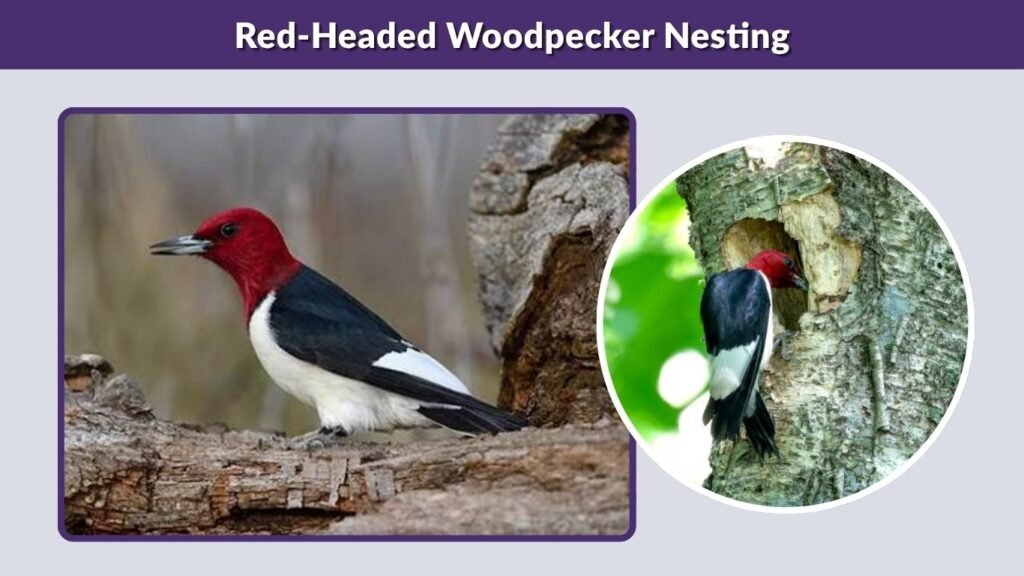
Red-headed woodpeckers are cavity-nesting birds. They frequently choose dead trees, dead limbs, or trees containing softened wood that can be excavated more easily. Suitable nesting trees are therefore an important part of their habitat. Both members of a pair may participate in excavation, incubation, and feeding young during the breeding season.
Nesting Habits
Their nesting process typically includes:
- Selecting a suitable dead or weakened tree
- Excavating or reusing a cavity
- Creating an entrance large enough for adults
- Laying several plain white eggs
- Sharing incubation duties
- Feeding nestlings inside the cavity
- Continuing to feed young after fledging
A pair may reuse a suitable cavity or excavate a new one in another nesting season.
Red-Headed Woodpecker Nest Box
They may occasionally use appropriately designed nest boxes where natural cavities are limited.
A successful nest box should be securely mounted in suitable open woodland habitat and positioned away from heavy disturbance. Preserving natural standing dead trees, where safe to do so, is often even more valuable because these trees provide nesting, roosting, feeding, and food-storage opportunities.
Red-Headed vs Red-Bellied Woodpecker
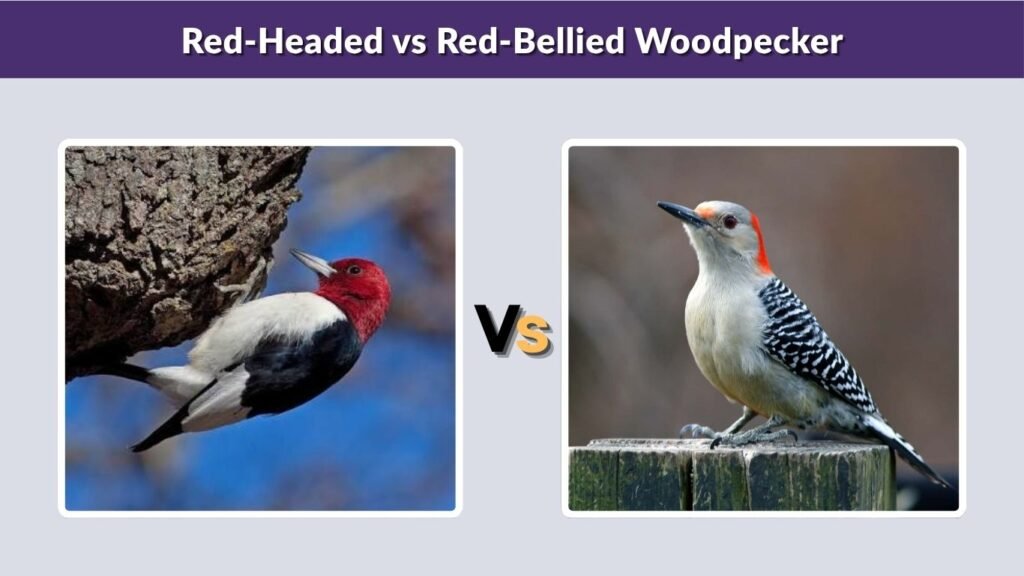
These two birds are commonly confused because of their names, yet adult plumage is quite different. The red-headed woodpecker has an entirely crimson head with sharply divided black-and-white body colors. The red-bellied woodpecker has a barred black-and-white back and only part of its head is red, while the reddish belly patch is often difficult to see.
Main Differences
Red-headed woodpecker: The entire adult head is red, the belly is white, and the wings have broad white patches.
Red-bellied woodpecker: The back has narrow zebra-like barring, the underside is grayish, and red is concentrated on the crown and nape.
The comparison is a common identification question for birdwatchers.
Pileated vs Red-Headed Woodpecker
The pileated woodpecker is sometimes called a “large red-headed woodpecker,” but it is a completely different species. Pileated woodpeckers are substantially larger and mostly black, with a dramatic red crest rather than an entirely red head. Understanding the difference helps avoid confusing red-headed woodpeckers with other large North American woodpeckers.
Size and Appearance
A pileated woodpecker may reach around crow size and has a long neck, black body, white facial stripes, and pointed red crest.
A red-headed woodpecker is much smaller, with a rounded crimson head, white belly, and clean black-and-white wing pattern.
Descriptions such as “giant red-headed woodpecker” often relate to searches involving other large woodpeckers rather than an unusually huge red-headed woodpecker.
FAQs
Red-headed woodpeckers generate many questions because their appearance, juvenile plumage, feeding habits, and geographic distribution differ from several familiar backyard woodpeckers. The following answers cover some of the most common identification and behavior questions, including how to recognize females, what they eat, where they live, and how they compare with other species.
Are Female Red-Headed Woodpeckers Red?
Yes. Adult females have a completely red head just like adult males. The two sexes are extremely similar in appearance.
How Big Is a Red-Headed Woodpecker?
Adults are generally about 7.5–9 inches long with a wingspan of roughly 16–17 inches.
What Do Red-Headed Woodpeckers Eat?
They eat insects, spiders, nuts, seeds, acorns, berries, fruits, and other available foods. They also catch some insects in flight.
Why Does a Juvenile Red-Headed Woodpecker Have a Gray Head?
Juveniles initially have grayish or brownish heads. Their characteristic red adult feathers develop gradually as they mature and molt.
Are Red-Headed Woodpeckers Rare?
Their abundance varies greatly by region. They remain locally common in some suitable habitats but have declined in many areas because of habitat changes and loss of suitable nesting and feeding sites.
