
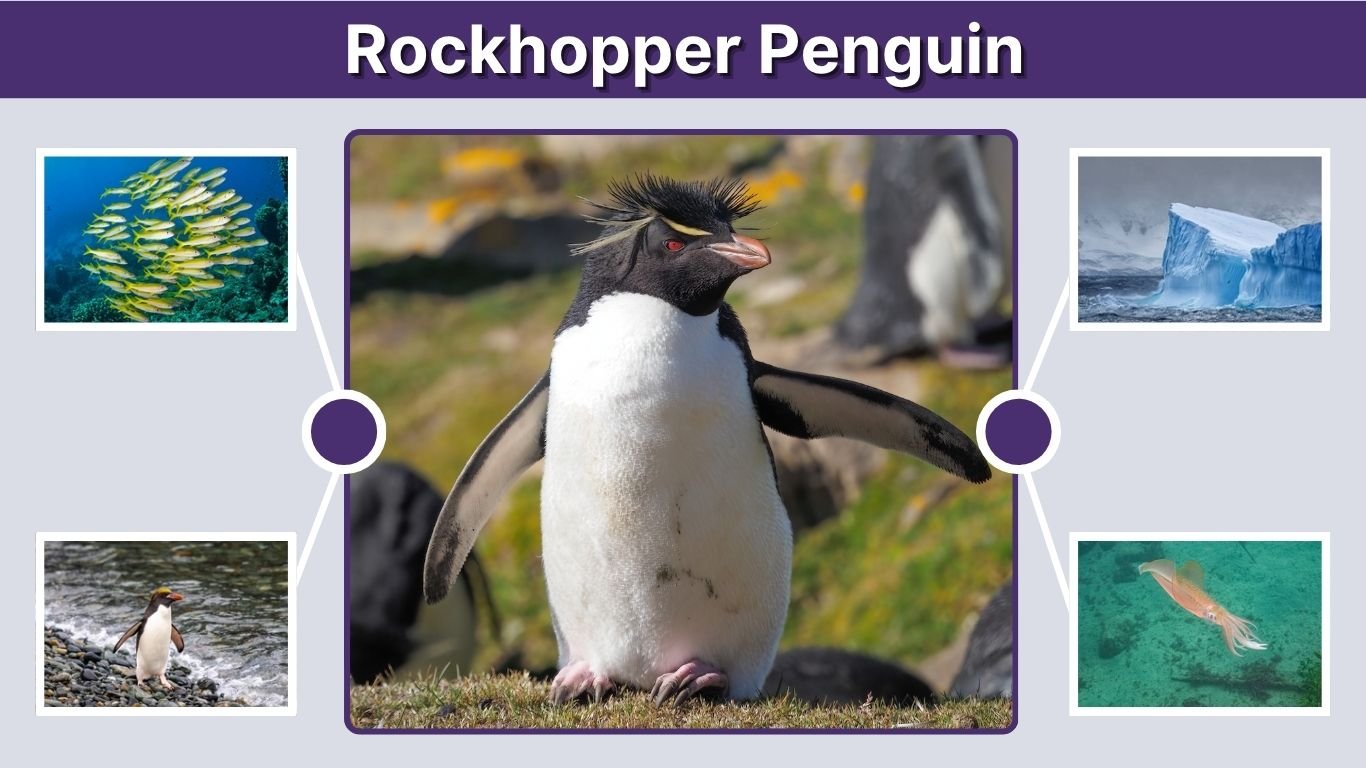
The rockhopper penguin is a small crested penguin famous for its bright yellow eyebrow feathers, red eyes, orange-red bill, and energetic habit of hopping across steep rocky terrain. Rockhoppers live on remote islands across the Southern Hemisphere and spend much of their non-breeding season at sea. They feed mainly on krill, crustaceans, squid, and small fish. This guide explores rockhopper penguin habitat, diet, height, behavior, breeding, migration, adaptations, lifespan, conservation, and the differences between northern, southern, and eastern rockhoppers. Pasted text
What Is a Rockhopper Penguin?
Rockhopper penguins belong to the crested-penguin genus Eudyptes. Their name comes from the way they travel across rugged colonies: instead of carefully waddling around rocks, they often jump from one rock to another. Modern classifications recognize distinct northern, southern, and eastern forms, although their exact taxonomic treatment has changed as genetic research has improved.
Rockhopper Penguin Identification
- Black back and white belly
- Bright yellow eyebrow-like crest
- Spiky yellow feathers extending behind the eyes
- Red eyes
- Strong orange-red bill
- Pinkish feet
- Short, powerful legs
- Stiff flippers adapted for swimming
- Compact, sturdy body
Rockhoppers are among the smallest crested penguins. Southern rockhopper penguins weigh roughly 2–3.8 kg, while adults are commonly around 55 cm tall.
Types of Rockhopper Penguins
The northern rockhopper penguin is known scientifically as Eudyptes moseleyi. It is recognized as a separate species and is currently listed as Endangered by BirdLife.
The southern form is Eudyptes chrysocome. BirdLife’s 2026 taxonomic process also treats the eastern rockhopper, Eudyptes filholi, separately. Both southern and eastern rockhoppers were recommended as Vulnerable in the 2026 Red List update.
Rockhopper Penguin Habitat and Range
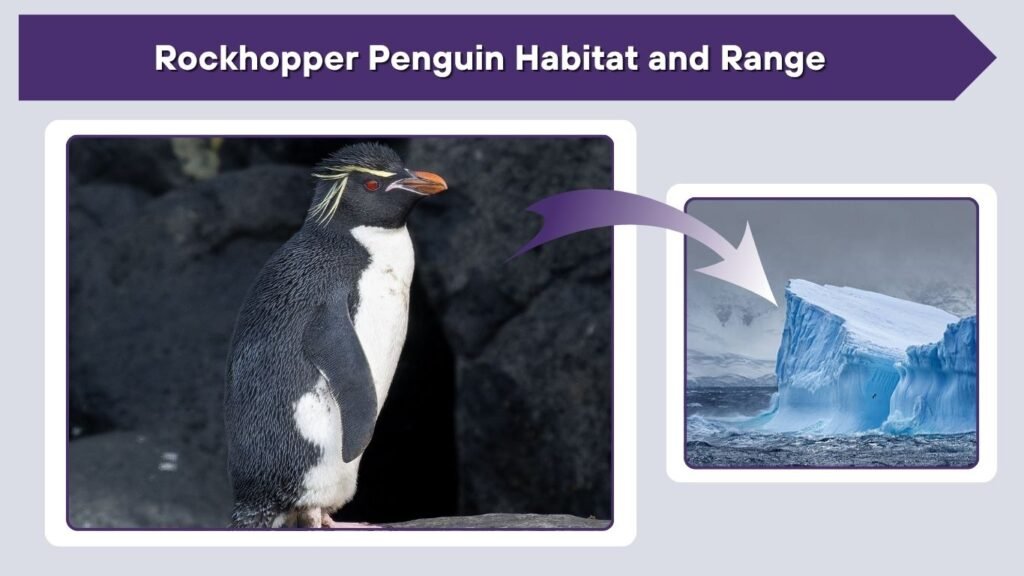
Rockhopper penguins are seabirds of cool southern oceans rather than true Antarctic ice specialists. They breed on remote islands with steep cliffs, rocky beaches, grassy slopes, and exposed coastlines. Their nesting habitat can look extremely difficult to cross, but their strong legs and hopping movements allow them to reach colonies that would be challenging for less agile animals.
Where Do Southern Rockhopper Penguins Live?
Southern rockhoppers breed on islands across the South Atlantic and southern oceans. Populations occur around areas such as the Falkland Islands, islands near southern South America, and other subantarctic island groups.
They generally leave their colonies after breeding and spend much of the non-breeding season at sea. Tagged southern rockhoppers have traveled thousands of kilometers during this period.
Northern and Eastern Rockhopper Habitat
Northern rockhoppers breed mainly on islands farther north in the South Atlantic and Indian Ocean than southern populations.
Eastern rockhoppers occur around subantarctic islands of the Indian and Pacific oceans. The separation of eastern and southern rockhoppers has received increasing support from genetic research and was incorporated into BirdLife’s 2026 assessment process.
What Does a Rockhopper Penguin Eat?
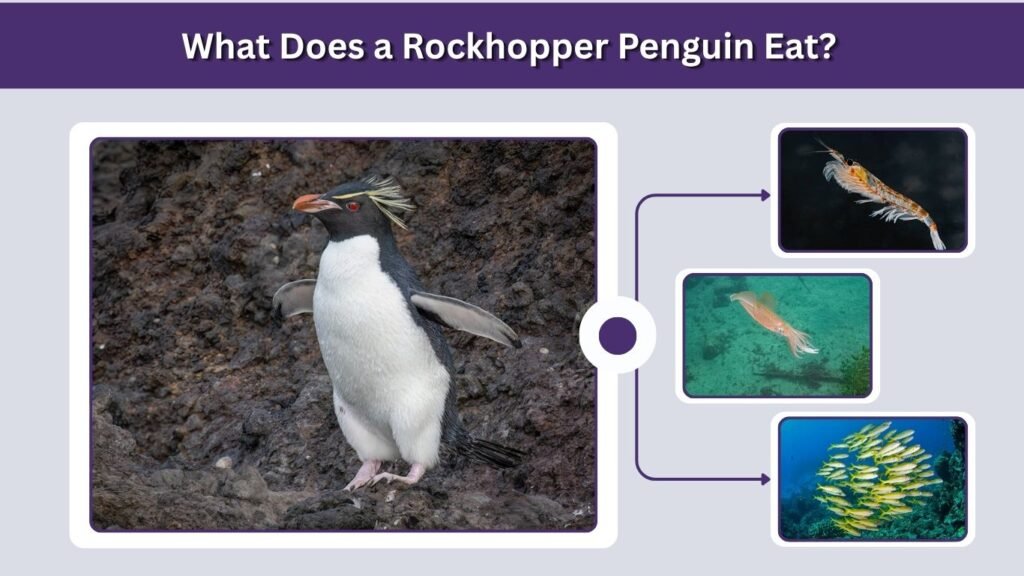
Rockhopper penguins are marine predators that obtain virtually all their food at sea. Diet varies among colonies and seasons because ocean conditions affect which prey is locally abundant. They are skilled divers and may repeatedly leave breeding colonies to forage offshore before returning with food for their chicks. Crustaceans and cephalopods are particularly important foods for southern rockhoppers.
Common Rockhopper Penguin Foods
- Krill
- Small crustaceans
- Squid
- Other cephalopods
- Small fish
- Various small marine animals
Southern rockhoppers commonly dive about 20–30 meters, although substantially deeper dives have been recorded. The Australian Antarctic Program reports a recorded depth of 113 meters in one study.
How Do Rockhoppers Find Food?
Their wings have evolved into powerful flippers that propel them rapidly through water. Instead of flying through the air, they effectively “fly” underwater.
Rockhoppers pursue prey beneath the surface and can make repeated dives while feeding. Their streamlined bodies, waterproof feathers, and strong flippers make them far better swimmers than their awkward-looking movements on land might suggest.
Rockhopper Penguin Size and Adaptations
A rockhopper may be relatively small compared with emperor or king penguins, but its body is highly specialized for life in cold, rough marine environments. Its dense feathers protect it from water and wind, while powerful feet help it negotiate steep shores. Its most famous adaptation is reflected directly in its name—the ability to hop across rocks.
How Tall Is a Rockhopper Penguin?
A southern rockhopper commonly stands about 55 cm, or roughly 22 inches, tall. Size varies somewhat among individuals and populations.
Their relatively short, sturdy build gives them a low center of gravity, which is useful on uneven terrain. Northern rockhoppers are similar in overall appearance but can be distinguished partly by differences in their crest feathers.
Important Rockhopper Adaptations
- Strong legs for hopping over rocks
- Webbed feet for swimming and climbing
- Flipper-shaped wings for underwater propulsion
- Dense waterproof plumage
- Thick insulating feather layers
- Streamlined body for efficient diving
- Countershading with a dark back and pale belly
- Strong bill used for feeding and social interactions
These features allow rockhoppers to switch between two dramatically different environments: rough island colonies on land and open ocean while feeding.
Rockhopper Penguin Behavior and Migration
Rockhopper penguins are highly social during the breeding season, gathering in colonies that can contain many birds. Colonies are noisy because individuals use vocalizations to communicate with mates, chicks, and neighbors. Physical displays involving the head and yellow crest feathers are also important. Outside the breeding season, these penguins spend considerably more time at sea.
Why Do Rockhopper Penguins Hop?
Their breeding islands frequently contain steep slopes, cliffs, boulders, and rocky shorelines. Hopping allows the birds to move directly over obstacles rather than waddling around every rock.
Their powerful legs can launch the body upward while the flippers help with balance. This behavior is so conspicuous that it became the basis of the common name “rockhopper.”
Do Rockhopper Penguins Migrate?
Yes. Southern rockhopper penguins are classified as full migrants by BirdLife. After breeding and moulting, they disperse into marine feeding areas and may remain at sea for months.
BirdLife reports that southern rockhoppers can travel up to about 5,000 km during the non-breeding period, although tracked birds often remain considerably closer to their breeding colonies.
Rockhopper Penguin Breeding and Life Cycle
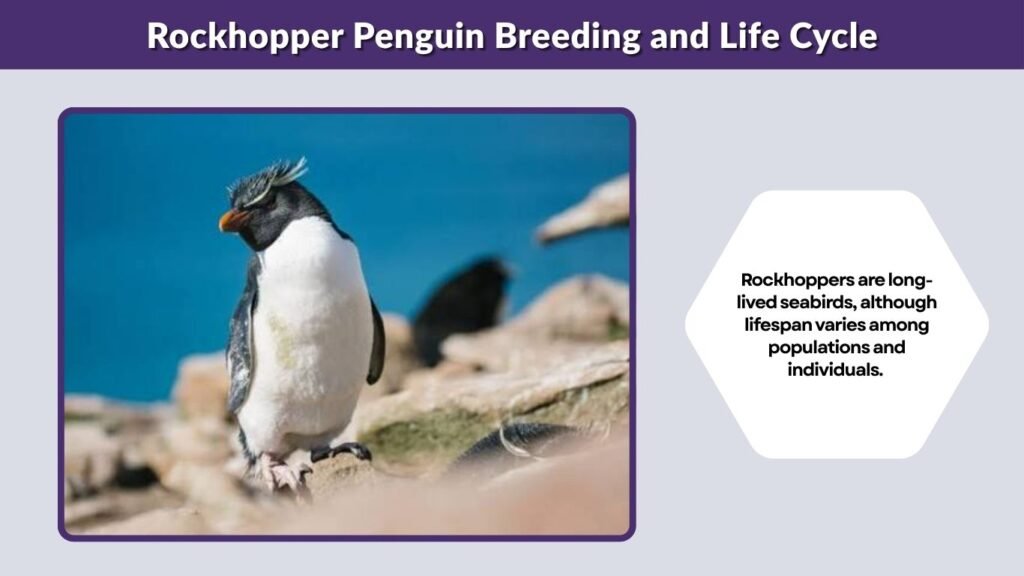
Rockhoppers return to breeding colonies seasonally, where pairs establish nests among rocks or vegetation. Timing differs with location. Like other crested penguins, females normally produce two eggs of noticeably different sizes. Both parents participate in incubation and later chick care, although their responsibilities change as the breeding season progresses.
Eggs and Chicks
Southern rockhopper females generally lay two eggs several days apart. The first is typically smaller than the second.
Incubation lasts approximately 32–34 days. After hatching, the male initially remains with the chick while the female goes to sea and returns with food. As chicks grow, they eventually develop waterproof juvenile plumage and leave the colony for the ocean.
Lifespan and Annual Moult
Rockhoppers are long-lived seabirds, although lifespan varies among populations and individuals. Adults must also undergo an annual moult, replacing old feathers with new ones.
During moulting they remain on land and cannot feed normally at sea, so they must build energy reserves beforehand. The timing of breeding, chick rearing, feeding, and moulting is therefore closely connected to ocean food availability.
Rockhopper Penguin vs. Macaroni Penguin
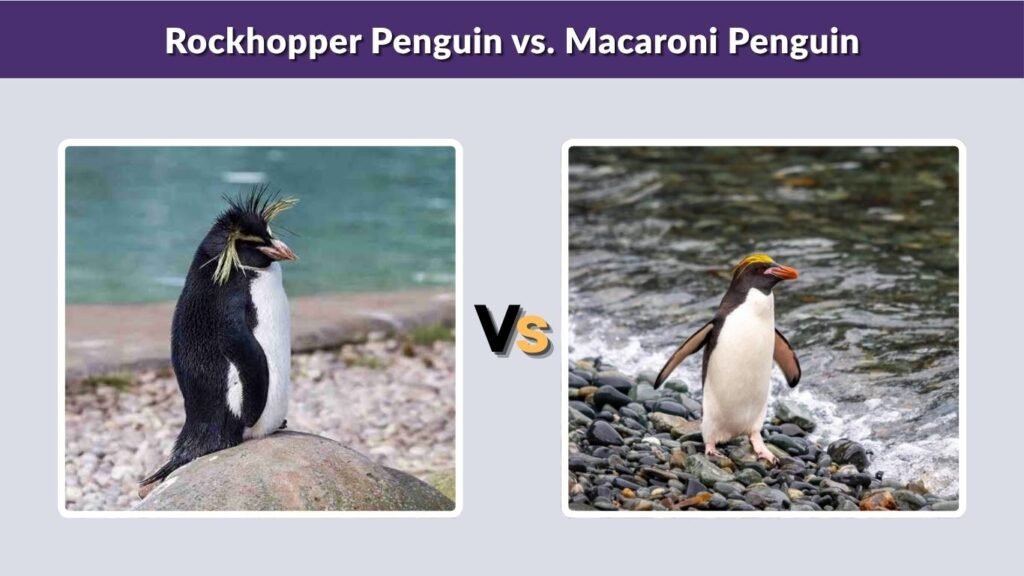
The attached keyword set shows substantial search interest in macaroni penguins vs. rockhopper penguins, and the two can indeed look similar because both belong to Eudyptes and possess yellow crests. Pasted text Their size and crest shape, however, provide useful identification clues.
Main Differences
- Rockhopper penguins are generally smaller.
- Rockhoppers have thinner yellow eyebrow feathers extending behind the eyes.
- Macaroni penguins have a fuller golden-orange crest across the forehead.
- Macaroni penguins generally have a heavier build.
- Rockhoppers are famous for hopping across steep rocky terrain.
- Both species are excellent swimmers and marine predators.
Both belong to the crested-penguin group, but they represent separate species with different breeding distributions.
Rockhopper Penguin Conservation
Rockhopper populations face pressure from changing marine conditions, food availability, pollution, introduced predators at some colonies, and other environmental threats. Climate-related changes in ocean temperature can alter prey distribution and reduce feeding success. Conservation status also differs among rockhopper species, making it important not to treat every rockhopper population as biologically identical.
Are Rockhopper Penguins Endangered?
The Northern Rockhopper Penguin is listed as Endangered. BirdLife’s 2026 process recognizes the Southern and Eastern Rockhopper Penguins separately and recommends both as Vulnerable.
Southern rockhopper numbers have experienced major historical declines in several colonies, although trends are not identical everywhere. Protecting breeding islands and maintaining productive marine feeding areas are therefore important parts of their conservation.
FAQs
1. What is the scientific name of a rockhopper penguin?
It depends on the species. The northern rockhopper is Eudyptes moseleyi, the southern rockhopper is Eudyptes chrysocome, and BirdLife’s 2026 taxonomy recognizes the eastern rockhopper as Eudyptes filholi.
2. What does a rockhopper penguin eat?
Rockhoppers mainly eat krill and other crustaceans, squid and related cephalopods, and small fish. Their exact diet varies with location and season.
3. How tall is a rockhopper penguin?
Southern rockhopper penguins commonly stand around 55 cm or 22 inches tall, making them among the smaller crested penguins.
4. Where does a rockhopper penguin live?
Rockhoppers breed on remote rocky islands in the Southern Hemisphere and spend much of the rest of the year at sea. Different species occupy different island groups across the South Atlantic, Indian, and Pacific oceans.
5. Why are they called rockhopper penguins?
They get their name from their characteristic way of moving through rocky breeding colonies. Their powerful legs allow them to jump or hop from rock to rock rather than relying only on the waddling walk associated with many penguins.
