

The Slender-billed Curlew (Numenius tenuirostris) was a migratory shorebird once found across parts of Europe, western Asia, and North Africa. Recognized by its slender downward-curving bill and spotted plumage, this curlew became increasingly rare during the twentieth century. After decades without a confirmed record, scientific analysis concluded that the species had disappeared. Today, the Slender-billed Curlew provides an important example of how rapidly a migratory bird can vanish when threats occur across breeding, migration, and wintering habitats.
What Was the Slender-Billed Curlew?
The Slender-billed Curlew was a member of the sandpiper family, Scolopacidae, and belonged to the same genus as the Eurasian Curlew and Whimbrel. It was a medium-sized curlew with a relatively delicate appearance. Historical records indicate that it bred in western Siberia and migrated through Europe and western Asia before spending winter in Mediterranean regions.
Slender-Billed Curlew Identification
Important identification features included:
- Scientific name: Numenius tenuirostris
- Length: Approximately 36–41 cm
- Bill: Long, thin, and curved downward
- Plumage: Pale brown and gray with darker markings
- Underparts: Whitish with distinctive dark spots along the breast and flanks
- Legs: Relatively long and dark
- Body shape: Slimmer and more delicate than the Eurasian Curlew
- Wings: Broad enough for sustained long-distance migration
The combination of spotted underparts and a relatively fine bill helped experienced observers distinguish it from similar curlews.
Slender-Billed Curlew vs Eurasian Curlew
The Eurasian Curlew was generally larger and heavier, with a noticeably longer and more substantial bill. The Slender-billed Curlew had a smaller, more delicate body and stronger spotting on its pale underparts.
Identification was difficult, however, particularly at long distances. Similarity to Eurasian Curlews and Whimbrels contributed to uncertainty surrounding some reported sightings after the species became extremely rare.
Slender-Billed Curlew Range and Habitat
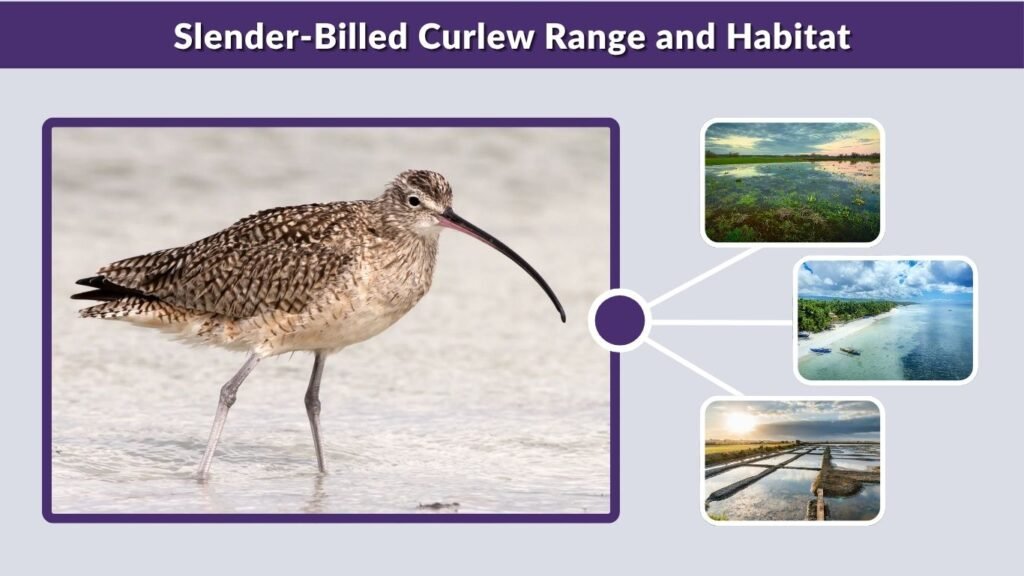
Historically, the Slender-billed Curlew was an exceptionally long-distance migrant. Its full breeding distribution was never completely understood because even early ornithologists had limited information about its remote nesting grounds. Available evidence indicates that its breeding range centered in western Siberia, while migration carried birds toward southeastern Europe, the Mediterranean, North Africa, and parts of the Middle East.
Historical Slender-Billed Curlew Range
The species was recorded in or associated with areas including:
- Western Siberia during breeding
- Kazakhstan and surrounding regions during migration
- Eastern and southeastern Europe
- Italy and Greece
- The Balkans
- Turkey
- North African Mediterranean wetlands
- Morocco
- Parts of the Middle East
- Coastal lagoons and estuaries around the Mediterranean
Migration routes connected distant wetlands, meaning the species depended on suitable habitat across several countries rather than one isolated location.
Preferred Habitat
During migration and winter, Slender-billed Curlews were associated mainly with wetlands. They used shallow lagoons, salt marshes, tidal flats, steppe wetlands, river deltas, and wet grasslands.
Their breeding habitat appears to have included wet bogs and marshy areas within the Siberian forest-steppe region.
This dependence on multiple wetland habitats may have made the species especially vulnerable. Damage to even a few important stopping or wintering sites could affect birds traveling thousands of kilometers.
What Did Slender-Billed Curlews Eat?
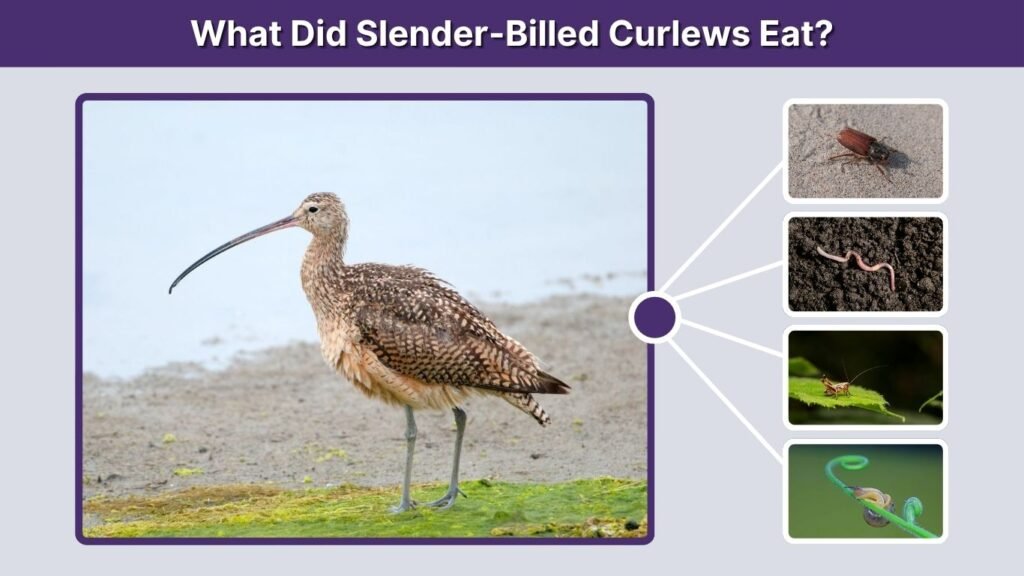
Like other curlews, the Slender-billed Curlew used its downward-curving bill to search beneath mud, shallow water, and soft ground. Its feeding habits were adapted to wetlands where small animals could be extracted from sediment. Historical information about its diet is less detailed than for common curlew species because relatively few individuals were studied closely.
Slender-Billed Curlew Diet
Its food likely included:
- Earthworms and other worms
- Small insects
- Insect larvae
- Beetles
- Small crustaceans
- Mollusks
- Other aquatic invertebrates
- Small organisms buried in wet soil
- Occasional plant material
How It Found Food
The bird typically walked across mudflats, wet grass, or shallow water while searching for prey. Its slender bill could be pushed into soft mud to reach organisms hidden beneath the surface.
Sensitive structures near the end of a shorebird’s bill help detect prey without requiring the animal to be visible. This feeding method allowed curlews to exploit food resources unavailable to birds equipped only for surface feeding.
Slender-Billed Curlew Call and Behavior
Because the species became extremely rare before modern sound-recording technology became widespread, relatively little detailed information survives about its vocal behavior. Historical descriptions suggest that it produced curlew-like calls used during flight and social interactions. Much of what is understood about its overall behavior comes from observations of migrating and wintering birds.
What Did the Slender-Billed Curlew Call Sound Like?
The Slender-billed Curlew’s call was generally described as a short, curlew-like whistle. Reports indicated that some vocalizations could be sharper or higher-pitched than those of the larger Eurasian Curlew.
Calls were useful for maintaining contact with other birds, particularly while flying or feeding in groups. Because few authenticated recordings exist, identifying the species from sound alone became increasingly difficult once its population collapsed.
Migration and Social Behavior
Slender-billed Curlews sometimes occurred alongside other shorebirds. During migration or winter they could associate with Eurasian Curlews, Whimbrels, and other wetland species.
Such mixed flocks created another identification challenge. When only one extremely rare Slender-billed Curlew might have been present among many common curlews, observers needed exceptionally clear views to confirm the record.
Is the Slender-Billed Curlew Extinct?
Yes. The evidence now supports the Slender-billed Curlew being extinct. A major scientific assessment published in 2024 concluded that extinction was overwhelmingly likely, and BirdLife’s subsequent global assessment confirmed the species as Extinct. It represents the first documented global bird extinction in modern times originating from mainland Europe, North Africa, and West Asia.
When Did the Slender-Billed Curlew Go Extinct?
There is no exact extinction date because nobody witnessed the death of the final individual.
The last unequivocally confirmed observation occurred in Morocco in 1995. Researchers continued investigating possible records for years afterward, but later claims could not provide sufficient evidence that surviving birds remained.
Therefore, 1995 is best understood as the year of the last confirmed sighting rather than a precise extinction date.
Why Did the Slender-Billed Curlew Go Extinct?
Researchers cannot identify one single cause with complete certainty. Several pressures probably contributed:
- Destruction and drainage of wetlands
- Loss of important migration stopover areas
- Conversion of natural habitat to agriculture
- Historical hunting
- Disturbance of feeding and resting areas
- Extremely small remaining population
- Problems finding mates as numbers declined
- Threats occurring across several countries along migration routes
Once the population became extremely small, even relatively minor environmental pressures could have had serious consequences.
Slender-Billed Curlew Sightings and Searches
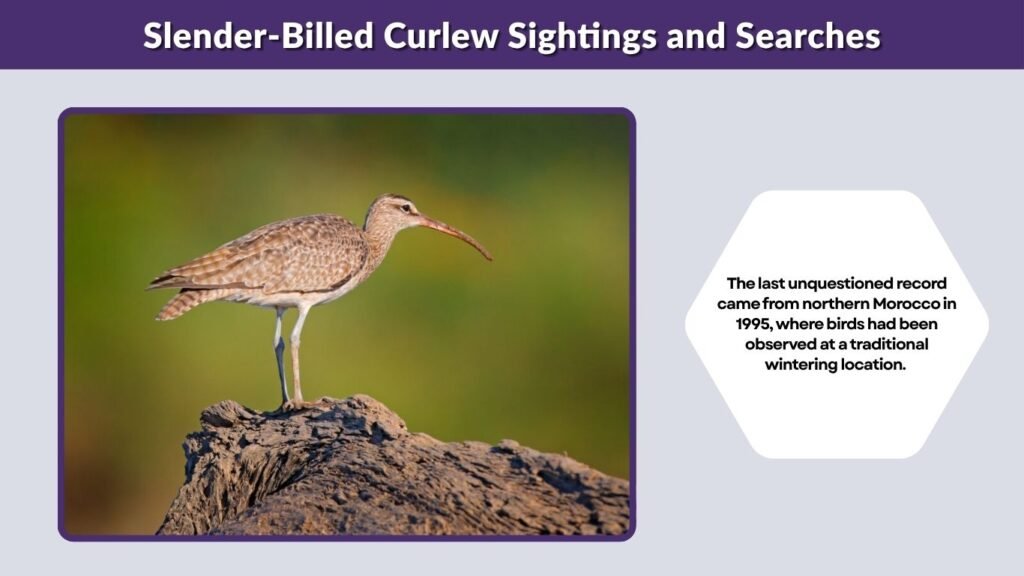
Possible Slender-billed Curlew sightings continued to attract attention long after confirmed records disappeared. Birdwatchers reported potential individuals in several European, Middle Eastern, and North African locations, but identifying such a rare bird requires strong photographic, genetic, or other independently verifiable evidence.
Last Confirmed Slender-Billed Curlew Sighting
The last unquestioned record came from northern Morocco in 1995, where birds had been observed at a traditional wintering location. Later searches failed to establish the existence of a surviving population. BirdLife reported that extensive efforts across the species’ former range produced no reliable evidence of persistence.
Reports from years such as 2004, 2012, 2014, and 2018 generated interest among birders, but none became universally accepted as confirmed evidence that the species survived.
Was the Slender-Billed Curlew Kept in Captivity?
There is no known captive population capable of preserving the species. Unlike animals maintained through conservation breeding programs, the Slender-billed Curlew disappeared without a secure captive group.
That means captive breeding could not serve as a final safeguard once the remaining wild population vanished.
FAQs
Questions surrounding the Slender-billed Curlew often focus on whether the species truly disappeared and whether recent sightings could indicate survival. Its similarity to other curlews made confirmation unusually difficult. Decades of unsuccessful searches and reassessment of historical records eventually provided scientists with enough evidence to conclude that the species was extinct.
1. Is the Slender-billed Curlew extinct?
Yes. The Slender-billed Curlew is now considered extinct following scientific assessment and its subsequent recognition as Extinct in BirdLife’s global conservation assessment.
2. When was the last Slender-billed Curlew seen?
The last unequivocally confirmed sighting occurred in Morocco in 1995. Later reports were investigated but did not provide adequate confirmation.
3. Why did the Slender-billed Curlew become extinct?
The exact combination of causes remains uncertain. Wetland destruction, habitat degradation, historical hunting, disruption of migration areas, and problems associated with an extremely small population probably contributed.
4. Where did the Slender-billed Curlew live?
It bred primarily in western Siberia and migrated through Europe and western Asia. Wintering birds occurred mainly around Mediterranean wetlands, including areas of North Africa.
5. What is the scientific name of the Slender-billed Curlew?
The scientific name is Numenius tenuirostris. It belonged to the family Scolopacidae, which also includes other curlews, sandpipers, and related shorebirds.
