
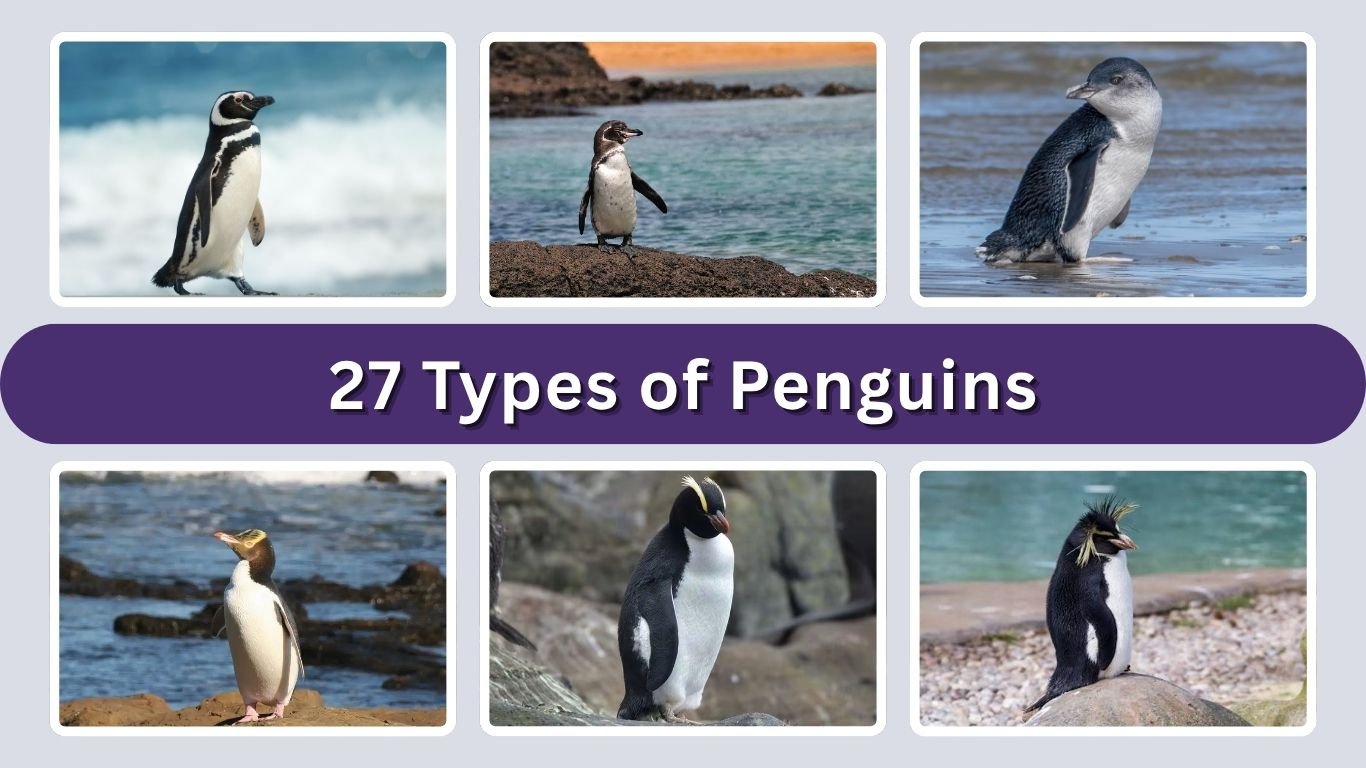
Penguins are fascinating flightless birds known for their excellent swimming skills, distinctive black-and-white plumage, and remarkable adaptations to marine environments. From the massive Emperor Penguin to the tiny Little Penguin, each type has unique features, habitats, feeding habits, and breeding behaviors. In this guide to 27 types of penguins, you will discover common penguin species, regional forms, and several extinct penguins that reveal the group’s rich evolutionary history. Learn how to identify each penguin and understand where these remarkable birds live.
1. Emperor Penguin
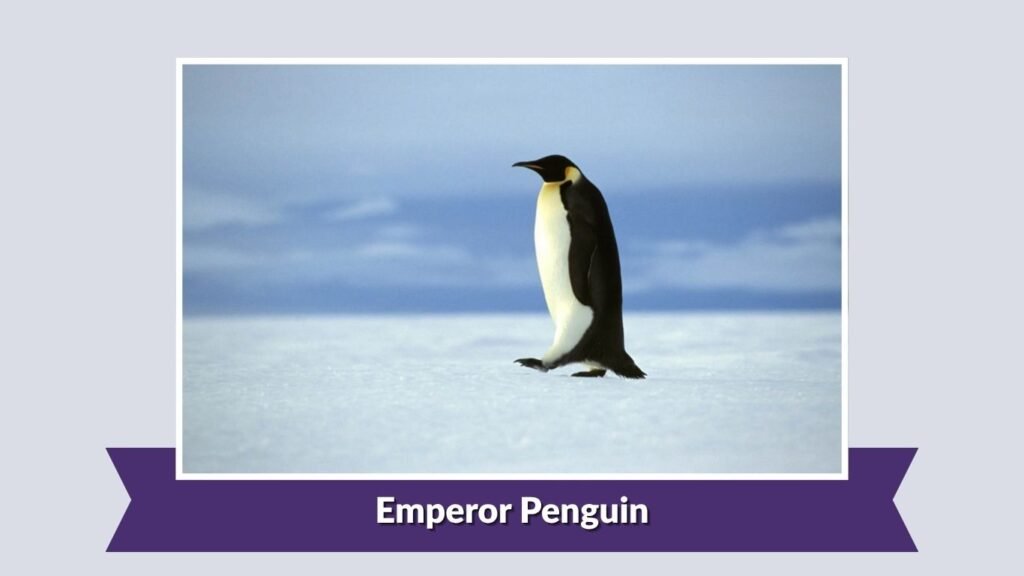
The Emperor Penguin is the largest living penguin species and one of the most recognizable birds of Antarctica. Famous for its impressive size, upright posture, and yellow-orange markings, this penguin is specially adapted to survive extreme cold. Emperor Penguins spend much of their lives on Antarctic sea ice and in the surrounding ocean, where they hunt for fish and other marine prey.
Identification
- Common Name: Emperor Penguin
- Scientific Name: Aptenodytes forsteri
- Height: About 39–47 inches
- Weight: Roughly 50–100 pounds
- Body Color: Black back with a white belly
- Head: Black with yellow-orange patches near the ears and neck
- Bill: Long, narrow, and slightly curved
- Young Chicks: Covered with soft gray feathers and a black-and-white face
Habitat and Distribution
Emperor Penguins live entirely in and around Antarctica. They are strongly associated with stable sea ice, especially during their breeding season. Large colonies may form far from open water, requiring adults to travel considerable distances between breeding areas and feeding grounds. Their thick feathers, dense body fat, and tightly packed colonies help them cope with extremely low temperatures and powerful Antarctic winds.
Diet and Feeding Behavior
The Emperor Penguin mainly feeds on fish, squid, and krill. It is an excellent underwater hunter capable of making deep and lengthy dives in search of food. Its streamlined body and strong flippers allow it to move efficiently through the water. Emperor Penguins can remain underwater for extended periods and may dive several hundred meters when pursuing prey.
Breeding and Life Cycle
Emperor Penguins have one of the most unusual breeding cycles among birds. Females lay a single egg during the Antarctic winter, then transfer it to the male. The male keeps the egg warm on his feet beneath a special fold of skin while fasting for weeks. After hatching, both parents take turns feeding and protecting the chick until it becomes independent.
2. King Penguin
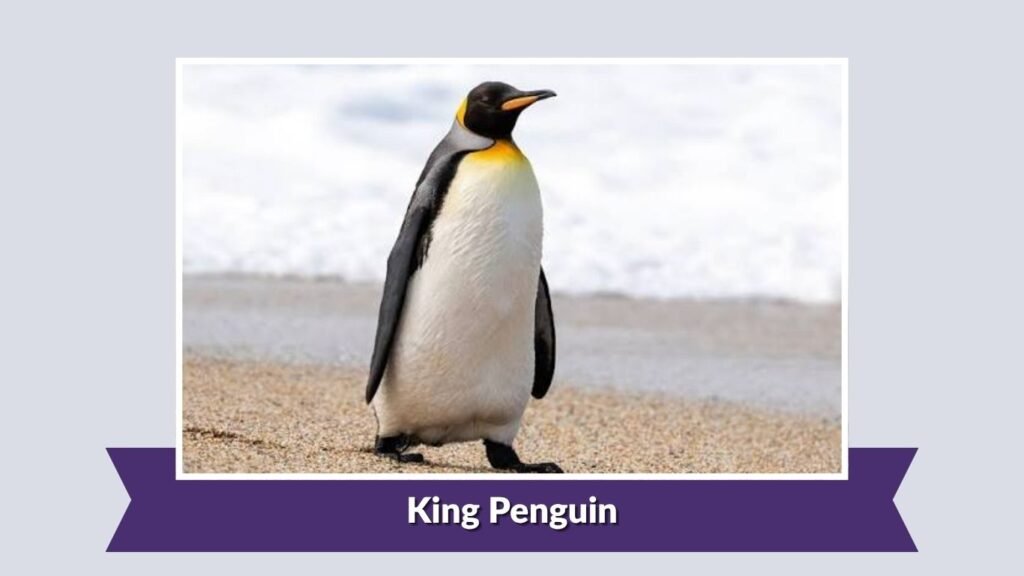
The King Penguin is the second-largest penguin species in the world, smaller only than the Emperor Penguin. It is easily recognized by its tall body, smooth black head, white belly, and bright orange-yellow markings around the neck. King Penguins live mainly on subantarctic islands, where they form enormous breeding colonies close to productive ocean feeding grounds.
Identification
- Common Name: King Penguin
- Scientific Name: Aptenodytes patagonicus
- Height: About 33–37 inches
- Weight: Roughly 22–40 pounds
- Body Color: Dark gray-black back with a white belly
- Head: Black with bright orange-yellow ear patches
- Bill: Long and narrow with orange coloration
- Chicks: Covered with thick brown down
Habitat and Distribution
King Penguins are mainly found on subantarctic islands, including South Georgia, the Falkland Islands region, the Crozet Islands, and the Kerguelen Islands. Unlike Emperor Penguins, they generally breed on ice-free beaches and open coastal areas. Their colonies can contain thousands of birds packed closely together.
Diet and Feeding Behavior
King Penguins primarily eat small fish, particularly lanternfish, along with squid and occasional crustaceans. They are powerful swimmers capable of diving deeply to locate prey. Their streamlined shape helps them move efficiently underwater, while excellent vision assists them when hunting in dim conditions.
Breeding and Life Cycle
King Penguins usually lay a single egg. Rather than building a nest, the parent balances the egg on its feet and protects it beneath a warm fold of abdominal skin. Both parents share incubation and feeding duties. Their breeding cycle is unusually long and can extend for more than a year.
3. Adélie Penguin
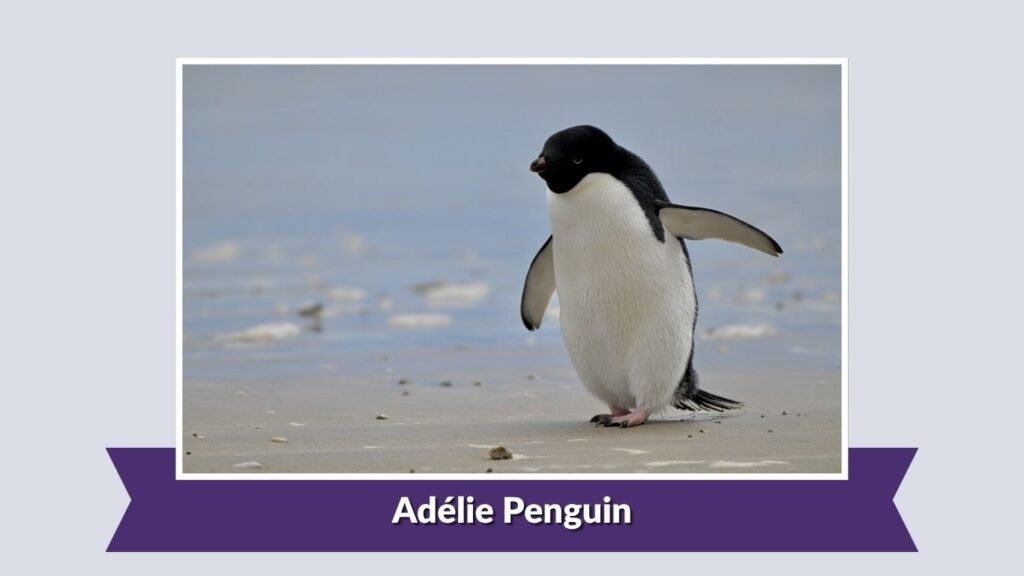
The Adélie Penguin is a small, energetic Antarctic penguin recognized by its classic black-and-white coloring and distinctive white eye ring. It is one of the most widespread penguins found around Antarctica. Adélie Penguins often gather in large colonies along rocky coastal areas and are known for their active behavior both on land and in the water.
Identification
- Common Name: Adélie Penguin
- Scientific Name: Pygoscelis adeliae
- Height: About 18–28 inches
- Weight: Roughly 8–13 pounds
- Body Color: Black back and white belly
- Head: Entirely black
- Eyes: Surrounded by a noticeable white ring
- Bill: Short with reddish coloring
Habitat and Distribution
Adélie Penguins live along the Antarctic coastline and on nearby islands. During the breeding season, they prefer ice-free rocky areas where they can build nests. Outside the breeding season, they spend considerable time at sea and are closely associated with areas containing seasonal sea ice.
Diet and Feeding Behavior
Their diet is dominated by Antarctic krill, though they also consume fish and squid. Adélie Penguins are agile swimmers that often hunt relatively close to the surface but can dive deeper when necessary. They commonly travel in groups when moving between colonies and feeding areas.
Breeding and Life Cycle
Adélie Penguins usually create nests using small stones. Females generally lay two eggs, and both parents take turns incubating them. Once the chicks hatch, the adults alternate between guarding them and returning to sea for food. Young birds eventually gather together in groups called crèches.
4. Chinstrap Penguin
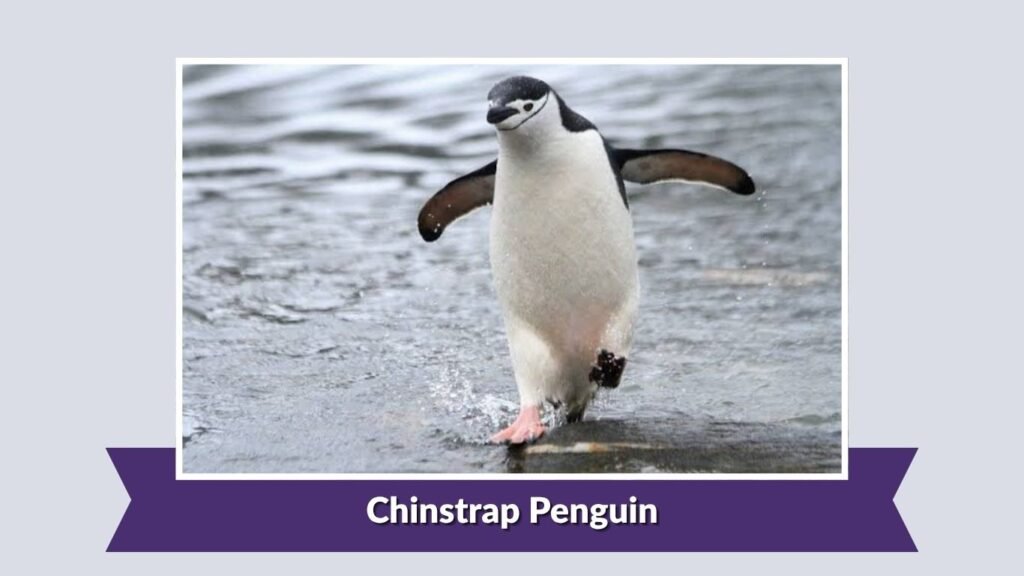
The Chinstrap Penguin gets its name from the thin black band running beneath its chin, giving the appearance of a helmet strap. This medium-sized penguin is common around parts of Antarctica and nearby islands. Chinstrap Penguins are highly social birds that form large, noisy breeding colonies and spend much of their time hunting in cold Southern Ocean waters.
Identification
- Common Name: Chinstrap Penguin
- Scientific Name: Pygoscelis antarcticus
- Height: About 27–30 inches
- Weight: Roughly 7–12 pounds
- Body Color: Black back with a white underside
- Head: Black crown with a white face
- Distinctive Mark: Narrow black line under the chin
- Bill: Short and dark-colored
Habitat and Distribution
Chinstrap Penguins occur mainly around the Antarctic Peninsula, South Shetland Islands, South Sandwich Islands, and other subantarctic locations. Their nesting sites are usually on rocky, ice-free slopes near the ocean. Some colonies contain hundreds of thousands of individuals.
Diet and Feeding Behavior
Krill forms the largest part of the Chinstrap Penguin’s diet. They also eat small fish and other marine organisms. Most feeding occurs near the surface, although these birds are capable divers. Their speed and agility underwater help them pursue moving prey.
Breeding and Life Cycle
During the breeding season, Chinstrap Penguins construct simple nests from stones. A female commonly lays two eggs, which are incubated by both parents. After hatching, chicks remain under parental care before joining groups with other young penguins. Both adults continue supplying food until the chicks develop waterproof feathers.
5. Gentoo Penguin
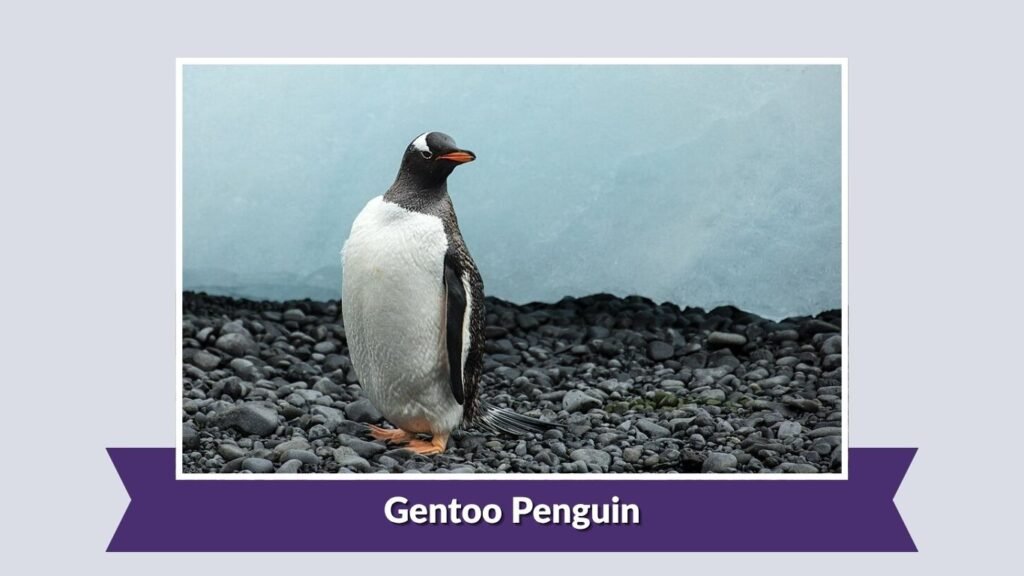
The Gentoo Penguin is a distinctive penguin known for the broad white stripe running across the top of its head. It is also one of the fastest swimming penguins. Gentoo Penguins inhabit several Antarctic and subantarctic regions and are frequently seen around rocky beaches, coastal grasslands, and areas close to nutrient-rich marine waters.
Identification
- Common Name: Gentoo Penguin
- Scientific Name: Pygoscelis papua
- Height: About 28–35 inches
- Weight: Roughly 10–19 pounds
- Body Color: Dark back and bright white belly
- Head: Black with a wide white stripe above the eyes
- Bill: Bright orange-red
- Feet: Orange to pinkish-orange
Habitat and Distribution
Gentoo Penguins are distributed around the Antarctic Peninsula and numerous subantarctic islands. They generally prefer coastal locations that remain relatively free from heavy ice during the breeding period. Colonies are often established on rocky ground, beaches, and gently sloping terrain.
Diet and Feeding Behavior
Their diet varies by location and may include krill, fish, squid, and other crustaceans. Gentoo Penguins are exceptionally fast swimmers and use powerful flipper strokes to chase prey underwater. They typically forage relatively close to their breeding colonies compared with some larger penguin species.
Breeding and Life Cycle
Gentoo Penguins build circular nests from stones, grass, and other available materials. Females normally lay two eggs, and both parents share incubation duties. Once the chicks hatch, both adults provide food. As they grow, the chicks become increasingly independent before eventually entering the ocean and learning to forage.
6. Little Penguin
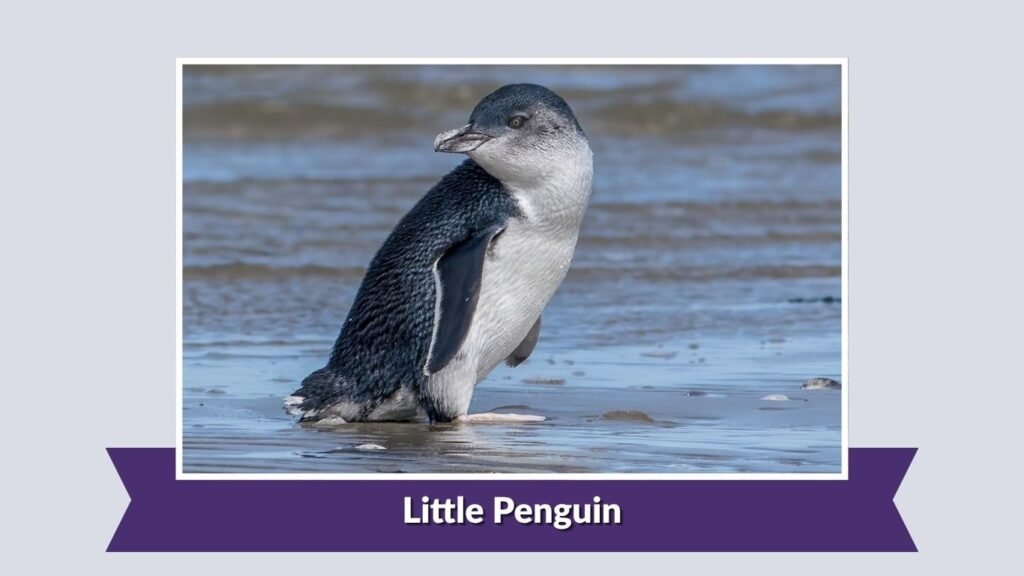
The Little Penguin is the smallest penguin species in the world. Its compact body, blue-gray feathers, and relatively small size make it easy to distinguish from most other penguins. Little Penguins are primarily found along the coastlines of southern Australia and New Zealand, where they spend their days feeding at sea and often return to nesting areas after sunset.
Identification
- Common Name: Little Penguin
- Scientific Name: Eudyptula minor
- Height: About 12–13 inches
- Weight: Roughly 2–3 pounds
- Body Color: Blue-gray upperparts with a white underside
- Head: Blue-gray rather than deep black
- Bill: Small and dark
- Body Shape: Compact and streamlined
Habitat and Distribution
Little Penguins occur along coastal areas of southern Australia and throughout parts of New Zealand. They commonly nest in burrows, natural rock crevices, caves, or sheltered coastal vegetation. Some populations also use artificial nesting boxes where conservation programs provide suitable habitat.
Diet and Feeding Behavior
Little Penguins feed mainly on small fish, squid, krill, and other marine animals. They usually forage in relatively shallow coastal waters and spend daylight hours swimming and hunting. Their small bodies allow them to maneuver quickly while chasing schooling fish.
Breeding and Life Cycle
Breeding behavior varies depending on location and environmental conditions. Little Penguins generally nest in burrows or protected cavities and may lay two eggs. Both parents participate in incubation and chick feeding. After several weeks, the young develop waterproof feathers and eventually begin making their first trips into the ocean.
7. African Penguin
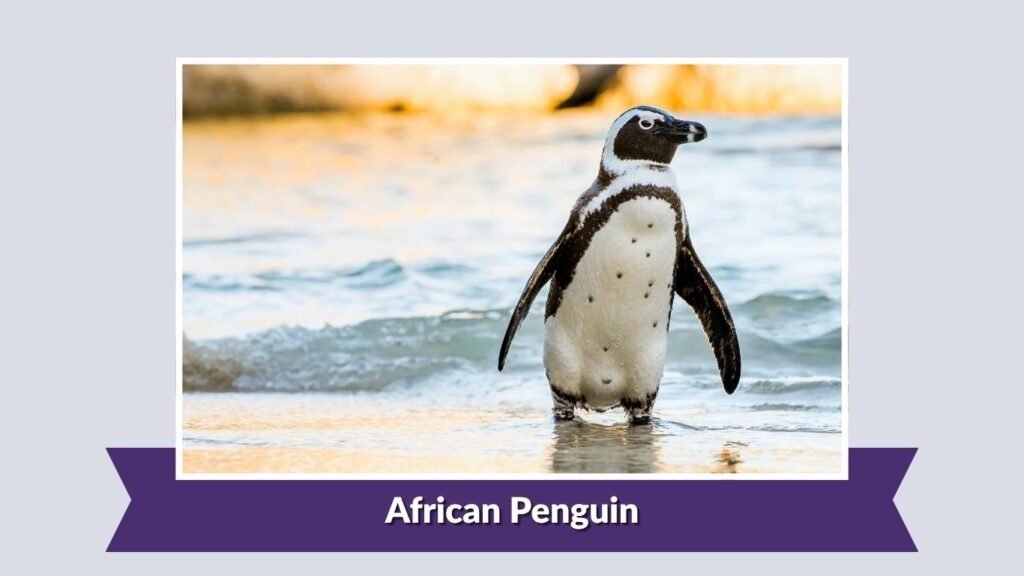
The African Penguin is a medium-sized penguin found along the southwestern coast of Africa. It is recognized by its black-and-white body, pink patches above the eyes, and distinctive black chest band. Unlike Antarctic penguins, this species lives in a much warmer climate and commonly nests on rocky islands and sheltered coastal areas.
Identification
- Common Name: African Penguin
- Scientific Name: Spheniscus demersus
- Height: About 24–28 inches
- Weight: Roughly 5–8 pounds
- Body Color: Black back with a white belly
- Head: Black with white facial markings
- Distinctive Mark: Black chest band and pink skin above the eyes
- Bill: Strong, pointed, and dark-colored
Habitat and Distribution
African Penguins occur along the coastlines of South Africa and Namibia. They usually breed on offshore islands, rocky beaches, and selected mainland sites. Their habitat provides easy access to productive coastal waters where food is available. Burrows, rocky crevices, and sheltered nesting areas help protect them from heat and predators.
Diet and Feeding Behavior
African Penguins mainly feed on small schooling fish such as anchovies and sardines. They may also eat squid and crustaceans. These penguins are efficient swimmers and often hunt in groups, using their speed and sharp underwater vision to chase fish through coastal waters.
Breeding and Life Cycle
African Penguins can breed at different times of the year depending on local conditions. Females commonly lay two eggs in a burrow or sheltered nest. Both parents share incubation and feeding duties. The chicks remain dependent on their parents until they grow waterproof feathers and become capable of feeding independently.
8. Humboldt Penguin
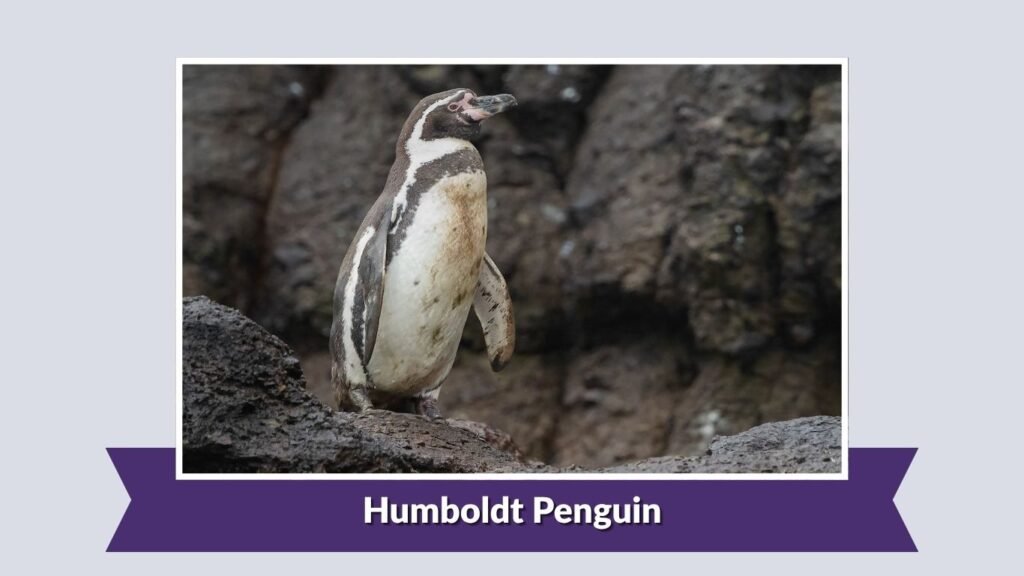
The Humboldt Penguin is a South American penguin named after the cold Humboldt Current that flows along the western coast of the continent. It has a black back, white underside, and a bold black band across its chest. These penguins are adapted to relatively dry coastal environments and often nest among rocks or in natural burrows.
Identification
- Common Name: Humboldt Penguin
- Scientific Name: Spheniscus humboldti
- Height: About 22–28 inches
- Weight: Roughly 8–13 pounds
- Body Color: Dark gray-black back and white belly
- Head: Black with a white stripe around the face
- Distinctive Mark: Broad black band across the upper chest
- Bill: Thick, dark, and slightly hooked
Habitat and Distribution
Humboldt Penguins live mainly along the Pacific coasts of Peru and Chile. They are strongly associated with the nutrient-rich waters of the Humboldt Current. Their nesting sites include rocky islands, coastal cliffs, caves, and burrows dug into soft ground or accumulated seabird deposits.
Diet and Feeding Behavior
Their diet consists primarily of small fish, including anchovies and sardines, although they may also consume squid and crustaceans. Humboldt Penguins typically forage in coastal waters and use their streamlined bodies to pursue fast-moving prey beneath the surface.
Breeding and Life Cycle
Humboldt Penguins usually form long-term breeding pairs. A female often lays two eggs, and both parents take turns keeping them warm. After the chicks hatch, the parents provide regurgitated food until the young birds develop enough feathers and strength to begin swimming and feeding on their own.
9. Magellanic Penguin
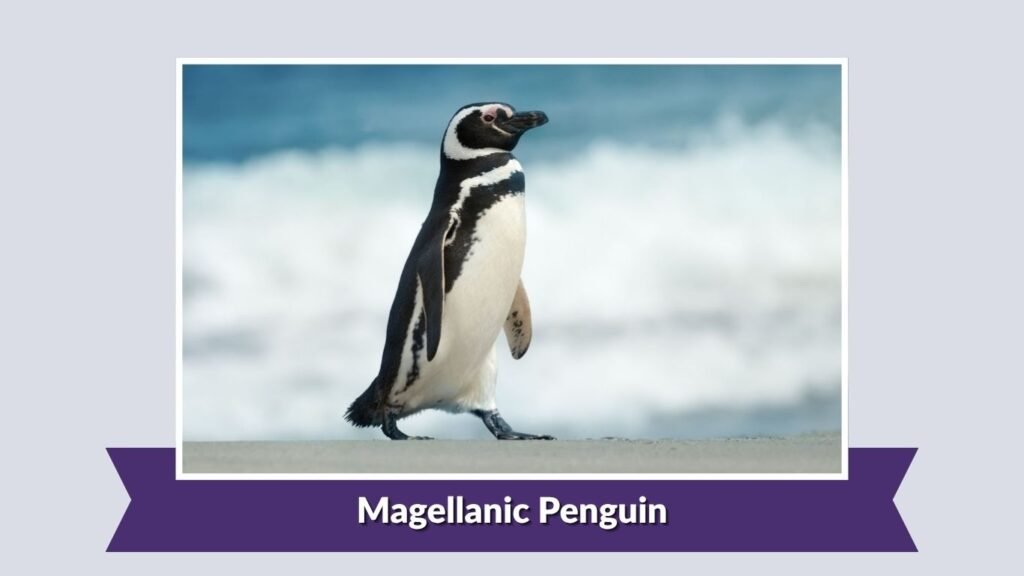
The Magellanic Penguin is a medium-sized species native to southern South America. It is named after explorer Ferdinand Magellan and is easily recognized by the two dark bands across its upper chest and neck area. Large colonies gather along coastal regions during the breeding season before many individuals migrate northward during the nonbreeding period.
Identification
- Common Name: Magellanic Penguin
- Scientific Name: Spheniscus magellanicus
- Height: About 24–30 inches
- Weight: Roughly 6–14 pounds
- Body Color: Black back and white underside
- Head: Black with a white curved facial stripe
- Distinctive Mark: Two dark bands around the chest and neck
- Bill: Dark, strong, and moderately long
Habitat and Distribution
Magellanic Penguins breed along the coasts of Argentina and Chile, including Patagonia and nearby islands. Some populations also occur around the Falkland Islands. They commonly nest in burrows dug into soil or beneath vegetation, where they receive protection from weather and intense sunlight.
Diet and Feeding Behavior
These penguins eat a variety of marine prey, including small fish, squid, and crustaceans. They are capable swimmers that may travel considerable distances from breeding colonies while searching for food. Their feeding patterns can change depending on local prey availability.
Breeding and Life Cycle
Magellanic Penguins typically return to the same breeding areas each year. Females generally lay two eggs, and both adults participate in incubation. After hatching, the chicks are protected and fed by their parents until they develop juvenile feathers and are ready to enter the ocean.
10. Galápagos Penguin
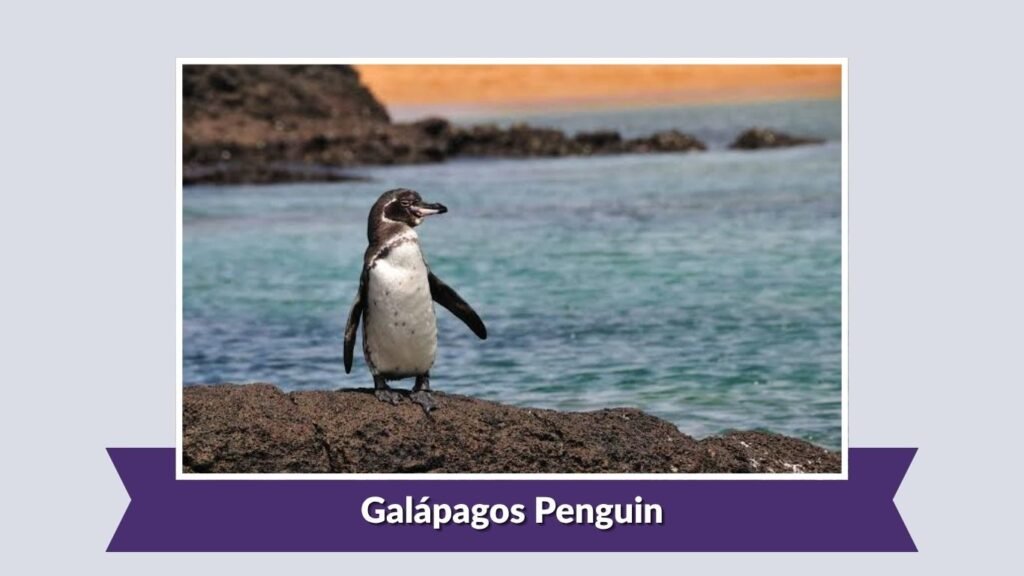
The Galápagos Penguin is one of the smallest penguin species and is famous for living close to the equator. It is found only around the Galápagos Islands, making it one of the world’s most geographically restricted penguins. Its survival in a tropical region is possible largely because cool ocean currents bring nutrient-rich water to the islands.
Identification
- Common Name: Galápagos Penguin
- Scientific Name: Spheniscus mendiculus
- Height: About 19–21 inches
- Weight: Roughly 4–6 pounds
- Body Color: Black upperparts with white underparts
- Head: Black with a thin white facial stripe
- Distinctive Mark: Narrow black band across the chest
- Bill: Slender, dark, and pointed
Habitat and Distribution
Galápagos Penguins are restricted to the Galápagos Islands of Ecuador. Most are concentrated around islands influenced by cooler ocean currents. They spend much of their time near rocky coastlines, caves, and crevices where they can find shade from the strong tropical sun.
Diet and Feeding Behavior
Their diet mainly includes small schooling fish such as sardines and anchovies. Galápagos Penguins generally hunt relatively close to shore, diving quickly after prey. Cool, productive waters are especially important because they support the fish populations on which these penguins depend.
Breeding and Life Cycle
Breeding often depends on favorable ocean conditions and food availability rather than a strict annual season. Pairs usually nest in sheltered rock cavities or crevices. Both parents incubate the eggs and feed the chicks. Adults also help protect young birds from excessive heat by selecting shaded nesting locations.
11. Yellow-eyed Penguin
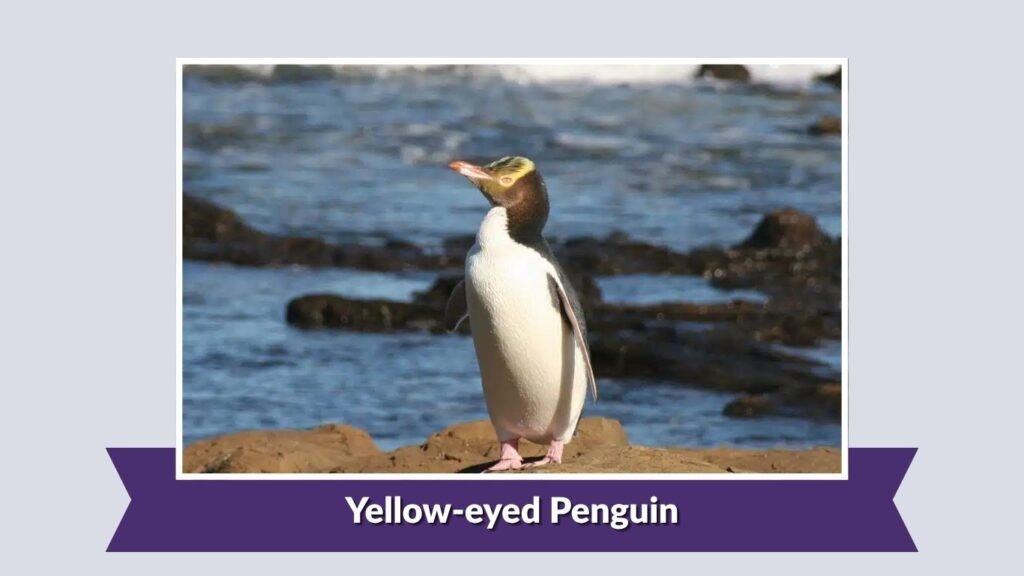
The Yellow-eyed Penguin is a distinctive penguin native to New Zealand. Its pale yellow eyes and yellow band of feathers extending around the back of the head make it easy to recognize. Unlike many penguins that breed in crowded colonies, Yellow-eyed Penguins prefer more isolated nesting sites surrounded by coastal vegetation.
Identification
- Common Name: Yellow-eyed Penguin
- Scientific Name: Megadyptes antipodes
- Height: About 24–31 inches
- Weight: Roughly 9–18 pounds
- Body Color: Dark gray back and white belly
- Eyes: Pale yellow
- Distinctive Mark: Yellow feather band around the head
- Bill: Long and reddish-brown
- Feet: Pinkish
Habitat and Distribution
Yellow-eyed Penguins occur along parts of southeastern New Zealand and nearby subantarctic islands. Their breeding habitat commonly includes coastal forests, scrublands, and grassy areas near the sea. Nesting pairs usually maintain greater distance from one another than highly colonial penguin species.
Diet and Feeding Behavior
These penguins primarily eat fish but may also consume squid and other marine animals. They usually leave nesting areas during the day to forage offshore. Yellow-eyed Penguins are capable divers and often search along the seafloor or within deeper coastal waters for suitable prey.
Breeding and Life Cycle
Yellow-eyed Penguins commonly form breeding pairs and select secluded nesting sites among vegetation. Females usually lay two eggs, with both parents sharing incubation responsibilities. After hatching, the chicks are guarded and regularly fed. Eventually, they develop waterproof plumage and begin exploring the ocean independently.
12. Fiordland Penguin
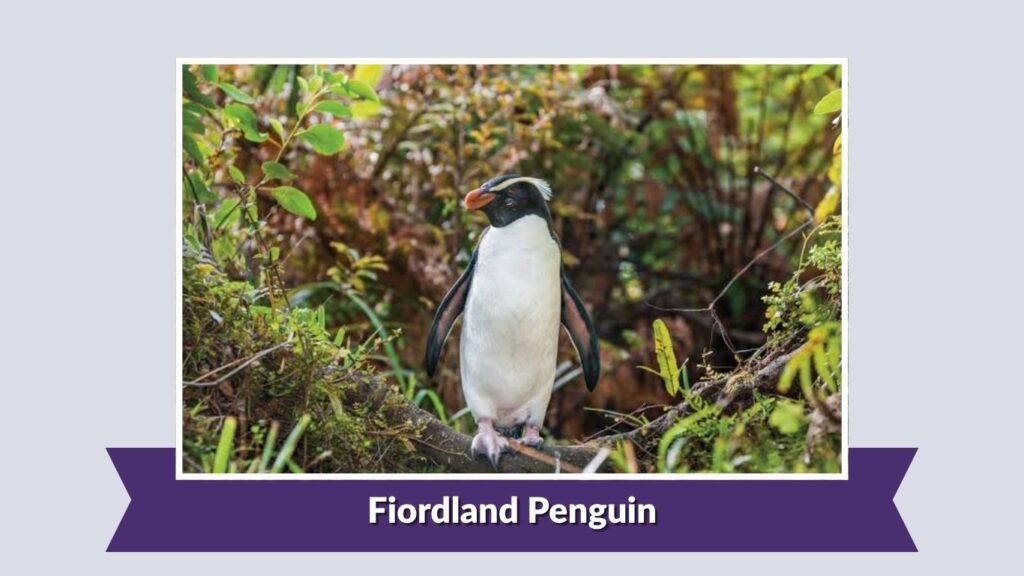
The Fiordland Penguin is a crested penguin native to New Zealand. It is easily recognized by the bright yellow feathers extending from above the eyes toward the back of the head. This penguin prefers remote, rugged coastlines and often nests beneath dense vegetation, tree roots, or rocky shelters where it can remain protected from weather and disturbance.
Identification
- Common Name: Fiordland Penguin
- Scientific Name: Eudyptes pachyrhynchus
- Height: About 22–24 inches
- Weight: Roughly 6–9 pounds
- Body Color: Black upperparts with a white underside
- Head: Black with prominent yellow eyebrow-like crests
- Bill: Thick and orange-brown
- Feet: Pinkish-white
Habitat and Distribution
Fiordland Penguins are primarily found along the southwestern coast of New Zealand’s South Island, particularly in Fiordland and Westland. They also breed on nearby islands. Their nesting areas are commonly located in coastal forests, caves, rocky crevices, and sheltered spaces surrounded by thick vegetation.
Diet and Feeding Behavior
These penguins feed on fish, squid, krill, and other small marine animals. They spend much of their lives at sea and are powerful swimmers capable of diving repeatedly while searching for prey. During breeding periods, adults regularly travel between feeding grounds and their hidden coastal nests.
Breeding and Life Cycle
Fiordland Penguins usually return to land during the breeding season and form nests in secluded locations. Females typically lay two eggs, although the second chick often has a better chance of surviving. Both parents help incubate the eggs and feed the developing chick until it becomes independent and begins life at sea.
13. Snares Penguin
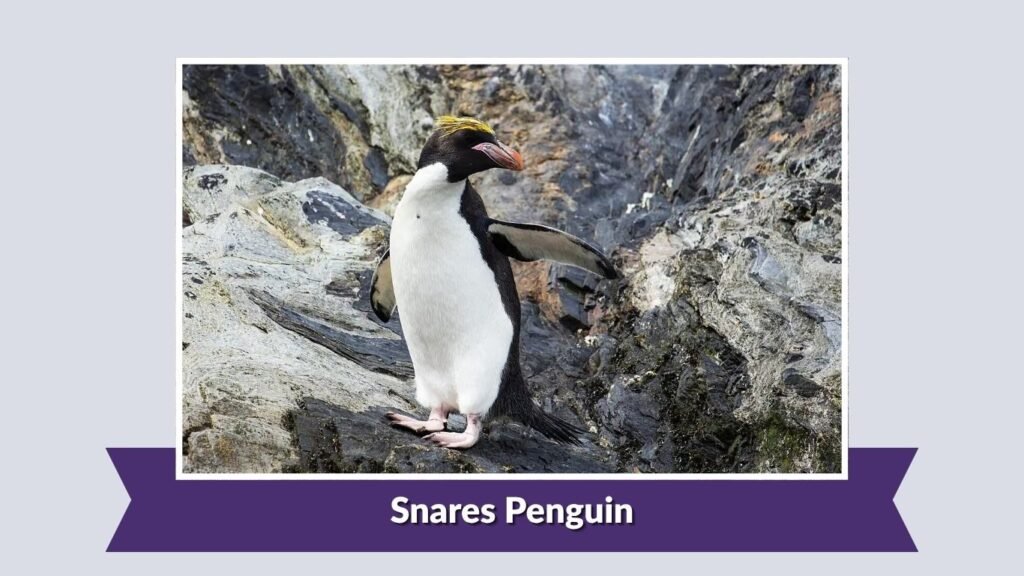
The Snares Penguin is a crested penguin found only around New Zealand’s Snares Islands. Its limited distribution makes it one of the more geographically restricted penguin species. It has a dark head, white underside, thick reddish bill, and striking yellow eyebrow feathers that sweep backward over the sides of the head.
Identification
- Common Name: Snares Penguin
- Scientific Name: Eudyptes robustus
- Height: About 20–28 inches
- Weight: Roughly 6–9 pounds
- Body Color: Black upperparts with a white belly
- Head: Black with bright yellow crests
- Bill: Thick and reddish-orange
- Eyes: Dark reddish-brown
- Feet: Pink
Habitat and Distribution
Snares Penguins breed exclusively on the Snares Islands south of New Zealand. These remote islands provide rocky coastlines, dense vegetation, and relatively undisturbed nesting areas. Colonies may occur under forest cover or on open rocky ground near convenient access points to the ocean.
Diet and Feeding Behavior
Their diet includes krill, small fish, and squid. Snares Penguins are agile underwater hunters and spend long periods at sea searching for food. During the breeding season, they tend to forage within manageable distances of their colonies so they can regularly return to feed their chicks.
Breeding and Life Cycle
Females usually lay two eggs in nests made from vegetation, stones, and other available materials. Both parents participate in incubation, although survival between the two eggs may differ. After hatching, chicks are protected and fed until they grow juvenile feathers and are capable of entering the ocean.
14. Erect-crested Penguin
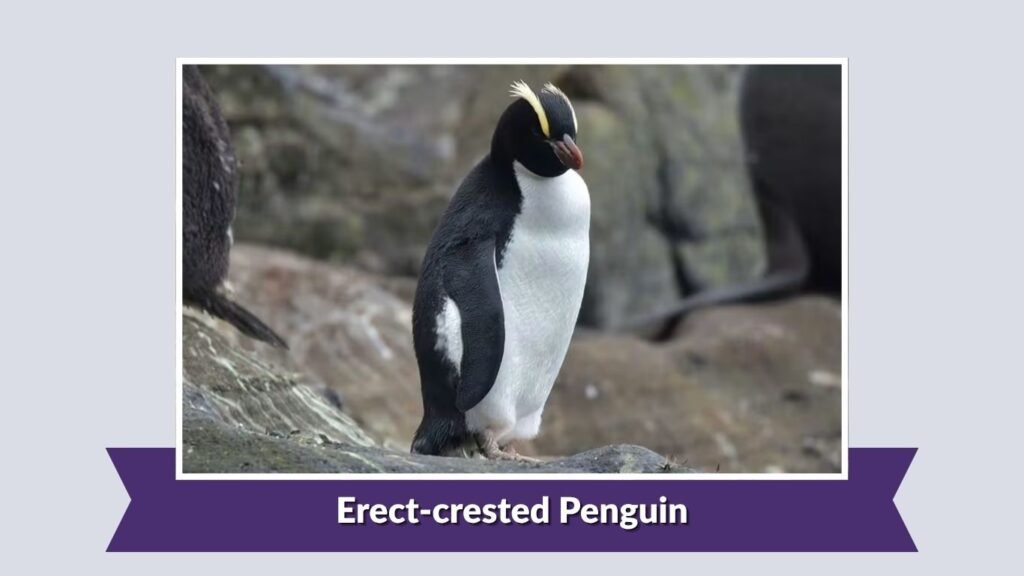
The Erect-crested Penguin is a distinctive crested penguin known for the upright yellow feather plumes above its eyes. It breeds mainly on remote subantarctic islands belonging to New Zealand. Compared with many other penguins, this species remains relatively difficult to study because its breeding colonies are isolated and challenging to access.
Identification
- Common Name: Erect-crested Penguin
- Scientific Name: Eudyptes sclateri
- Height: About 20–28 inches
- Weight: Roughly 5–13 pounds
- Body Color: Black back and white underside
- Head: Black with upright yellow crest feathers
- Bill: Strong and orange-brown
- Eyes: Dark reddish-brown
- Feet: Pinkish
Habitat and Distribution
Erect-crested Penguins mainly breed on New Zealand’s Antipodes and Bounty Islands. These remote locations feature rugged rocky coastlines and steep terrain. Outside the breeding season, the birds spend much of their time at sea, where their exact movements can be difficult to observe.
Diet and Feeding Behavior
Their diet is thought to include fish, squid, krill, and other small marine organisms. Like other crested penguins, they are skilled swimmers and divers that pursue prey underwater. Their streamlined bodies and strong flippers allow them to move quickly through rough subantarctic seas.
Breeding and Life Cycle
Erect-crested Penguins breed in colonies and usually lay two eggs. The first egg is noticeably smaller than the second, and generally only one chick survives. Both parents participate in reproductive duties. Once the surviving chick grows sufficiently, it joins other young penguins before eventually becoming independent.
15. Macaroni Penguin
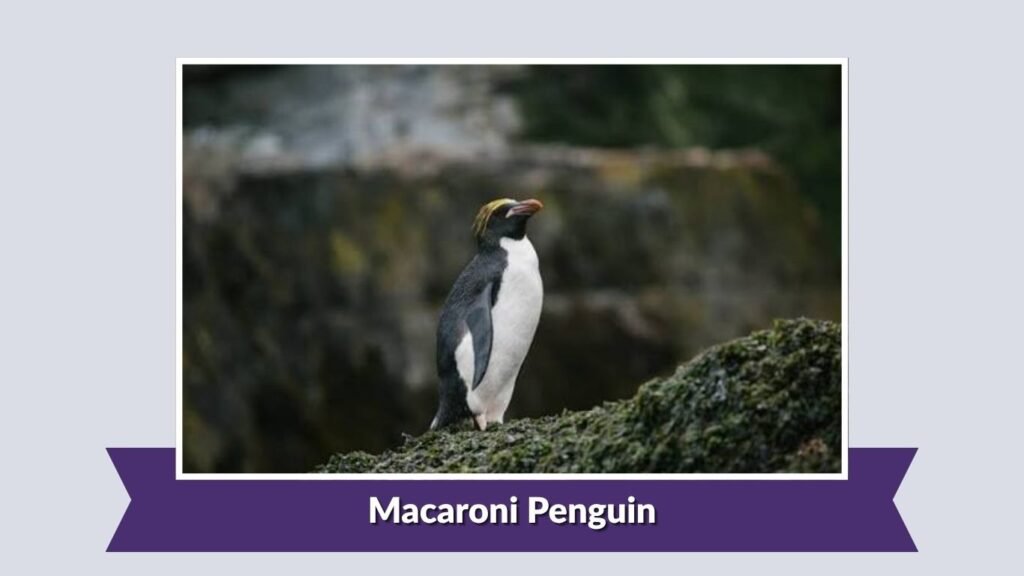
The Macaroni Penguin is one of the most recognizable crested penguins because of its bright golden-yellow feathers above the eyes. These long crest feathers contrast sharply with its black head and white underside. Macaroni Penguins occur across a broad part of the Southern Ocean and often gather in extremely large breeding colonies.
Identification
- Common Name: Macaroni Penguin
- Scientific Name: Eudyptes chrysolophus
- Height: About 27–30 inches
- Weight: Roughly 7–14 pounds
- Body Color: Black upperparts with a white belly
- Head: Black with long golden-yellow crest feathers
- Bill: Thick and orange-red
- Eyes: Reddish-brown
- Feet: Pink
Habitat and Distribution
Macaroni Penguins breed on numerous subantarctic islands, including South Georgia, the South Sandwich Islands, Crozet Islands, and Kerguelen Islands. Their colonies are often located on steep rocky slopes or coastal areas where birds can access the ocean.
Diet and Feeding Behavior
Krill forms a major part of their diet, although they also eat fish and squid. Macaroni Penguins are strong divers and may travel considerable distances while searching for productive feeding grounds. Large groups often forage in nutrient-rich waters surrounding their breeding islands.
Breeding and Life Cycle
Females generally lay two eggs, but the first is much smaller and rarely produces a surviving chick. The second egg receives most of the parental investment. Both parents participate in incubation and chick care. As chicks grow, they gather in groups while adults continue bringing food from the ocean.
16. Royal Penguin
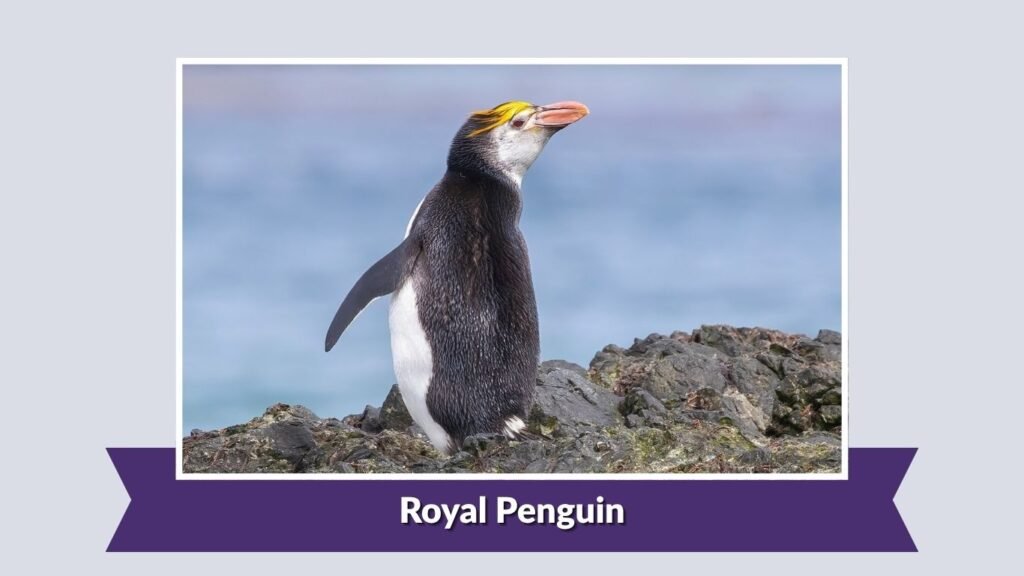
The Royal Penguin is a striking crested penguin best known for its largely white face and bright yellow-orange crest feathers. It is closely related to the Macaroni Penguin but has noticeably different facial coloring. Royal Penguins breed almost entirely around Macquarie Island, making their breeding distribution highly restricted.
Identification
- Common Name: Royal Penguin
- Scientific Name: Eudyptes schlegeli
- Height: About 26–30 inches
- Weight: Roughly 9–18 pounds
- Body Color: Dark back with a white belly
- Face: Mostly white
- Crest: Yellow-orange feathers above the eyes
- Bill: Large and orange-red
- Feet: Pink
Habitat and Distribution
Royal Penguins breed primarily on Macquarie Island and nearby small islands between Australia and Antarctica. They nest on rocky beaches, slopes, and open ground, sometimes forming very large colonies. Outside the breeding season, they spend months at sea across surrounding Southern Ocean waters.
Diet and Feeding Behavior
Royal Penguins mainly feed on krill, fish, and squid. They are excellent swimmers that dive repeatedly when searching for prey. Ocean conditions strongly influence where they forage, and adults may travel substantial distances while collecting enough food for themselves and their developing chicks.
Breeding and Life Cycle
Royal Penguins usually arrive at breeding grounds during the southern spring. Females generally lay two eggs, but the first is commonly smaller and is often lost. Both parents share incubation of the remaining egg and later feed the chick. Young penguins eventually develop waterproof feathers and leave the colony for life at sea.
17. Northern Rockhopper Penguin
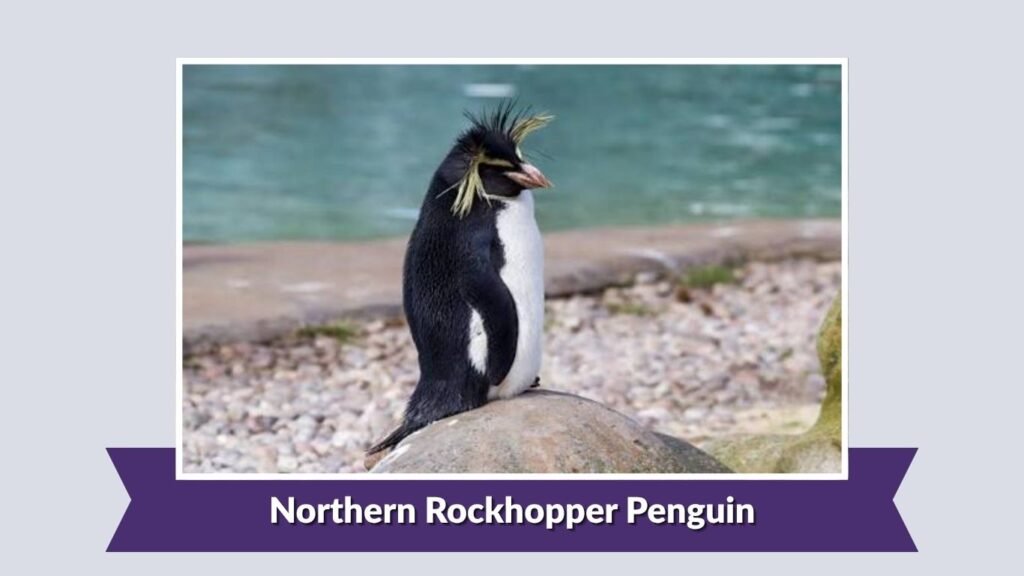
The Northern Rockhopper Penguin is a small crested penguin famous for its bright yellow eyebrow feathers and energetic movements across rocky terrain. Rather than waddling carefully around obstacles, these penguins often hop between rocks, which helps explain their common name. They inhabit remote islands in the South Atlantic and Indian oceans and spend much of their nonbreeding lives at sea.
Identification
- Common Name: Northern Rockhopper Penguin
- Scientific Name: Eudyptes moseleyi
- Height: About 20–23 inches
- Weight: Roughly 5–10 pounds
- Body Color: Black upperparts and white underparts
- Head: Black with long yellow crest feathers
- Eyes: Reddish
- Bill: Thick and orange-red
- Feet: Pink
Habitat and Distribution
Northern Rockhopper Penguins breed on remote islands, especially Tristan da Cunha and Gough Island in the South Atlantic. Some populations also occur around islands in the southern Indian Ocean. They prefer rugged coastal environments with rocky slopes, cliffs, and areas that provide relatively direct access to the sea.
Diet and Feeding Behavior
Their diet consists mainly of krill, small fish, squid, and other crustaceans. Northern Rockhoppers are excellent underwater hunters and use their powerful flippers to pursue prey. They may travel significant distances from breeding colonies while feeding, especially when nearby marine resources become limited.
Breeding and Life Cycle
Northern Rockhopper Penguins gather in dense breeding colonies. Females normally lay two eggs, although the second and larger egg usually has the greater chance of producing a surviving chick. Both parents contribute to incubation and feeding. Young penguins eventually gather with other chicks before developing waterproof feathers and becoming independent.
18. Western Rockhopper Penguin
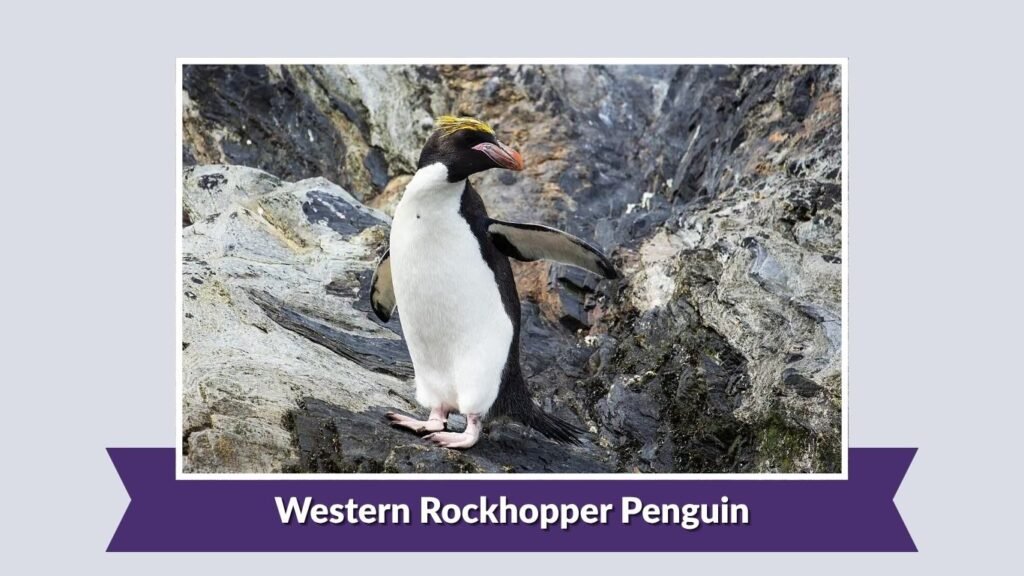
The Western Rockhopper Penguin is a small, sturdy penguin distinguished by its yellow crest, red eyes, and remarkable ability to move across steep rocky coastlines. Formerly grouped under the broader name Southern Rockhopper Penguin, it is now recognized separately in current IOC taxonomy. These penguins breed on isolated islands in the southern Atlantic and southeastern Pacific regions.
Identification
- Common Name: Western Rockhopper Penguin
- Scientific Name: Eudyptes chrysocome
- Height: About 20–23 inches
- Weight: Roughly 5–9 pounds
- Body Color: Dark upperparts with a white belly
- Head: Black with yellow eyebrow crests
- Eyes: Bright reddish
- Bill: Short, thick, and orange-brown
- Feet: Pink
Habitat and Distribution
Western Rockhopper Penguins occur around southern South America and several nearby islands. Important breeding areas include the Falkland Islands and islands around Cape Horn. They favor rocky coastlines where they can establish colonies on slopes, cliff edges, and areas surrounded by tussock vegetation.
Diet and Feeding Behavior
These penguins mainly consume krill, squid, small fish, and other marine organisms. Their diet varies according to local prey availability and season. They are powerful swimmers that can dive repeatedly while searching for food and may forage considerable distances from their nesting areas.
Breeding and Life Cycle
Breeding colonies become busy and noisy when adults return from the ocean. Pairs construct simple nests using grass, stones, and available vegetation. Females generally produce two eggs, but usually only one chick is successfully raised. Both parents help protect and feed the chick until it can survive independently at sea.
19. Eastern Rockhopper Penguin
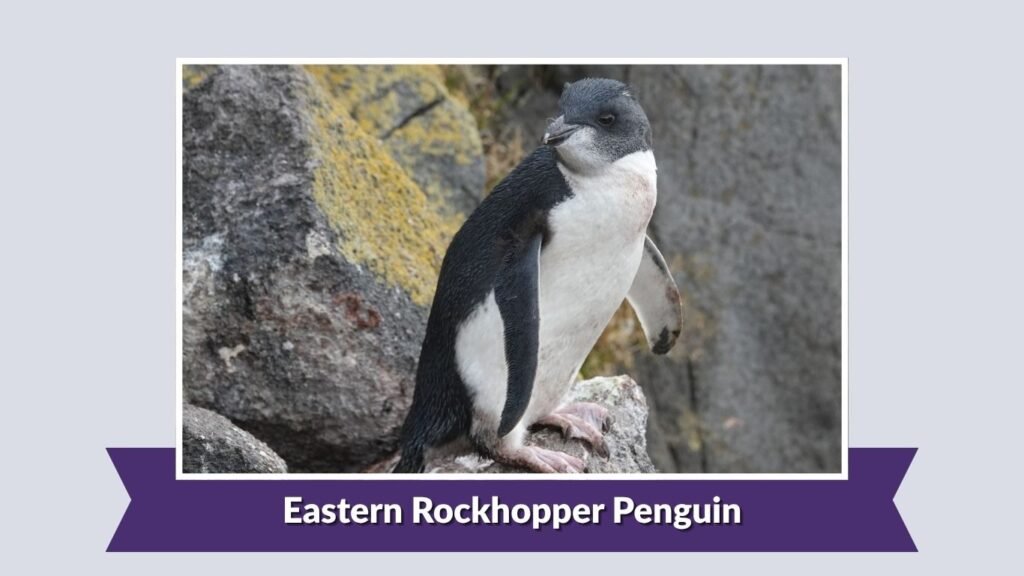
The Eastern Rockhopper Penguin is a crested penguin of the southern Indian and Pacific oceans. Once grouped with the Western Rockhopper Penguin, it is now recognized as a separate species by current IOC taxonomy. Its bright yellow head plumes, red eyes, and compact body give it the classic rockhopper appearance, while its strong feet help it navigate rugged island coastlines.
Identification
- Common Name: Eastern Rockhopper Penguin
- Scientific Name: Eudyptes filholi
- Height: Around 20–23 inches
- Weight: Roughly 5–9 pounds
- Body Color: Black upperparts and white underside
- Head: Black with yellow crest feathers
- Eyes: Reddish-brown
- Bill: Thick and orange-brown
- Feet: Strong and pinkish
Habitat and Distribution
Eastern Rockhopper Penguins breed on islands across parts of the southern Indian and Pacific oceans. Their colonies can occur on steep slopes, rocky shores, and areas covered with low vegetation. These isolated islands provide suitable breeding grounds while surrounding ocean waters supply important feeding opportunities.
Diet and Feeding Behavior
Krill and other crustaceans make up an important portion of their diet, along with squid and small fish. Eastern Rockhoppers are active pursuit hunters that use rapid flipper movements to travel underwater. They spend much of the year at sea when they are not involved in breeding or molting.
Breeding and Life Cycle
During the breeding season, adults return to established colonies and form nests on rocky ground. Females commonly lay two eggs of different sizes. Usually the larger second egg has the better chance of survival. Parents share reproductive responsibilities and continue feeding the chick until it develops waterproof plumage and leaves the colony.
20. White-flippered Penguin
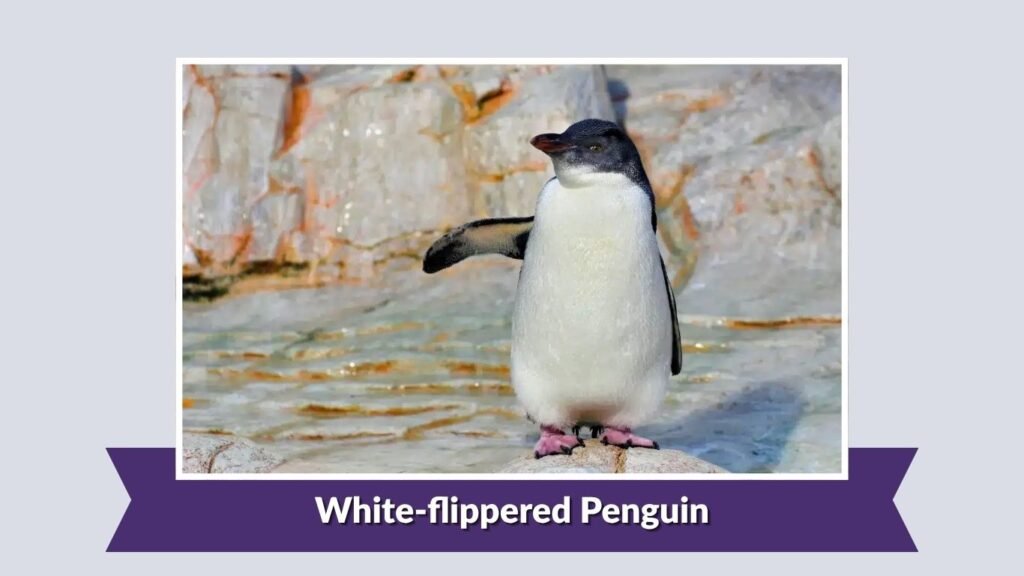
The White-flippered Penguin is a distinctive regional form of the Little Penguin associated particularly with the Canterbury region of New Zealand. It gets its name from the noticeably broad white markings along its flippers. Although sometimes presented separately in popular penguin lists, modern classifications generally place it within the Little Penguin rather than recognizing it as an independent species.
Identification
- Common Name: White-flippered Penguin
- Scientific Group: Eudyptula minor
- Height: Around 12–16 inches
- Weight: Roughly 2–4 pounds
- Body Color: Pale blue-gray above and white below
- Flippers: Distinct broad white margins
- Head: Blue-gray with lighter facial areas
- Bill: Short and dark
- Body Shape: Small and compact
Habitat and Distribution
White-flippered Penguins are especially associated with Banks Peninsula and nearby parts of Canterbury on New Zealand’s South Island. They inhabit coastal environments where rocky areas, burrows, caves, and sheltered ground provide nesting opportunities. Like other Little Penguins, they generally return to land after spending the day feeding at sea.
Diet and Feeding Behavior
These small penguins mainly hunt fish and other small marine organisms in coastal waters. They use quick underwater movements to pursue schooling prey and generally forage at relatively shallow depths compared with larger penguins. Their compact size makes them agile swimmers.
Breeding and Life Cycle
Pairs use burrows, rock cavities, or other sheltered spaces for nesting. Both adults participate in incubation and chick care. Parents repeatedly travel between the nest and nearby feeding areas to provide food. Chicks eventually replace their down with waterproof juvenile feathers before beginning an independent life in the ocean.
21. Wilson’s Penguin
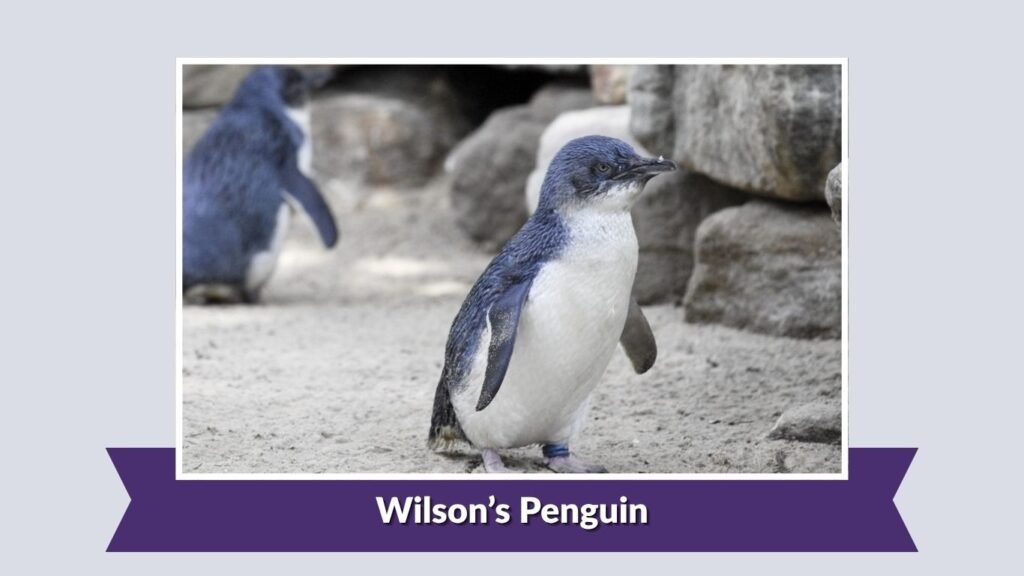
Wilson’s Penguin, also called Wilson’s Little Penguin, is an extinct penguin known from fossil material discovered in New Zealand. Unlike most penguins discussed in modern wildlife guides, it cannot be seen alive today. Its discovery is scientifically important because it provides evidence that small penguins related to today’s Little Penguins inhabited the New Zealand region millions of years ago.
Identification
- Common Name: Wilson’s Penguin
- Alternative Name: Wilson’s Little Penguin
- Scientific Name: Eudyptula wilsonae
- Status: Extinct
- Group: Little penguin lineage
- Known From: Fossil remains
- Region: New Zealand
- Age: Pliocene period
Habitat and Distribution
Wilson’s Penguin is known from fossil evidence in New Zealand rather than observations of living birds. Its remains indicate that members of the Little Penguin lineage were established in the Zealandia region millions of years ago. The ancient coastal environments of this region likely provided marine feeding opportunities similar in broad ecological terms to those used by small penguins today.
Diet and Feeding Behavior
Because Wilson’s Penguin is known only from fossils, its exact diet and daily feeding behavior cannot be observed directly. Scientists can instead compare its anatomy and evolutionary relationships with living members of the genus Eudyptula. It was probably adapted for swimming and pursuing relatively small marine prey.
Evolution and History
Wilson’s Penguin helps scientists understand the long evolutionary history of small penguins around New Zealand. Fossil evidence shows that the lineage was present in the region millions of years before modern Little Penguins. Discoveries such as this allow researchers to reconstruct how penguins diversified, changed in size, and adapted to different marine environments through geological time.
22. Waitaha Penguin
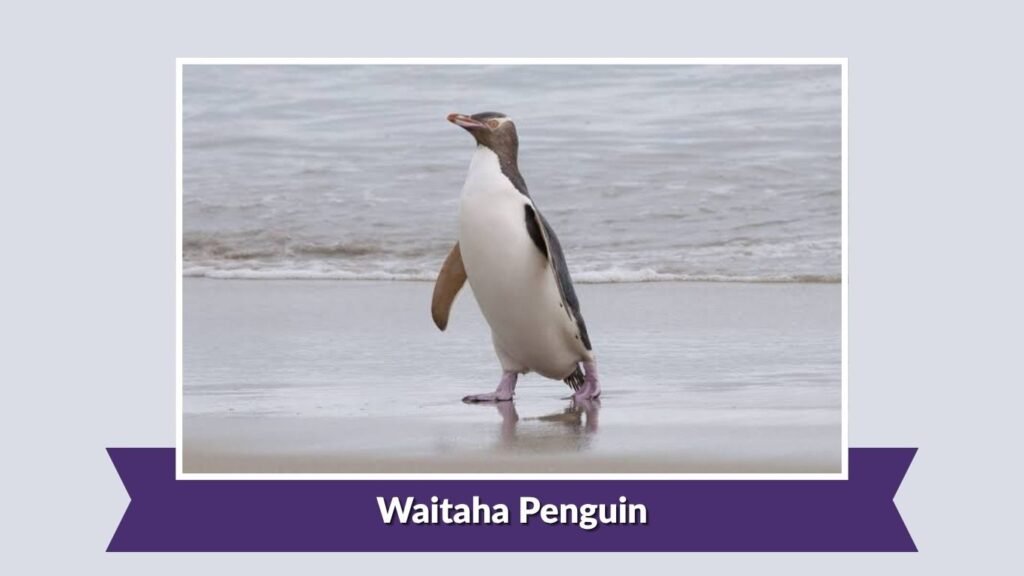
The Waitaha Penguin was an extinct penguin native to New Zealand. It was closely related to the modern Yellow-eyed Penguin and occupied parts of mainland New Zealand before disappearing after human settlement. Fossil and ancient DNA evidence helped scientists recognize it as a distinct prehistoric penguin population, providing important information about how New Zealand’s penguin communities changed over time.
Identification
- Common Name: Waitaha Penguin
- Scientific Name: Megadyptes waitaha
- Status: Extinct
- Family: Spheniscidae
- Region: New Zealand
- Closest Living Relative: Yellow-eyed Penguin
- Body Size: Smaller than the modern Yellow-eyed Penguin
- Known From: Subfossil remains and ancient DNA
Habitat and Distribution
Waitaha Penguins once occurred across parts of New Zealand, including areas of the South Island. Evidence suggests that they occupied coastal habitats before modern Yellow-eyed Penguins became widespread on the mainland. Following the disappearance of the Waitaha Penguin, Yellow-eyed Penguins expanded into some of the coastal areas that had previously been occupied by their relatives.
Diet and Feeding Behavior
Direct observations of the Waitaha Penguin are impossible because the species disappeared centuries ago. However, its close relationship with Yellow-eyed Penguins suggests that it was a marine predator adapted for underwater hunting. It probably depended on coastal waters where fish and other small marine animals were available.
Its streamlined penguin body would have allowed it to use its flippers for propulsion while pursuing prey beneath the surface.
Extinction and History
Evidence indicates that the Waitaha Penguin disappeared after humans reached New Zealand. Researchers have linked its extinction with human activity, including hunting. Its disappearance created an ecological opportunity that allowed Yellow-eyed Penguins from southern islands to expand onto mainland New Zealand. The species is therefore an important example of how human settlement can rapidly alter seabird communities.
23. Chatham Penguin
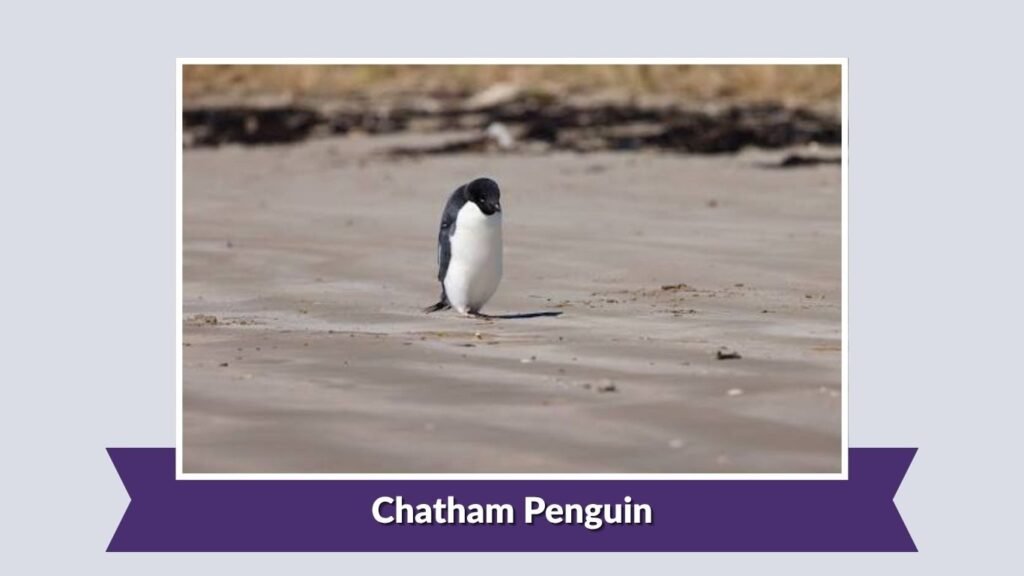
The Chatham Penguin, also known as the Chatham Islands Penguin or Chatham Crested Penguin, was an extinct crested penguin native to New Zealand’s Chatham Islands. Scientists formally described it from subfossil bones after recognizing that the remains differed from those of other crested penguins. It survived until relatively recent historical times before disappearing following human settlement.
Identification
- Common Name: Chatham Penguin
- Other Name: Chatham Crested Penguin
- Scientific Name: Eudyptes warhami
- Status: Extinct
- Group: Crested penguins
- Region: Chatham Islands
- Known From: Subfossil bones
- Estimated Extinction: Around the 17th century
Habitat and Distribution
The Chatham Penguin was endemic to the Chatham Islands, meaning that its natural breeding population was restricted to this island group east of mainland New Zealand. Coastal areas would have provided suitable locations for nesting as well as access to productive marine feeding grounds.
Its geographic isolation probably played an important role in the development of characteristics that distinguished it from related crested penguins.
Diet and Feeding Behavior
No direct records describe its feeding habits. However, as a member of the crested penguin group, the Chatham Penguin was almost certainly an active marine hunter. It likely pursued small fish, squid, and crustaceans while swimming and diving in waters surrounding the Chatham Islands.
Like living crested penguins, it probably spent considerable periods at sea outside its breeding season.
Extinction and Life History
Subfossil evidence indicates that the Chatham Penguin survived until after Polynesian settlement of the Chatham Islands. Researchers believe it became extinct within a few centuries of human arrival, probably between approximately 1650 and 1700. Its remains were initially confused with those of other crested penguins before detailed studies established Eudyptes warhami as a separate species.
24. Ridgen’s Penguin
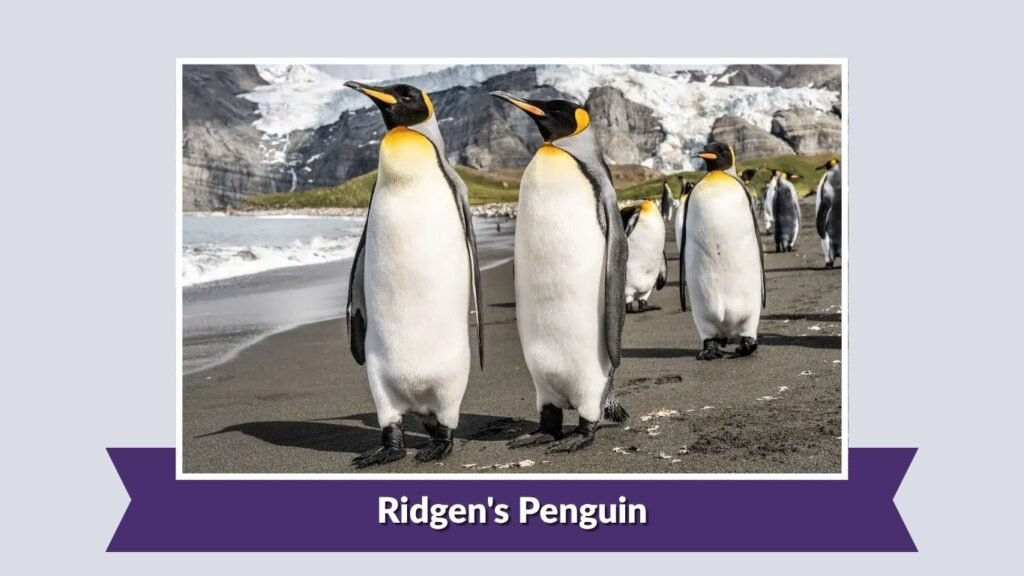
Ridgen’s Penguin was a prehistoric penguin belonging to the same genus as today’s Emperor and King Penguins. Fossil remains discovered at Motunau in North Canterbury, New Zealand, revealed an unusually large penguin that lived millions of years ago. Its discovery demonstrates that the Aptenodytes lineage once included additional large species beyond the two representatives surviving today.
Identification
- Common Name: Ridgen’s Penguin
- Scientific Name: Aptenodytes ridgeni
- Status: Extinct
- Family: Spheniscidae
- Region: New Zealand
- Size: Very large penguin
- Related Living Penguins: Emperor and King Penguins
- Known From: Fossil leg bones
Habitat and Distribution
Fossils of Ridgen’s Penguin were discovered at Motunau Beach in North Canterbury. The geology surrounding the fossil makes its exact age difficult to determine, although researchers consider it most likely to have lived during the Late Pliocene, roughly several million years ago.
Ancient New Zealand had extensive marine environments capable of supporting a remarkable diversity of penguins, including several species substantially larger than many modern forms.
Diet and Feeding Behavior
The feeding habits of Ridgen’s Penguin are unknown because scientists have only fossil material to study. Its relationship with the Emperor and King Penguins provides clues about its probable lifestyle. It was almost certainly a powerful marine diver that hunted prey beneath the ocean surface.
Fish and squid may have formed important parts of its diet, although direct fossil evidence is insufficient to establish its exact food preferences.
Discovery and Evolution
An 11-year-old named Alan Ridgen discovered well-preserved fossil leg bones at Motunau in 1968. The species was later named in his honor. Researchers placed it in Aptenodytes, making it an extinct relative of today’s largest living penguins. New Zealand Birds Online describes the species as probably larger than the Emperor Penguin.
25. Grebneff’s Penguin
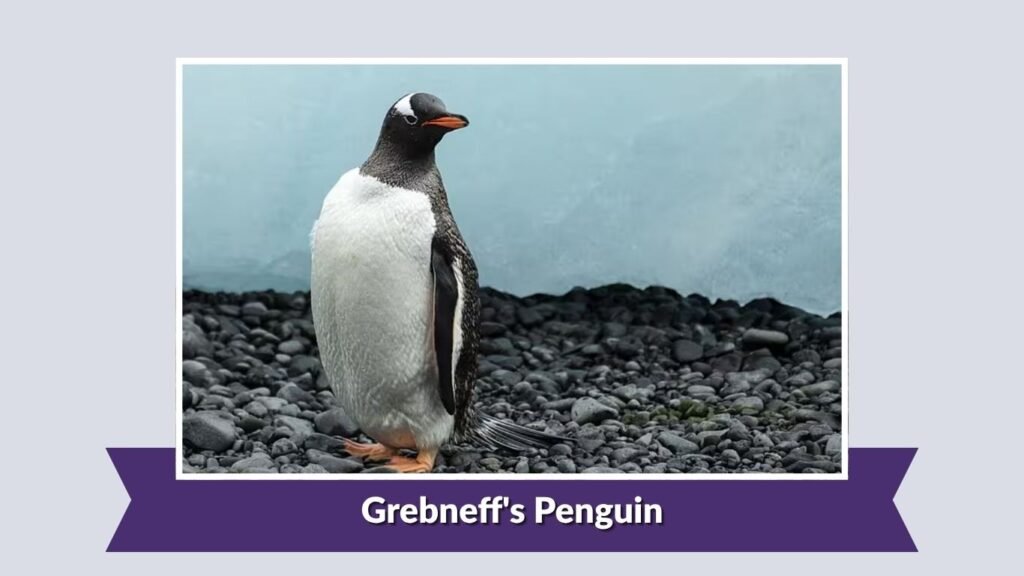
Grebneff’s Penguin was a giant prehistoric penguin that lived in New Zealand during the Late Oligocene. It belonged to the extinct genus Kairuku, a group famous for its unusually tall and slender penguins. Relatively complete fossil skeletons have allowed scientists to understand its body proportions better than those of many other ancient penguins known only from scattered bones.
Identification
- Common Name: Grebneff’s Penguin
- Scientific Name: Kairuku grebneffi
- Status: Extinct
- Genus: Kairuku
- Region: New Zealand
- Age: About 26–27 million years ago
- Size: Giant penguin
- Known From: Partial and relatively complete skeletons
Habitat and Distribution
Fossils of Grebneff’s Penguin have been found in New Zealand’s South Island, particularly around North Otago and South Canterbury. During the Oligocene, the geography and marine environment of New Zealand were very different from those seen today.
Warm coastal seas and productive marine ecosystems supported numerous seabirds, including several large penguins. Fossil discoveries show that giant penguins were once an important part of these ancient communities.
Diet and Feeding Behavior
Although its precise diet cannot be reconstructed with certainty, Grebneff’s Penguin was clearly adapted to an aquatic lifestyle. Its long body and powerful flipper-like wings would have allowed it to move efficiently underwater while pursuing prey.
It likely consumed fish and squid available in the surrounding ocean. Its large size may also have influenced how deeply it could dive and the kinds of prey it was capable of pursuing.
Fossils and Evolution
Scientists described Kairuku grebneffi from unusually complete fossil material. Grebneff’s Penguin and related Kairuku species were extremely large compared with most living penguins. Their fossils provide valuable evidence showing that giant body sizes evolved repeatedly during penguin history.
26. Waitaki Penguin
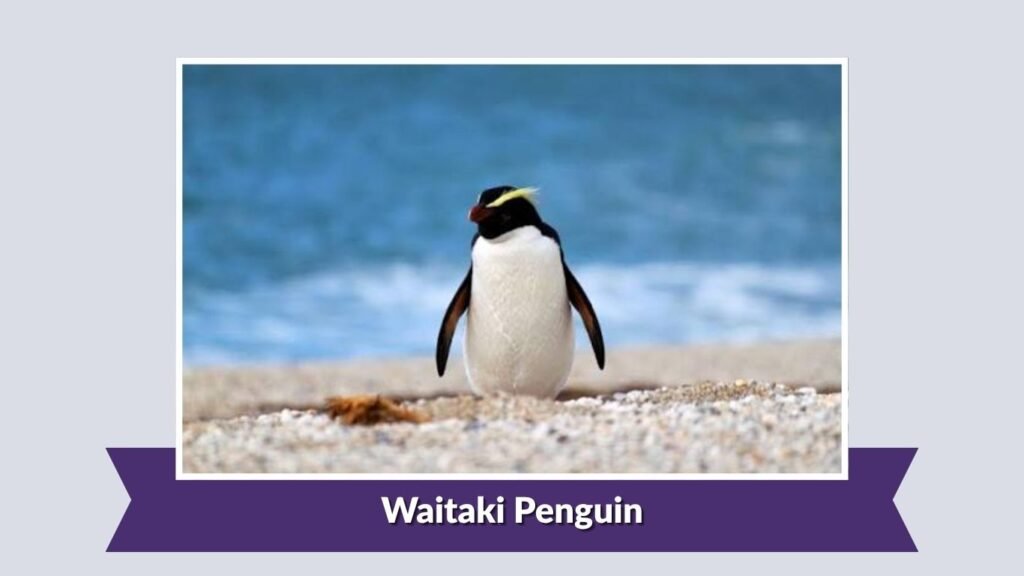
The Waitaki Penguin was another giant member of the extinct Kairuku penguin group. It lived in New Zealand approximately 26–27 million years ago during the Late Oligocene. Its tall body and unusual skeletal proportions made it very different from the short, stocky appearance people commonly associate with modern penguins.
Identification
- Common Name: Waitaki Penguin
- Scientific Name: Kairuku waitaki
- Status: Extinct
- Genus: Kairuku
- Region: New Zealand
- Age: About 26–27 million years ago
- Size: Giant penguin
- Known From: Fossil skeleton
Habitat and Distribution
The Waitaki Penguin is known from fossil material found near the Waihao River in South Canterbury, New Zealand. The rocks containing these fossils formed when parts of the region were associated with shallow marine environments.
Conditions at the time supported a rich community of marine animals. Ancient penguins could travel through these waters while using nearby coastal areas for resting, breeding, and other activities.
Diet and Feeding Behavior
Scientists cannot determine the exact diet of the Waitaki Penguin from fossil bones alone. However, its anatomy clearly identifies it as a specialized swimming bird. Like modern penguins, it would have used its wings as flippers to move underwater rather than for flight.
Fish and squid were likely potential prey. Its large body may have provided advantages for swimming long distances and making substantial dives while searching for marine food.
Fossil Discovery and Importance
The Waitaki Penguin is known from a skeleton discovered along the Waihao River. Together with Grebneff’s Penguin, it helped scientists establish the extinct genus Kairuku. These fossils are especially valuable because relatively complete ancient penguin skeletons are uncommon. They reveal that New Zealand once supported giant penguins with body proportions unlike those of any species alive today.
27. Fordyce’s Penguin
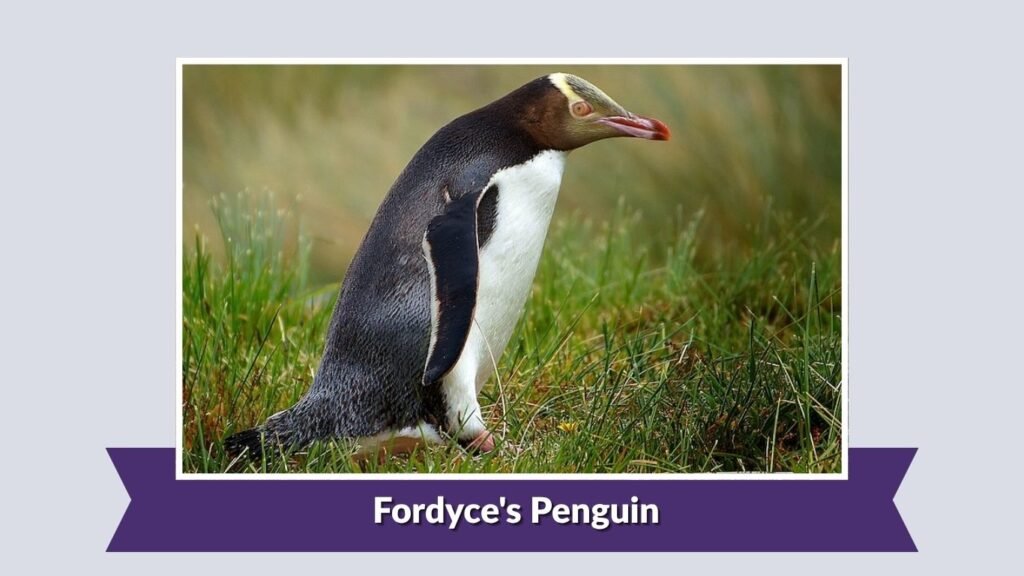
Fordyce’s Penguin was an enormous prehistoric penguin from New Zealand and is considered the largest penguin species yet identified from fossil evidence. It lived during the Paleocene, relatively early in penguin evolutionary history. Its extraordinary size demonstrates that penguins developed giant body forms surprisingly soon after their ancestors abandoned aerial flight and became specialized marine divers.
Identification
- Common Name: Fordyce’s Penguin
- Scientific Name: Kumimanu fordycei
- Status: Extinct
- Genus: Kumimanu
- Region: New Zealand
- Age: Paleocene
- Size: Largest known penguin species
- Known From: Fossil wing, vertebral, and other skeletal remains
Habitat and Distribution
Fordyce’s Penguin lived in prehistoric New Zealand when marine ecosystems and coastlines differed dramatically from the modern environment. Fossil remains demonstrate that extremely large penguins inhabited this region early in the evolutionary history of the group.
The surrounding oceans would have provided the marine environment necessary for a bird that had already evolved powerful swimming adaptations rather than the ability to fly.
Diet and Feeding Behavior
No one can know its exact hunting strategy from the available fossils, but Fordyce’s Penguin was adapted to life in the ocean. Its remarkable body size may have allowed it to remain underwater for substantial periods and potentially exploit prey inaccessible to smaller penguins.
It probably hunted marine animals such as fish and squid by pursuing them underwater with powerful strokes of its flippers.
Size and Evolutionary Importance
Fordyce’s Penguin was described from fossils discovered in New Zealand, including an exceptionally large humerus. Researchers regard it as the largest penguin species yet discovered. Its existence shows that extreme gigantism appeared very early in penguin evolution rather than developing only after millions of years of gradual change.
FAQs
1. How many types of penguins are there?
The exact number of living penguin species depends on the taxonomic authority used, and classification can change when genetic research separates or combines populations. A list of 27 types therefore needs to include recognized living species, regional forms, or extinct penguins rather than claiming that 27 universally accepted living species exist.
2. What is the largest living penguin?
The Emperor Penguin is the largest penguin alive today. Adults can stand well over three feet tall and are considerably larger than species such as Adélie, Chinstrap, Little, or Rockhopper Penguins.
3. What is the smallest penguin?
The Little Penguin is generally recognized as the smallest living penguin. It occurs around New Zealand and southern Australia and is known for its small body and blue-gray upper feathers.
4. Are there extinct types of penguins?
Yes. Numerous penguin species have become extinct throughout evolutionary history. Examples include the Waitaha Penguin, Chatham Penguin, Ridgen’s Penguin, Grebneff’s Penguin, Waitaki Penguin, and Fordyce’s Penguin. Fossils show that some prehistoric penguins were substantially larger than modern species.
5. Did giant penguins really exist?
Yes. Fossil discoveries from New Zealand and other regions demonstrate that several giant penguin species once existed. Kairuku penguins were very large, while Fordyce’s Penguin represents an even more extreme example of prehistoric penguin gigantism. These discoveries provide important evidence about how penguins evolved after becoming flightless marine birds.
