
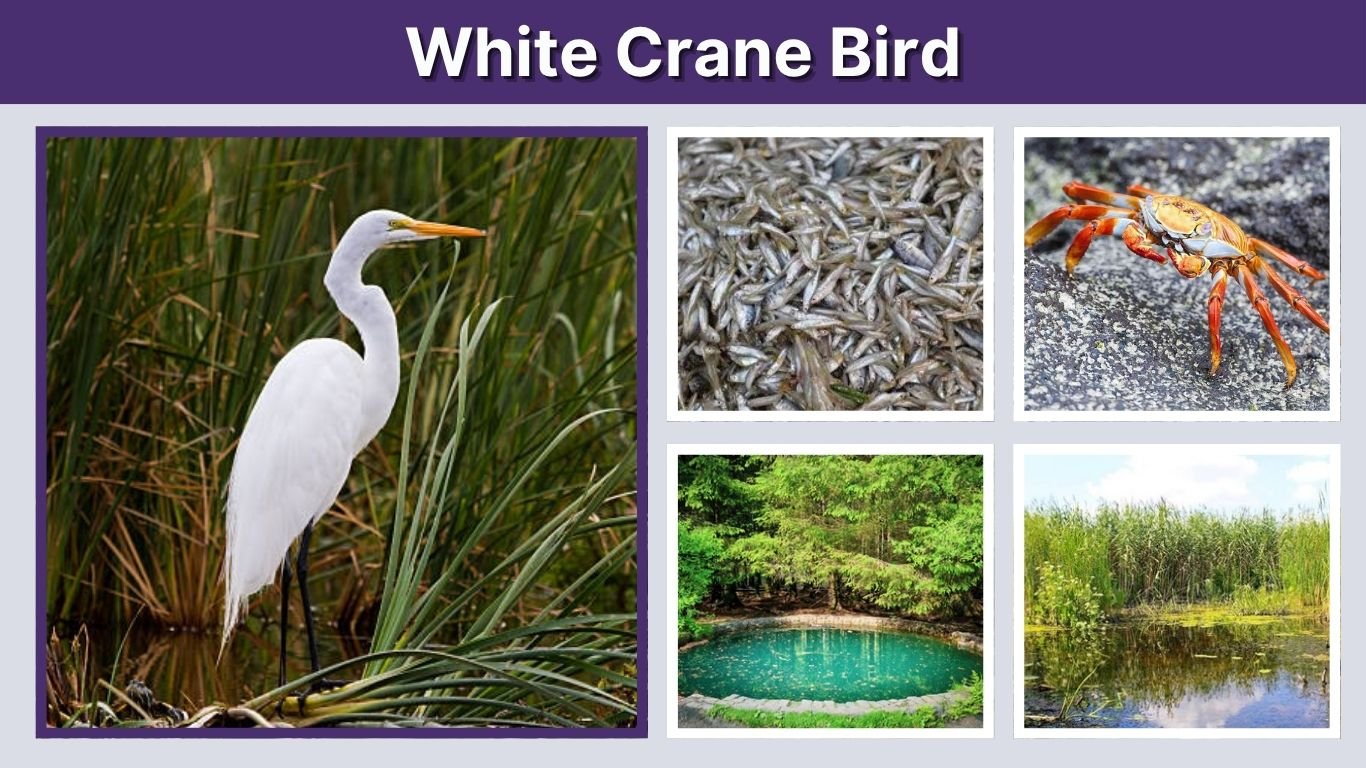
A tall white bird walking through a marsh is often called a white crane bird, but it may actually be an egret, heron, ibis, or stork. True white cranes include the Whooping Crane, Siberian Crane, and mostly white Red-crowned Crane. They can be identified by their large bodies, long legs, extended necks in flight, and distinctive facial markings. Correct identification depends on the bird’s size, bill shape, leg color, wing pattern, and location.
What Is a White Crane Bird?
“White crane” is a descriptive term rather than the official name of one species. Several crane species have predominantly white plumage, while many unrelated wading birds have a similar long-legged appearance.
The Whooping Crane is the best-known white crane in North America. It is the continent’s tallest bird, standing close to five feet tall. Adults are white with black legs, a red crown, dark facial markings, and black wing tips that become visible when the wings are open.
How to Identify a True Crane
Look for these general characteristics:
- Large, heavy body
- Very long legs and neck
- Straight, strong bill
- Neck held straight during flight
- Legs extending well beyond the tail
- Slow, powerful wingbeats
- Loud, trumpet-like or bugling calls
- Black flight feathers in several white species
Cranes usually walk through shallow wetlands, grasslands, and agricultural fields. Unlike herons, they fly with their necks fully extended. Herons and egrets normally pull their necks into an S-shaped curve while flying.
Types of White Crane Birds
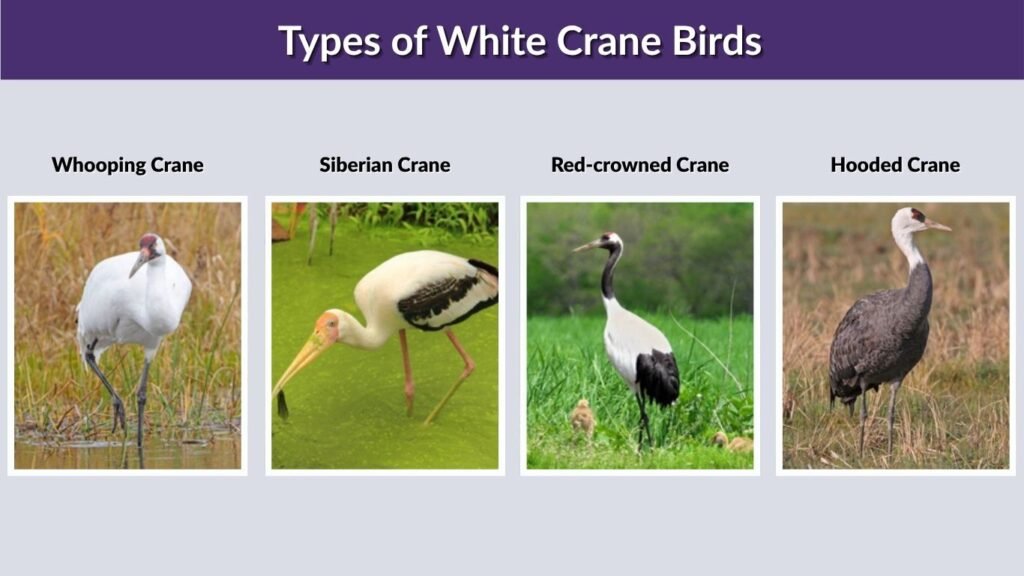
Only a few crane species appear almost entirely white. Others combine white plumage with black, grey, or red markings.
| Species | Main identification features | General range |
| Whooping Crane | White body, red crown, black facial stripe and black wing tips | North America |
| Siberian Crane | White body, reddish face and black wing tips | Northern Russia and parts of Asia |
| Red-crowned Crane | White body, black neck, black secondary feathers and red crown | East Asia |
| Hooded Crane | White head and neck with a dark grey body | East Asia |
| White-naped Crane | Grey body, white neck stripe and reddish face | East Asia |
1. Whooping Crane
The Whooping Crane is a true all-white crane native to North America. Adults have snow-white body feathers, black legs, a red featherless crown, and a dark “mustache” extending along the face.
Black primary feathers are mostly hidden when the bird stands but become conspicuous in flight. Juveniles have cinnamon-brown feathers mixed with white and lack the clearly defined adult facial pattern.
Whooping Cranes breed in freshwater wetlands and use shallow marshes, prairies, croplands, and coastal habitats during migration and winter. The largest natural migratory population breeds in northwestern Canada and winters along the Texas Gulf Coast. The species remains endangered despite decades of recovery work.
2. Siberian Crane
The Siberian Crane is another almost completely white species. Adults have white plumage, black primary wing feathers, reddish-pink legs, and bare red skin across the face and forehead.
Its black flight feathers are normally concealed when the wings are folded. In flight, they form obvious black tips or outer sections against the otherwise white wings. Juveniles are partly cinnamon-brown before developing adult plumage.
Siberian Cranes breed in Arctic Russia and migrate to Asian wintering grounds. They depend heavily on remote wetlands and are threatened by habitat loss, disturbance, poisoning, and changes along their migration routes.
3. Red-Crowned Crane
The Red-crowned Crane is a large black-and-white crane from East Asia. Its body and wings are primarily white, but the neck, throat, and parts of the wings are black. Adults also have a distinctive patch of exposed red skin on top of the head.
The black neck makes this species easier to distinguish from the Whooping and Siberian cranes. Red-crowned Cranes breed in large wetlands in northeastern Asia, while a resident population lives on the Japanese island of Hokkaido.
White Birds That Look Like Cranes
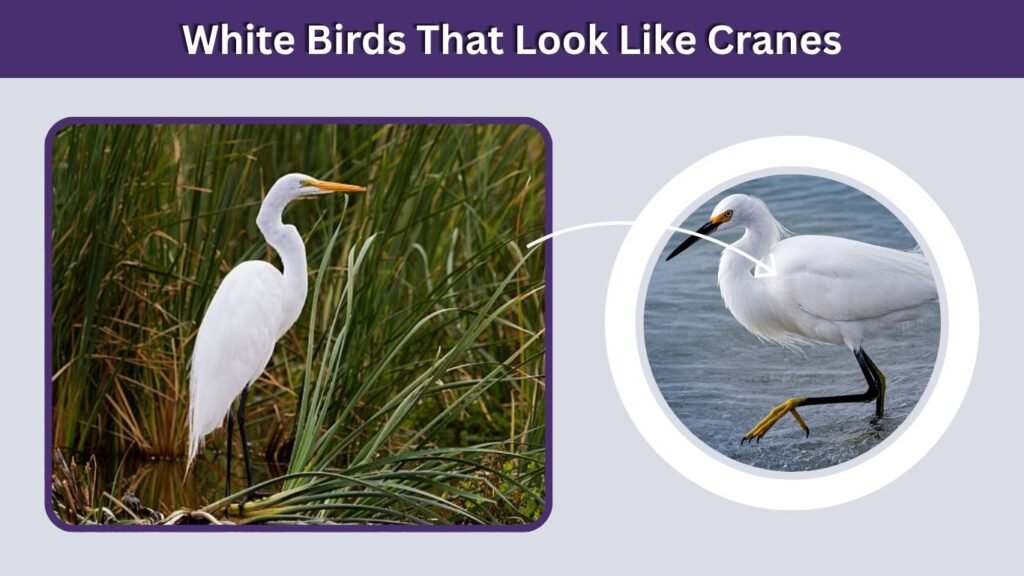
Most reports of a “small white crane bird” or “white crane-like bird” actually involve an egret, ibis, or another wading bird.
Great Egret
The Great Egret is the bird most frequently mistaken for a white crane. It is tall and entirely white, with a long yellowish-orange bill and black legs.
A Great Egret measures roughly 37–41 inches long, making it much smaller and lighter than a Whooping Crane. In flight, it pulls its neck backward instead of extending it straight ahead.
Snowy Egret
A small white crane-looking bird with a thin black bill, black legs, and bright yellow feet is probably a Snowy Egret. This bird is only about 22–26 inches long.
Snowy Egrets commonly forage in shallow water, where they walk, run, or stir the bottom with their yellow feet to disturb fish and aquatic animals.
White Ibis
The White Ibis has a white body, reddish legs, and a long downward-curving red or pink bill. Black wing tips are visible during flight.
Although its long legs and neck can create a crane-like outline, its strongly curved bill provides an immediate identification clue. White Ibises are smaller than Great Egrets and frequently gather in flocks.
Wood Stork
A Wood Stork is a large white bird with black flight feathers, long legs, and a dark, featherless head. It can look surprisingly similar to a Whooping Crane from a distance.
However, the Wood Stork has a thicker, downward-curving bill, darker head, and black feathers running along a larger portion of each wing.
White Crane Birds in Florida
Most white crane sightings in Florida are actually Great Egrets, Snowy Egrets, Cattle Egrets, White Ibises, or Wood Storks. These species are widely associated with Florida’s ponds, canals, wetlands, lawns, and coastal environments.
Florida’s native crane is the Florida Sandhill Crane, but adults are grey rather than white. They have long legs, a long neck, and a red patch of bare skin on the crown.
Whooping Cranes may occur in Florida as part of introduced or managed populations, but an all-white bird casually observed beside a suburban pond is much more likely to be an egret.
White Crane Birds in Other Locations
Texas
Texas is one of the most important places to see wild Whooping Cranes. The major natural population spends winter along the Gulf Coast around the Aransas region before migrating north through the central United States and Canada.
Large white birds elsewhere in Texas may still be Great Egrets, White Ibises, or Wood Storks, so viewers should look for the crane’s red crown, black facial markings, great height, and straight neck in flight.
California
White crane-like birds in California are usually Great Egrets, Snowy Egrets, or Cattle Egrets. Red-crowned, Siberian, and Whooping Cranes are not normal widespread California birds.
Michigan and the Midwest
Sandhill Cranes are common in parts of the Midwest, but their plumage is usually grey, sometimes stained rusty brown by iron-rich mud. Whooping Cranes are rare, although individuals from managed eastern populations may occasionally appear in Midwestern wetlands.
Hawaii
Small white birds seen on lawns, roadsides, and pastures in Hawaii are usually Cattle Egrets. They have compact bodies, relatively short necks, and yellow bills. They are not cranes.
What Does a Flying White Crane Look Like?

A true white crane flies with its head and neck stretched straight forward and its long legs trailing behind. Its wingbeats are deep and deliberate, although cranes may also soar with their wings extended.
A flying Whooping Crane displays broad white wings with sharply contrasting black tips. Its long neck, enormous wingspan, and trailing legs help separate it from white geese and pelicans.
Herons and egrets normally retract their necks in flight. Ibises keep their necks straight but have long curved bills, while storks have heavier bills and broader black areas on the wings.
White Crane Habitat and Diet

White cranes generally depend on open wetlands where they can see approaching predators and find abundant food. Depending on the species and season, their habitats may include:
- Freshwater marshes
- Shallow lakes and ponds
- Coastal salt marshes
- Wet grasslands
- Flooded agricultural fields
- Riverbanks and mudflats
- Northern breeding wetlands
Cranes are omnivorous. They may eat aquatic insects, crustaceans, small fish, frogs, worms, snails, plant roots, tubers, berries, seeds, and waste grain. Their exact diet changes with habitat and seasonal food availability.
White Crane Bird Meaning and Symbolism
The white crane has acquired symbolic meanings in several cultures, especially in East Asia. It may represent:
- Peace and purity
- Long life and good health
- Loyalty between partners
- Grace and patience
- Wisdom and spiritual awareness
- Hope during difficult times
- Good fortune and prosperity
Crane symbolism varies among religions, regions, and artistic traditions. A white crane appearing in a dream, painting, or decoration does not have one universal spiritual meaning. Its interpretation depends on personal beliefs and cultural context.
The paper origami crane is also strongly associated with peace and hope. However, an origami crane represents the broader cultural image of cranes rather than one particular biological species.
FAQs
Is a crane always a white bird?
No. Most crane species are grey, brown, black, or combinations of several colors. The Whooping and Siberian cranes are predominantly white, while the Red-crowned Crane has a white body with a black neck and wing markings.
What is a large white bird that looks like a crane?
A large white crane-like bird may be a Great Egret, Wood Stork, White Ibis, Siberian Crane, or Whooping Crane. Check the bill shape, neck position in flight, leg color, head markings, and location to narrow the identification.
What is a small white crane-like bird?
A small white bird with long legs is usually an egret rather than a crane. Snowy Egrets have black bills and yellow feet, while Cattle Egrets have yellowish bills and shorter, heavier-looking necks.
Are there white cranes in Florida?
Whooping Cranes can occur in Florida, but they are uncommon. Most white birds identified casually as cranes are Great Egrets, Snowy Egrets, White Ibises, Cattle Egrets, or Wood Storks.
What does a white crane symbolize?
A white crane commonly symbolizes peace, purity, longevity, loyalty, hope, and good fortune. Meanings differ by culture, religion, artwork, and personal interpretation, so no single explanation applies in every situation.
