
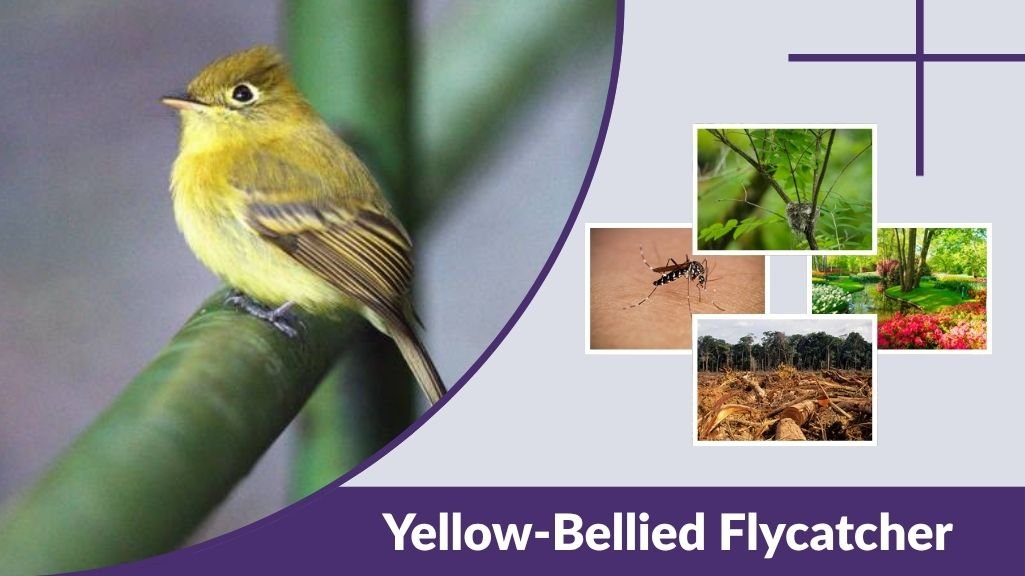
The Yellow-Bellied Flycatcher is a small forest bird known for its olive-green feathers and soft yellow underparts. Birdwatchers often struggle to identify this species because it closely resembles other flycatchers, especially the Least Flycatcher and Acadian Flycatcher. Despite its tiny size, this bird has a distinct voice and prefers cool northern forests during breeding season.
In this guide, you will learn how to identify the Yellow-Bellied Flycatcher, where it lives, what it eats, and how it behaves in the wild. You will also discover important differences between similar species and helpful birdwatching tips.
What Is a Yellow-Bellied Flycatcher?
The Yellow-Bellied Flycatcher is a small migratory songbird from the tyrant flycatcher family. Its scientific name is Empidonax flaviventris. This species breeds mainly in Canada and the northeastern United States before migrating south for winter. Birders often recognize it by its bright yellow belly, olive upperparts, and rounded eye-ring.
Scientific Classification
- Family: Tyrannidae
- Genus: Empidonax
- Scientific name: Empidonax flaviventris
- Common name: Yellow-Bellied Flycatcher
- Native region: North America
Key Physical Features
- Olive-green back and wings
- Bright yellow throat and belly
- Pale eye-ring shaped like a teardrop
- Two light-colored wing bars
- Short tail and small pointed bill
Male vs Female Yellow-Bellied Flycatcher
Male and female Yellow-Bellied Flycatchers look very similar. Both have olive upperparts and yellow underparts, making them difficult to separate in the field. Males may appear slightly brighter during breeding season, while females can have duller tones. Juveniles usually show buff-colored wing bars and softer plumage.
Yellow-Bellied Flycatcher Identification Tips
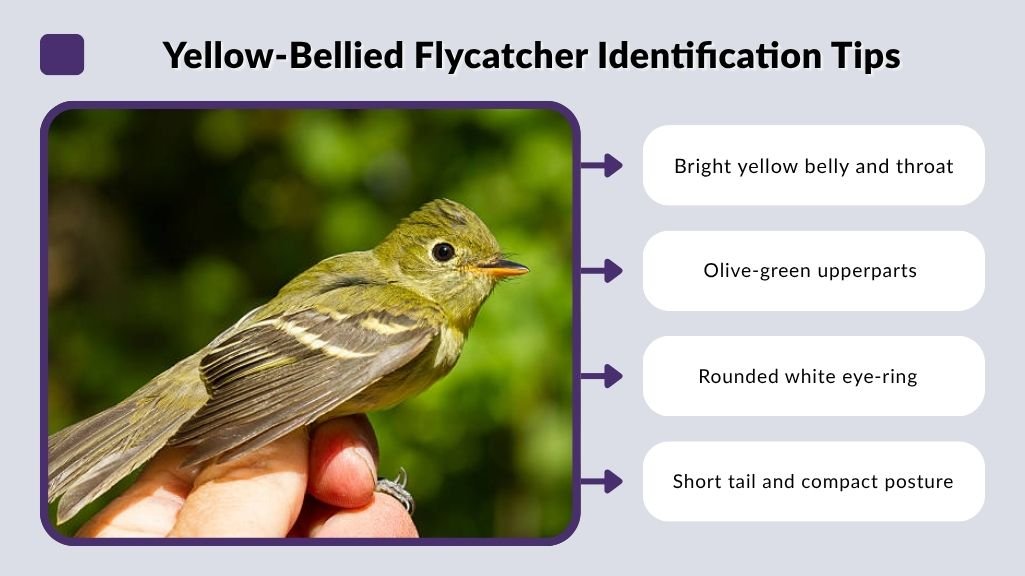
Correctly identifying this bird can be challenging because many Empidonax flycatchers share similar colors and shapes. Careful attention to the eye-ring, bill color, and voice can help birdwatchers identify the species more accurately. Habitat also plays an important role since this bird prefers cool, wet forests rather than dry woodland areas.
Size and Measurements
The Yellow-Bellied Flycatcher is a very small bird with a compact body shape. Adults typically measure around 5 to 6 inches long with a wingspan close to 8 inches. Their lightweight bodies help them move quickly through dense forest vegetation while searching for insects.
Field Identification Checklist
- Bright yellow belly and throat
- Olive-green upperparts
- Rounded white eye-ring
- Small dark bill with orange lower mandible
- Short tail and compact posture
Yellow-Bellied Flycatcher Sounds and Calls
This species is often easier to hear than see. Its common call sounds like “che-bek” or “tse-berk.” The song is sharp, clear, and repeated several times from hidden forest perches. Birdwatchers usually hear the bird during spring and summer mornings in breeding areas.
How to Identify Juveniles and Baby Birds
Young Yellow-Bellied Flycatchers have softer plumage colors compared to adults. Their wing bars often appear buffy instead of white, and the yellow belly may look pale. Juveniles usually stay hidden in thick vegetation while waiting for food from their parents.
Yellow-Bellied Flycatcher Habitat and Range
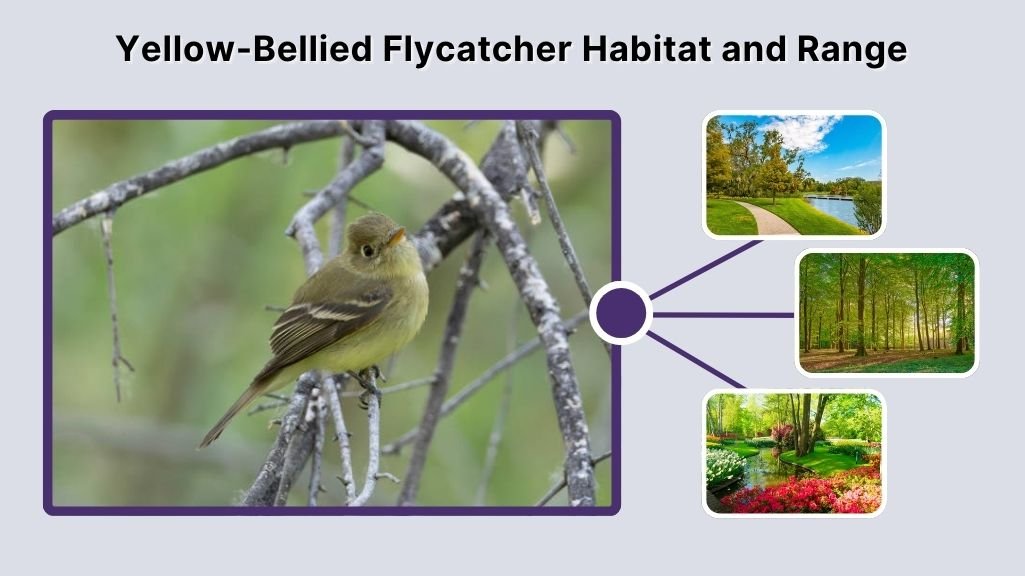
The Yellow-Bellied Flycatcher prefers cool, moist forests with thick vegetation and moss-covered ground. It breeds mainly in northern forests where spruce, fir, and tamarack trees dominate the landscape. During migration, the bird can appear in parks, woodland edges, and backyard gardens across eastern North America.
Preferred Habitat
This species thrives in damp forest habitats that provide shelter and abundant insects. Wet woodland environments also offer safe nesting locations hidden from predators.
Common Habitat Features
- Mossy conifer forests
- Wet spruce and fir woods
- Forest edges near ponds
- Shrubby bog areas
- Dense northern woodlands
Breeding Range
The breeding range of the Yellow-Bellied Flycatcher stretches across much of Canada and parts of the northeastern United States. Large breeding populations can be found around the Great Lakes region, Ontario, Quebec, and New Brunswick. Smaller populations also nest in northern Minnesota and Michigan.
Migration and Winter Range
During fall migration, Yellow-Bellied Flycatchers travel south to Central America. They spend winter in countries such as Costa Rica, Panama, and Honduras. Migration usually begins in late summer and peaks during September. Spring migration starts again in April and May when birds return north to breed.
Yellow-Bellied Flycatcher Nesting Behavior
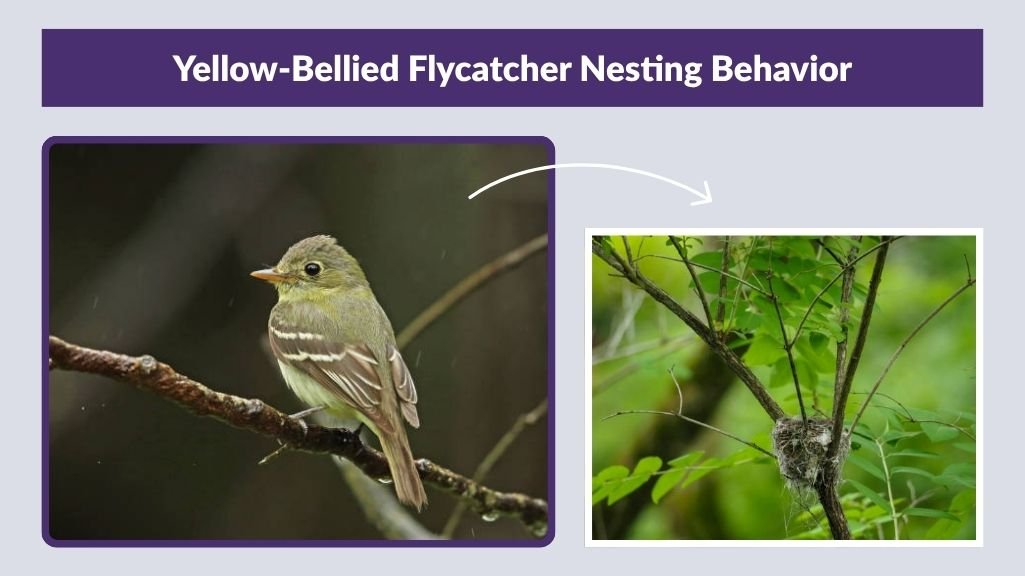
The nesting behavior of this species is unique because many nests are built directly on the ground. Females carefully hide nests among moss, grass, and forest plants to protect eggs and chicks from predators. These hidden nesting habits make Yellow-Bellied Flycatcher nests difficult for humans to locate in the wild.
Nest Location and Construction
Female Yellow-Bellied Flycatchers build cup-shaped nests using moss, grass, bark strips, and fine roots. Most nests are placed in damp forest areas near fallen logs or low shrubs. The hidden nest location helps protect young birds from predators such as snakes and larger birds.
Eggs and Incubation
The female usually lays three to four creamy white eggs with small brown markings. Incubation lasts about two weeks, and the female performs most of the warming duties. During this period, the male often stays nearby and helps defend the nesting territory.
Yellow-Bellied Flycatcher Diet and Feeding Habits
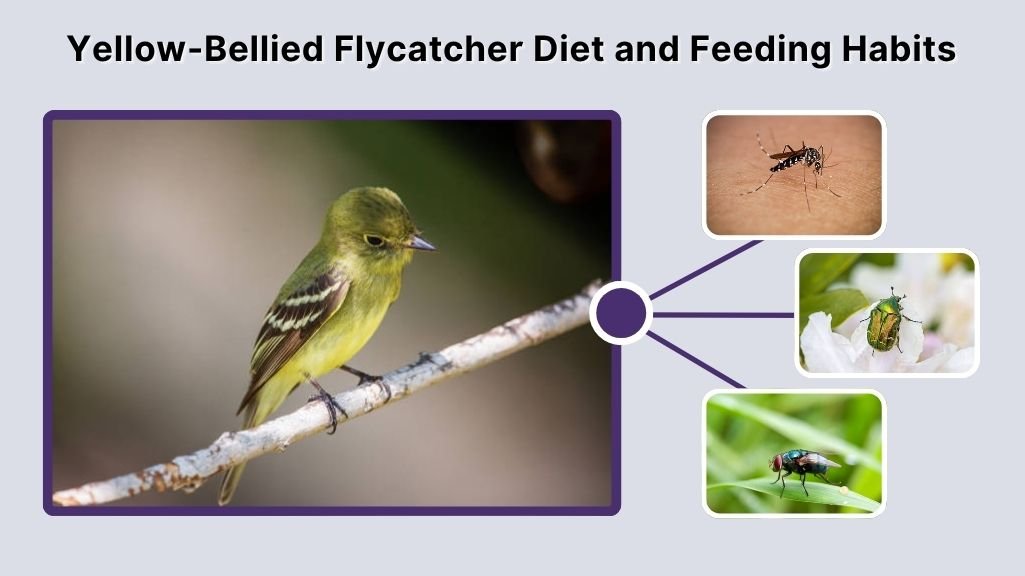
The Yellow-Bellied Flycatcher survives mainly on insects captured in forests and woodland clearings. Like many flycatchers, it hunts by waiting quietly on a perch before darting out to grab prey in midair. Its quick flight movements and sharp eyesight make it an effective insect hunter during both breeding and migration seasons.
What Do Yellow-Bellied Flycatchers Eat?
- Mosquitoes
- Beetles
- Flies
- Moths
- Spiders
- Small berries during migration
Hunting Techniques
This bird commonly uses a “perch-and-sally” hunting style. It waits on a branch, quickly flies out to catch insects, and then returns to the same perch. The Yellow-Bellied Flycatcher often feeds in shaded forest areas where insects are plentiful and easier to catch among leaves and branches.
Seasonal Feeding Changes
During summer, insects provide most of the bird’s nutrition because protein is important for breeding and raising chicks. In fall migration, the bird may eat small berries and soft fruits to gain extra energy for long-distance travel to Central America.
Yellow-Bellied Flycatcher Behavior and Adaptations
The Yellow-Bellied Flycatcher is usually shy and difficult to observe in dense forests. It spends much of its time quietly moving through low branches while searching for insects. Its olive-green body helps it blend into forest vegetation, making the bird less visible to predators and birdwatchers alike.
Typical Behavior
This species is not very social and is often seen alone during migration. It tends to remain hidden inside thick vegetation rather than sitting in open areas. Birdwatchers may notice occasional tail flicking and short flights between nearby branches while the bird hunts.
Adaptations for Forest Life
- Camouflage coloring for protection
- Sharp bill for catching insects
- Fast flight for hunting prey
- Quiet movements in dense woods
- Strong navigation during migration
Migration Behavior
Yellow-Bellied Flycatchers migrate mainly at night. Traveling after dark helps them avoid predators and cooler nighttime air may reduce energy loss during long flights. During migration stops, they rest in woodland habitats and feed heavily before continuing their journey south.
Yellow-Bellied Flycatcher vs Least Flycatcher
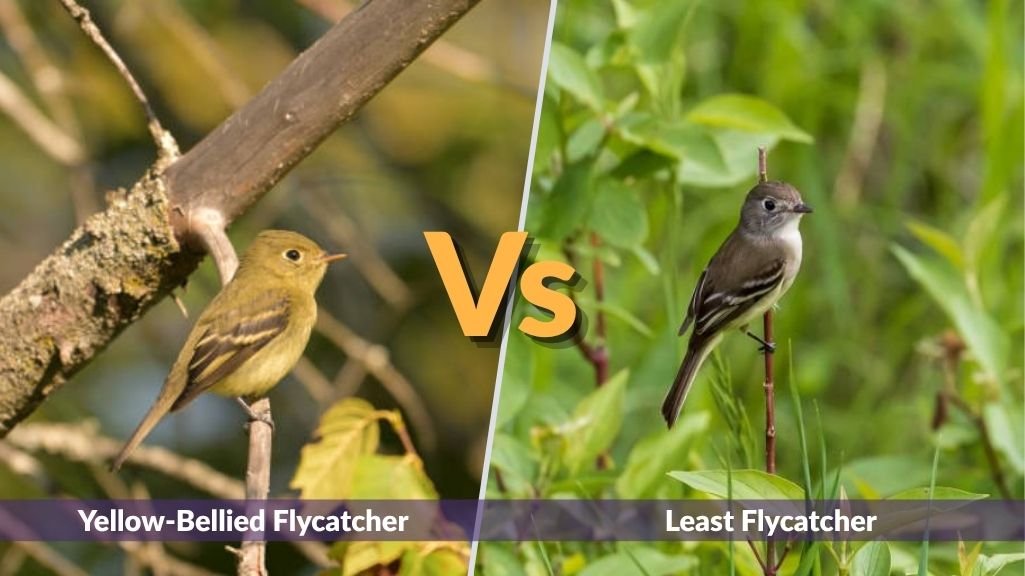
Many birdwatchers confuse the Yellow-Bellied Flycatcher with the Least Flycatcher because both belong to the Empidonax group. However, careful observation of color, eye-rings, and calls can help separate the two species. Habitat differences also provide important clues during identification.
Visual Differences
| Feature | Yellow-Bellied Flycatcher | Least Flycatcher |
| Belly Color | Bright yellow | Pale whitish |
| Eye Ring | Bold and rounded | Thin and narrow |
| Upperparts | Olive-green | Gray-olive |
| Bill | More orange lower mandible | Darker and smaller |
Differences in Song and Call
The Yellow-Bellied Flycatcher gives a softer “che-bek” call, while the Least Flycatcher produces a sharper “che-bec” sound. Experienced birders often identify these species by voice before seeing the birds clearly.
Habitat Differences
Yellow-Bellied Flycatchers usually prefer wet northern forests and boggy woodland habitats. Least Flycatchers are more common in drier deciduous forests, orchards, and suburban tree areas.
Yellow-Bellied Flycatcher vs Acadian Flycatcher
The Acadian Flycatcher is another species commonly confused with the Yellow-Bellied Flycatcher. Although both birds have olive tones, the Acadian Flycatcher appears larger and less yellow underneath. Their habitats and vocalizations also differ significantly.
Appearance Comparison
The Yellow-Bellied Flycatcher has a brighter yellow throat and belly. It also shows a stronger eye-ring. Acadian Flycatchers usually appear greener above with a longer body shape and larger bill.
Habitat Comparison
Yellow-Bellied Flycatchers breed mainly in cool northern forests. Acadian Flycatchers prefer mature deciduous forests in the southeastern and eastern United States. The habitat difference is often one of the easiest ways to separate these species.
Voice and Behavior Differences
Acadian Flycatchers produce a loud “peet-sa” song that sounds very different from the softer calls of the Yellow-Bellied Flycatcher. Acadians also perch higher in trees and are more active in open woodland spaces.
Conservation Status and Threats
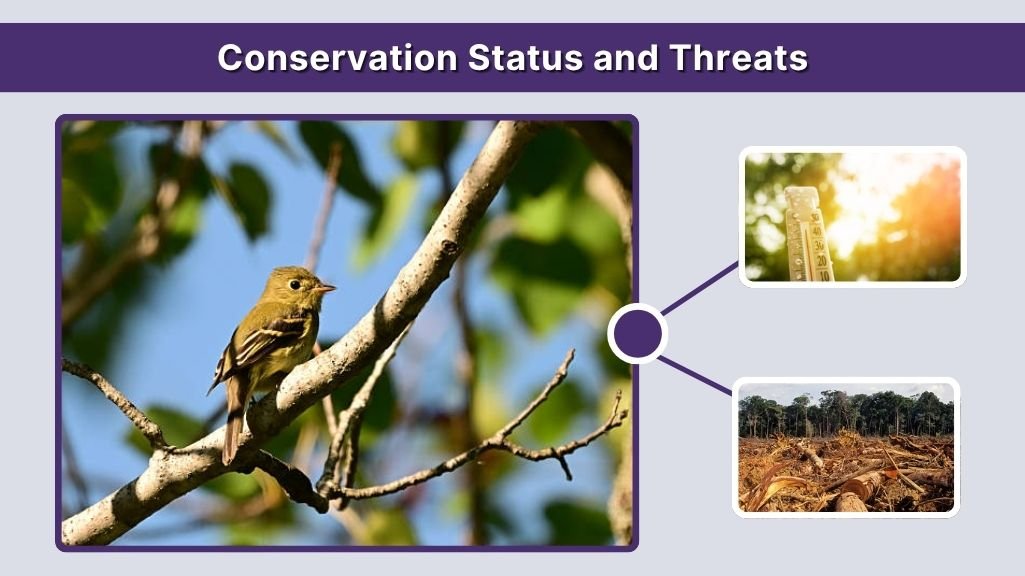
The Yellow-Bellied Flycatcher currently has a stable overall population, but habitat loss remains a concern in some areas. Wet forest habitats are especially sensitive to logging, drainage projects, and climate change. Protecting northern forests is important for the long-term survival of this migratory bird.
Is the Yellow-Bellied Flycatcher Endangered?
The species is not currently classified as endangered. Conservation organizations consider its population relatively stable across much of its breeding range. However, local declines may occur where wet forests disappear.
Threats to Survival
- Habitat destruction
- Climate change
- Wetland loss
- Forest fragmentation
- Human disturbance during nesting
Conservation Efforts
Researchers and bird conservation groups monitor Yellow-Bellied Flycatcher populations through surveys and migration studies. Protected forests and wetland conservation programs help preserve breeding and migration habitats across North America.
FAQs
What does a Yellow-Bellied Flycatcher look like?
The Yellow-Bellied Flycatcher is a small olive-green bird with a bright yellow throat and belly. It has pale wing bars, a rounded white eye-ring, and a short tail. Its compact body shape and soft colors help it blend into dense forest habitats.
Where do Yellow-Bellied Flycatchers live?
Yellow-Bellied Flycatchers breed mainly in Canada and the northeastern United States. They prefer cool, wet forests with spruce, fir, and mossy ground cover. During winter, they migrate to Central America and are commonly found in tropical woodlands.
How can you tell a Yellow-Bellied Flycatcher from a Least Flycatcher?
The Yellow-Bellied Flycatcher has brighter yellow underparts and a bolder eye-ring than the Least Flycatcher. It also shows more olive coloring on the back. Their calls are different as well, making voice an important identification clue for birdwatchers.
What do Yellow-Bellied Flycatchers eat?
These birds mainly eat insects such as flies, mosquitoes, beetles, and moths. They catch prey by flying out from branches and grabbing insects in midair. During migration, they may also feed on small berries and soft fruits for extra energy.
Is the Yellow-Bellied Flycatcher endangered?
The Yellow-Bellied Flycatcher is not currently considered endangered. Its population remains stable across much of its range. However, habitat loss, wetland destruction, and climate change can threaten local populations if forest ecosystems are damaged.