
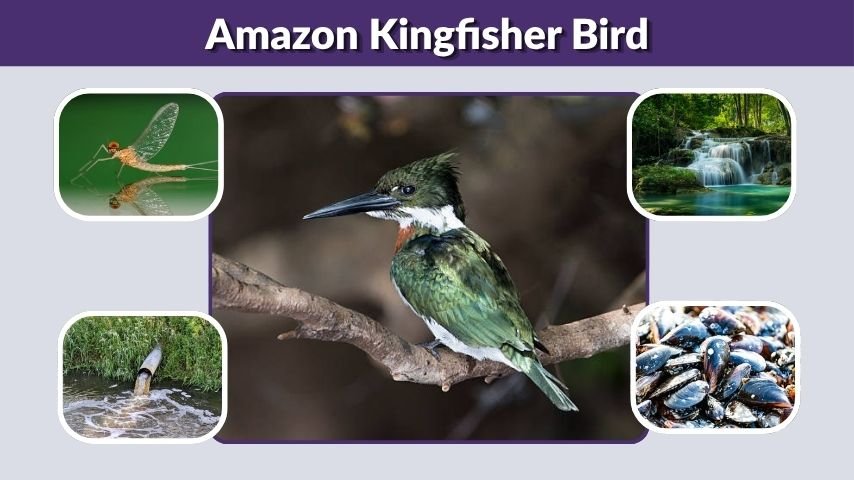
The Amazon kingfisher is a striking tropical bird known for its green upperparts, strong bill, and skillful fishing behavior. Found along rivers, lakes, wetlands, and forest edges across Central and South America, this bird is often seen perched quietly above water before diving for prey. Its bold appearance, wide range, and close link to freshwater habitats make it one of the most fascinating kingfishers of the American tropics.
What Is the Amazon Kingfisher?
The Amazon kingfisher is a medium-sized water kingfisher that belongs to the family Alcedinidae. Its scientific name is Chloroceryle amazona. Although its name points to the Amazon region, the bird is not limited to the Amazon rainforest. It lives across a much wider range, from southern Mexico through Central America and into large parts of South America.
This bird is closely associated with freshwater. It is usually found near rivers, streams, ponds, lakes, marshes, mangroves, and quiet waterways where fish and aquatic prey are available. Like other kingfishers, it has a large head, a sharp pointed bill, short legs, and a compact body designed for fast dives into water.
Scientific Classification
| Category | Details |
|---|---|
| Common name | Amazon Kingfisher |
| Scientific name | Chloroceryle amazona |
| Family | Alcedinidae |
| Order | Coraciiformes |
| Main habitat | Tropical rivers, wetlands, lakes, and forested waterways |
| Diet | Mainly fish, with some crustaceans and aquatic animals |
| Conservation status | Least Concern |
The name “Amazon kingfisher” can confuse some searchers because “Amazon” is also a shopping platform. In bird terms, however, it refers to a real Neotropical kingfisher species connected to river systems and tropical lowlands.
Amazon Kingfisher Appearance and Size
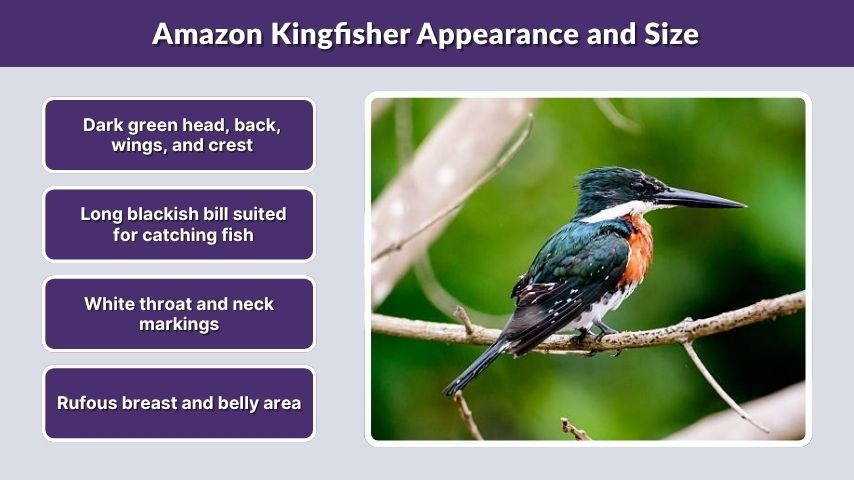
The Amazon kingfisher has a classic kingfisher shape: a sturdy body, a large head, a shaggy crest, and a long heavy bill. Its upperparts are usually dark green or glossy green, helping it blend with shaded riverbanks and vegetation. The underparts differ between males and females, which makes sex identification easier than in many other birds.
Male Amazon Kingfisher
The male Amazon kingfisher is often easier to recognize because of its rich rufous breast. He usually has green upperparts, a white collar, and a warm chestnut or rufous area across the underparts. This bold contrast makes him stand out when perched in good light.
Key male features include:
- Dark green head, back, wings, and crest
- Long blackish bill suited for catching fish
- White throat and neck markings
- Rufous breast and belly area
- Compact but powerful body for diving
Female Amazon Kingfisher
The female Amazon kingfisher looks similar in size and structure but has different markings on the underparts. Females commonly show a green breast band or broken green markings, with white and rufous areas below. These markings help separate females from males in the field.
Female birds can sometimes be confused with Green Kingfishers, especially at a distance. Size, bill thickness, and breast pattern are helpful clues when identifying them.
Amazon Kingfisher Range and Habitat
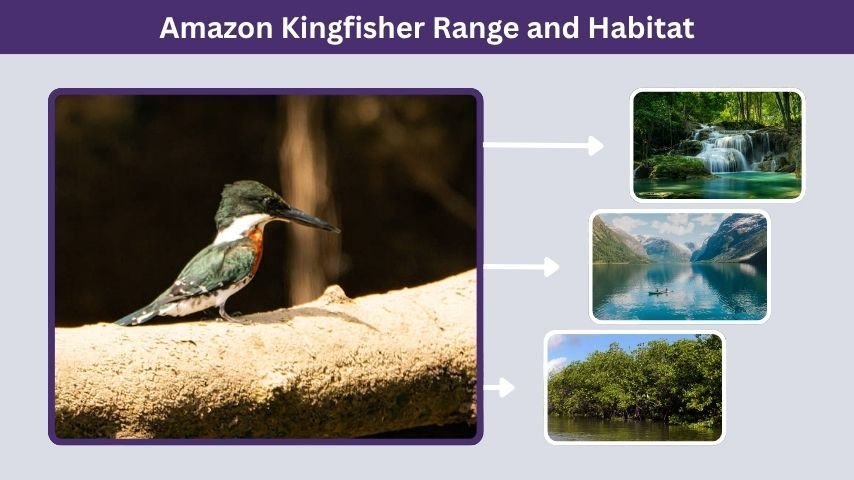
The Amazon kingfisher has a broad range across the American tropics. It occurs from southern Mexico through Central America and into South America, reaching countries such as Colombia, Venezuela, Brazil, Peru, Bolivia, Paraguay, and northern Argentina. It is mainly a lowland bird and is strongly linked to warm, watery habitats.
Where Does the Amazon Kingfisher Live?
This bird prefers areas where there is still or slow-moving water with nearby perches. It may sit on branches, exposed roots, posts, wires, or dead snags while watching the water below. Once it sees prey, it dives quickly and returns to a perch to eat.
Common habitats include:
- Forested rivers and tropical streams
- Lakes, lagoons, and oxbow lakes
- Wetlands, marshes, and swamps
- Mangrove edges and coastal waterways
- Open riverbanks near lowland forest
Although it is strongly associated with tropical regions, the Amazon kingfisher does not need dense rainforest only. It can also use open waterways, disturbed edges, and river systems near human activity if food and nesting sites remain available.
What Does an Amazon Kingfisher Eat?
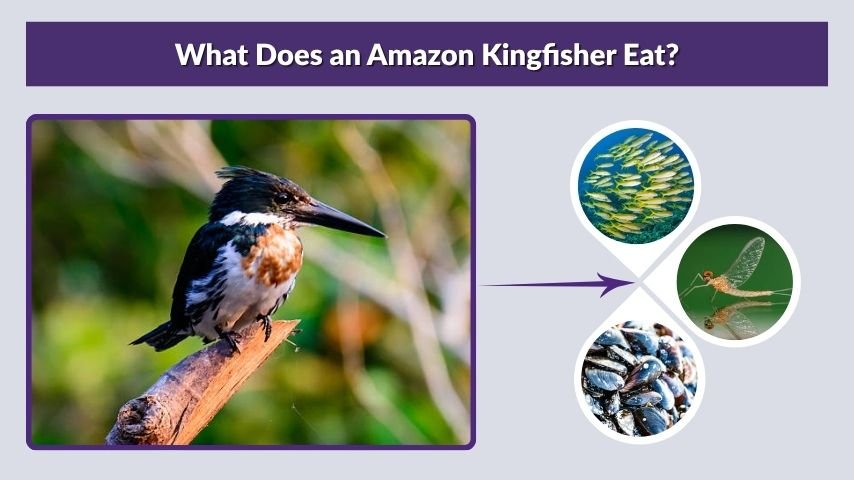
The Amazon kingfisher mainly eats fish. Its body is built for this lifestyle, with sharp eyesight, a powerful bill, and fast diving ability. The bird usually hunts from a perch above the water, watching patiently before plunging down to catch prey.
Hunting Behavior
The hunting method is simple but effective. The bird sits quietly, scans the water, dives headfirst, catches prey in its bill, and then returns to a perch. It may beat larger prey against the perch before swallowing it. This behavior is common among many kingfishers.
Its diet may include:
- Small fish
- Aquatic insects
- Crustaceans
- Small freshwater animals
- Occasionally other tiny aquatic prey
Amazon kingfishers are important predators in freshwater ecosystems. By feeding on fish and aquatic animals, they form part of the natural balance of tropical river systems.
Amazon Kingfisher Adaptations
The Amazon kingfisher has several adaptations that help it survive near water. These traits support fishing, diving, perching, and nesting along riverbanks.
Built for Fishing
Its long, strong bill works like a spear or gripping tool. The bird does not chew its food. Instead, it catches prey, positions it correctly, and swallows it. Its large head and neck muscles help absorb the impact of diving and handling slippery prey.
Sharp Eyesight
Good vision is essential for hunting. The Amazon kingfisher must judge prey movement through the water surface, where light reflection can make fish harder to see. Its sharp eyesight helps it spot movement from a perch and strike quickly.
Perching Lifestyle
This bird often saves energy by waiting on a perch rather than flying constantly. A good perch gives it a clear view of the water and a quick path for diving. That is why exposed branches, wires, posts, and dead trees are useful hunting spots.
Riverbank Nesting
Like many kingfishers, the Amazon kingfisher nests in burrows. It usually digs tunnels into earthen banks near water. This nesting style protects eggs and chicks from some predators and harsh weather, although riverbank erosion and disturbance can still threaten nests.
Amazon Kingfisher Nest and Breeding
The Amazon kingfisher usually nests in a tunnel dug into a riverbank or similar earthen slope. Both the male and female may help with nesting duties. The nest chamber is hidden at the end of the burrow, away from the entrance.
This type of nest is practical for a water-loving bird. Riverbanks provide suitable soil, nearby food, and quick access to hunting areas. However, nesting success depends on stable banks and relatively safe surroundings. Flooding, erosion, human disturbance, and habitat damage can affect breeding sites.
Young kingfishers grow inside the burrow before leaving the nest. After fledging, they must quickly learn to hunt, perch, dive, and avoid predators.
Amazon Kingfisher vs Green Kingfisher
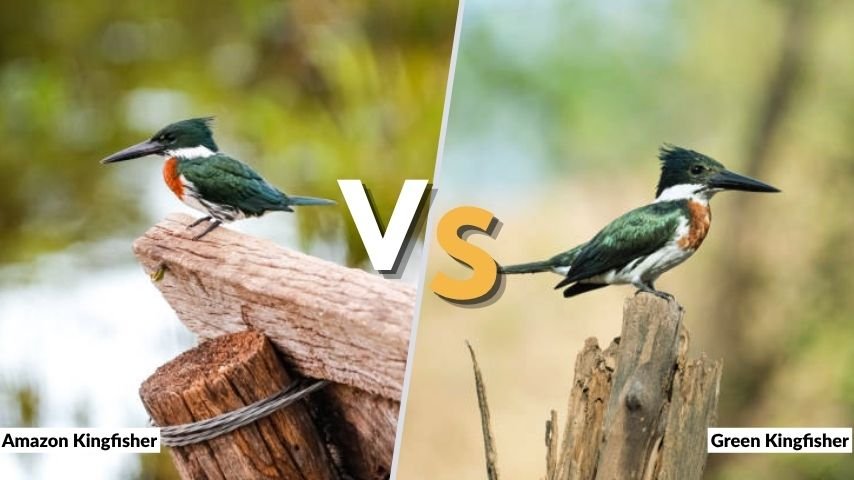
The Amazon kingfisher is often compared with the Green Kingfisher because both species can look similar. They share green upperparts, a water-based lifestyle, and overlapping ranges in parts of the Americas. However, the Amazon kingfisher is generally larger and has a heavier bill.
The Green Kingfisher is smaller and often appears more compact. Female markings also differ, and the Amazon kingfisher usually looks more robust overall. When birdwatchers compare Amazon kingfisher vs Green Kingfisher, size and bill shape are often the best starting points.
Quick Identification Tips
Look for these clues in the field:
- Amazon kingfisher is larger than Green Kingfisher.
- Amazon kingfisher has a thicker, heavier bill.
- Males show strong rufous underparts.
- Females have distinctive green and white breast markings.
- Amazon kingfishers often use larger rivers and open waterways.
If the bird is far away, wait for it to move or turn. A side view of the bill and chest usually makes identification easier.
Interesting Amazon Kingfisher Facts
The Amazon kingfisher is more than a colorful river bird. Its behavior, range, and adaptations make it a memorable species for birdwatchers and nature lovers.
Notable Facts
- The Amazon kingfisher is a resident bird, meaning it generally stays within its range instead of making long migrations.
- It is strongly tied to freshwater habitats and is rarely far from water.
- Its scientific name is Chloroceryle amazona.
- Males and females have different chest markings.
- It hunts mostly by watching from a perch and diving into water.
- Despite the name, it can be found far beyond the Amazon Basin.
- It is one of the larger green kingfishers of the New World.
- River health is important for its food supply and nesting success.
These facts also explain why the bird is a strong topic for informational searches. People often want to know what it eats, where it lives, how big it is, and how to identify it.
Conservation Status and Threats
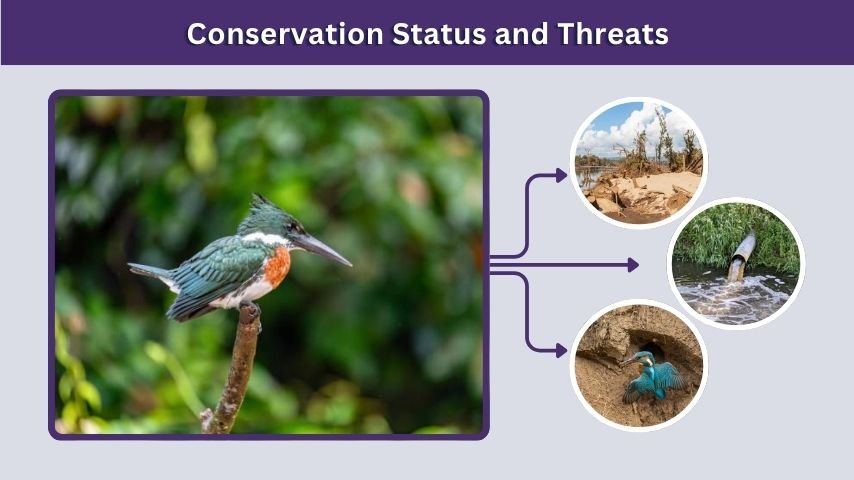
The Amazon kingfisher is currently considered a species of Least Concern because it has a very large range and a large population. That means it is not currently listed as globally endangered. However, “Least Concern” does not mean the bird faces no risks.
Freshwater birds depend heavily on clean and stable waterways. When rivers are polluted, forest edges are cleared, wetlands are drained, or riverbanks are damaged, local kingfisher populations can suffer. The Amazon kingfisher may still be common in many areas, but protecting tropical waterways is important for its long-term health.
Main Concerns
Important threats can include:
- Deforestation near rivers and wetlands
- Water pollution from farming, mining, and settlements
- Loss of nesting banks through erosion or construction
- Disturbance around breeding sites
- Decline in fish and aquatic prey
Conservation for this bird is closely connected to protecting rivers, wetlands, mangroves, and tropical lowland ecosystems.
How to Spot an Amazon Kingfisher
Seeing an Amazon kingfisher is easiest near slow rivers, lagoons, or forested waterways. The bird often gives itself away by sitting on an exposed perch close to water. It may remain still for long periods, then suddenly dive.
Birdwatching Tips
To improve your chances:
- Walk slowly near river edges and quiet wetlands.
- Scan low branches, wires, exposed roots, and posts.
- Watch for a green bird with a large bill and crest.
- Listen for sharp calls near water.
- Use binoculars to check the breast markings.
- Look during calmer parts of the day when birds are actively hunting.
Avoid approaching nests or disturbing riverbanks. A respectful distance protects the bird and gives you better viewing opportunities.
FAQs
Is the Amazon kingfisher found only in the Amazon rainforest?
No, the Amazon kingfisher is not found only in the Amazon rainforest. Its range extends from southern Mexico through Central America and into much of South America. It often lives near rivers, lakes, wetlands, mangroves, and tropical lowland waterways, including but not limited to the Amazon Basin.
What does an Amazon kingfisher eat?
The Amazon kingfisher mainly eats small fish. It may also take crustaceans, aquatic insects, and other small freshwater animals. It usually hunts from a perch above the water, dives headfirst to catch prey, and then returns to a branch or post to swallow its food.
How can you identify a male Amazon kingfisher?
A male Amazon kingfisher usually has glossy green upperparts, a long heavy bill, a white throat or collar area, and rich rufous coloring across the breast and underparts. Its strong bill, green back, and bold chest color make it easier to identify when seen clearly.
What is the difference between Amazon kingfisher and Green Kingfisher?
The Amazon kingfisher is generally larger and heavier than the Green Kingfisher. It also has a thicker bill and different chest markings. Size is one of the best clues, especially when the bird is perched near water. Females can be trickier, so breast pattern and bill shape are useful.
Is the Amazon kingfisher endangered?
The Amazon kingfisher is not currently considered endangered. It is listed as Least Concern because it has a wide range and a large population. However, local threats such as river pollution, deforestation, wetland loss, and disturbance near nesting banks can still affect the species in some areas.