
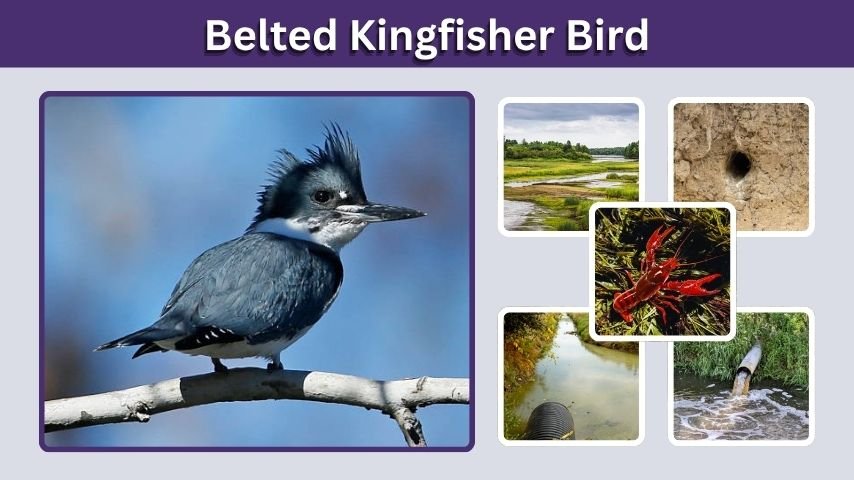
The Belted Kingfisher is one of the most recognizable birds near rivers, lakes, ponds, and coastlines in North America. With its shaggy crest, large head, dagger-like bill, and loud rattling call, this bird is often heard before it is seen. Known for diving after fish and nesting in earthen banks, the Belted Kingfisher is a fascinating species for birdwatchers, photographers, and nature lovers.
What Is a Belted Kingfisher?
The Belted Kingfisher is a medium-sized water bird with the scientific name Megaceryle alcyon. It belongs to the kingfisher family, a group of birds known for hunting aquatic prey. Unlike small songbirds that hide in trees, the Belted Kingfisher often perches in open places above water, watching for fish below.
This bird is famous for its bold shape. It has a large head, a thick pointed bill, short legs, a stocky body, and a ragged crest that gives it a slightly wild appearance. Its blue-gray upperparts, white collar, and chest band make it easy to identify when seen clearly.
The Belted Kingfisher is found across much of North America. It breeds in Canada and the United States, and many birds move south during colder months when northern waters freeze. In warmer areas, including parts of the southern United States, Mexico, Central America, and the Caribbean, it may be seen during winter.
Belted Kingfisher Identification
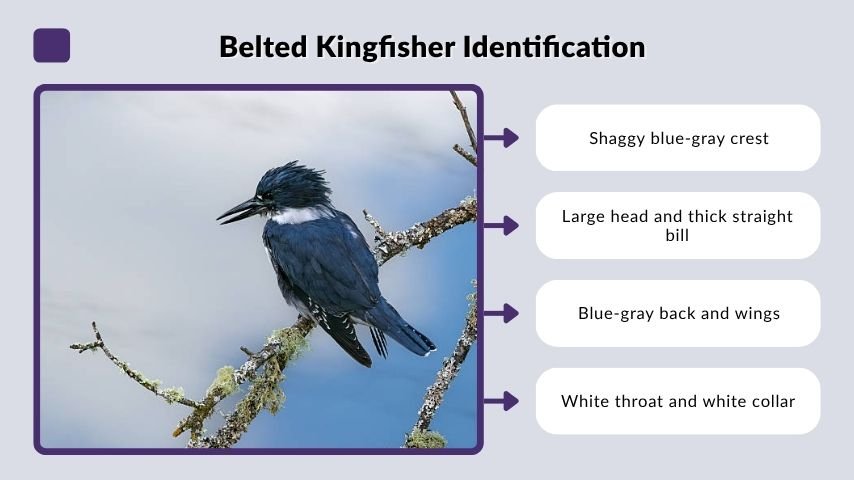
The Belted Kingfisher has a distinctive look that separates it from many other birds near water. Its body appears top-heavy because of the large head and long bill. In flight, it often looks direct and energetic, with quick wingbeats and a slightly uneven path over rivers or shorelines.
Key Features
Look for these field marks when identifying a Belted Kingfisher:
- Shaggy blue-gray crest
- Large head and thick straight bill
- Blue-gray back and wings
- White throat and white collar
- Blue-gray band across the chest
- Stocky body and short legs
- Loud rattling call near water
Cornell Lab notes that males have one blue band across the white breast, while females have both a blue band and a chestnut band. This makes the female Belted Kingfisher more colorful than the male, which is unusual among many bird species.
Female Belted Kingfisher vs Male
One of the most searched topics about this bird is the difference between a female Belted Kingfisher and a male Belted Kingfisher. This is because the species has a rare pattern: the female is more brightly marked than the male.
Male Belted Kingfisher
The male Belted Kingfisher has blue-gray upperparts, a white underside, and one blue-gray band across the chest. He has the same shaggy crest and heavy bill as the female, but lacks the rusty chestnut band on the belly.
Female Belted Kingfisher
The female Belted Kingfisher has the same blue-gray head, crest, wings, and chest band, but she also has a rusty or chestnut band across the lower breast and sides. This extra color makes her easier to recognize when perched or photographed from the front.
Simple Comparison
| Feature | Male Belted Kingfisher | Female Belted Kingfisher |
|---|---|---|
| Crest | Shaggy blue-gray crest | Shaggy blue-gray crest |
| Chest band | One blue-gray band | Blue-gray band plus rusty band |
| Underparts | Mostly white below the chest band | White with chestnut/rusty markings |
| Colorfulness | Less colorful | More colorful |
| Bill | Long, thick, straight | Long, thick, straight |
This difference is useful for birdwatchers. If you see a Belted Kingfisher with a rusty band below the blue chest band, you are probably looking at a female.
Belted Kingfisher Call and Sound
The Belted Kingfisher call is one of the best ways to detect the bird. It is a loud, harsh, mechanical rattle that often carries across water. Many people hear the call before they ever spot the bird.
The sound is often described as a rapid, dry rattle. Both male and female Belted Kingfishers give these strong rattling calls, especially when disturbed or flying along a territory. Cornell describes the calls as strident, mechanical rattles, and notes that threatened birds may also give screams.
When Do Belted Kingfishers Call?
Belted Kingfishers may call while:
- Flying along rivers or shorelines
- Defending a feeding area
- Reacting to people or predators
- Communicating with a mate
- Moving near a nesting bank
Because the call is so distinctive, learning it can make identification much easier. Around lakes and creeks, a sudden rattling sound overhead is often a good clue that a Belted Kingfisher is nearby.
Belted Kingfisher Habitat
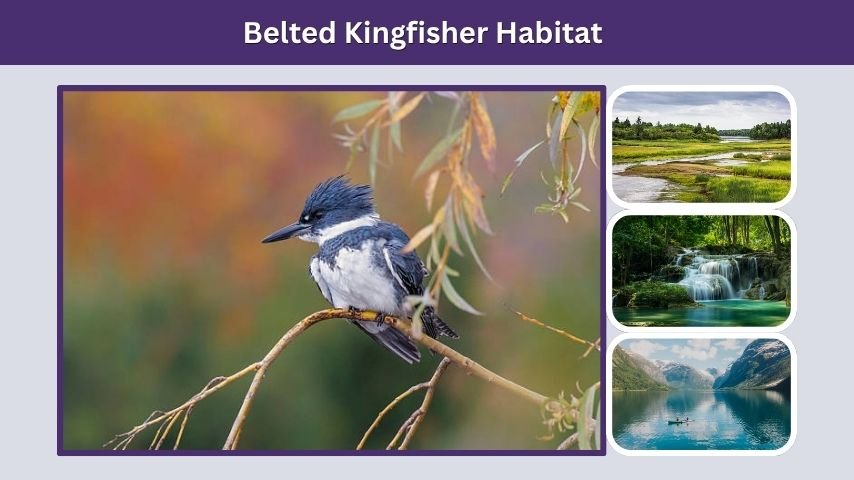
The Belted Kingfisher lives near water because most of its food comes from aquatic habitats. It can be found around freshwater, brackish water, and coastal environments. The most important habitat features are clear hunting water, available prey, and perches near the water’s edge.
Common Habitats
Belted Kingfishers are often found near:
- Rivers and streams
- Lakes and ponds
- Marshes and wetlands
- Reservoirs and canals
- Estuaries and coastal bays
- Shorelines and tidal creeks
- Gravel pits and cut banks
Cornell notes that the bird nests in burrows along earthen banks and feeds mostly on aquatic prey, diving to catch fish and crayfish with its heavy, straight bill.
In Florida and other southern areas, Belted Kingfishers may be common winter visitors around ponds, canals, mangrove edges, and coastal waterways. In northern regions, they are more common during the breeding season, especially where open water and nesting banks are available.
Belted Kingfisher Range and Migration
The Belted Kingfisher has a wide range across North America. It breeds across much of Canada and the United States, especially where suitable water and nesting banks exist. During winter, many birds from colder northern regions move south because frozen water limits access to fish.
Some Belted Kingfishers remain year-round in areas where water stays open. Others migrate to the southern United States, Mexico, Central America, the Caribbean, and parts of northern South America. This means the bird can be seen in different regions depending on the season.
Do Belted Kingfishers Migrate?
Yes, many Belted Kingfishers migrate, especially those that breed in colder northern areas. Their movement is strongly linked to water conditions. If ponds, lakes, and rivers freeze, the bird cannot hunt fish easily, so it must move to places with open water.
Migration is not the same for every individual. A bird living near open coastal water may stay through winter, while one nesting near inland northern lakes may travel far south.
Belted Kingfisher Diet
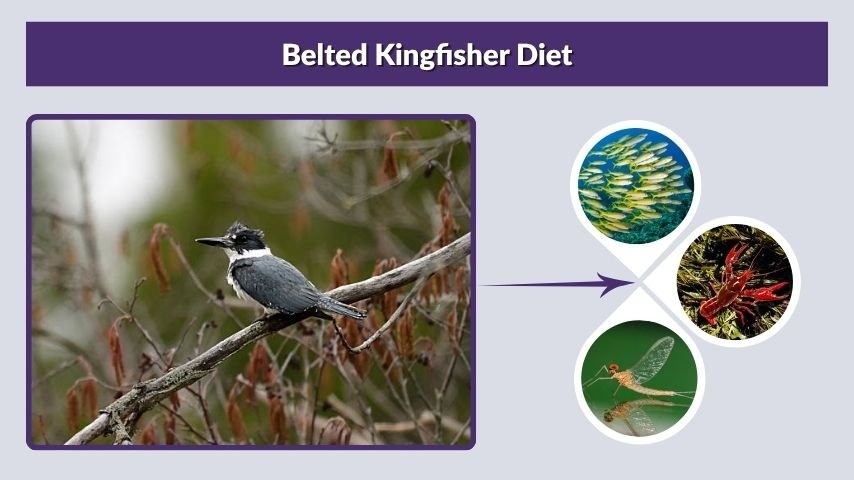
The Belted Kingfisher mainly eats fish, but it is not limited to fish alone. It is an opportunistic hunter that also takes other aquatic animals when available.
What Do Belted Kingfishers Eat?
Their diet can include:
- Small fish
- Crayfish
- Aquatic insects
- Frogs
- Tadpoles
- Small crustaceans
- Occasionally small reptiles or other small animals
The bird usually hunts by perching above water and watching for movement below. Once it spots prey, it dives headfirst into the water and grabs the animal with its bill. After catching a fish or crayfish, it often returns to a perch and may strike the prey against the branch before swallowing it.
This feeding style explains why Belted Kingfishers are so closely tied to water. Clean, fish-filled waterways are essential for their survival.
Belted Kingfisher Diving and Flight
The Belted Kingfisher is an active and powerful hunter. It often perches quietly at first, then suddenly dives into the water with speed and precision. Sometimes it also hovers above the water before diving, especially when there is no good perch nearby.
Diving Behavior
A typical hunting sequence looks like this:
- The bird sits on a branch, wire, post, or bank.
- It watches the water carefully.
- It dives headfirst after prey.
- It catches the prey in its bill.
- It returns to a perch to handle and swallow the food.
Its large bill is well suited for grabbing slippery prey. Its sharp eyesight helps it judge the movement and position of fish below the water surface.
Flight Style
In flight, the Belted Kingfisher can look strong and slightly uneven. It often flies low over water, calling loudly as it moves. The bird may patrol a stretch of river or shoreline repeatedly, especially when defending a feeding territory.
Belted Kingfisher Nest and Breeding
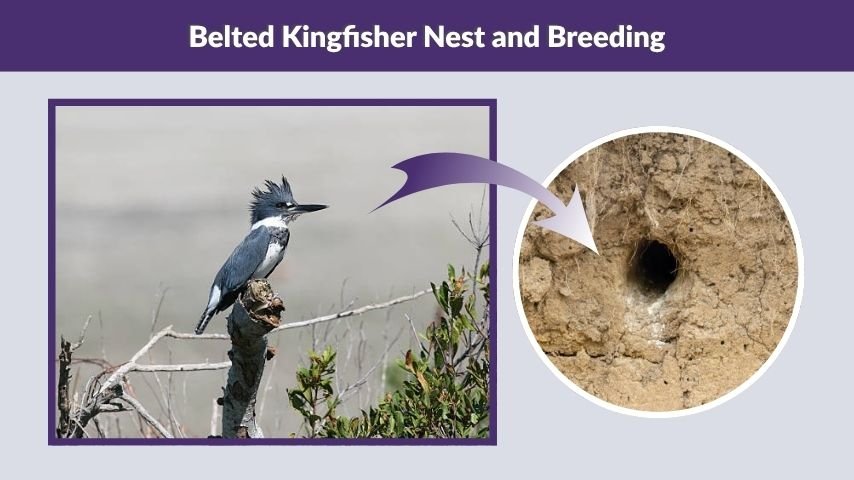
The Belted Kingfisher does not build a typical cup nest in a tree. Instead, it digs a tunnel into an earthen bank. This nesting habit is one of the most interesting parts of its life history.
Nest Location
The nest is usually placed in a vertical or steep bank near water. Suitable sites may include natural riverbanks, stream banks, road cuts, gravel pits, or other exposed soil faces. Cornell notes that human activity such as road building and gravel pits has sometimes created nesting banks that allowed the species to expand breeding areas.
Nest Burrow
The pair digs a long tunnel into the bank, ending in a nesting chamber. The eggs are laid inside this chamber, where they are protected from many weather conditions and some predators.
Both parents help care for the young. Audubon notes that both male and female Belted Kingfishers feed the young, usually raising one brood per year, and sometimes two in the south.
Young Belted Kingfishers
Young Belted Kingfishers remain in the burrow until they are developed enough to leave. After fledging, they continue to depend on the adults for food for a period of time. They must then learn to hunt, dive, and handle prey on their own.
Belted Kingfisher Size
The Belted Kingfisher is larger and bulkier than many small perching birds. It is not a large bird compared with herons or gulls, but its oversized head and bill make it appear bigger than its body length alone suggests.
Most Belted Kingfishers are about the size of a large songbird or small crow-like bird in body bulk, but with a very different shape. The heavy bill, short legs, and compact body are all part of its fishing lifestyle.
Why Its Shape Matters
The bird’s size and body shape help it hunt effectively. The large head supports a strong bill. The compact body helps with sudden dives. The wings allow quick patrol flights over water. The short legs are not useful for walking, but they work well for perching.
Belted Kingfisher Behavior
Belted Kingfishers are often solitary outside the breeding season. A single bird may defend a feeding area along a river, pond, or shoreline. When another kingfisher enters the area, loud calls and chasing may follow.
During the breeding season, pairs defend territory near nesting sites. Their loud call, rapid flight, and bold behavior make them noticeable around water.
Common Behaviors
You may see a Belted Kingfisher:
- Perching on a branch over water
- Flying low along a stream
- Hovering before a dive
- Diving into water for fish
- Rattling loudly when disturbed
- Defending a stretch of shoreline
- Entering or leaving a nest burrow
The bird can seem nervous or alert. It often moves away quickly when people approach, calling loudly as it flies.
Belted Kingfisher in Florida, Michigan, Illinois, and the UK
Some keyword searches focus on locations, such as Florida, Michigan, Illinois, and the UK. The bird’s presence depends on geography and season.
Belted Kingfisher in Florida
In Florida, the Belted Kingfisher is often seen around canals, ponds, marshes, estuaries, and coastal areas, especially during the nonbreeding season. Some individuals may be present around suitable water habitats where food is available.
Belted Kingfisher in Michigan and Illinois
In states such as Michigan and Illinois, Belted Kingfishers are commonly associated with breeding-season waterways. They may nest in suitable banks near rivers, lakes, and gravel pits. Many birds move south when winter freezes limit access to open water.
Belted Kingfisher in the UK
The Belted Kingfisher is not a regular UK bird. The common kingfisher in the UK is a different species, often called the Eurasian Kingfisher. Rare vagrants can occur far outside normal range, but UK birders should not expect Belted Kingfisher as a common species.
Are Belted Kingfishers Rare or Endangered?
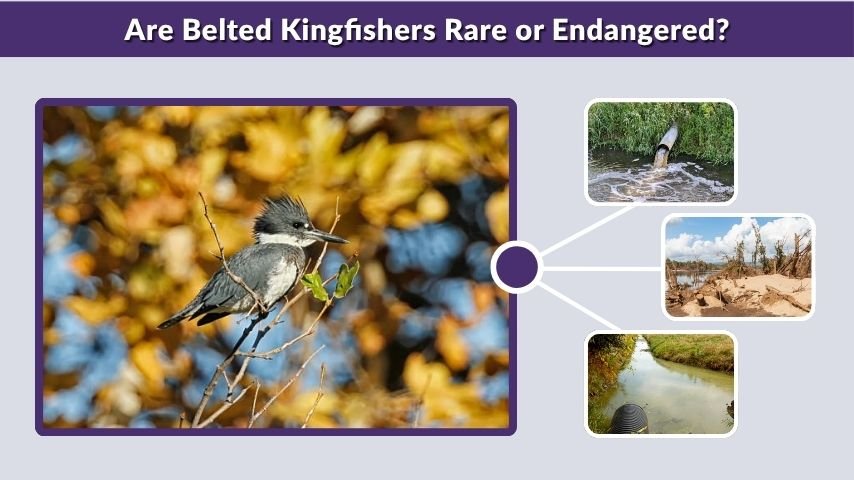
The Belted Kingfisher is not globally endangered. BirdLife International lists the species as Least Concern, meaning it is not currently considered at high risk of extinction globally.
However, local populations still depend on healthy waterways and suitable nesting banks. Pollution, waterway development, removal of natural banks, and loss of wetland habitat can reduce local nesting and feeding opportunities.
Main Threats
Potential threats include:
- Loss of natural riverbanks
- Water pollution
- Disturbance near nesting sites
- Decline in fish populations
- Wetland drainage
- Shoreline development
Protecting clean water, natural shorelines, and nesting banks helps support this species.
Belted Kingfisher Facts
Here are some quick facts about the Belted Kingfisher:
- Scientific name: Megaceryle alcyon
- Family: Alcedinidae
- Main food: Fish and other aquatic prey
- Main habitat: Rivers, lakes, ponds, wetlands, and shorelines
- Nest type: Burrow in an earthen bank
- Call: Loud, dry, mechanical rattle
- Female marking: Extra rusty chestnut band
- Conservation status: Least Concern
- Behavior: Often perches above water and dives after prey
The female being more colorful than the male is one of the bird’s most memorable traits. Cornell highlights the Belted Kingfisher as one of the few bird species where the female is more brightly colored than the male.
How to Spot a Belted Kingfisher
The easiest way to find a Belted Kingfisher is to visit a quiet waterway and listen. Its loud rattling call often reveals its presence. Then scan exposed branches, wires, posts, docks, and banks near the water.
Birdwatching Tips
To improve your chances:
- Visit rivers, ponds, lakes, marshes, or coastal creeks.
- Listen for a loud rattling call.
- Look for a blue-gray bird with a shaggy crest.
- Watch branches and wires over water.
- Scan steep banks for nest holes during breeding season.
- Observe from a distance to avoid disturbing nests.
Photographers often look for kingfishers near regular perches. These birds may return to the same hunting spots repeatedly, especially if the perch gives a good view of fish below.
FAQs
What does a Belted Kingfisher sound like?
A Belted Kingfisher makes a loud, dry, mechanical rattling call. The sound often carries over rivers, lakes, and shorelines. Both males and females call, especially when flying, defending territory, or reacting to disturbance. Many birdwatchers hear the bird before they see it.
What does a Belted Kingfisher eat?
A Belted Kingfisher mainly eats small fish. It also catches crayfish, aquatic insects, frogs, tadpoles, and other small water animals. It usually hunts from a perch, dives headfirst into the water, grabs prey with its bill, and returns to a perch to swallow it.
How do you tell a male and female Belted Kingfisher apart?
The male has one blue-gray band across the white chest. The female has that same blue-gray band plus an extra rusty or chestnut band across the lower breast and sides. This makes the female more colorful than the male, which is unusual among birds.
Where do Belted Kingfishers nest?
Belted Kingfishers nest in burrows dug into earthen banks. These banks are often near rivers, lakes, streams, gravel pits, or road cuts. The tunnel leads to a nesting chamber where the eggs are laid. Both parents help feed the young after hatching.
Do Belted Kingfishers migrate?
Many Belted Kingfishers migrate, especially those living in northern areas where water freezes in winter. They move to regions with open water so they can continue catching fish. In milder coastal or southern areas, some birds may stay year-round if food remains available.
