
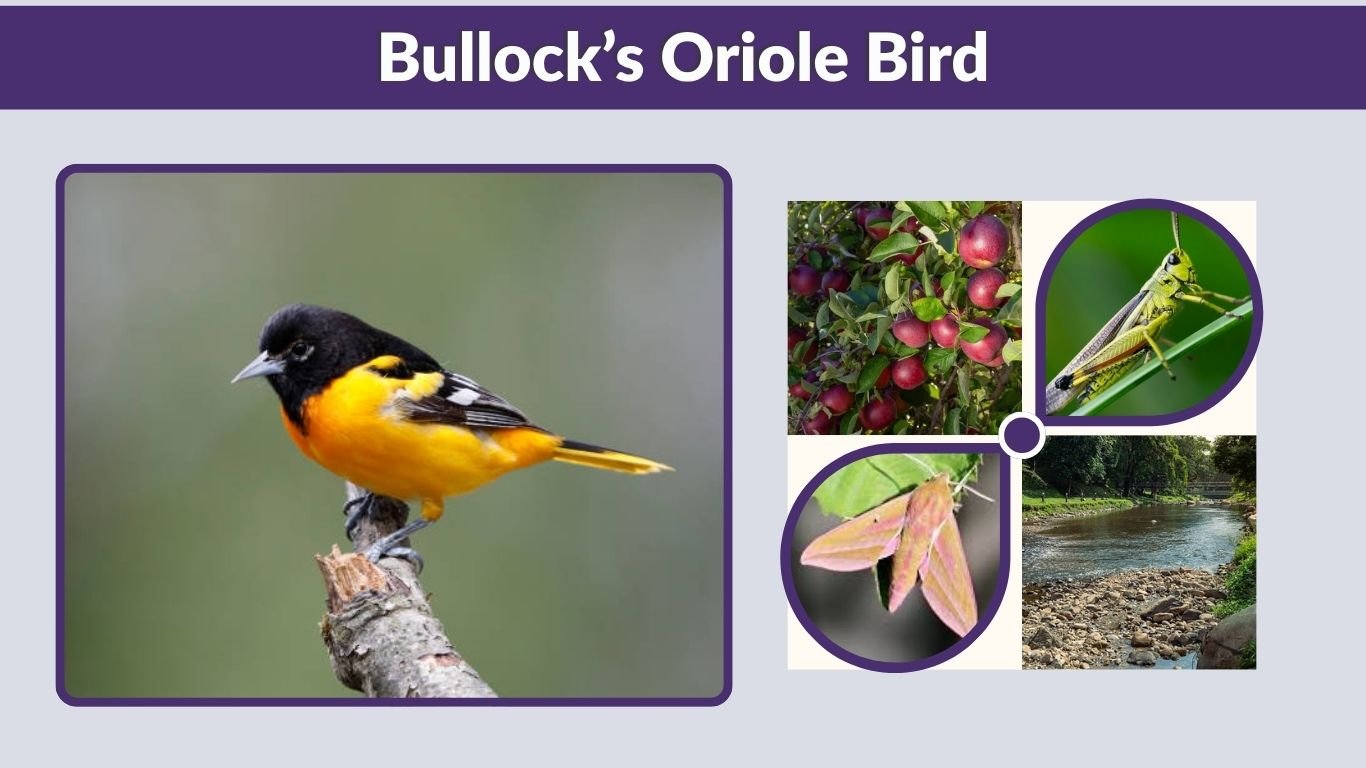
Bullock’s oriole is a bright western songbird known for its orange, black, and white pattern, hanging nest, and clear whistled song. It is often seen in open woodlands, cottonwood groves, farms, parks, and backyards with tall trees. Males are bold and colorful, while females and young birds are softer yellow-gray. This guide explains how to identify, attract, and understand Bullock’s orioles.
What Is a Bullock’s Oriole?
Bullock’s oriole is a medium-sized songbird in the blackbird family. Its scientific name is Icterus bullockii. It is mainly found in western North America during the breeding season and migrates south for winter. Birdwatchers often notice it in spring when males arrive with bright plumage and musical calls.
This bird was named after William Bullock, an English naturalist and collector. It is closely related to the Baltimore oriole, and the two were once grouped together as the “northern oriole.” Today, they are treated as separate species, although they can hybridize where their ranges meet.
Why Bullock’s Orioles Stand Out
Bullock’s orioles are easy to admire because they combine bright color with active movement. They often forage high in trees, hanging upside down while searching leaves and flowers for insects and nectar.
They are also popular backyard visitors when offered oranges, grape jelly, nectar, or mealworms.
Bullock’s Oriole Identification
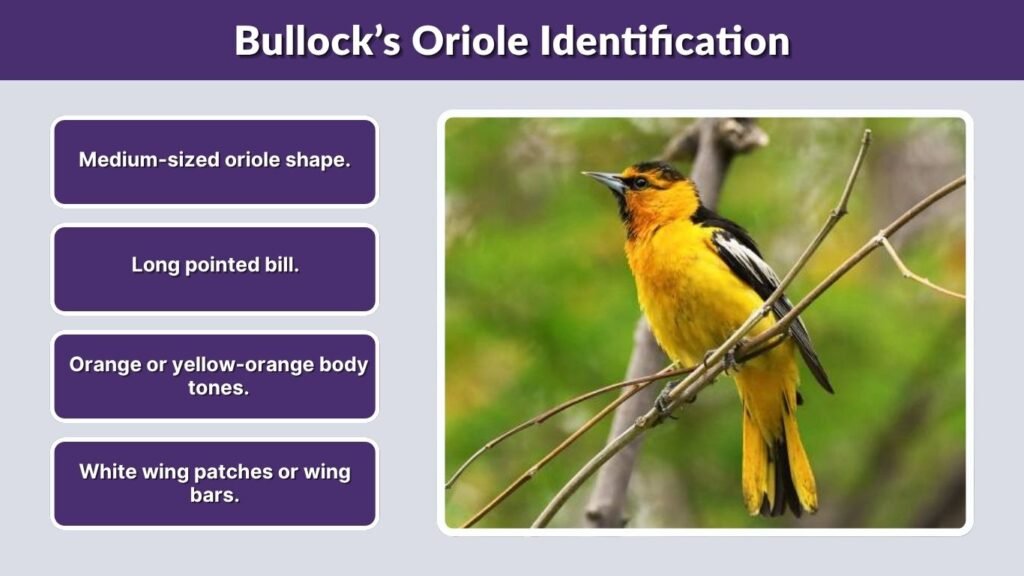
Adult male Bullock’s orioles are the easiest to identify. They have a bright orange face, eyebrow, breast, and belly, with a black throat, black line through the eye, black back, and bold white wing patches. The black throat patch is one of the strongest field marks.
Females are more subtle. They are usually yellow-orange on the face, chest, and tail area, with grayish or olive-brown upperparts. Their wings are darker with pale wing bars, but they do not have the male’s strong black-and-orange contrast.
Juveniles and immature males can be confusing because they may look similar to females. Young males gradually develop darker markings and stronger orange tones as they mature.
Key Field Marks
Look for these signs:
- Medium-sized oriole shape
- Long pointed bill
- Orange or yellow-orange body tones
- White wing patches or wing bars
- Black throat in adult males
- Active movement in tree canopies
- Interest in fruit, nectar, and insects
- Hanging pouch-style nest in trees
Color can vary with age, sex, light, and season, so shape and behavior are also important.
Male vs Female Bullock’s Oriole
Male and female Bullock’s orioles look different enough that beginners may mistake them for separate species. The male has bold orange, black, and white coloring. The female is softer, with yellow-orange and gray-brown tones.
| Feature | Male Bullock’s Oriole | Female Bullock’s Oriole |
|---|---|---|
| Main color | Bright orange, black, and white | Yellow-orange, gray, and olive-brown |
| Face | Orange with black eye line | Yellowish or orange-yellow |
| Throat | Black throat patch | Usually pale or lightly marked |
| Wings | Black with large white patches | Darker with pale wing bars |
| Back | Mostly black | Grayish or brownish |
| Overall look | Bold and high contrast | Softer and more camouflaged |
| Identification difficulty | Easier | More challenging |
Female Bullock’s orioles are often best identified by their warm yellow-orange face and chest, pointed bill, long body shape, and oriole-like behavior.
Bullock’s Oriole Size and Shape
Bullock’s orioles are medium-sized songbirds, larger than most warblers but smaller than many jays or robins. They have slender bodies, long tails, and pointed bills. Their bill is strong enough to handle insects, fruit, and nectar.
Their shape helps separate them from similar yellow or orange birds. Western tanagers, for example, are stockier and have different wing patterns. Female orioles usually look longer and slimmer than many tanagers or finches.
General Size Features
Bullock’s orioles usually show:
- Slim body
- Long tail
- Sharp pointed bill
- Strong legs for perching
- Medium songbird size
- Agile movement among branches
They often stay high in leafy trees, so listening for their calls can help locate them.
Bullock’s Oriole Range
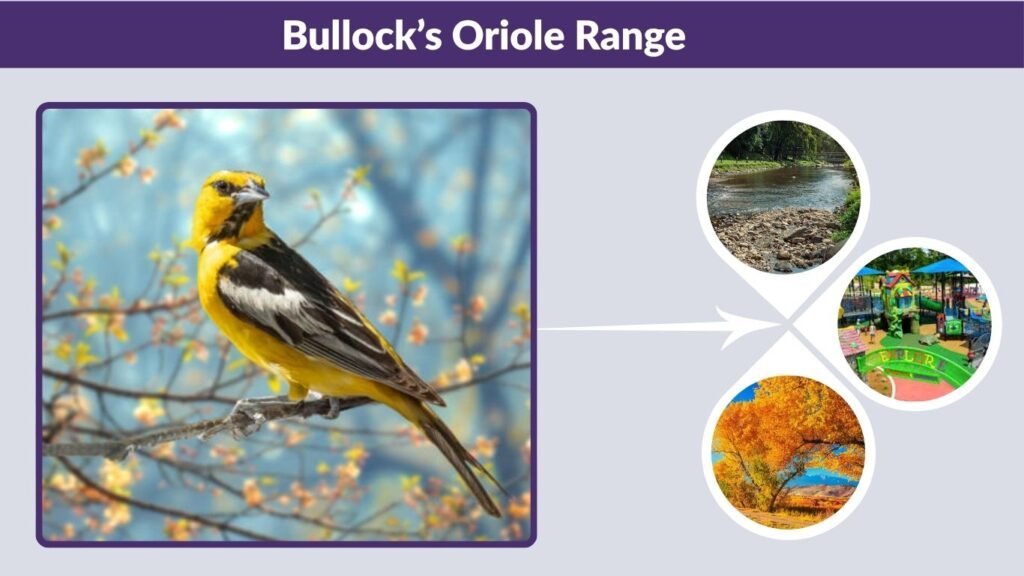
Bullock’s orioles are mainly western birds. During breeding season, they are found across much of the western United States and parts of western Canada. They are common in states such as California, Oregon, Washington, Idaho, Utah, Colorado, Arizona, New Mexico, and parts of the Great Plains.
They prefer places with open trees rather than dense forest. Cottonwood groves, streamside woods, farms, orchards, parks, and suburban areas can all provide suitable habitat.
Bullock’s Oriole in Colorado, California, Utah, and Oregon
In Colorado, Bullock’s orioles are often seen near cottonwoods, riparian corridors, farms, and open woodlands. In California, they may appear in oak woodland, parks, orchards, and neighborhoods with tall trees. In Utah and Oregon, they are common in streamside trees, open groves, and mixed rural habitats.
Their exact timing varies by location, but they are most noticeable in spring and early summer.
Bullock’s Oriole Migration
Bullock’s orioles are migratory birds. They spend the breeding season in western North America and migrate south for winter, mainly to Mexico and parts of Central America.
Spring migration usually brings them north as flowers bloom, insects increase, and trees leaf out. Fall migration begins after breeding season, when adults and young birds move south again.
When Do Bullock’s Orioles Migrate?
Migration timing depends on region and weather. In many areas, they arrive in spring around April or May. They may leave breeding areas in late summer or early fall. Backyard feeders are often most successful in spring when migrants are hungry and searching for quick energy.
Bullock’s Oriole Habitat
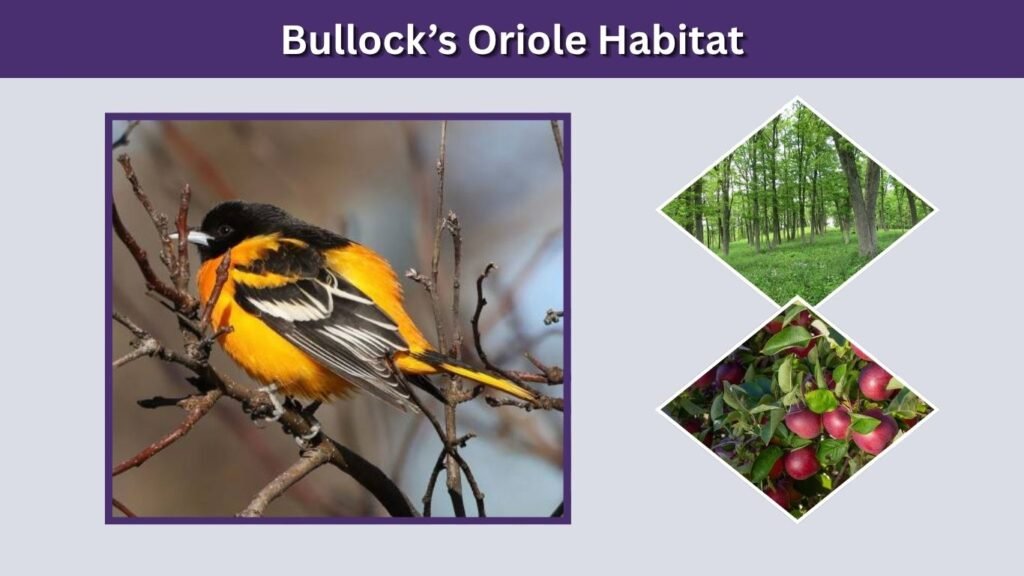
Bullock’s orioles prefer open habitats with tall deciduous trees. They are especially associated with cottonwoods, willows, sycamores, oaks, and other trees near water or open land. They are less likely to live deep inside dense forests.
Good habitat provides insects, fruit, nectar, nesting branches, and safe cover. These birds often build nests near the tips of flexible branches, where predators have a harder time reaching them.
Best Places to Find Them
You may find Bullock’s orioles in:
- Streamside woodlands
- Cottonwood groves
- Open oak woodland
- Orchards
- Farms
- Parks
- Suburban yards
- Shelterbelts
- Woodland edges
- Tall trees near water
A good birding strategy is to listen first, then scan the upper branches for movement and orange flashes.
Bullock’s Oriole Song and Call
Bullock’s orioles have a rich, varied song made of whistles, chatters, and short phrases. Their song can sound musical but less smooth than a Baltimore oriole’s. Males often sing from high perches during breeding season.
Their calls include harsh chatter notes, sharp calls, and short contact sounds. These calls are useful when birds are hidden in leaves.
What Does a Bullock’s Oriole Sound Like?
A Bullock’s oriole may sound like a mix of clear whistles and scratchy notes. The song can vary between individuals. Once you learn the rhythm, it becomes easier to detect them even when they stay high in trees.
Bullock’s Oriole Nest
Bullock’s orioles build impressive hanging nests. The female usually does most of the weaving, creating a pouch-like nest suspended from a branch. The nest may be made from plant fibers, grasses, bark strips, hair, string-like material, and other flexible fibers.
The nest often hangs in a tall tree, sometimes near the end of a thin branch. This location helps protect eggs and chicks from climbing predators.
Nesting Behavior
During breeding season, the female builds the nest and incubates the eggs. The male may help guard the territory and may assist with feeding. Once chicks hatch, both parents may bring insects and other food to the young.
The nest is one of the best signs that orioles are breeding nearby, but it can be hard to see until leaves thin out.
What Do Bullock’s Orioles Eat?
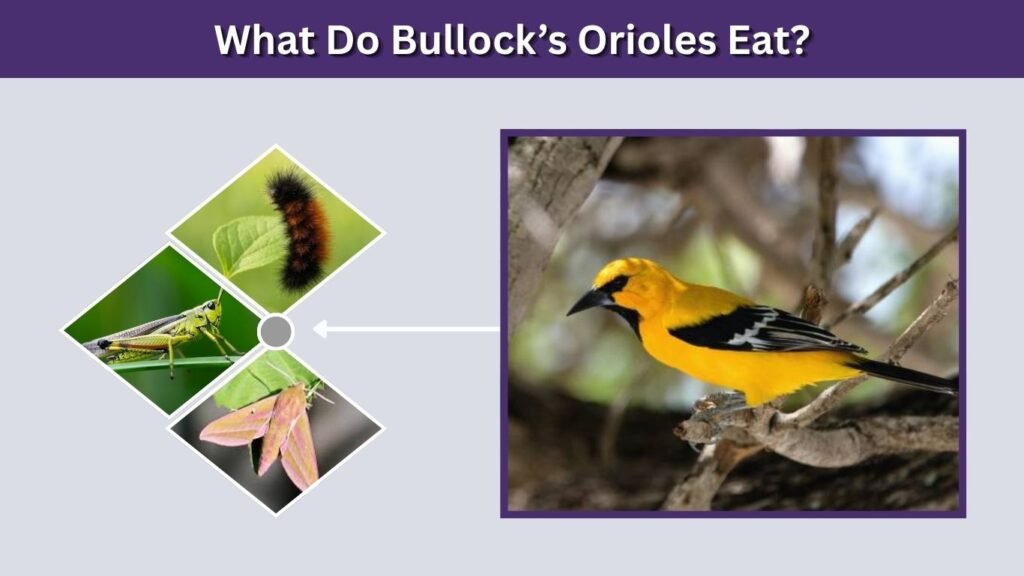
Bullock’s orioles eat insects, fruit, and nectar. During nesting season, insects are especially important because chicks need protein. Adults search leaves, flowers, and branches for caterpillars, beetles, grasshoppers, spiders, and other small prey.
They also enjoy sweet foods, especially during migration. In backyards, they may visit orange halves, grape jelly, nectar feeders, and mealworm dishes.
Foods They May Eat
Common foods include:
- Caterpillars
- Beetles
- Grasshoppers
- Spiders
- Moths
- Wild berries
- Oranges
- Grapes
- Nectar
- Grape jelly
- Mealworms
Jelly should be offered in small amounts only. Too much jelly can spoil, attract insects, and create an unhealthy feeding habit.
How to Attract Bullock’s Orioles
Attracting Bullock’s orioles is easiest during spring migration and early breeding season. They are drawn to bright fruit, sweet nectar, and insect-rich yards.
Backyard Feeding Tips
To attract them:
- Put out orange halves in spring
- Offer a small amount of grape jelly
- Use a clean oriole nectar feeder
- Provide mealworms during nesting season
- Plant native fruiting shrubs
- Grow flowering plants
- Keep feeders clean
- Avoid heavy pesticide use
- Provide tall trees if possible
Place feeders where birds can see them, preferably near trees or shrubs. Clean feeders often because nectar, fruit, and jelly spoil quickly in warm weather.
Bullock’s Oriole vs Baltimore Oriole
Bullock’s orioles and Baltimore orioles are close relatives, but they live mostly in different regions. Bullock’s orioles are western birds, while Baltimore orioles are eastern birds. Where their ranges meet, they may hybridize.
Adult male Baltimore orioles have a black head and bright orange body. Male Bullock’s orioles have an orange face with a black throat and black eye line, rather than a fully black head.
Simple Difference
If you are in the western United States and see an orange oriole with a black throat and orange face, it may be a Bullock’s oriole. If you are in the eastern United States and see a bird with a fully black head and orange body, it is more likely a Baltimore oriole.
Bullock’s Oriole vs Hooded Oriole
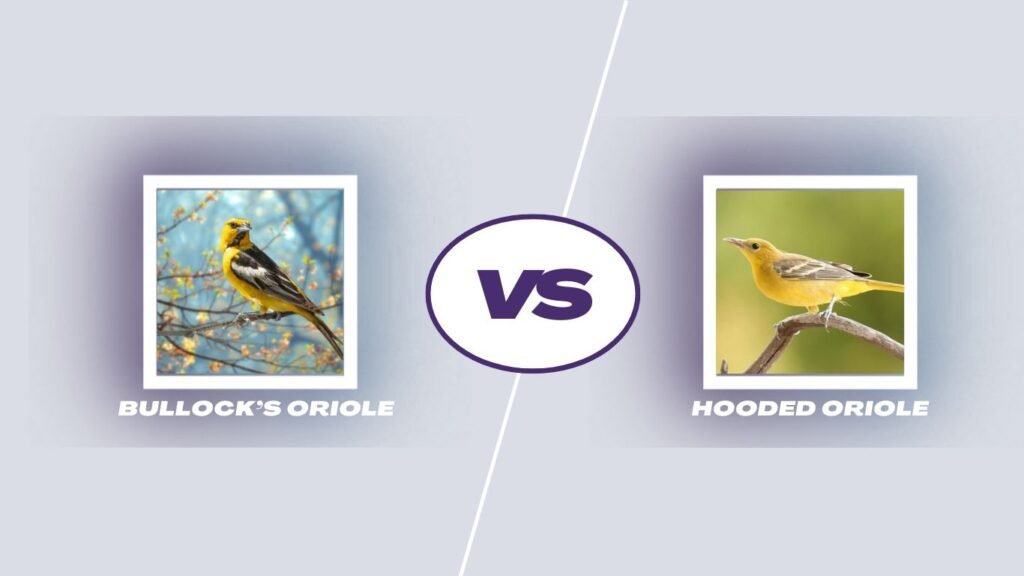
Bullock’s orioles can also be confused with hooded orioles in the Southwest and California. Male hooded orioles are usually bright yellow-orange with a black throat and face, but they lack the same bold white wing patch pattern of Bullock’s orioles.
Hooded orioles are often associated with palm trees and more southern habitats. Bullock’s orioles are more widespread in open woodlands and riparian areas.
Juvenile Bullock’s Oriole
Juvenile Bullock’s orioles are usually duller than adults. They may look yellowish, grayish, or olive, with less contrast. Young males may develop patchy dark markings as they mature.
Juveniles are often seen after nesting season, following adults and begging for food. Their softer colors can make them hard to identify, but the pointed bill, long tail, and oriole behavior are helpful clues.
FAQs
What does a Bullock’s oriole look like?
A male Bullock’s oriole has a bright orange face and body, black throat, black eye line, black back, and bold white wing patches. The female is softer yellow-orange with grayish or olive-brown upperparts. Both have a pointed bill, long tail, and slim oriole shape.
Where do Bullock’s orioles live?
Bullock’s orioles live mainly in western North America during breeding season. They are found in open woodlands, cottonwood groves, riparian corridors, orchards, parks, farms, and suburban areas with tall trees. In winter, they migrate south, mainly to Mexico and parts of Central America.
What do Bullock’s orioles eat?
Bullock’s orioles eat insects, fruit, and nectar. During nesting season, insects such as caterpillars, beetles, and spiders are especially important for feeding chicks. At feeders, they may eat orange halves, small amounts of grape jelly, nectar, and mealworms if the food is fresh.
How do you attract Bullock’s orioles?
Offer orange halves, clean nectar feeders, small portions of grape jelly, and mealworms in spring. Plant native shrubs and trees that provide fruit, flowers, and insects. Keep feeders clean, avoid pesticides, and place feeding stations near trees or shrubs where orioles feel safe.
What is the difference between Bullock’s oriole and Baltimore oriole?
Bullock’s orioles are mainly western birds, while Baltimore orioles are mainly eastern birds. Male Bullock’s orioles have an orange face with a black throat and eye line. Male Baltimore orioles have a fully black head with a bright orange body. Their ranges can overlap in the Great Plains.
