
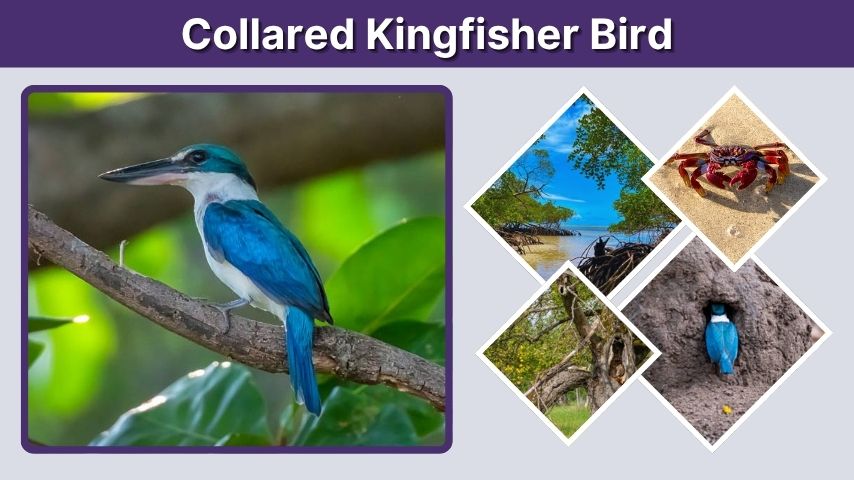
The Collared Kingfisher is a bright, noisy, and adaptable bird found across tropical and subtropical parts of Asia, the Middle East, and the Pacific. Known for its blue-green upperparts, white collar, dark eye stripe, and strong bill, this kingfisher is often seen in mangroves, coastal forests, wetlands, gardens, and wooded edges. Although it is called a kingfisher, it eats much more than fish.
What Is a Collared Kingfisher?
The Collared Kingfisher is a medium-sized kingfisher with the scientific name Todiramphus chloris. It belongs to the tree kingfisher group, meaning it often hunts from perches in trees, shrubs, posts, and wires rather than relying only on diving into water. It is also known as the White-collared Kingfisher, Black-masked Kingfisher, or Mangrove Kingfisher.
This bird is famous for its sharp contrast of colors. It usually has blue-green or turquoise upperparts, pale underparts, a white collar around the neck, and a dark line through the eye. Its strong bill helps it catch insects, crabs, lizards, fish, and other small animals.
The Collared Kingfisher has a broad distribution. It occurs from the Red Sea region across southern Asia and Southeast Asia to island groups in the western Pacific. Because its range is wide and its habitats are varied, it can look slightly different across regions. Some populations have also been treated differently by taxonomists, with several island forms split or discussed as separate species.
Collared Kingfisher Identification
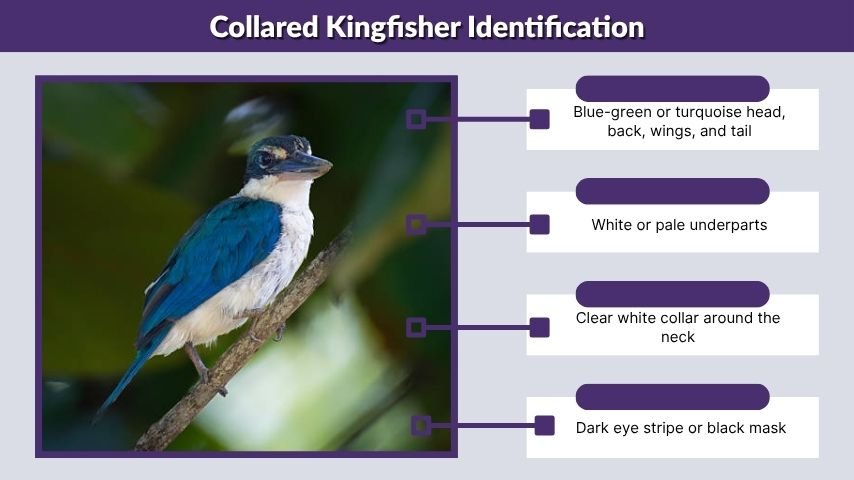
The Collared Kingfisher is usually easy to recognize when seen clearly. Its upright posture, heavy bill, white collar, and blue-green back make it stand out from many other coastal and woodland birds.
Key Field Marks
Look for these features when identifying a Collared Kingfisher:
- Blue-green or turquoise head, back, wings, and tail
- White or pale underparts
- Clear white collar around the neck
- Dark eye stripe or black mask
- Large, strong, straight bill
- Compact body and short legs
- Upright perching posture
- Loud, repeated calls
The color can appear different depending on sunlight. In strong light, the back may look bright turquoise or blue. In shade, it can appear darker green. The white collar and dark eye stripe are often the most useful marks.
Collared Kingfisher Size and Appearance
The Collared Kingfisher is medium-sized for a kingfisher. It is not as large as many kookaburras, but it is more solid and heavy-billed than many small garden birds. The bird’s large head and strong bill give it a powerful look.
| Feature | Collared Kingfisher Details |
|---|---|
| Common name | Collared Kingfisher |
| Scientific name | Todiramphus chloris |
| Other names | White-collared Kingfisher, Mangrove Kingfisher, Black-masked Kingfisher |
| Family | Alcedinidae |
| Main colors | Blue-green upperparts, white collar, pale underparts |
| Main habitats | Mangroves, coasts, wetlands, forests, gardens, plantations |
| Diet | Insects, crabs, lizards, fish, frogs, small animals |
| Conservation status | Least Concern |
Its shape is typical of tree kingfishers: a large head, short neck, sturdy body, short legs, and a large bill. This structure helps it strike prey quickly from a perch.
Collared Kingfisher Habitat
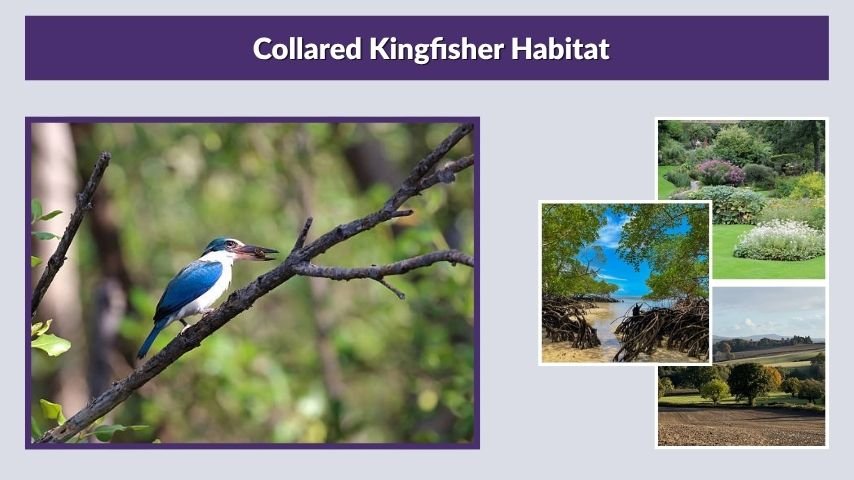
The Collared Kingfisher is strongly associated with coastal and mangrove habitats, but it is not limited to them. In many areas, it also lives in open woodland, forest edges, gardens, plantations, riversides, wetlands, and agricultural land.
Common Habitat Types
You may find Collared Kingfishers in:
- Mangrove forests
- Coastal scrub and shorelines
- Tidal creeks and estuaries
- River edges and wetlands
- Open woodland
- Forest edges
- Gardens and parks
- Coconut plantations
- Farmland with trees
- Coastal villages and urban green spaces
Its ability to use many habitats is one reason the species remains widespread. In some regions, it is a familiar bird around human settlements, especially where trees, open hunting areas, and small prey are available.
Why Mangroves Matter
The name “Mangrove Kingfisher” comes from the bird’s close link with mangrove ecosystems. Mangroves provide perches, nesting sites, crabs, insects, small fish, and shelter. In coastal Southeast Asia and island regions, Collared Kingfishers are often heard calling from mangrove edges and tidal channels.
Mangrove loss can reduce local habitat quality, even though the species is still globally common. Protecting mangroves benefits not only this kingfisher but also fish, crabs, shorebirds, and many coastal communities.
Collared Kingfisher Range and Distribution
The Collared Kingfisher has a very wide Indo-Pacific range. It is found from the Red Sea area through southern Asia, Southeast Asia, and many island regions toward the Pacific. Its distribution includes countries and regions such as India, Sri Lanka, Bangladesh, Myanmar, Thailand, Malaysia, Singapore, Indonesia, the Philippines, Papua New Guinea, and parts of the Pacific island world.
Because the species has such a wide range, local appearance and behavior can vary. Some forms have been split from the Collared Kingfisher complex by different authorities. This is why readers may see related names such as Pacific Kingfisher, Torresian Kingfisher, Islet Kingfisher, or Melanesian Kingfisher in bird guides and databases.
Is the Collared Kingfisher Migratory?
In many areas, the Collared Kingfisher is mainly resident, meaning it stays in the same general region throughout the year. Some local movements may occur depending on food, weather, tides, breeding, or habitat conditions. Island and coastal populations often remain close to suitable territories.
Unlike long-distance migrant birds, this kingfisher is usually seen as a local or regional resident across much of its range.
Collared Kingfisher Diet
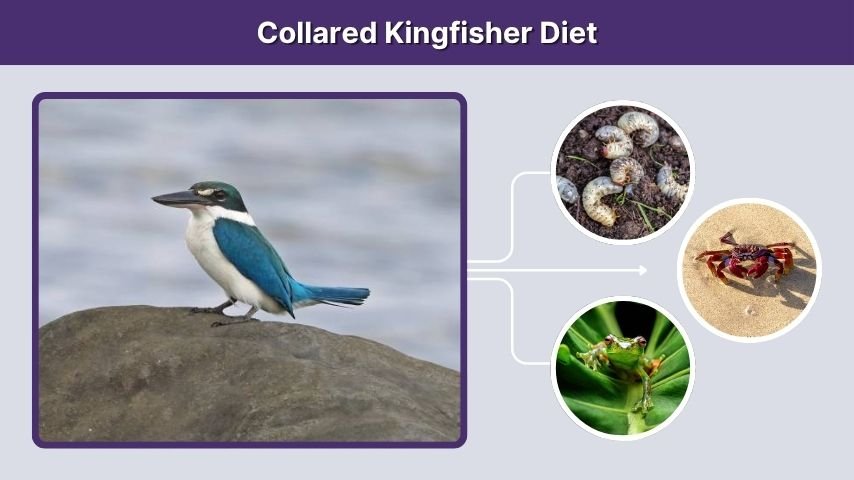
Despite the name “kingfisher,” this bird does not eat only fish. It has a broad diet and often hunts on land. It catches prey from the ground, trees, mudflats, water edges, and mangrove roots.
What Does a Collared Kingfisher Eat?
Its diet may include:
- Insects and insect larvae
- Crabs and other crustaceans
- Small fish
- Frogs
- Lizards and small reptiles
- Worms and other invertebrates
- Small rodents or tiny vertebrates on occasion
The Collared Kingfisher usually hunts by waiting on a perch. When it spots prey, it drops or swoops down quickly, grabs the animal in its bill, and returns to a perch. Larger prey may be beaten against a branch before being swallowed.
Hunting Behavior
The hunting style of the Collared Kingfisher is patient and sudden. It may sit quietly for long periods, scanning the ground, mud, water, or vegetation. Once prey moves, the bird launches quickly.
Common Hunting Places
Collared Kingfishers often hunt from:
- Mangrove branches
- Fence posts
- Powerlines
- Dead trees
- Low coastal shrubs
- Garden trees
- Riverbank perches
- Exposed roots near mudflats
This perch-and-pounce method saves energy. Instead of flying constantly, the bird waits for the right moment. Its strong bill and quick flight make it an effective predator of small animals.
Collared Kingfisher Call and Sound
The Collared Kingfisher is often heard before it is seen. Its call is loud, sharp, and repeated. In mangroves and coastal forests, the call can carry clearly across open water and dense vegetation.
The sound is often described as a harsh “kek-kek-kek,” “ki-ki-ki,” or repeated ringing notes. The exact quality can vary by region and individual, but the call is usually strong, clear, and repetitive.
When Does It Call?
A Collared Kingfisher may call when:
- Defending a territory
- Communicating with a mate
- Reacting to disturbance
- Moving through mangroves
- Advertising during breeding season
- Warning other birds nearby
Learning the call is useful for birdwatchers because the bird may sit hidden in foliage. A loud repeated call from a mangrove edge is often the first clue that one is nearby.
Collared Kingfisher Nest and Breeding
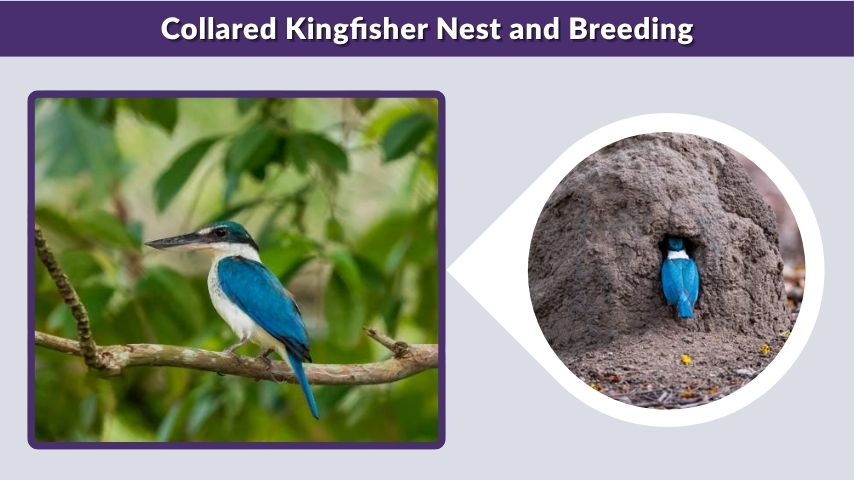
The Collared Kingfisher nests in enclosed cavities. It does not build an open cup nest like many songbirds. Instead, it may use holes in trees, termite mounds, earth banks, or other natural cavities.
Nesting Sites
Possible nest sites include:
- Tree hollows
- Termite nests
- Earth banks
- Rotten branches
- Old cavities
- Holes in coastal banks
Both members of the pair may take part in nesting duties. The eggs are usually laid inside the cavity, where they are better protected from weather and some predators. After hatching, the young remain inside until they are ready to leave.
Baby Collared Kingfishers
Young Collared Kingfishers are fed by the parents. They grow inside the nesting cavity and later emerge as fledglings. Juveniles may look duller than adults, with less crisp colors and softer markings.
Female Collared Kingfisher vs Male
Male and female Collared Kingfishers are generally similar. In many views, they are difficult to separate with certainty. Both sexes show blue-green upperparts, pale underparts, a white collar, a dark eye stripe, and a strong bill.
Female Collared Kingfisher
A female may appear slightly duller or greener in some populations, but this is not always reliable. Light, age, feather wear, and regional variation can make identification tricky.
Male Collared Kingfisher
A male may look brighter or cleaner in color, but again, this difference can be subtle. In the field, most observers identify the species rather than confidently sexing the bird unless they have excellent views or are watching a pair.
The safest approach is to use structure, habitat, and plumage pattern to identify the bird as a Collared Kingfisher, while treating sex identification with caution.
Juvenile Collared Kingfisher
A juvenile Collared Kingfisher looks similar to an adult but is usually duller. It may have less bright upperparts, buff or dusky feather edges, and a less clean white collar. The dark eye stripe may also appear less bold.
Juvenile Identification Clues
Look for:
- Duller blue-green upperparts
- Less crisp white collar
- Softer facial pattern
- Buff or brownish feather edges
- Same large bill and kingfisher shape
- Perching and hunting behavior similar to adults
Young birds can be harder to identify in regions with several similar kingfishers. A clear view of the collar, mask, bill, and habitat helps.
Collared Kingfisher vs Sacred Kingfisher
The Collared Kingfisher is sometimes confused with the Sacred Kingfisher because both belong to the genus Todiramphus and share blue-green upperparts, pale underparts, and a strong bill. However, they differ in range, habitat preference, and appearance.
Main Differences
The Collared Kingfisher is often more strongly linked with mangroves, coastal areas, and tropical shorelines. The Sacred Kingfisher is often seen in Australia, New Zealand, and nearby regions, using woodland, open country, river edges, and coastal habitats.
The Collared Kingfisher usually has a strong white collar and a bold dark mask. The Sacred Kingfisher often looks slightly softer in pattern and may be more associated with open woodland or inland hunting areas, depending on location.
For accurate identification, use a local field guide because these birds vary across their ranges.
Collared Kingfisher Conservation Status
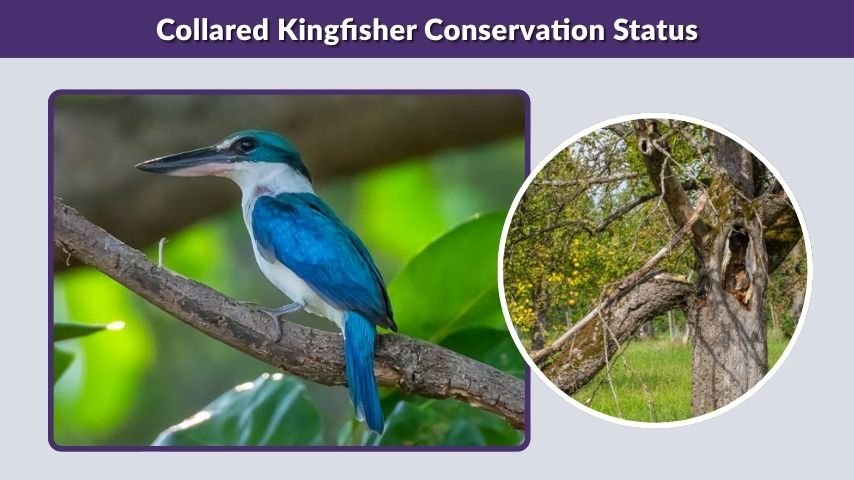
The Collared Kingfisher is listed globally as Least Concern by BirdLife/IUCN, meaning it is not currently considered at high risk of extinction worldwide.
However, local habitats can still be threatened. Mangrove clearing, coastal development, pollution, and loss of old trees or nesting cavities may affect local populations. A species can be common globally while still declining or disappearing from damaged local habitats.
Main Threats
Potential local threats include:
- Mangrove destruction
- Coastal development
- Pollution in wetlands and tidal areas
- Loss of nesting trees
- Disturbance around nest sites
- Reduction of insect and crab populations
Protecting coastal forests, mangroves, wetlands, and natural nesting sites helps support Collared Kingfishers and many other species.
Interesting Collared Kingfisher Facts
The Collared Kingfisher is a bird with many names, broad habits, and a complex range. It is one of the best-known kingfishers in coastal parts of Asia and the Pacific.
Quick Facts
- Scientific name: Todiramphus chloris
- Also called White-collared Kingfisher
- Also called Mangrove Kingfisher
- Belongs to the tree kingfisher group
- Often hunts insects, crabs, lizards, and small fish
- Uses mangroves, forests, gardens, and coastal habitats
- Usually hunts from a perch
- Has a loud repeated call
- Nests in cavities, banks, or termite mounds
- Listed globally as Least Concern
One of the most interesting things about this bird is that it does not behave like a purely water-based kingfisher. It can hunt on mudflats, in gardens, around trees, and along coastal edges.
How to Spot a Collared Kingfisher
Finding a Collared Kingfisher is easiest in suitable coastal or wooded habitats. Mangrove edges, tidal creeks, gardens near the coast, and open woodland are good places to search.
Birdwatching Tips
To spot one:
- Listen for loud repeated calls.
- Scan mangrove branches and exposed perches.
- Check powerlines, posts, and dead trees.
- Look for blue-green upperparts and a white collar.
- Watch for sudden drops from a perch to the ground.
- Search coastal forests, gardens, and wetlands.
- Use binoculars to confirm the dark mask and bill shape.
If the bird flies away, watch where it lands. Collared Kingfishers often move from one perch to another and may remain within the same territory.
FAQs
What does a Collared Kingfisher eat?
A Collared Kingfisher eats insects, crabs, small fish, frogs, lizards, worms, and other small animals. It often hunts from a perch, then drops or swoops down to catch prey. Although called a kingfisher, it frequently hunts on land and in mangroves, not only in water.
Where does the Collared Kingfisher live?
The Collared Kingfisher lives across a wide Indo-Pacific range, from the Red Sea and southern Asia through Southeast Asia and many Pacific island regions. It is commonly found in mangroves, coastal forests, tidal creeks, wetlands, gardens, plantations, and wooded areas near water.
What does a Collared Kingfisher sound like?
A Collared Kingfisher has a loud, sharp, repeated call often described as “kek-kek-kek” or similar ringing notes. It calls from exposed perches, mangroves, gardens, and coastal trees, especially when defending territory or communicating with a mate.
Is the Collared Kingfisher endangered?
No, the Collared Kingfisher is not globally endangered. BirdLife/IUCN lists it as Least Concern. However, local populations can still be affected by mangrove loss, coastal development, pollution, and the removal of nesting trees or natural cavities.
What is the difference between Collared Kingfisher and Sacred Kingfisher?
The Collared Kingfisher usually has a bold white collar, strong dark eye mask, and close association with mangroves and coastal habitats. The Sacred Kingfisher is often linked with Australia, New Zealand, woodland, river edges, and open country. Because both can look similar, location and habitat are important clues.
