
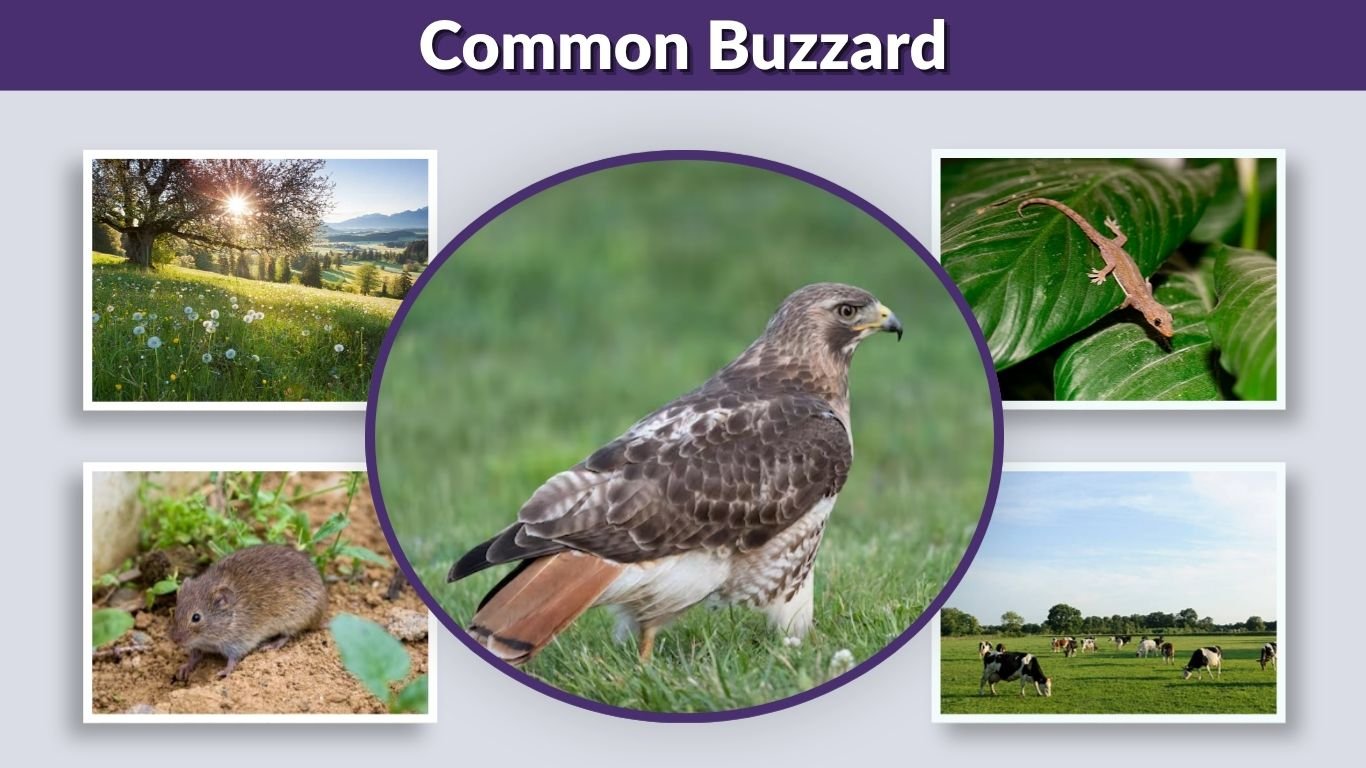
The Common Buzzard (Buteo buteo) is a medium-to-large bird of prey found across much of Europe and western Asia. It is known for its broad wings, short fan-shaped tail, variable brown plumage, and cat-like mewing call. Common Buzzards frequently soar over farmland and woodland or wait on fence posts for prey. They feed on small mammals, birds, carrion, insects, and earthworms, making them adaptable hunters capable of living in many rural habitats.
Common Buzzard Facts at a Glance
The Common Buzzard belongs to the order Accipitriformes and family Accipitridae, which also includes many hawks, eagles, and other buzzards. Although usually called simply the “Buzzard” in Britain and Ireland, its full common name helps distinguish it from similar species.
| Feature | Common Buzzard information |
| Scientific name | Buteo buteo |
| Family | Accipitridae |
| Length | Approximately 51–57 cm |
| Wingspan | Approximately 113–128 cm |
| Average weight | Around 828 grams, with females generally heavier |
| Typical lifespan | About 12 years after reaching breeding age |
| Diet | Small mammals, birds, carrion, insects, amphibians, and worms |
| Habitat | Farmland, woodland, grassland, heathland, and moorland |
| Typical clutch | Two to three eggs |
| Call | A high, cat-like mewing sound |
Measurements vary according to sex, subspecies, location, and individual condition. Females are generally larger and heavier than males, although the sexes have similar plumage.
Common Buzzard Identification
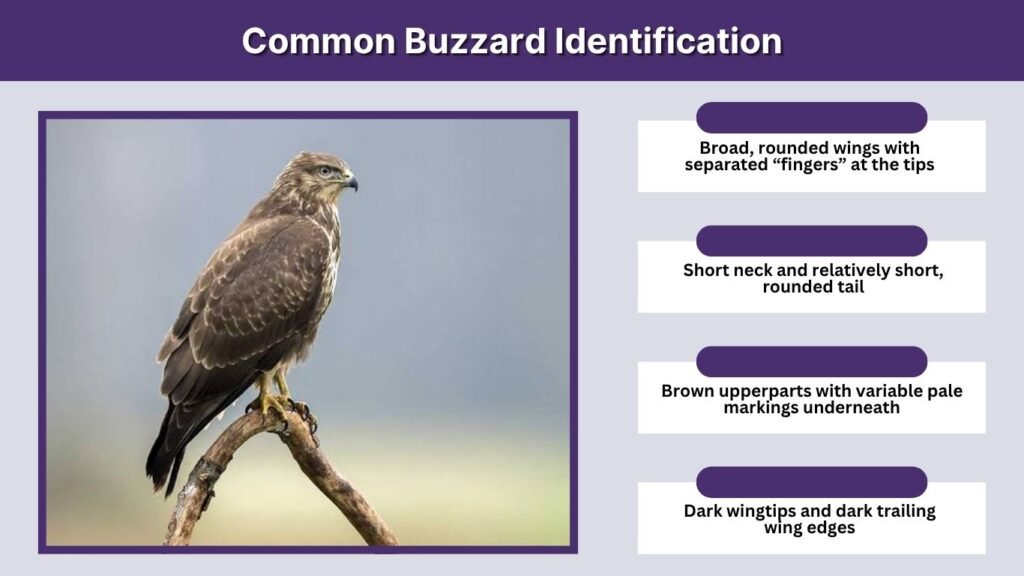
Identifying this species can be surprisingly difficult because its feather colors vary enormously. Some individuals are almost entirely dark brown, while others have pale cream or nearly white underparts.
Key Identification Features
Look for these characteristics:
- Broad, rounded wings with separated “fingers” at the tips
- Short neck and relatively short, rounded tail
- Brown upperparts with variable pale markings underneath
- Dark wingtips and dark trailing wing edges
- Finely barred tail with a broader terminal band in adults
- Yellow legs and feet
- Yellow-based hooked bill with a dark tip
- Hunched appearance when perched
- Wings held in a shallow V while soaring
The bird’s shape is often more reliable than its color. Even unusually pale or dark individuals retain the broad wings, compact body, short tail, and heavy-billed profile typical of the species.
Juvenile Common Buzzard
Juveniles resemble adults but often have more streaked underparts, a less clearly defined dark tail band, and slightly different feather edges. Their eyes may appear paler or more grayish than those of older birds.
Young buzzards can be particularly difficult to separate from other Buteo species. Observers should consider body proportions, wing shape, tail pattern, flight style, habitat, and location rather than relying on one marking.
Common Buzzard Size and Wingspan
A Common Buzzard is approximately 51–57 cm long, with a wingspan of around 113–128 cm. A typical bird therefore has a wingspan close to 1.2 metres, even though its body is only slightly longer than that of a large crow.
Females are usually heavier than males. BTO data place the average adult weight at approximately 828 grams, with recorded individuals varying considerably. The difference in size between the sexes may be noticeable when a pair is perched or flying together, but it is rarely dependable enough to identify sex in a solitary wild bird.
What Do Common Buzzards Eat?
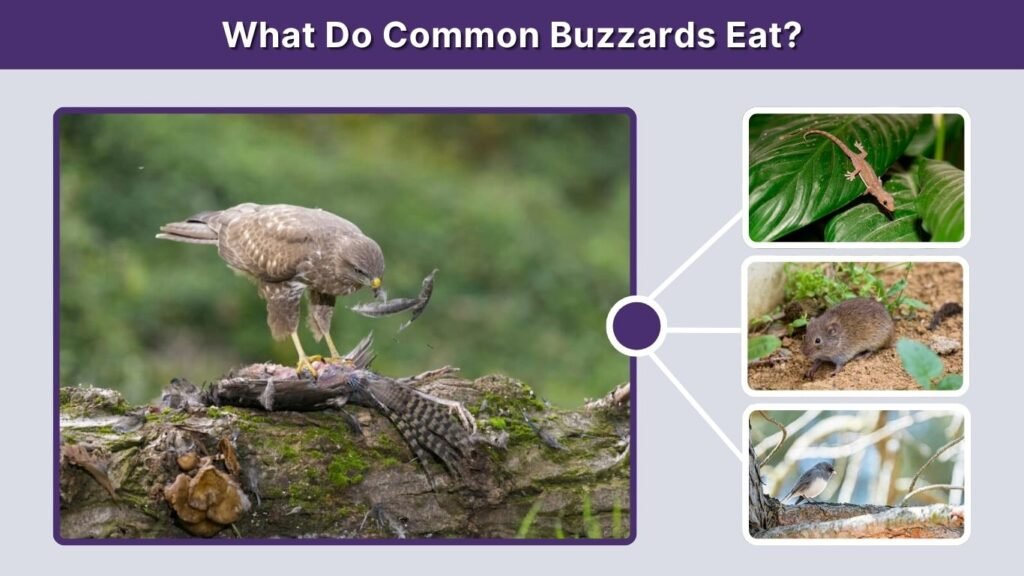
Common Buzzards are opportunistic predators. Rather than specializing in one food, they take whatever suitable prey is locally abundant.
Their diet may include:
- Voles, mice, rats, and other rodents
- Rabbits and young hares
- Small or weakened birds
- Frogs and other amphibians
- Snakes and lizards
- Large insects
- Earthworms
- Carrion and roadkill
Small mammals are particularly important in many regions. Rabbit and vole abundance can influence breeding density and reproductive success because pairs with reliable prey supplies can feed their chicks more successfully.
How Do Common Buzzards Hunt?
A buzzard commonly waits on a tree, post, pole, or roadside fence while scanning the ground. After detecting movement, it drops or glides toward the prey and captures it with its talons.
It also circles high on rising warm air, known as thermals, while searching the countryside below. Buzzards sometimes walk across fields to find earthworms and insects. They frequently scavenge carrion, particularly during winter or when live prey is difficult to catch.
Common Buzzard Habitat and Range
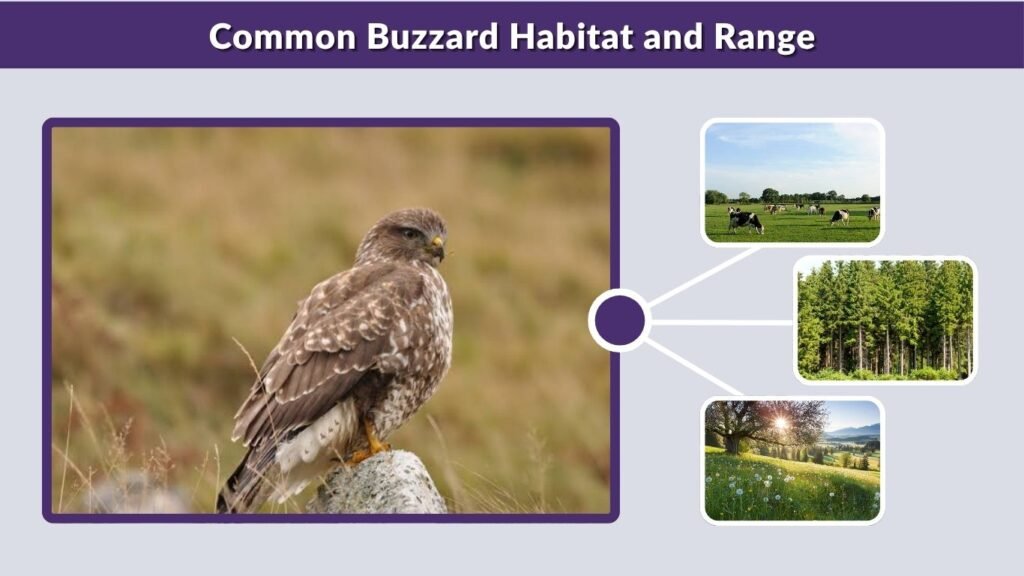
Common Buzzards need a mixture of nesting trees and open hunting areas. They are therefore strongly associated with landscapes where woods, hedgerows, grasslands, pastures, and cultivated fields occur together.
Preferred Habitat
Typical habitats include:
- Farmland and pasture
- Woodland edges
- Small woods and forest clearings
- Grasslands and meadows
- Heathland and moorland
- Wet fields and marsh edges
- Hillsides and upland valleys
They may also perch beside major roads and motorways, where roadside verges provide hunting opportunities and roadkill supplies carrion. Dense urban centers are less suitable, although buzzards may occur around wooded suburbs and rural town edges.
Geographic Range
The species occurs widely across Europe and extends eastward into western and central parts of Asia. Some populations remain within the same general area throughout the year, while others migrate or move south during winter.
In Britain, the Buzzard has recovered strongly after historical declines and is now considered the country’s most common and widespread bird of prey. It can be encountered throughout much of England, Scotland, Wales, and the eastern part of Ireland.
Common Buzzard in Flight
A soaring Common Buzzard holds its broad wings in a shallow V and often spreads its short tail into a fan. Its outer primary feathers appear separated like fingers.
The bird may circle for long periods without flapping as it rides thermal air currents. During ordinary travel, it uses several slow, powerful wingbeats followed by a glide. Its broad-winged silhouette looks compact compared with the longer-winged and longer-tailed Honey Buzzard.
Buzzards also perform aerial courtship displays. A male may climb high before descending steeply in a roller-coaster-like dive. The female may join him, and both birds may circle and call during the display.
What Does a Common Buzzard Sound Like?
The Common Buzzard produces a high, drawn-out “kee-yaa” or “pee-oo” call. It is often described as a mournful mewing noise that resembles a cat.
The call is frequently heard when birds are soaring, communicating with a mate, defending territory, or displaying during the breeding season. Young birds may also make persistent begging calls after leaving the nest.
Common Buzzard Nest and Eggs
Pairs usually build a bulky stick nest in a mature tree, frequently near the edge of woodland. In some landscapes, they may nest on rocky ledges or cliffs.
Nesting and Breeding
Both birds may contribute sticks, twigs, heather, and other materials. Fresh green leaves are commonly added to the nest lining during the breeding season.
A typical clutch contains two or three eggs, although larger and smaller clutches have been recorded. The eggs are generally white with reddish-brown markings. Incubation lasts around 34 days and is performed mainly by the female, with occasional assistance from the male.
The chicks hatch covered in down and remain dependent on their parents. They normally leave the nest approximately 44–52 days after hatching but may continue receiving food while learning to hunt. A pair usually raises only one brood each year.
Common Buzzard Lifespan
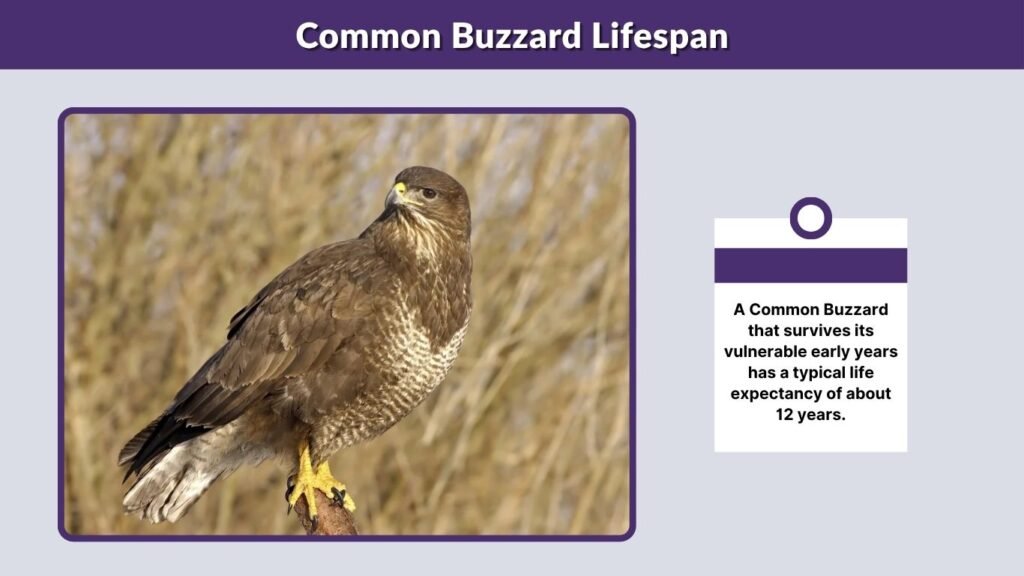
A Common Buzzard that survives its vulnerable early years has a typical life expectancy of about 12 years. Birds commonly begin breeding at approximately three years old.
Exceptional individuals can live much longer. The oldest Buzzard documented through BTO ringing data reached more than 30 years of age. Juveniles face lower survival rates than established adults because they must learn to hunt, find territories, and survive periods of limited food.
Common Buzzard vs Honey Buzzard
Despite their names and similar size, the Common Buzzard and Honey Buzzard are not members of the same genus.
| Feature | Common Buzzard | Honey Buzzard |
| Scientific name | Buteo buteo | Pernis apivorus |
| Head | Broad and heavy-looking | Small and pigeon-like |
| Tail | Shorter and fan-shaped | Longer and more strongly barred |
| Soaring wings | Held in a shallow V | Usually held flatter |
| Main diet | Mammals, birds, carrion, and worms | Wasp and bee larvae |
| UK status | Common resident | Scarce summer visitor |
Honey Buzzards have longer wings and tails, a narrower neck, and a smaller projecting head. They also specialize in opening wasp and bee nests to eat larvae rather than hunting mainly for small mammals.
Common Buzzard vs Rough-Legged Buzzard
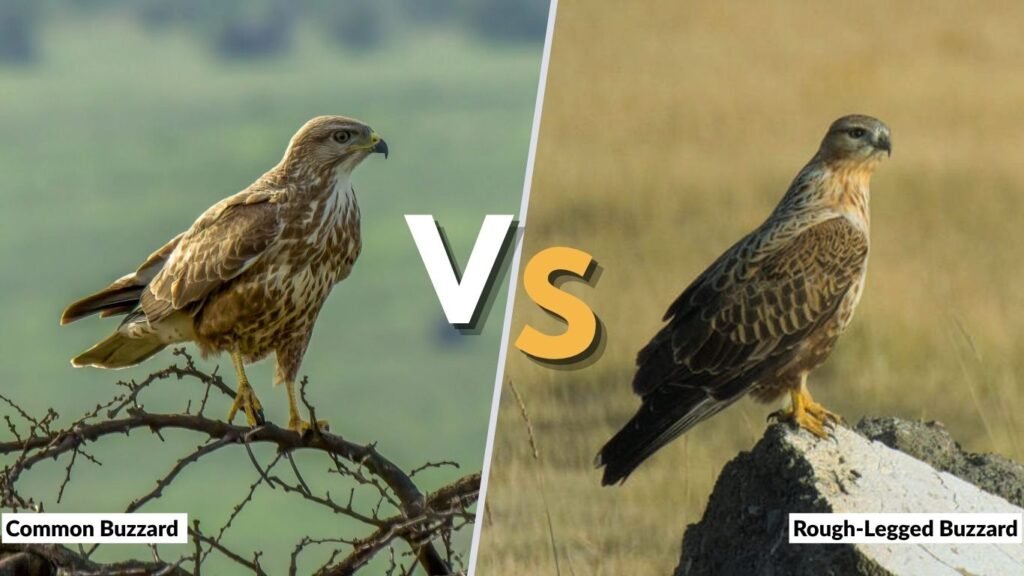
A Rough-legged Buzzard is usually paler and slightly longer-winged. It commonly has a white tail with a strong black terminal band, dark wrist patches, a pale head, and feathering down its legs.
Rough-legged Buzzards also hover more frequently while hunting. However, pale Common Buzzards can look extremely similar, so the tail pattern, leg feathering, wing proportions, and behavior should all be checked.
FAQs
Is a Common Buzzard a hawk?
Yes, in a broad sense. The Common Buzzard belongs to the Accipitridae family, which includes hawks and eagles. Birds in the genus Buteo are called buzzards in Europe but are commonly called hawks in North America.
Are Common Buzzards dangerous to humans?
Common Buzzards normally avoid people and do not hunt humans or pets. Breeding adults may become defensive near a nest, but attacks are uncommon. People should give nesting birds space and avoid handling injured or trapped raptors.
Can a Common Buzzard pick up a dog or cat?
A Common Buzzard is not large enough to carry a typical dog or adult cat. It primarily takes rodents, rabbits, small birds, amphibians, insects, and carrion. Very small unattended animals could attract curiosity, but attacks on pets are unusual.
Do Common Buzzards migrate?
Migration varies by population. Many western European birds remain near their territories year-round, while populations breeding in colder northern and eastern regions may travel south for winter. Young birds may also disperse widely while searching for territories.
What is the spiritual meaning of a Common Buzzard?
In modern symbolism, the Common Buzzard is sometimes associated with patience, observation, adaptability, and seeing situations from a wider perspective. These interpretations are cultural or personal beliefs rather than scientifically established characteristics of the bird.
