
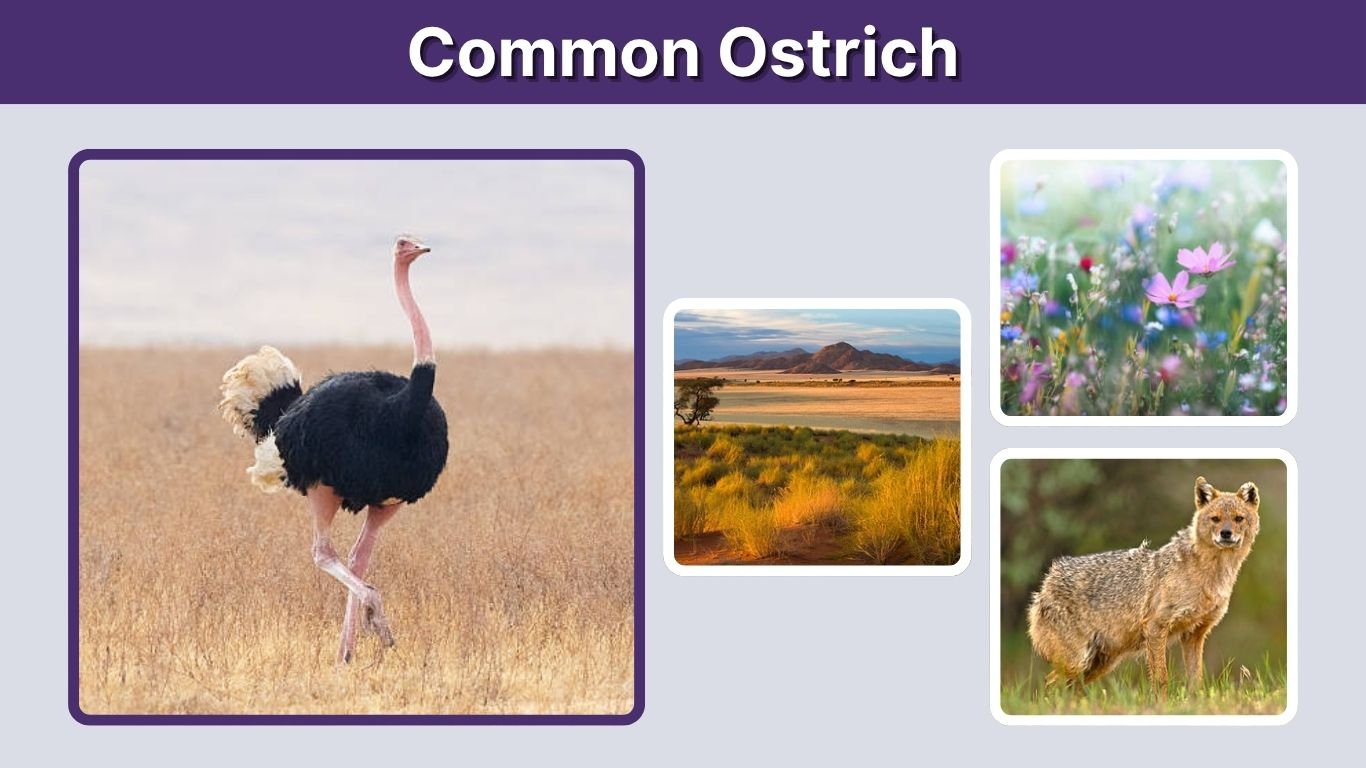
The common ostrich is the world’s largest living bird and one of Africa’s most recognizable animals. Known scientifically as Struthio camelus, this enormous flightless bird is built for life on open plains, where speed is more useful than flight. Powerful legs, two-toed feet, excellent eyesight, and a flexible diet help it survive in dry environments. Common ostriches are also known for their huge eggs, unusual courtship behavior, booming calls, and remarkable ability to run away from predators at high speed.
What Is a Common Ostrich?
The common ostrich is a large flightless bird native to Africa and belongs to the family Struthionidae. It is a ratite, placing it among other flightless birds such as emus, rheas, cassowaries, and kiwis. Unlike most birds, the common ostrich relies primarily on its legs for transportation, defense, and escaping predators.
Common Ostrich Scientific Name and Classification
The scientific name of the common ostrich is Struthio camelus.
Its basic classification includes:
- Kingdom: Animalia
- Phylum: Chordata
- Class: Aves
- Order: Struthioniformes
- Family: Struthionidae
- Genus: Struthio
- Species: Struthio camelus
- Common name: Common ostrich
Several regional forms have traditionally been recognized within the common ostrich, although classification can vary depending on the taxonomic treatment being followed.
Common Ostrich Characteristics
The common ostrich has an unmistakable appearance. Its body is covered with loose feathers, while the neck and legs have much less feathering.
Adult males generally have black body plumage with white feathers on the wings and tail. Females usually have grayish-brown feathers, which provide better camouflage around nesting areas.
The bird also has extremely large eyes, a relatively small head, a broad beak, long legs, and only two toes on each foot.
Common Ostrich Size and Height
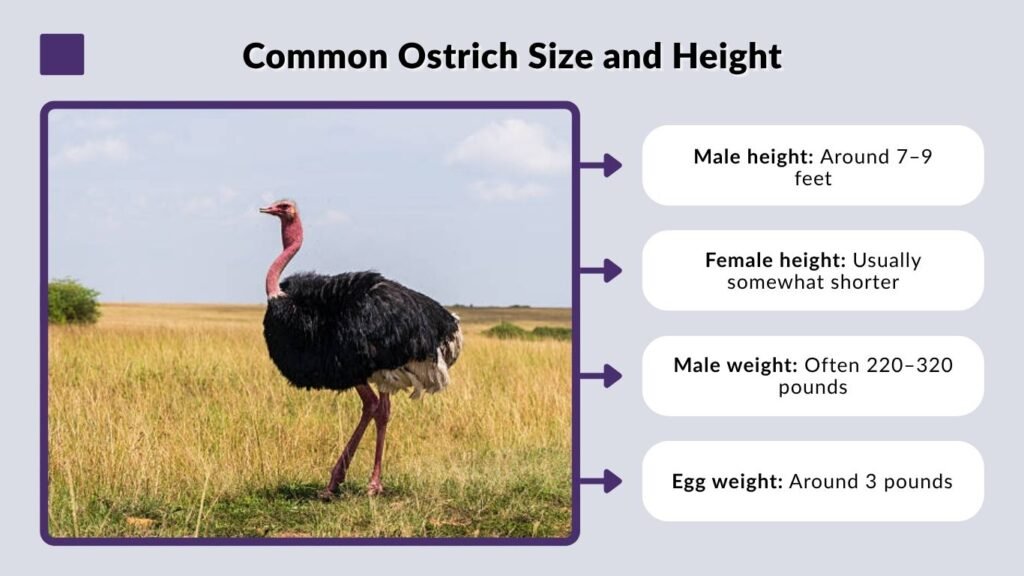
The common ostrich is considerably larger than any flying bird. Much of its impressive height comes from its long neck and extremely powerful legs. Males are generally larger than females, although body size varies with age, genetics, nutrition, and environmental conditions. Their height allows ostriches to scan open landscapes for approaching predators.
Common Ostrich Height and Weight
Typical measurements include:
- Male height: Around 7–9 feet
- Female height: Usually somewhat shorter
- Male weight: Often 220–320 pounds
- Female weight: Commonly lighter than males
- Egg weight: Around 3 pounds
- Toes: Two on each foot
- Wingspan: Large wings, despite being unable to fly
An adult common ostrich can easily stand taller than an average human.
Common Ostrich Compared to a Human
A large male ostrich may tower over an adult person. While many humans are between 5 and 6 feet tall, a mature male ostrich can approach 9 feet when standing upright.
The ostrich is also extremely heavy for a bird but distributes its body weight efficiently across its long legs.
Despite its enormous size, it can accelerate rapidly and move with surprising agility.
How Fast Is a Common Ostrich?
Because the common ostrich cannot fly, running is its most important method of escaping danger. Its anatomy is highly specialized for fast movement across open terrain. Long legs generate huge strides, strong muscles produce acceleration, and specialized feet reduce unnecessary weight while maintaining good contact with the ground.
Common Ostrich Speed
A common ostrich can reach approximately 40–45 mph during a fast sprint.
Its running abilities include:
- Powerful acceleration
- Long strides
- High top speed
- Good endurance
- Rapid changes in direction
- Efficient movement over open terrain
A full running stride can cover more than 10 feet under suitable conditions.
Why Common Ostriches Run So Fast
The ostrich’s legs contain powerful muscles positioned relatively high on the limb, while the lower legs are lighter. This arrangement helps the bird move its legs quickly without wasting excessive energy.
Its two-toed feet are another important adaptation. The larger toe helps support the bird’s weight and provides traction.
The wings are also useful while running because they can help maintain balance when the ostrich changes direction.
Common Ostrich Habitat and Range

Common ostriches are strongly associated with open African landscapes. They need enough visibility to detect predators and sufficient open ground to use their speed effectively. Dense forests would limit both advantages, so ostriches are better suited to grasslands, savannas, semi-deserts, and other relatively open habitats.
Where Do Common Ostriches Live?
Common ostriches may inhabit:
- Savannas
- Grasslands
- Semi-deserts
- Dry plains
- Shrublands
- Open woodland edges
- Arid and semi-arid regions
Their distribution occurs across parts of Africa, particularly areas providing suitable open habitat.
Common Ostrich Adaptations
Common ostriches possess numerous adaptations for hot, dry environments.
Their long legs keep much of the body away from hot ground surfaces. Areas with sparse feathers allow body heat to escape more easily, while the feathers can be repositioned according to temperature.
Excellent eyesight helps them identify distant predators, and their flexible feeding habits allow them to survive when certain foods become scarce.
What Does a Common Ostrich Eat?
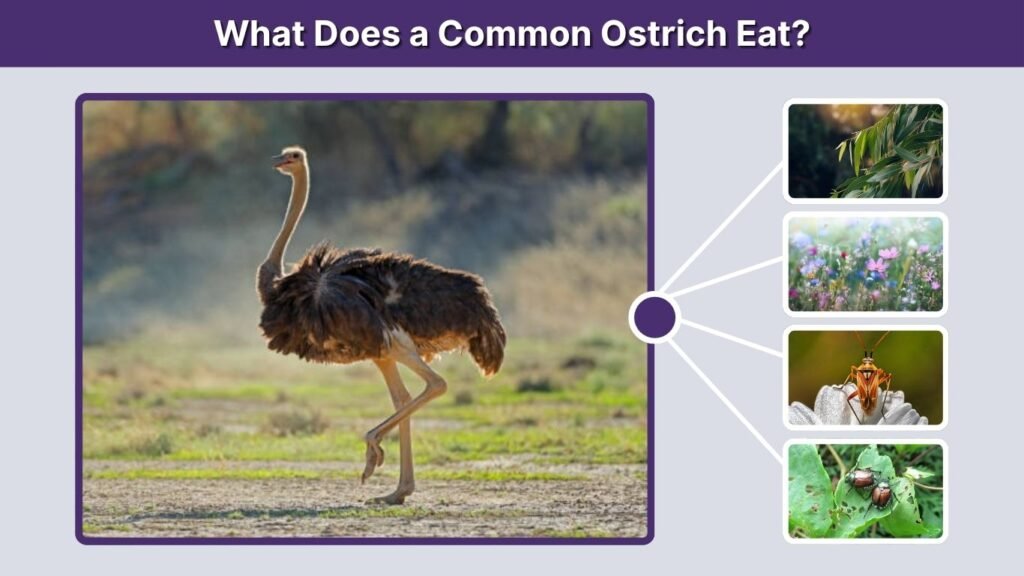
The common ostrich is an opportunistic omnivore. Plant material makes up much of its diet, but it may also consume insects and small animals when available. This flexible diet is valuable in environments where food availability changes with rainfall, temperature, and season.
Common Ostrich Diet
Common foods include:
- Grass
- Seeds
- Leaves
- Roots
- Flowers
- Fruits
- Shrubs
- Insects
- Grasshoppers
- Beetles
- Small reptiles
- Other small animals
Ostriches do not have teeth, so they cannot chew food in the way mammals do.
How Common Ostriches Digest Food
Common ostriches deliberately swallow small stones and grit.
These materials travel into the gizzard, a powerful muscular part of the digestive system. The stones help grind hard seeds and tough vegetation into smaller pieces.
This process performs a function similar to chewing and allows ostriches to process fibrous foods effectively even though they lack teeth.
Common Ostrich Eggs and Life Cycle
Reproduction begins with elaborate courtship behavior. Males may display their wings, move their bodies dramatically, and perform movements intended to attract females. Eggs are laid in shallow nests on the ground, and several females may sometimes contribute eggs to the same nesting area.
Common Ostrich Eggs
Common ostrich eggs have several notable features:
- Largest eggs of any living bird
- Weight of roughly 3 pounds
- Thick, strong shell
- Creamy-white coloration
- Incubation period of around six weeks
- Laid in ground nests
Despite their enormous absolute size, ostrich eggs are relatively small compared with the body weight of the adult female.
Common Ostrich Chicks
Baby common ostriches are called chicks. They hatch with striped and mottled feathers that provide camouflage against dry ground and vegetation.
Chicks can walk soon after hatching and quickly begin following adults.
Young ostriches grow rapidly, developing longer legs, stronger muscles, and improved running ability. Their patterned juvenile plumage gradually changes as they mature.
Common Ostrich Lifespan
A common ostrich can potentially live for several decades, especially after surviving its vulnerable early years.
Eggs and chicks face significant predation, while healthy adults have fewer natural enemies because of their large size, speed, sharp eyesight, and powerful defensive kicks.
Food availability, disease, habitat conditions, and predation all influence lifespan in wild birds.
Common Ostrich Predators and Defense
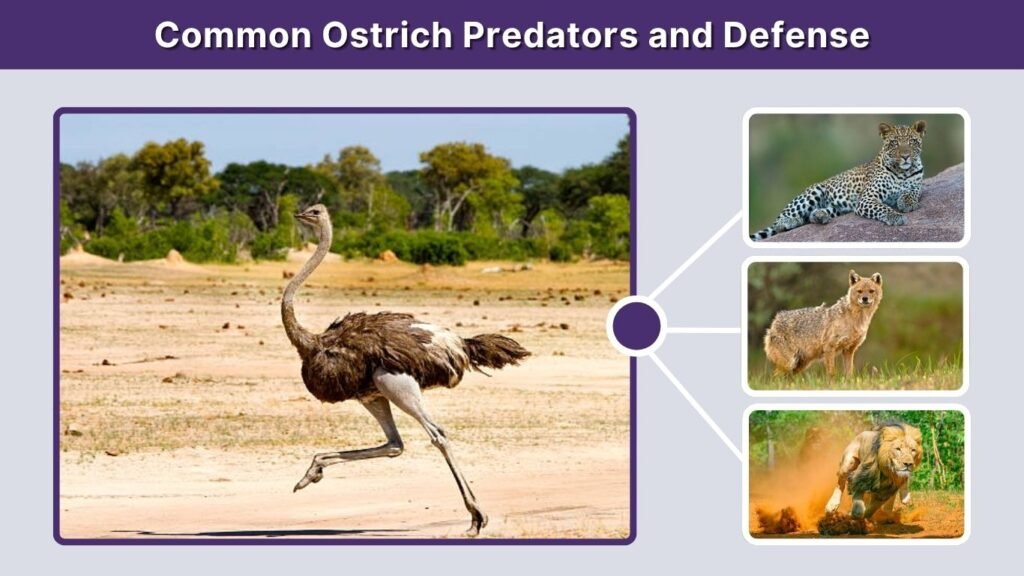
Adult common ostriches are formidable animals, but they still face large African predators. Young ostriches and eggs are much more vulnerable. Their survival strategies therefore combine excellent vision, group awareness, camouflage, running, and physical defense.
Common Ostrich Predators
Potential predators include:
- Lions
- Leopards
- Cheetahs
- Hyenas
- Jackals
- Large birds of prey that may target chicks
- Other opportunistic predators of eggs
Adults usually attempt to escape danger by running before physically confronting a predator.
How Common Ostriches Defend Themselves
If cornered, an ostrich can deliver extremely powerful forward kicks.
Its long leg acts as a powerful weapon, while the large claw on the main toe can cause serious injury.
Parents can become especially defensive around nests or young chicks. This is one reason people should never assume that a captive or apparently calm ostrich is harmless.
Common Ostrich Sounds and Behavior
Common ostriches communicate through body posture, movements, and vocalizations. They may travel individually, in pairs, or in groups depending on season and environmental conditions. Social behavior becomes especially noticeable during breeding, when males establish territories and perform courtship displays.
What Sound Does a Common Ostrich Make?
Male ostriches can produce surprisingly deep booming sounds, particularly during breeding periods.
Common ostrich sounds can include:
- Deep booms
- Hissing
- Whistling
- Low calls
- Chick vocalizations
The male’s booming call can travel over considerable distances and may sound unexpected coming from a bird.
Do Common Ostriches Bury Their Heads?
No. Common ostriches do not bury their heads in sand to hide from danger.
The myth probably developed because nesting ostriches frequently lower their heads close to the ground while checking or turning their eggs.
When viewed from far away, the small head and neck may blend into the landscape, creating the illusion that the bird has placed its head underground.
Common Ostrich vs. Somali Ostrich
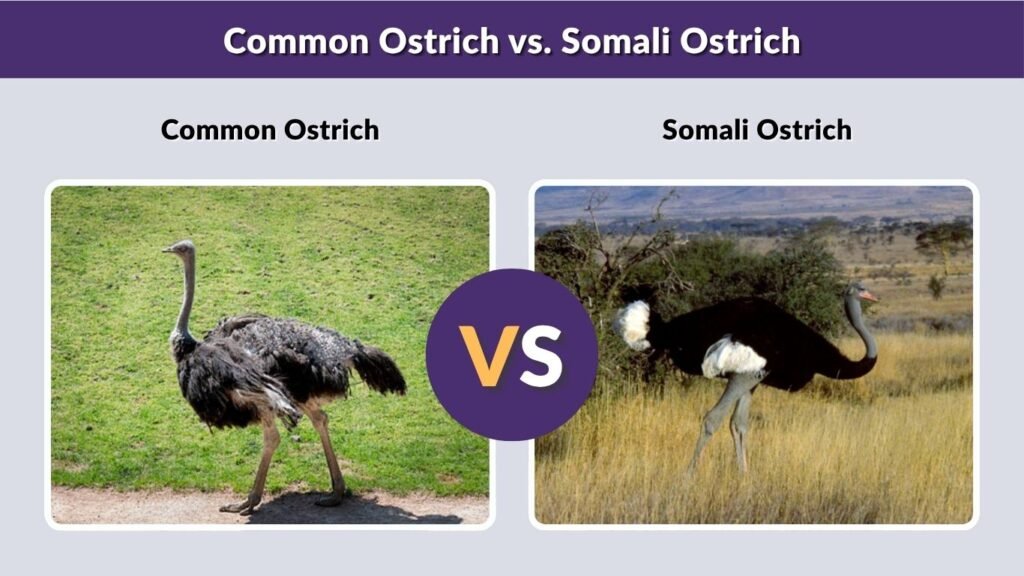
The Somali ostrich and common ostrich are closely related but recognized as separate species. Both are enormous flightless birds adapted to running across dry African landscapes, yet differences in coloration, geographic distribution, and physical appearance can help distinguish them.
Main Differences
| Feature | Common Ostrich | Somali Ostrich |
| Scientific name | Struthio camelus | Struthio molybdophanes |
| Distribution | Several parts of Africa | Mainly northeastern Africa |
| Male neck color | Often pinkish or reddish | Typically bluish-gray |
| Size | Very large | Very large |
| Toes | Two | Two |
| Flight ability | Flightless | Flightless |
Both species rely heavily on speed, excellent vision, and powerful legs for survival.
FAQs
1. What is the scientific name of the common ostrich?
The scientific name of the common ostrich is Struthio camelus. It belongs to the family Struthionidae and is one of the world’s largest and most distinctive flightless birds.
2. How fast can a common ostrich run?
A common ostrich can reach roughly 40–45 mph when sprinting. Its long muscular legs, lightweight lower limbs, two-toed feet, and long stride make it exceptionally well adapted for high-speed running.
3. What does a common ostrich eat?
Common ostriches mainly eat grasses, seeds, leaves, flowers, roots, and fruits. They are opportunistic omnivores and can also consume insects, small reptiles, and other small animals when those foods are available.
4. Where does the common ostrich live?
Common ostriches live in parts of Africa, primarily occupying open habitats such as savannas, grasslands, semi-deserts, shrublands, and dry plains where they have enough visibility and room to run.
5. Can a common ostrich fly?
No. The common ostrich is completely flightless. Its body is specialized for running rather than flying. Although its wings cannot lift it into the air, they remain useful for courtship displays, balance, communication, and protecting chicks.
