
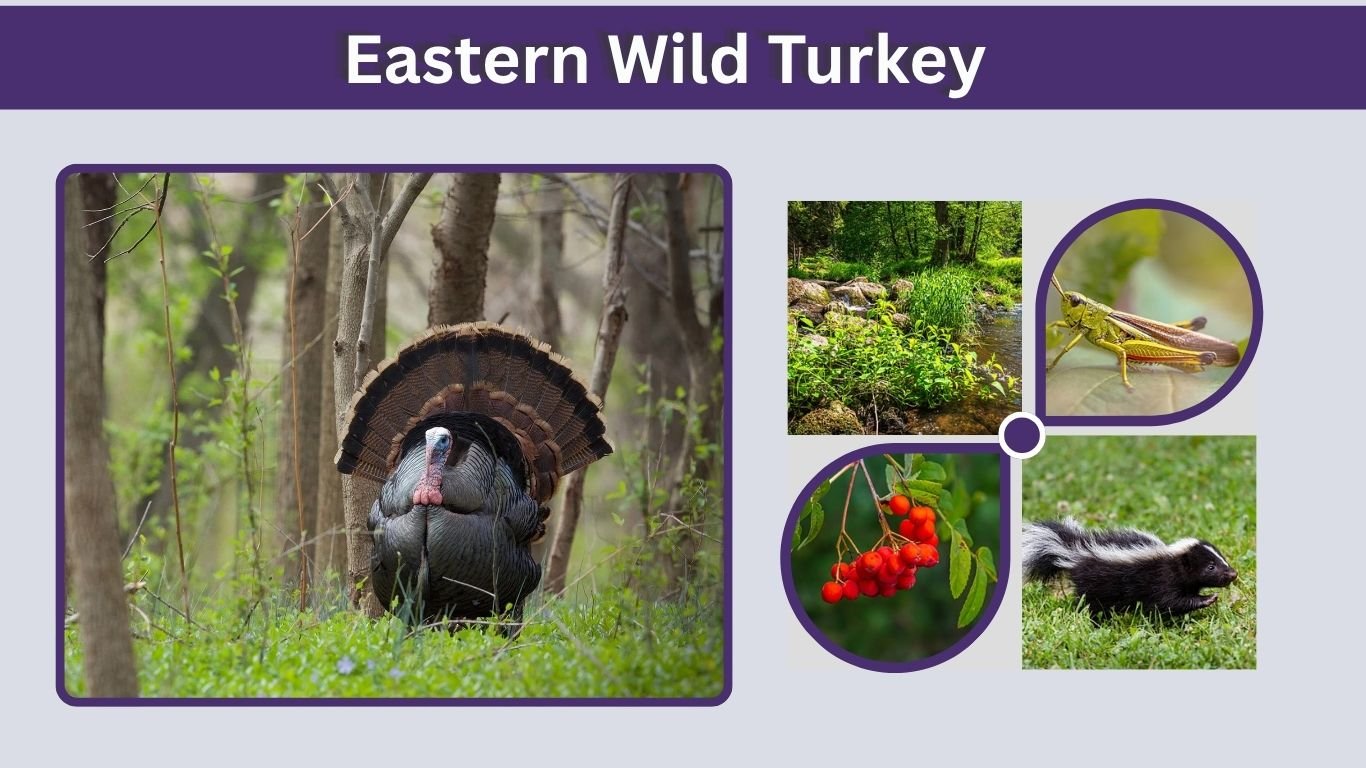
The Eastern wild turkey is the largest and most widespread wild turkey subspecies in North America. Recognized by its dark, iridescent body, chestnut-brown tail tips, powerful legs, and heavily barred wings, it inhabits forests, farms, swamps, and woodland clearings across the eastern United States. Eastern turkeys spend most of their time walking and feeding on the ground but fly into trees to sleep at night. Males are famous for their spring gobbling and elaborate strutting displays, while females build concealed ground nests and raise the poults alone. Their adaptable diet includes acorns, seeds, fruits, vegetation, insects, and other small animals.
What Is an Eastern Wild Turkey?
The Eastern wild turkey, scientifically named Meleagris gallopavo silvestris, is one of the recognized subspecies of the North American wild turkey. It belongs to the pheasant family, Phasianidae.
It is the most widely distributed wild turkey subspecies east of the Mississippi River and occurs across much of the eastern and central United States. Its range overlaps with other turkey subspecies in some areas, making individual identification difficult where birds have been relocated or populations have interbred.
Scientific Classification
| Category | Classification |
| Kingdom | Animalia |
| Class | Aves |
| Order | Galliformes |
| Family | Phasianidae |
| Genus | Meleagris |
| Species | Meleagris gallopavo |
| Subspecies | Meleagris gallopavo silvestris |
What Does an Eastern Wild Turkey Look Like?
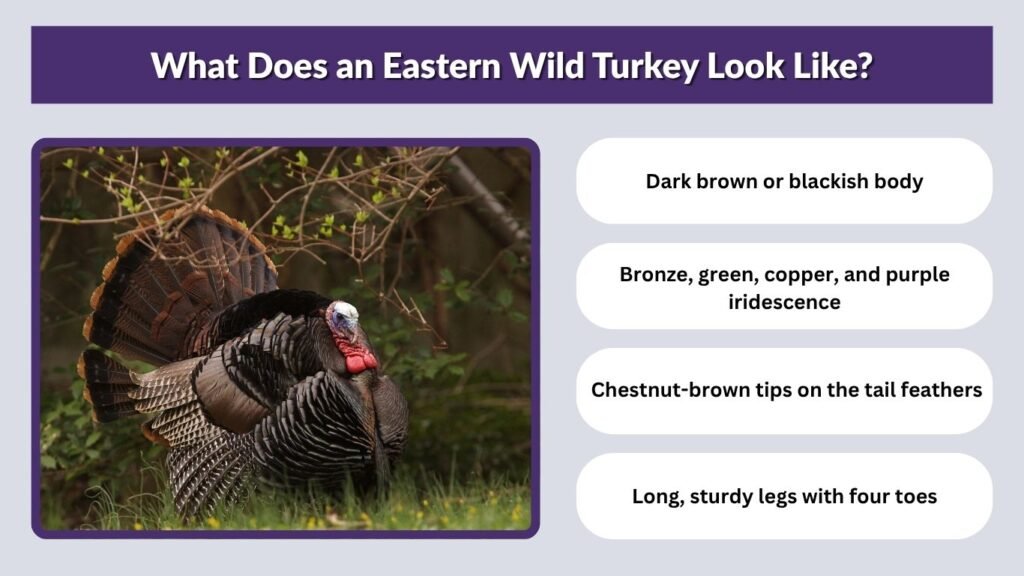
Eastern wild turkeys are large, long-legged birds with broad bodies, relatively small heads, powerful feet, and rounded tails. Their feathers may look black or dark brown from a distance, but direct sunlight reveals bronze, copper, green, blue, and purple iridescence.
Identification
- Dark brown or blackish body
- Bronze, green, copper, and purple iridescence
- Chestnut-brown tips on the tail feathers
- Strong black-and-white barring across the wings
- Long, sturdy legs with four toes
- Small, mostly featherless head
- Red, blue, white, or gray head and neck skin
- Long, hair-like breast beard on most males
- Broad tail that opens into a rounded fan
- Males usually have black-tipped breast feathers
- Females generally have buff-tipped breast feathers
The chestnut-brown tail border is one of the easiest ways to separate an Eastern turkey from a pale-tipped Merriam’s or Gould’s turkey.
Eastern Wild Turkey Size
Eastern wild turkeys are among the largest birds regularly found in eastern forests. Adult males, called toms or gobblers, commonly weigh approximately 16–25 pounds, although exceptionally large individuals can weigh more.
Adult females, called hens, are usually much lighter and commonly weigh around 8–12 pounds. A fully upright adult may stand approximately 3–4 feet tall.
| Feature | Male | Female |
| Common name | Tom or gobbler | Hen |
| Typical weight | 16–25 pounds | 8–12 pounds |
| Body appearance | Large and heavily iridescent | Smaller and browner |
| Head coloring | Bright red, blue and white | Usually dull blue-gray |
| Beard | Common | Occasionally present |
| Spurs | Usually present | Usually absent |
Body size varies with age, food availability, genetics, season, and local habitat.
Male vs. Female Eastern Wild Turkey
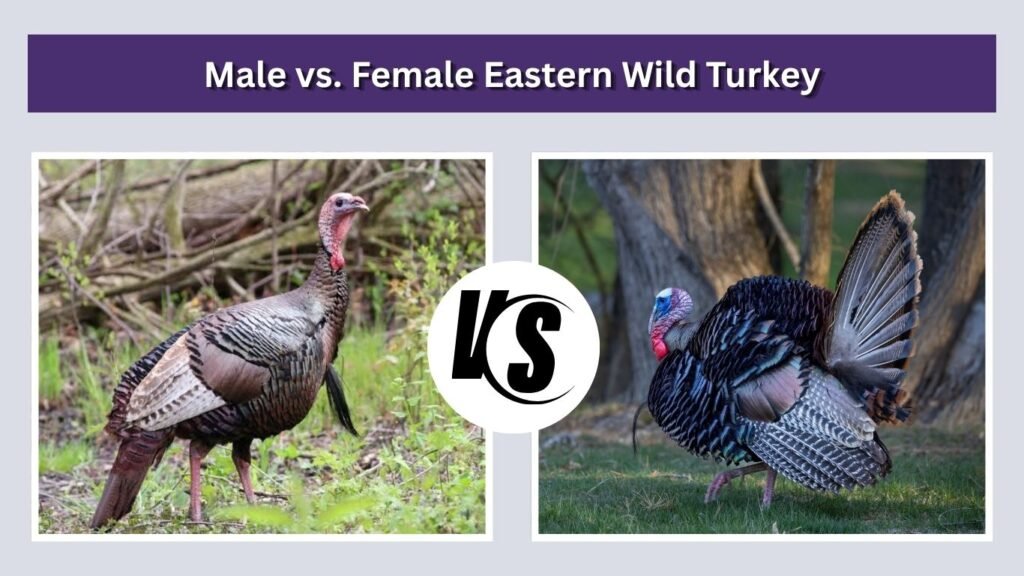
Male and female Eastern turkeys differ considerably in appearance and behavior.
Eastern Wild Turkey Gobbler
An adult male has dark, glossy feathers, a large body, a bare colorful head, a fleshy snood above the beak, and wattled skin along the neck. His head may change color rapidly during courtship or agitation.
Mature males usually develop leg spurs and a beard projecting from the breast. During spring, a tom spreads his tail, lowers his wings, raises his body feathers, and struts while gobbling to attract hens.
A young male is called a jake. Jakes are smaller, usually have short beards and rounded central tail feathers that extend above the remaining feathers when the fan is spread.
Eastern Wild Turkey Hen
A hen has duller brown plumage that helps her blend into leaves and vegetation while nesting. Her head is smaller and less brightly colored, and she normally lacks noticeable spurs.
Some hens develop breast beards, so the presence of a beard does not always prove that a turkey is male. Breast-feather tips are often more dependable: males generally have dark tips, while hens usually have buff-colored edges.
Eastern Wild Turkey Feathers and Fan
Eastern turkey feathers provide camouflage, insulation, display, and flight. The body feathers have microscopic structures that reflect light, creating their characteristic metallic colors.
The wings contain strong black-and-white barring. Compared with the darker Osceola turkey, an Eastern turkey generally displays more white across its folded and extended wing feathers.
The tail fan contains broad feathers ending in warm chestnut or chocolate-brown bands. Male turkeys spread the fan during courtship and dominance displays, although females can also fan their tails when alarmed or defensive.
Rare color variations include smoke-gray, reddish, blackish, and unusually pale plumage. A light-colored wild turkey is not necessarily an albino; many retain normally colored eyes, skin, and some pigmented feathers.
Eastern Wild Turkey Habitat and Range
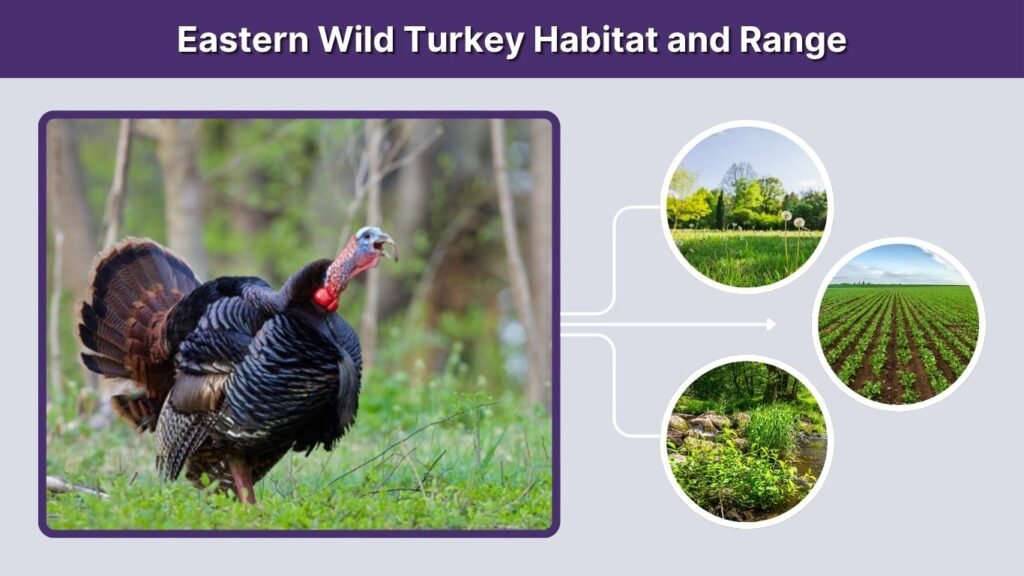
Eastern wild turkeys occupy deciduous and mixed forests across the eastern half of North America. Their habitat extends from portions of the northern United States and southern Canada into Texas and the Southeast, excluding much of peninsular Florida, where the Osceola subspecies occurs.
They need a varied landscape rather than uninterrupted mature forest.
Preferred Habitat
Suitable turkey habitat includes:
- Oak and hickory forests
- Mixed hardwood and pine woodland
- Forest openings and meadows
- Agricultural field edges
- Brushy clearings
- Swamps and wooded wetlands
- Streamside forests
- Recently burned or managed woodland
- Areas with mature roosting trees
Mature trees provide safe nighttime roosts, while open areas supply seeds, green plants, insects, and brood-rearing habitat. Dense grasses and shrubs provide nesting cover for hens.
What Do Eastern Wild Turkeys Eat?
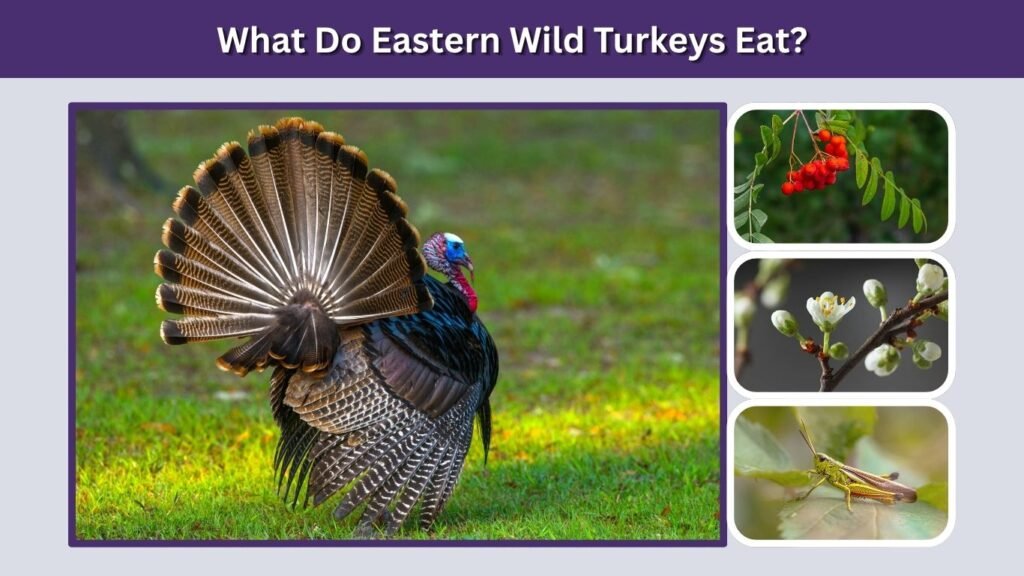
Eastern wild turkeys are opportunistic omnivores. Adults obtain most of their food from plants but also consume many insects and small animals.
Common Foods
Their diet includes:
- Acorns
- Beech and ash seeds
- Hickory nuts
- Berries and wild fruits
- Grasses and grass seeds
- Green leaves
- Flowers and buds
- Tubers and roots
- Corn and other waste grain
- Grasshoppers
- Beetles and caterpillars
- Snails, spiders, and other invertebrates
- Occasional small amphibians or reptiles
Acorns are particularly important during fall and winter in hardwood forests. Turkeys scratch through leaves with their strong feet to uncover nuts, seeds, insects, and other food.
Diet of Eastern Turkey Poults
Newly hatched poults need protein for rapid feather, bone, and muscle development. Their early diet consists largely of grasshoppers, beetles, spiders, and other invertebrates.
Hens lead their broods through grassy openings where insects are abundant and vegetation is short enough for poults to move through. As the young grow, they gradually consume more fruits, seeds, leaves, and other plant material.
Eastern Wild Turkey Behavior and Sounds
Eastern wild turkeys are active during daylight. They normally leave their tree roosts near sunrise, feed and travel through the morning, rest or dust-bathe around midday, and forage again before flying up to roost near sunset.
They communicate through numerous vocalizations, including gobbles, clucks, purrs, yelps, cutts, whistles, and alarm calls.
The male’s gobble is the best-known sound and is mainly associated with spring courtship. Gobbling helps hens locate males but may also reveal a male’s position to predators or competing gobblers.
Despite their heavy appearance, wild turkeys can run quickly and make powerful short flights. They usually fly to escape immediate danger, cross obstacles, or reach their nighttime roosts.
Eastern Wild Turkey Nesting, Eggs, and Poults
The hen builds a shallow nest on the ground beneath shrubs, fallen branches, tall grass, or other concealing vegetation. She lines the depression lightly with leaves and plant material.
A hen generally lays one egg per day until the clutch contains approximately 8–15 eggs, with around 10–12 being common. Incubation lasts roughly 28 days and begins after most or all eggs have been laid, allowing the poults to hatch close together.
Raising the Poults
Turkey poults are covered with down and can walk soon after hatching. The hen leads them away from the nest to find insects and shelter.
The male does not help incubate eggs or care for the young. Poults initially sleep on the ground beneath or beside their mother, making them vulnerable to cold rain and predators.
At around two weeks old, poults begin making short flights and may roost in low trees with the hen.
Eastern Wild Turkey Lifespan and Predators
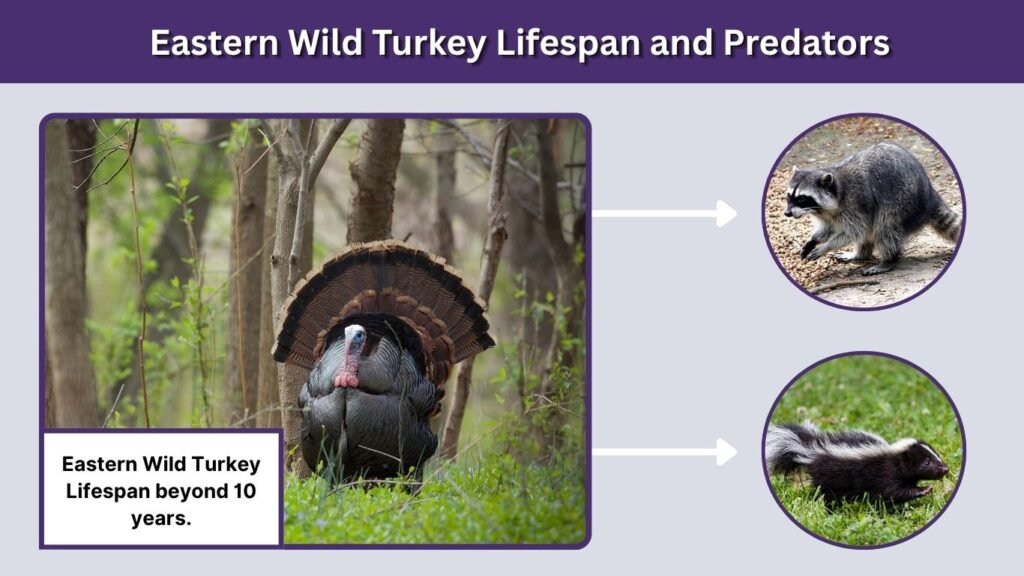
Wild turkey mortality is highest during the egg and poult stages. Nests may be raided by raccoons, opossums, skunks, snakes, foxes, crows, and other predators.
Poults may be taken by hawks, owls, bobcats, coyotes, foxes, and domestic or feral animals. Adult turkeys are powerful and alert but can still be killed by large predators.
Many wild turkeys live fewer than two years because of predation, weather, disease, habitat conditions, and other pressures. Individuals that reach adulthood may survive much longer, with some wild birds living beyond 10 years.
Eastern vs. Other Wild Turkey Subspecies
| Subspecies | Main distinguishing feature |
| Eastern | Chestnut-brown fan tips and strong wing barring |
| Rio Grande | Tan or buff fan tips; associated with central plains |
| Merriam’s | Cream or nearly white fan and rump tips |
| Osceola | Darker wings with limited white barring |
| Gould’s | Broad white fan tips and generally long legs |
An Eastern turkey may be difficult to distinguish in areas where subspecies were introduced or hybridized. Tail-tip color, wing barring, geography, and overall plumage should be considered together rather than relying on one feature.
FAQs
What is the Eastern wild turkey’s scientific name?
The scientific name is Meleagris gallopavo silvestris. It is a subspecies of the North American wild turkey rather than a separate species.
Where do Eastern wild turkeys sleep?
They usually sleep on sturdy branches in mature trees. Roosting above the ground protects them from many nighttime predators, although hens with very young poults initially sleep on the ground.
Can Eastern wild turkeys fly?
Yes. They are strong but short-distance fliers. They commonly fly into roost trees, cross rivers or roads, and escape danger, but most daily feeding and travel occur on foot.
How many eggs does an Eastern turkey lay?
A hen commonly lays approximately 10–12 eggs, although a clutch may contain 8–15. She generally deposits one egg per day before beginning continuous incubation.
Are Eastern wild turkeys aggressive?
Wild turkeys usually avoid people. However, males may chase or confront people during breeding season, particularly in suburban areas where they have become accustomed to being fed.
