
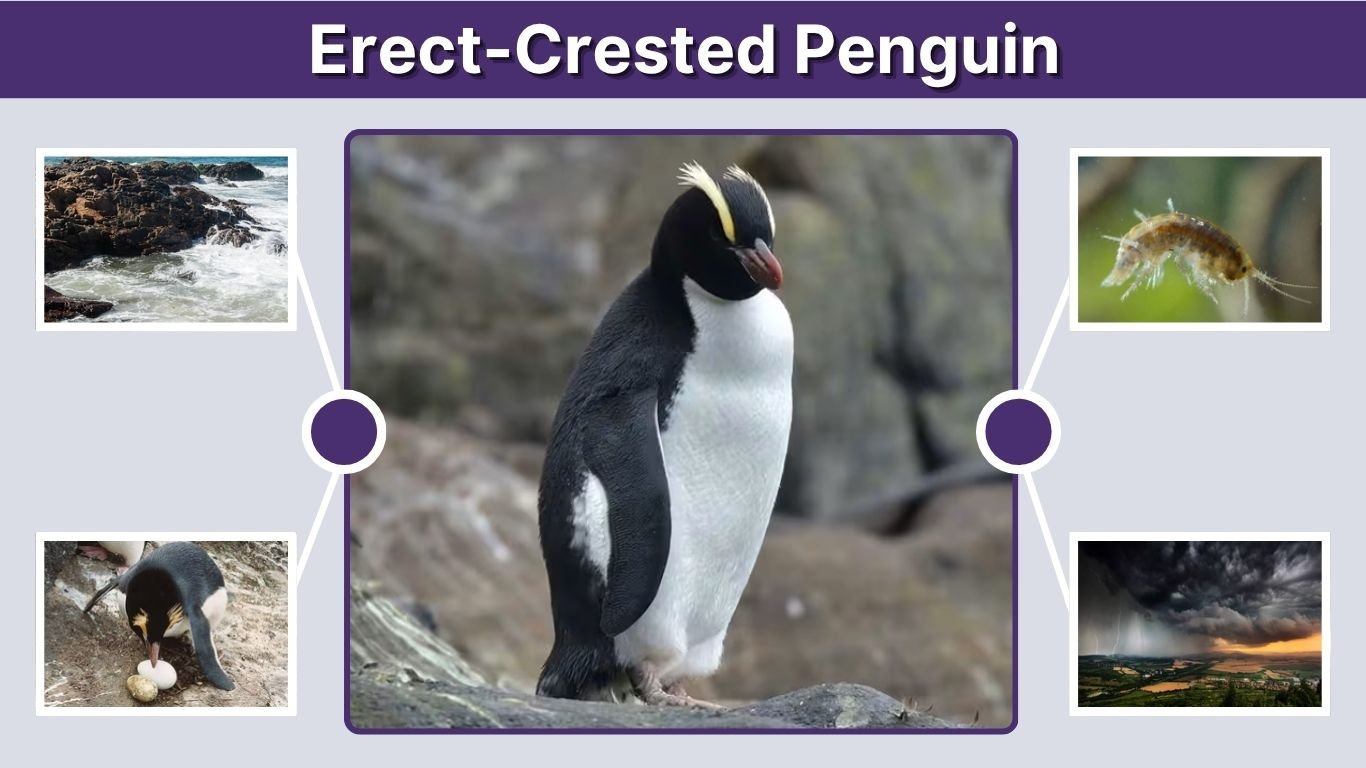
The erect-crested penguin (Eudyptes sclateri) is a rare crested penguin found primarily on remote subantarctic islands belonging to New Zealand. Named for the striking yellow feathers that stand upright above its eyes, this penguin spends most of its life at sea and returns to land mainly for breeding and moulting. Its unusual breeding behavior, restricted nesting range, and declining conservation status make it especially interesting. This guide covers erect-crested penguin habitat, diet, size, population, predators, adaptations, breeding, and other fascinating facts.
What Is an Erect-Crested Penguin?
The erect-crested penguin is one of several species in the genus Eudyptes, a group recognized for colorful yellow head crests. It is endemic to New Zealand and breeds predominantly on the Antipodes and Bounty Islands. Compared with many penguins, relatively little is known about its life because its breeding colonies occupy remote and difficult-to-access islands.
Erect-Crested Penguin Identification
- Scientific name: Eudyptes sclateri
- New Zealand name: Tawaki nana hī
- Family: Spheniscidae
- Length: Around 65 cm
- Weight: Approximately 4 kg
- Back and head: Black
- Underparts: White
- Bill: Large and orange-brown
- Eyes: Reddish-brown
- Crest: Bright yellow feathers extending above the eyes
The yellow eyebrow feathers rise prominently when erect, producing the distinctive appearance responsible for the species’ common name.
What Does an Erect-Crested Penguin Look Like?
Adult erect-crested penguins have the familiar black-and-white coloring of many penguins, but their head markings immediately stand out. Yellow stripes begin near the bill and rise backward over the eyes into prominent crests.
The large orange-brown bill has conspicuous pale skin around its base. Young birds have smaller bills and less impressive crest feathers than mature adults.
Erect-Crested Penguin Habitat and Range
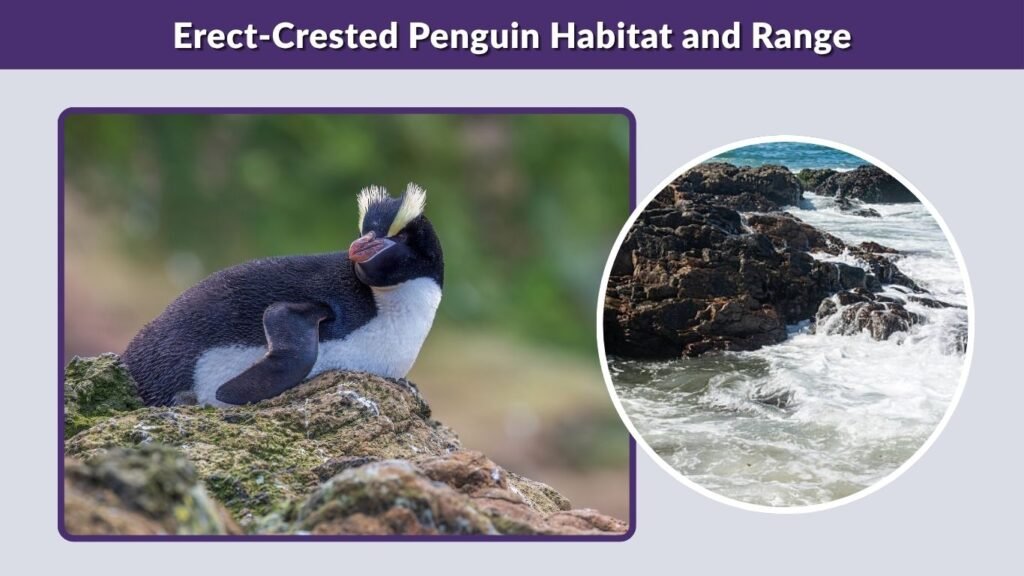
Erect-crested penguins have one of the more restricted breeding ranges among penguins. Almost the entire breeding population is concentrated on islands far south of mainland New Zealand. They come ashore primarily for breeding and moulting and are thought to spend the remainder of the year roaming offshore waters, although their nonbreeding distribution remains poorly understood.
Where Does the Erect-Crested Penguin Live?
Nearly all erect-crested penguins breed on the Antipodes Islands and Bounty Islands. Colonies on Antipodes Island occur along rocky coastal margins, while the largely vegetation-free Bounty Islands provide exposed rocky nesting locations.
Away from the breeding season, occasional individuals have been recorded around the Snares, Auckland, Campbell, Chatham and Macquarie Islands, mainland New Zealand, and even farther away.
Life at Sea
Once breeding and moulting are finished, erect-crested penguins become largely pelagic, meaning they spend extended periods at sea.
Their exact winter distribution remains uncertain. Observations suggest they range widely through waters southeast of New Zealand and potentially farther across the Southern Ocean region. This marine lifestyle makes studying their feeding movements and annual survival particularly challenging.
Erect-Crested Penguin Diet
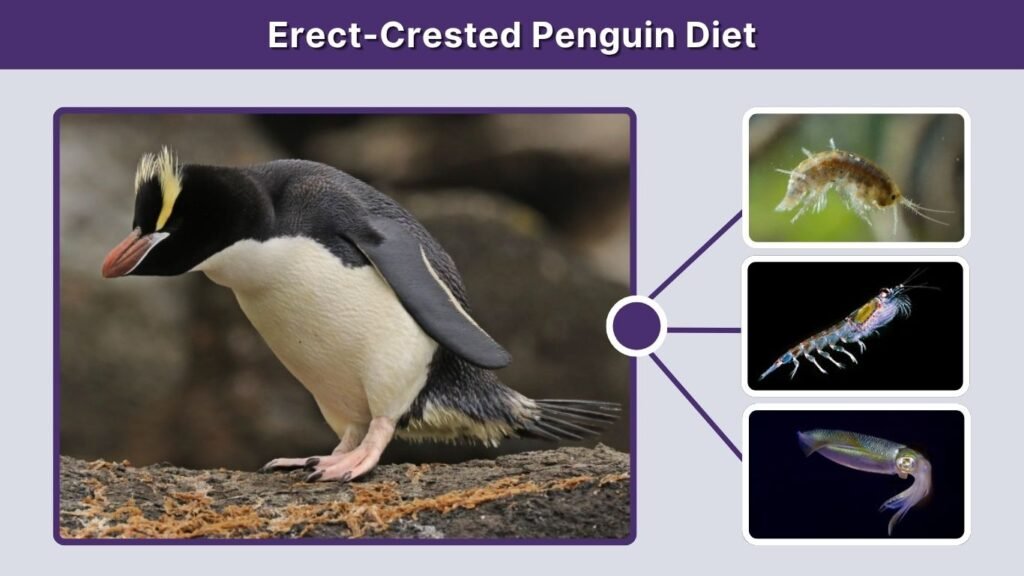
The erect-crested penguin is a marine predator that captures its food underwater. Scientific information about its complete diet remains limited compared with better-studied penguins because feeding areas around its remote colonies are difficult to observe. Available evidence indicates that small marine invertebrates form an important part of its food supply.
What Do Erect-Crested Penguins Eat?
Their known diet includes:
- Small crustaceans
- Krill-like marine organisms
- Squid
- Other small marine prey
Their exact diet probably changes according to season, prey availability, and feeding location.
How Do They Feed?
Like other penguins, erect-crested penguins use their wings as powerful flippers instead of flying through the air. Their streamlined bodies allow them to pursue prey underwater efficiently.
Adults breeding in colonies may forage in small groups near their islands. Because researchers still know relatively little about their offshore movements, their typical diving depths and detailed feeding strategies remain subjects for further study.
Erect-Crested Penguin Size and Adaptations
At roughly 65 cm long and around 4 kg, the erect-crested penguin is a medium-to-large member of the crested penguin group. Its body is highly adapted to life in cold marine environments. Dense plumage, strong flippers, and a compact shape help it travel efficiently through the ocean while retaining body heat.
Important Physical Adaptations
- Streamlined body for efficient swimming
- Strong flippers for underwater propulsion
- Dense feathers that provide insulation
- Black-and-white countershading
- Webbed feet for swimming and movement on rocks
- Strong legs for negotiating rugged nesting areas
- Body fat that helps conserve heat
- Specialized waterproof plumage
Annual Moult
Penguins cannot gradually replace flight feathers like most flying birds. Instead, they undergo a rapid annual moult in which their old feathers are replaced over a relatively short period.
Adult erect-crested penguins generally moult around late February through early April. Individual birds remain ashore for approximately 26–30 days while their new plumage develops.
Erect-Crested Penguin Breeding and Life Cycle
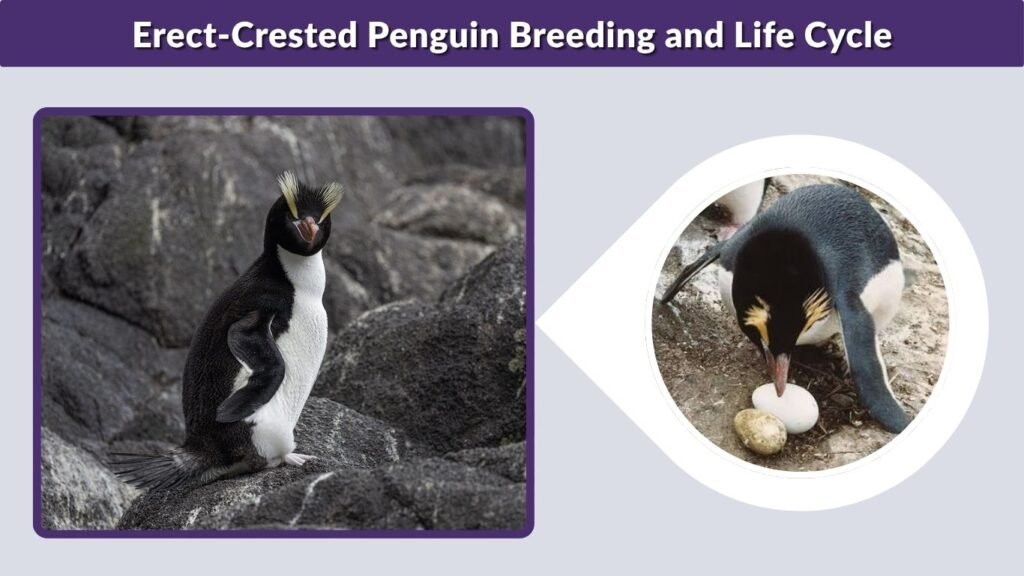
One of the most fascinating characteristics of the erect-crested penguin is its unusual breeding strategy. Pairs generally produce two dramatically different-sized eggs. Almost all breeding occurs in dense colonies on the Antipodes and Bounty Islands, where birds establish simple nests among rocky coastal terrain.
Eggs and Breeding
A typical pair lays two eggs roughly four days apart. Surprisingly, the second egg is much larger than the first—the difference is more extreme than in any other living bird species documented by New Zealand Birds Online.
The smaller first egg is usually lost around the time the second egg is laid. Researchers still do not fully understand why erect-crested penguins continue producing this smaller first egg.
From Egg to Chick
Incubation lasts approximately 35 days and is shared between the parents. Once the surviving chick hatches, it remains dependent on its parents for warmth, protection, and food.
Young birds eventually become more independent and typically fledge at approximately 75 days old. After leaving the colony, juveniles begin the marine stage of their lives.
Erect-Crested Penguin Population and Conservation
The erect-crested penguin has a relatively small global breeding population concentrated in only a few locations. That restricted range creates conservation concerns even though its main breeding islands lack many introduced predators. Evidence from historical photographs also indicates that some colonies on the Antipodes Islands have declined substantially over time.
Erect-Crested Penguin Population
New Zealand Birds Online gives estimates of approximately:
- 42,500 breeding pairs on the Antipodes Islands
- 26,000 breeding pairs on the Bounty Islands
- About 68,500 breeding pairs worldwide
These figures are estimates, and monitoring such isolated colonies is difficult.
Is the Erect-Crested Penguin Endangered?
Yes, internationally the erect-crested penguin is listed as Endangered by BirdLife International/IUCN criteria. Within New Zealand’s national classification, it is categorized as At Risk – Declining.
Its limited breeding distribution means that large environmental changes affecting only a few islands or surrounding marine areas could potentially influence a significant proportion of the entire species.
Erect-Crested Penguin Predators and Threats
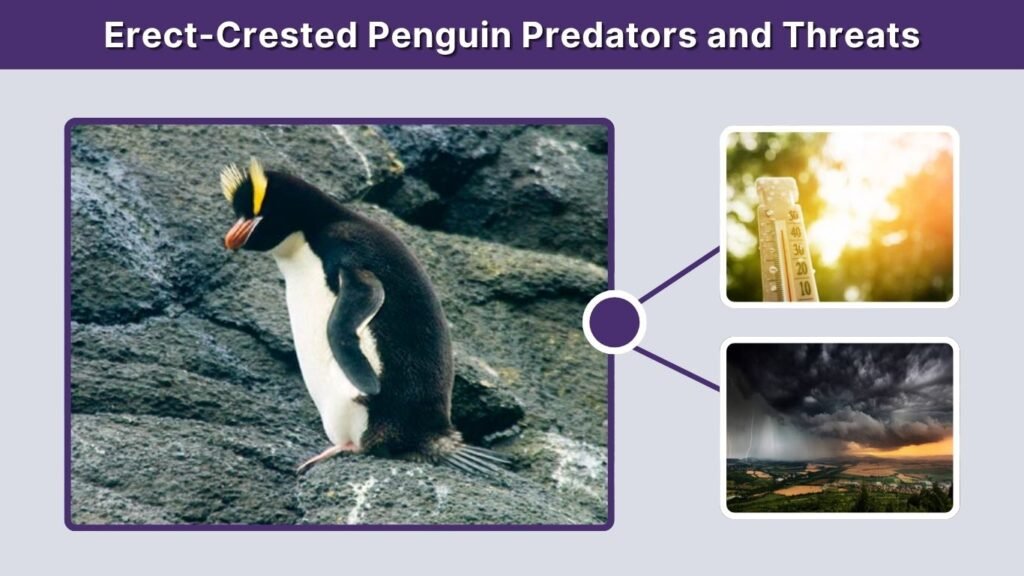
Erect-crested penguins breed on isolated islands that are comparatively protected from many land predators introduced elsewhere in New Zealand. Nevertheless, survival depends heavily on conditions at sea. Researchers suspect that changes to local ocean productivity and prey availability may be important reasons behind historical declines in some colonies.
Major Potential Threats
- Changes in ocean productivity
- Reduced availability of marine prey
- Climate-related changes to marine ecosystems
- Extreme weather
- Natural marine predators
- Disturbance of limited breeding habitat
- Risks associated with having a highly restricted breeding range
Interestingly, New Zealand Birds Online reports no recognized major fisheries interaction for the species at present.
Why Climate Change Matters
Changes in ocean temperature and circulation can alter where fish, squid, and crustaceans occur. If prey moves farther from breeding colonies, adults may need to travel longer distances to obtain enough food for themselves and their chicks.
New Zealand conservation research has identified the erect-crested penguin among seabirds with high vulnerability to climate change.
Interesting Erect-Crested Penguin Facts
Erect-crested penguins remain among the least thoroughly studied penguins because researchers must reach extremely isolated breeding sites. What scientists have discovered reveals an unusual species with fascinating reproductive behavior and a lifestyle closely tied to the productive waters surrounding New Zealand’s subantarctic islands.
Quick Fun Facts
- Its scientific name is Eudyptes sclateri.
- It breeds mainly on the Bounty and Antipodes Islands.
- Adults grow to roughly 65 cm long.
- The average weight is around 4 kg.
- It lays two unusually different-sized eggs.
- The second egg averages far larger than the first.
- Usually only the second egg contributes to successful reproduction.
- Incubation lasts about 35 days.
- Chicks generally fledge at around 75 days.
- Adults spend roughly a month ashore during their annual moult.
FAQs
Where does the erect-crested penguin live?
Erect-crested penguins breed mainly on New Zealand’s remote Antipodes and Bounty Islands. They spend much of the rest of their lives at sea. Occasional birds appear around other subantarctic islands, mainland New Zealand, and southern Australia, but their complete nonbreeding marine distribution is still not well understood.
What do erect-crested penguins eat?
Erect-crested penguins feed on marine prey, with small crustaceans and squid among the foods known from studies of the species. Much remains unknown about their full diet because their colonies and marine feeding areas are extremely remote. Food availability around breeding islands may influence breeding success and long-term population trends.
How tall is an erect-crested penguin?
An adult erect-crested penguin is approximately 65 cm long and weighs around 4 kg, although individual size varies. It is recognized by its black upperparts, white underside, large orange-brown bill, reddish-brown eyes, and the distinctive yellow eyebrow feathers that rise into upright crests above its head.
Is the erect-crested penguin endangered?
Yes. BirdLife lists the erect-crested penguin as Endangered globally, while New Zealand classifies the species as At Risk – Declining. Its restricted breeding range and evidence of historical population declines make conservation monitoring particularly important, even though its remote breeding islands are relatively protected from introduced terrestrial predators.
Why is it called an erect-crested penguin?
The name comes from the penguin’s distinctive yellow crest feathers. These feathers begin above the bill and eyes and can stand noticeably upright, producing a more erect appearance than the crests of some related penguin species. The feature is particularly conspicuous in mature adults and helps identify the species visually.
