
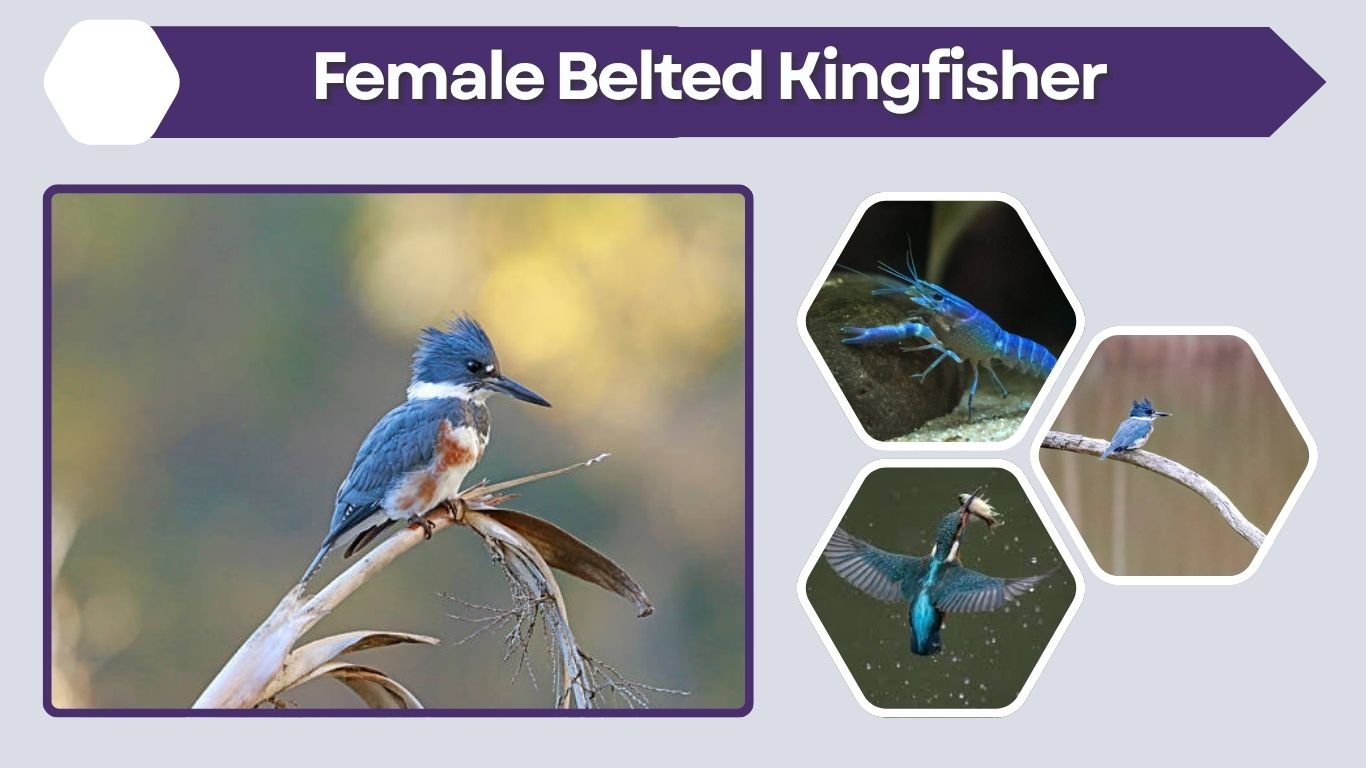
The female Belted Kingfisher is one of the most interesting birds in North America because she is more colorful than the male. While many bird species have brighter males, Belted Kingfishers reverse that pattern. Both sexes have a shaggy crest, blue-gray upperparts, and a strong fishing bill, but the female has an extra rusty band across her belly. That feature makes her easier to identify near rivers, lakes, ponds, and coastlines.
What Is a Female Belted Kingfisher?
A female Belted Kingfisher is the adult female of the species Megaceryle alcyon. This bird belongs to the kingfisher family and is strongly connected to water. Like the male, she hunts mostly by watching from a perch, diving into the water, and catching fish or other aquatic prey with her long, heavy bill.
The female looks bold and rugged. She has a large head, a shaggy crest, a white collar, blue-gray wings, and a thick bill. Her most important field mark is the rusty or chestnut band across the lower breast and sides. Cornell Lab describes Belted Kingfishers as powdery blue-gray birds where males have one blue breast band, while females have both a blue band and a chestnut band.
Female Belted Kingfisher Identification
The easiest way to identify a female Belted Kingfisher is to look at the breast and belly. If the bird has a blue-gray band across the chest and a second rusty band below it, it is likely a female.
Key Female Field Marks
Look for these features when identifying a female:
- Shaggy blue-gray crest
- Large head and long straight bill
- White throat and white collar
- Blue-gray band across the upper chest
- Rusty or chestnut band across the lower breast
- Rusty color along the sides or flanks
- Stocky, top-heavy body shape
The rusty band is the most helpful clue. From the front or side, it often stands out clearly. From behind, however, males and females can look much more similar because both have blue-gray backs, wings, and crests.
Belted Kingfisher Male vs Female
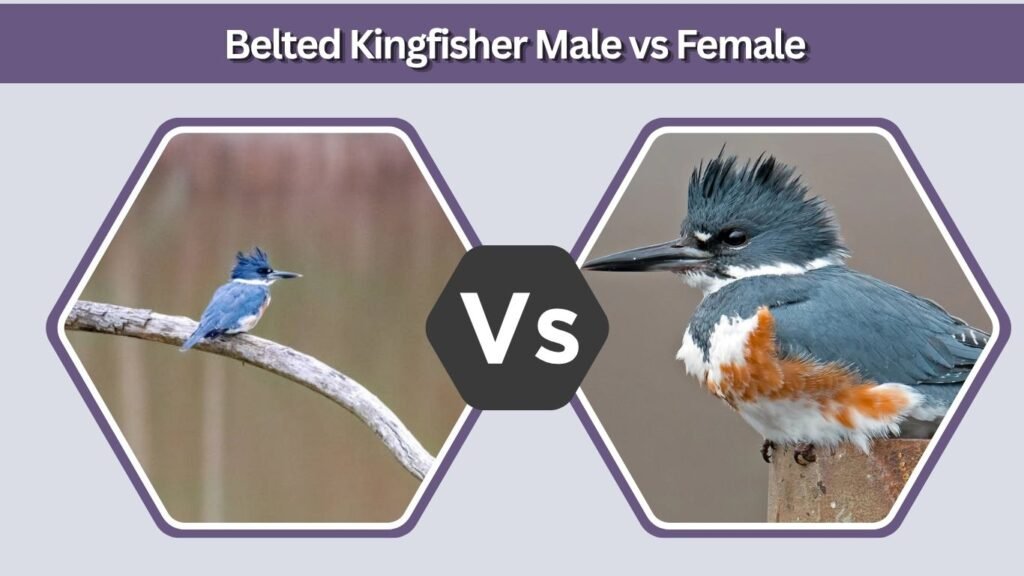
The main difference between male and female Belted Kingfishers is the color pattern on the underparts. The male has one blue-gray band across a mostly white breast. The female has that same blue-gray band plus an extra rusty band across the belly and sides.
This makes the female more colorful than the male, which is unusual among birds. Cornell Lab notes that the Belted Kingfisher is one of the few bird species where the female is more brightly colored than the male.
| Feature | Female Belted Kingfisher | Male Belted Kingfisher |
|---|---|---|
| Chest band | Blue-gray band plus rusty band | One blue-gray band |
| Belly color | White with rusty/chestnut band | Mostly white |
| Flanks | Often rusty or chestnut | Mostly white or plain |
| Crest | Shaggy blue-gray crest | Shaggy blue-gray crest |
| Bill | Long, thick, straight bill | Long, thick, straight bill |
| Overall color | More colorful | Less colorful |
Male Belted Kingfisher
The male Belted Kingfisher has a blue-gray head, shaggy crest, white collar, blue-gray back, and one blue-gray band across the chest. Below that band, the underparts are mostly white. He still looks strong and distinctive, but he lacks the rusty belly band that makes the female stand out.
Female Belted Kingfisher
The female Belted Kingfisher has the same general body shape and blue-gray upperparts as the male. The difference is her extra chestnut-colored band. This reddish-brown color may extend across the lower breast and down the sides, giving her a richer and more patterned appearance.
Why Is the Female Belted Kingfisher More Colorful?
In many birds, males are brighter because they use color to attract mates. Belted Kingfishers are different. The female has more color than the male, which makes this species unusual and memorable for birdwatchers.
The exact reason for this reverse color pattern is not always explained simply. However, the extra rusty band is a reliable identification feature. It may be connected to the species’ breeding behavior, territorial behavior, or evolutionary history. What matters most for field identification is that the female carries the extra chestnut band while the adult male does not.
This difference is especially helpful because both sexes otherwise share many similar traits. Both have large heads, heavy bills, shaggy crests, and blue-gray upperparts.
Female Belted Kingfisher Photo Clues
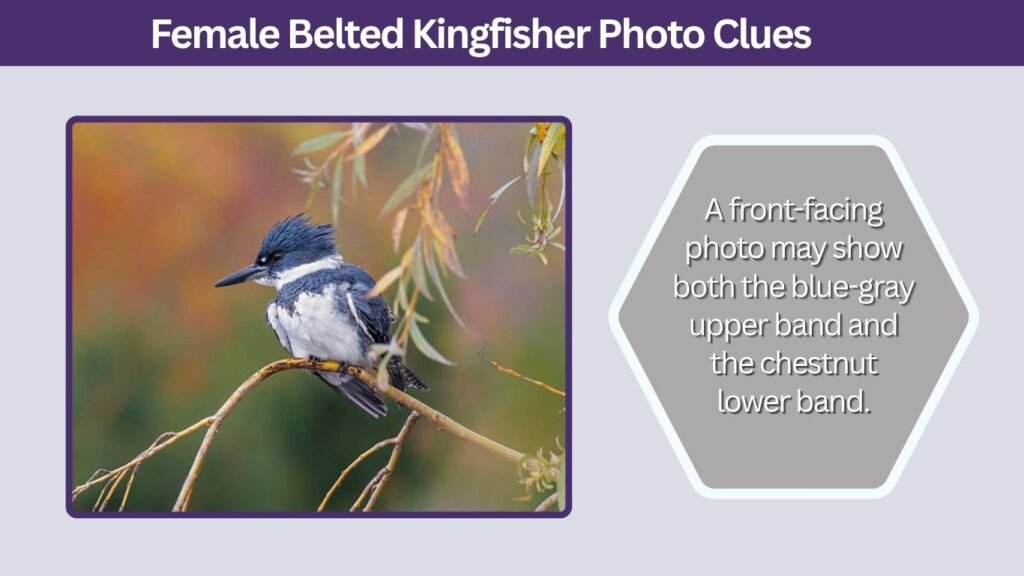
When looking at a female Belted Kingfisher photo, focus on the front and side of the bird. A clear side-view image usually shows the rusty band best. A front-facing photo may show both the blue-gray upper band and the chestnut lower band.
What to Check in Photos
Use these clues when checking photos:
- Is there a rusty band below the blue chest band?
- Does the rusty color continue onto the sides?
- Is the bird blue-gray above and white below?
- Does it have a shaggy crest?
- Is the bill long, thick, and straight?
- Is the bird perched near water?
A back-view photo may not be enough to confirm sex. Since both male and female Belted Kingfishers have similar blue-gray upperparts, the underparts are the most important area to examine.
Juvenile Female Belted Kingfisher
Juvenile Belted Kingfishers can be harder to identify than adults. Young birds may show markings that resemble female-like rusty coloring, even when they are male. This can confuse beginners who are trying to separate juvenile males from juvenile females.
A juvenile female may show rusty coloring, but the markings can be less clean or less bold than those of an adult female. Juvenile birds may also look slightly less polished overall, with softer edges to the plumage and a less crisp pattern.
Adult Female vs Juvenile Female
Adult females usually show a clearer and stronger rusty band. Juvenile females may show a thinner, less complete, or less sharply defined rusty area. When identifying young kingfishers, it helps to consider season, behavior, and overall plumage condition.
Because juvenile birds can be tricky, it is better to say “likely female” when the view is poor or the bird is young.
Female and Male Belted Kingfisher Size
Female and male Belted Kingfishers are similar in size. Both are medium-sized, stocky birds with large heads and heavy bills. The female may average slightly larger in some measurements, but size alone is not the best way to tell them apart.
For field identification, plumage is much more useful than size. A distant female and male can look nearly the same unless you can see the chest and belly clearly.
Best Identification Method
Do not rely only on body size. Instead, use this order:
- Look for the rusty belly band.
- Check the blue-gray chest band.
- Observe the bird from the front or side.
- Use size only as a supporting clue.
- Consider whether the bird may be juvenile.
The rusty band is the strongest clue for an adult female.
Female Belted Kingfisher Behavior
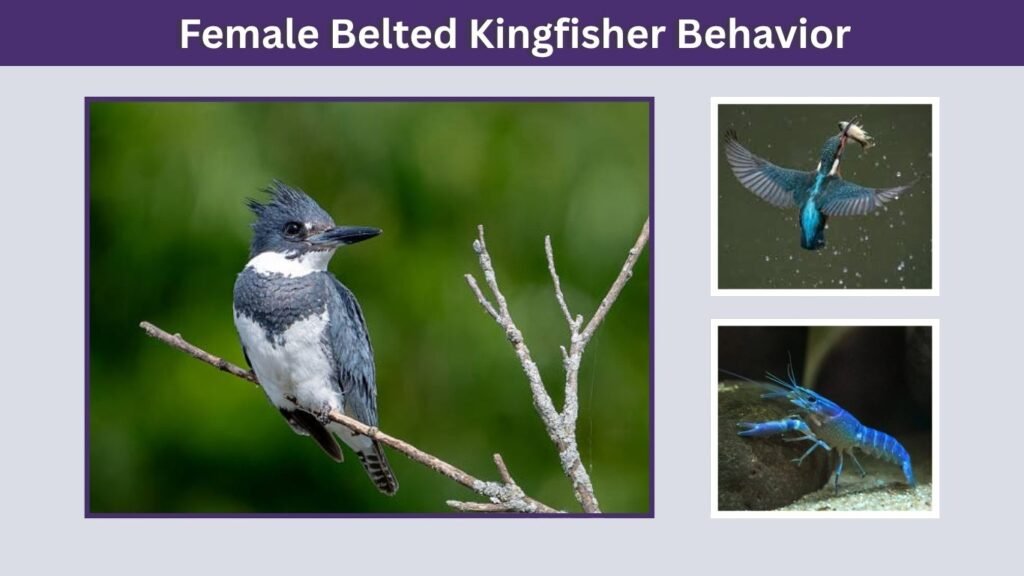
Female Belted Kingfishers behave much like males. They perch above water, watch for prey, dive headfirst, and return to a perch after catching food. Their diet is mostly aquatic prey, especially fish and crayfish. Cornell Lab describes the species as feeding almost entirely on aquatic prey and diving to catch fish and crayfish with a heavy, straight bill.
Female Belted Kingfishers can also be territorial. During the breeding season, a pair may defend an area near a nesting site. Outside the breeding season, individual birds may defend feeding territories along rivers, ponds, or shorelines.
Common Behaviors
You may see a female Belted Kingfisher:
- Perching on branches, wires, posts, or banks
- Flying low over water
- Giving a loud rattling call
- Diving after fish
- Carrying prey back to a perch
- Visiting or digging a nest burrow
- Chasing other kingfishers from a territory
Her behavior can look bold and restless. She may fly away with a loud call when approached.
Do Female Belted Kingfishers Migrate?
Female Belted Kingfishers can migrate, just like males. Migration depends more on location and water conditions than on sex. In northern areas, birds often move south when rivers, lakes, and ponds freeze. Since they need open water to catch fish, frozen habitats force many individuals to relocate.
In milder regions, some Belted Kingfishers may stay year-round if open water and food remain available. Along coasts, rivers, and southern wetlands, a female may continue hunting through winter without making a long movement.
Migration Clues
A female Belted Kingfisher may be seen:
- In northern breeding areas during spring and summer
- Moving through migration routes in fall or spring
- Around southern ponds, canals, and coasts in winter
- Near open water at any season where food is available
So, the answer is yes: female Belted Kingfishers do migrate in many parts of the range, but not every individual migrates long distances.
Female Belted Kingfisher Nesting Role
Belted Kingfishers nest in burrows dug into earthen banks. Both the male and female take part in raising the young. The nest tunnel may be placed along a riverbank, stream bank, gravel pit, road cut, or other exposed soil face near water.
Audubon notes that both male and female Belted Kingfishers feed the young. Nestlings leave the nest about 27 to 29 days after hatching and may still be fed by both parents for about three weeks afterward.
Nesting Responsibilities
The female may help with:
- Choosing or defending the nesting area
- Excavating or using the burrow
- Incubating eggs
- Feeding young
- Guarding the nest area
- Helping fledglings after they leave the burrow
The pair’s shared role is important because young kingfishers need regular feeding before and after leaving the nest.
Female Belted Kingfisher in Virginia and Other States
Searches such as “female Belted Kingfisher Virginia” usually come from people who have seen a bird near a river, pond, lake, or coastline and want to identify it. Virginia is within the normal range of the Belted Kingfisher, and females can be seen where suitable water habitat exists.
The same identification rules apply in Virginia, Florida, Michigan, Illinois, and many other places in North America. Look for the large head, shaggy crest, blue-gray upperparts, and the female’s extra rusty band.
Quick Tips to Identify a Female Belted Kingfisher
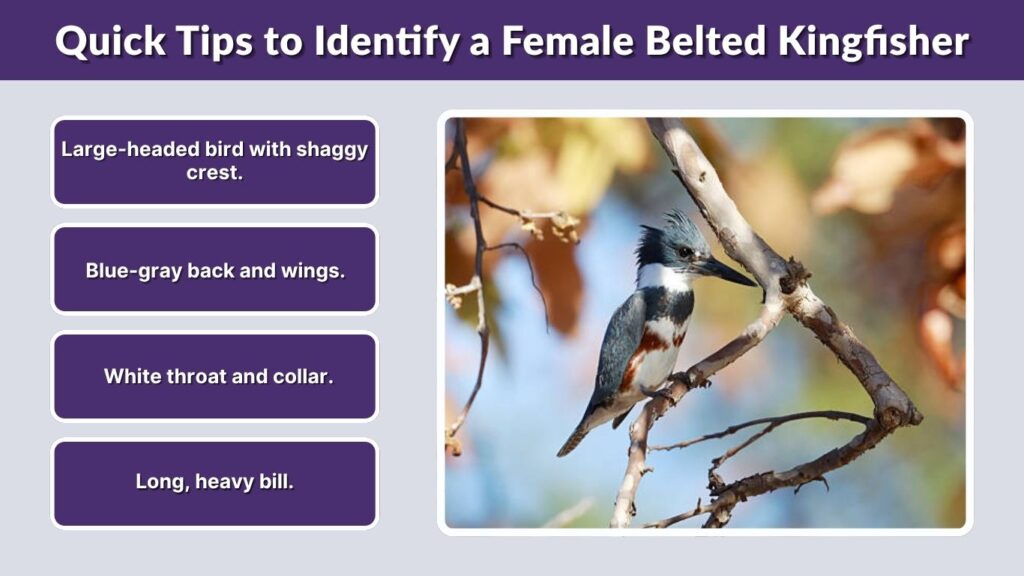
To identify a female quickly, remember this simple rule: two bands mean female. The first band is blue-gray across the upper chest. The second band is rusty or chestnut across the lower breast and sides.
Field Checklist
Use this checklist near water:
- Large-headed bird with shaggy crest
- Blue-gray back and wings
- White throat and collar
- Long, heavy bill
- Loud rattling call
- Perched above water
- Rusty band below the blue chest band
If all these features are present, you are very likely looking at a female Belted Kingfisher.
FAQs
How can you tell if a Belted Kingfisher is female?
A female Belted Kingfisher has two visible bands on the front: a blue-gray band across the chest and a rusty or chestnut band across the lower breast and sides. The male usually has only one blue-gray chest band and mostly white underparts below it.
Is the female Belted Kingfisher more colorful than the male?
Yes, the female Belted Kingfisher is more colorful than the male. She has an extra rusty band across the belly and sides, while the male has only a blue-gray chest band. This is unusual because male birds are often the brighter sex in many species.
What does a male Belted Kingfisher look like?
A male Belted Kingfisher has a shaggy blue-gray crest, blue-gray upperparts, a white collar, a long heavy bill, and one blue-gray band across the white chest. He does not have the rusty belly band that adult females show.
Do female Belted Kingfishers migrate?
Yes, many female Belted Kingfishers migrate, especially from northern areas where water freezes in winter. Migration depends on access to open water and food. Some females in milder areas may stay year-round if they can continue catching fish.
Can juvenile Belted Kingfishers look like females?
Yes, juvenile Belted Kingfishers can sometimes show rusty markings, which may make them look female-like. Adult females usually have a clearer rusty band, while juvenile markings may appear less crisp. When the bird is young or distant, identification can be less certain.