
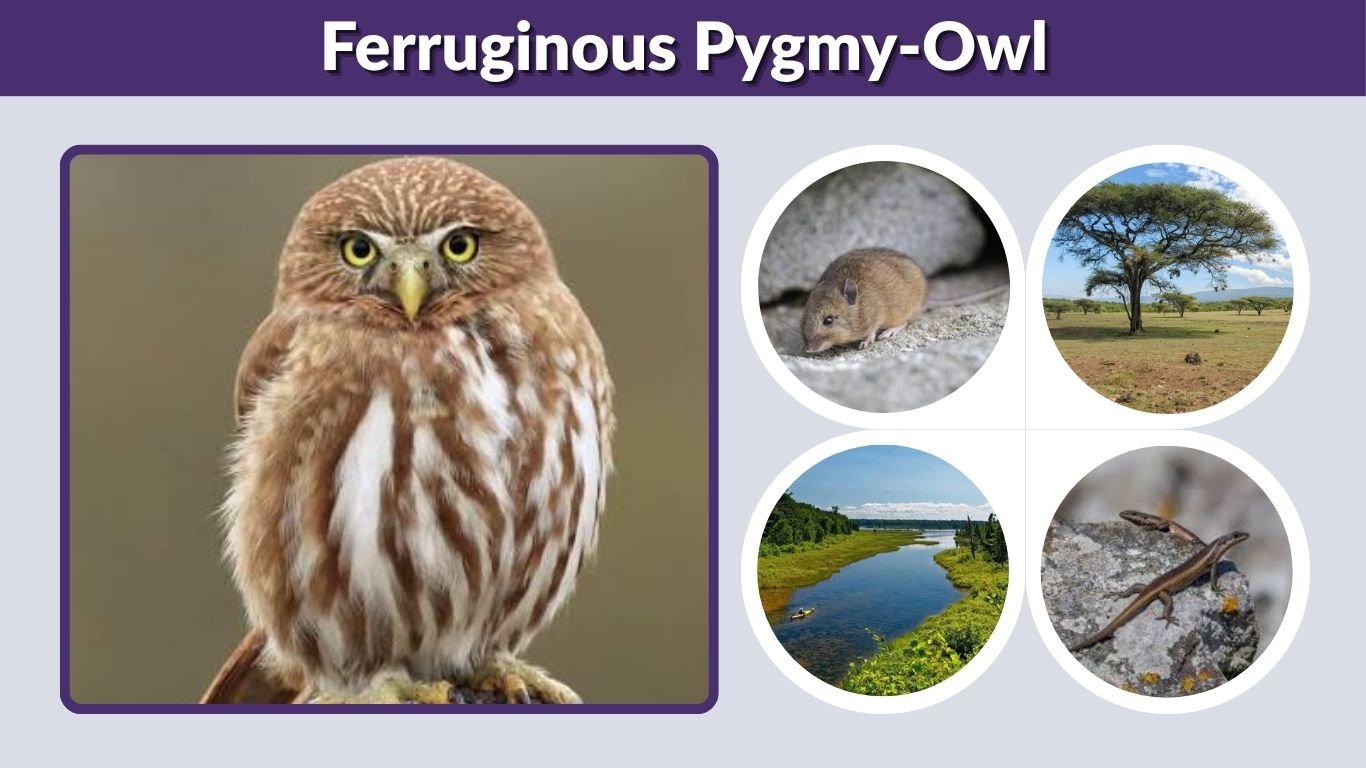
The Ferruginous Pygmy-Owl (Glaucidium brasilianum) is a tiny but powerful owl found from the southwestern United States through Mexico, Central America, and much of South America. Despite being smaller than an American Robin, it hunts birds, reptiles, insects, and mammals—sometimes taking prey larger than itself. Its round head, long barred tail, rust-colored plumage, false eyespots, and repeated whistled call make it one of the most recognizable small owls in the Americas.
Ferruginous Pygmy-Owl Facts
The word “ferruginous” means rust-colored, referring to the rich reddish-brown plumage shown by many individuals. However, the species is variable, and some birds are grayish-brown rather than rusty.
| Feature | Description |
|---|---|
| Scientific name | Glaucidium brasilianum |
| Family | Strigidae |
| Length | 5.5–7.1 inches |
| Weight | 1.9–2.8 ounces |
| Wingspan | Approximately 11.8 inches |
| Main colors | Rufous, cinnamon, or grayish-brown |
| Activity | Day, dawn, dusk, and occasionally night |
| Nest | Natural cavity, woodpecker hole, or nest box |
| Diet | Birds, reptiles, insects, mammals, and amphibians |
| Typical clutch | 2–7 white eggs |
How to Pronounce Ferruginous Pygmy-Owl
“Ferruginous” is pronounced approximately fuh-ROO-juh-nus, while “pygmy” is pronounced PIG-mee. The complete name can therefore be spoken as:
fuh-ROO-juh-nus PIG-mee owl
Its scientific name, Glaucidium brasilianum, can be approximated as glaw-SID-ee-um bruh-zil-ee-AH-num. Scientific Latin pronunciation may vary among speakers.
Ferruginous Pygmy-Owl Identification
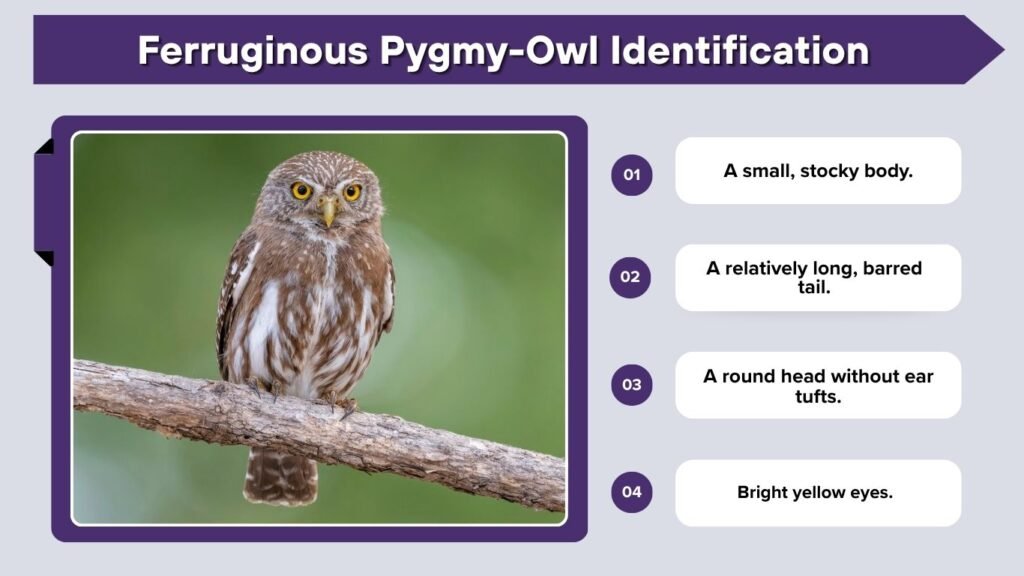
This owl’s tiny size and long tail can make it resemble a songbird when first observed. Unlike a screech-owl, it lacks visible ear tufts and has a smoothly rounded head.
Color and Physical Features
Important identification characteristics include:
- A small, stocky body
- A relatively long, barred tail
- A round head without ear tufts
- Bright yellow eyes
- A yellowish bill
- Bold white eyebrows
- Fine pale streaks on the crown
- Heavily streaked whitish underparts
- White spots on the wings
- Large feet and strong talons
- Two black false eyespots on the back of the head
Plumage ranges from rich cinnamon-rufous to grayish-brown. The long tail may show alternating rufous and dark-brown bars or brown feathers crossed by incomplete pale bands.
The false eyespots are dark patches bordered with white. They may confuse predators or direct mobbing birds away from the vulnerable back of the owl’s head.
Male vs. Female
Male and female Ferruginous Pygmy-Owls look similar. Females are generally somewhat larger and may appear more richly colored, but size and color overlap too much for dependable field identification.
Behavior provides occasional clues during nesting. The female incubates and broods the chicks, while the male supplies food. Both parents participate in feeding older nestlings.
Ferruginous Pygmy-Owl Size
A Ferruginous Pygmy-Owl measures approximately 5.5–7.1 inches long and weighs only 1.9–2.8 ounces. Its wingspan is about 11.8 inches.
It is:
- Smaller than an American Robin
- Slightly larger than an Elf Owl
- Smaller than most screech-owls
- Similar in size to a Northern Pygmy-Owl
Its talons appear disproportionately large for its body. This feature allows it to capture relatively heavy prey, including small birds that may weigh as much as or more than the owl.
Cornell Lab’s identification guide describes it as a tiny, plump, long-tailed owl measuring approximately 14–18 centimeters.
Ferruginous Pygmy-Owl Sound and Call
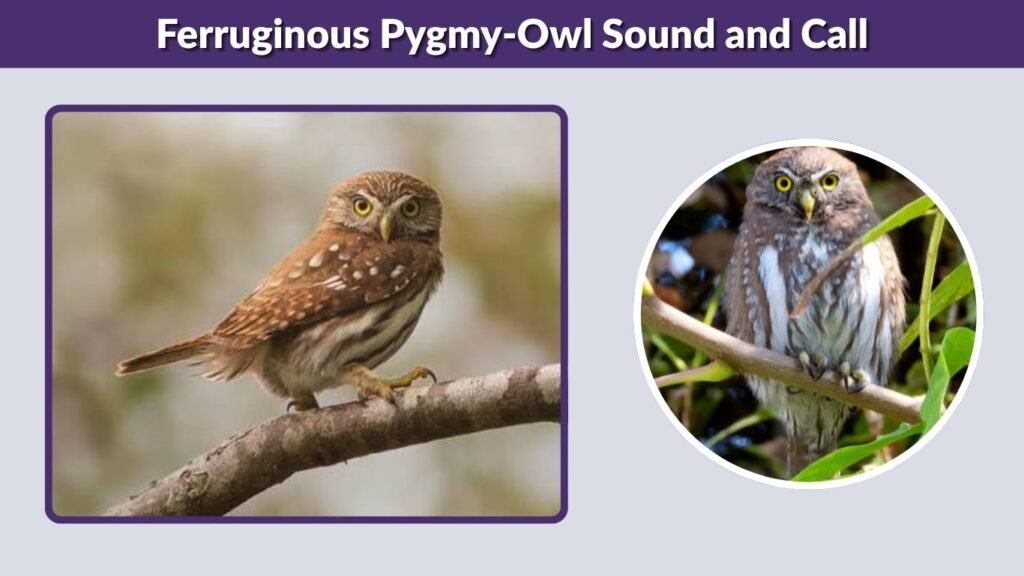
The Ferruginous Pygmy-Owl does not produce the deep hooting associated with larger owls. Its principal song consists of evenly spaced, hollow whistled notes.
What Does Its Call Sound Like?
The song can be written as:
toot-toot-toot-toot-toot
The notes are short, clear, and monotonous, with roughly three notes delivered per second. An individual song may continue for up to ten seconds, followed by a pause before the owl starts again.
Other vocalizations include:
- Short, sharp notes
- Low twittering calls
- Squeaky or bubbling sounds
- Begging calls from young owls
- Alarm notes near the nest
Males sing to advertise territories, attract females, and maintain pair bonds. Calling activity can be strongest around dawn and dusk, although the owl may vocalize during daylight. Recordings are available through the Cornell Lab’s Ferruginous Pygmy-Owl sound guide.
Imitating or playing its call often attracts small birds that recognize the owl as a predator and gather to mob it. Repeated playback should be avoided because it may disrupt feeding, territorial behavior, or nesting.
Ferruginous Pygmy-Owl Range
Ferruginous Pygmy-Owls have a broad New World distribution. Depending on the taxonomic treatment used, the species occurs from southern Arizona and Texas through Mexico and Central America into large portions of South America.
Geographic Distribution
Its broader range includes parts of:
- Southern Arizona
- Southern Texas
- Mexico
- Central America
- Brazil
- Bolivia
- Paraguay
- Argentina
- Other tropical and subtropical areas of South America
Populations do not occupy every location within this range. Their distribution depends on suitable vegetation, nest cavities, prey, climate, and connections between habitat patches.
Different authorities may classify certain regional populations as separate species or subspecies. Therefore, field guides and range maps can differ slightly.
Ferruginous Pygmy-Owl Habitat
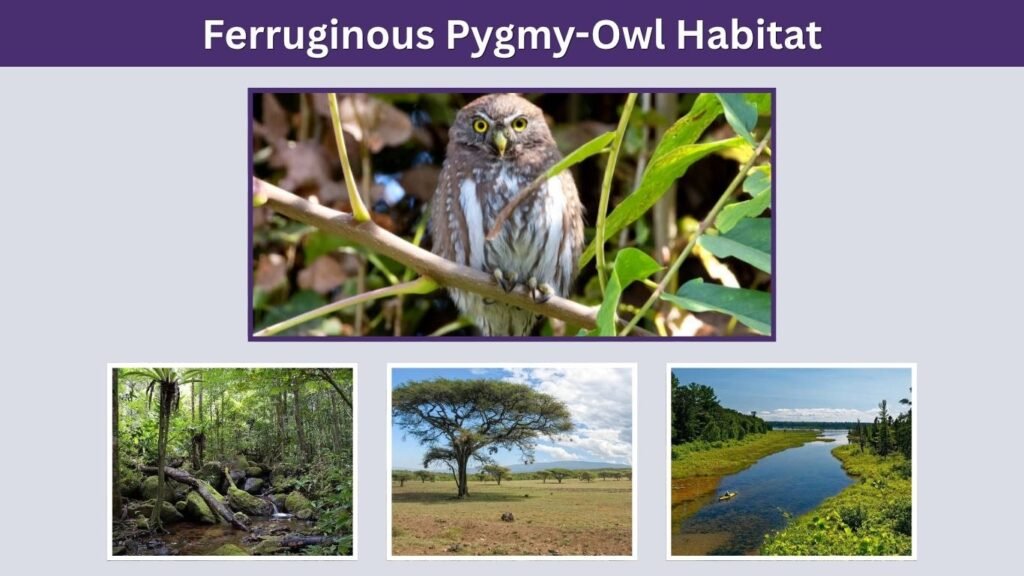
This adaptable owl occupies numerous warm, low-elevation environments. It often favors habitat edges, where woodland or dense vegetation meets a clearing or more open hunting ground.
Common Habitats
The species may inhabit:
- Tropical and subtropical forest
- Tropical dry woodland
- Thornscrub
- Savanna
- Desert scrub
- Riparian woodland
- Mesquite woodland
- Forest edges and clearings
- Coffee plantations
- Orchards and gardens
- Suburban areas with mature trees
Most populations occur in lowlands, although Ferruginous Pygmy-Owls may reach elevations around 6,500 feet in some regions.
Good habitat combines protected nesting cavities with trees, shrubs, or tall cacti that provide hunting perches and cover. Connected vegetation is especially important because severe fragmentation can isolate small populations.
Cactus Ferruginous Pygmy-Owl
The Cactus Ferruginous Pygmy-Owl, Glaucidium brasilianum cactorum, is the subspecies occurring in parts of the southwestern United States and Mexico. Despite its name, it does not depend exclusively on cacti.
Cactus Pygmy-Owl Habitat
It occupies Sonoran Desert and subtropical habitats containing a mixture of trees, shrubs, cacti, and open hunting spaces. Important habitat may include:
- Saguaro and organ-pipe cactus areas
- Mesquite woodland
- Palo verde vegetation
- Ironwood woodland
- Thornscrub
- Riparian corridors
- Texas live-oak and ebony woodland
The owl frequently uses existing cavities made by woodpeckers. In desert areas, cavities in large saguaros can provide nest sites, while trees or nest boxes may be used elsewhere.
Range and Conservation Status
The Cactus Ferruginous Pygmy-Owl occurs in southern Arizona, southern Texas, and Mexico. U.S. populations are small and fragmented compared with populations farther south.
The U.S. Fish and Wildlife Service’s ECOS profile currently lists the subspecies as threatened under the Endangered Species Act. It received federal threatened status in 2023 with a species-specific 4(d) rule.
Major threats include:
- Habitat destruction
- Urban development
- Agricultural conversion
- Habitat fragmentation
- Invasive vegetation
- Altered wildfire patterns
- Prolonged drought
- Increasing heat and aridity
- Loss of nest cavities
- Reduced prey availability
As of the latest federal regulatory agenda located for this article, a separate critical-habitat designation remained a long-term rulemaking action rather than a completed designation. Legal and regulatory status should always be confirmed through ECOS before making land-management decisions.
Cactus Ferruginous Pygmy-Owl Survey Protocol
Wildlife professionals survey for the owl by listening for natural vocalizations and, where authorized, broadcasting recorded calls from predetermined locations. Surveys are normally repeated because an owl may remain silent during a single visit.
An official protocol may specify:
- Appropriate survey seasons
- Starting and ending times
- Weather limitations
- Distance between stations
- Number of visits
- Call-broadcast sequences
- Listening periods
- Documentation requirements
- Procedures following a detection
Call playback and nest searching can disturb owls. In Arizona, qualifying surveys covered by the federal 4(d) rule must follow the approved protocol and applicable state scientific-activity permitting requirements. Property owners should not conduct professional clearance surveys themselves. A permitted biologist or the appropriate wildlife agency should be consulted.
“ECOS” refers to the U.S. Fish and Wildlife Service’s Environmental Conservation Online System, where federal listing documents and species information are maintained.
Ferruginous Pygmy-Owl Diet
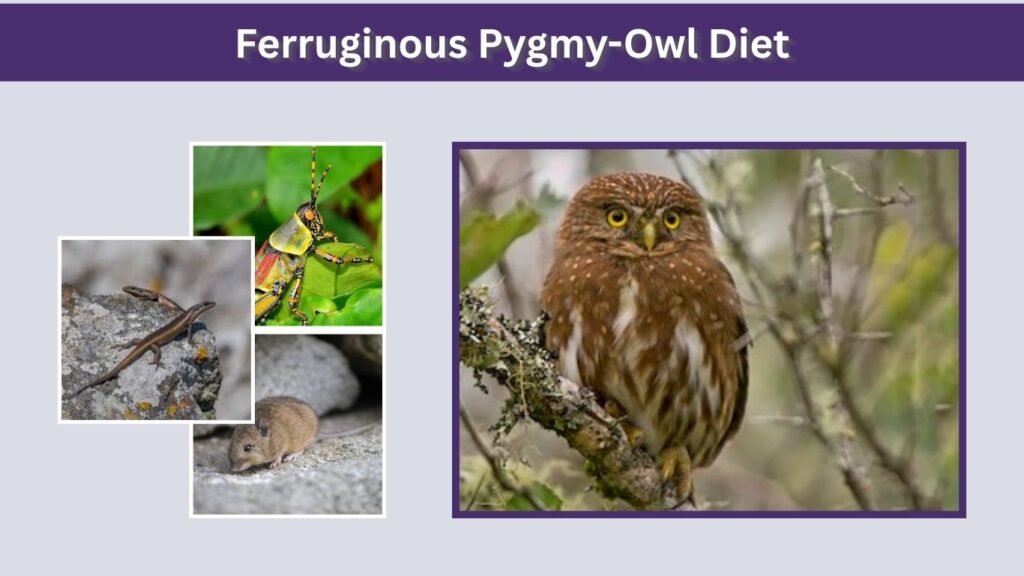
Although small, this owl is an active predator with a varied diet. It hunts mainly from exposed or partly concealed perches, watching for movement before making a short, rapid dive.
What Does It Eat?
Common prey includes:
- Grasshoppers and large insects
- Lizards and small snakes
- Mice and other small mammals
- Frogs and other amphibians
- Hummingbirds
- Sparrows and other small birds
- Bird eggs and nestlings
Diet varies geographically. In parts of Texas, insects may form a large portion of the diet, followed by reptiles, birds, and mammals. Arizona birds commonly take reptiles and small birds. Tropical populations may hunt a broader selection of insects and vertebrates.
Unlike many owls that rely heavily on silent nighttime flight, Ferruginous Pygmy-Owls frequently hunt during daylight. Their symmetrical ears and comparatively noisy flight suggest that vision plays an especially important role in locating prey.
Nesting and Life Cycle
Ferruginous Pygmy-Owls are cavity nesters but do not excavate their own holes. They use natural cavities, abandoned woodpecker holes, suitable cactus cavities, and occasionally nest boxes.
The female lays approximately two to seven unmarked white eggs directly on the cavity floor. Incubation lasts around 23–28 days, followed by a nestling period of approximately 21–29 days.
The female performs most incubation and early brooding. The male delivers prey, which the female tears into smaller pieces for the chicks. Older nestlings receive food from both parents.
Ferruginous Pygmy-Owl vs. Northern Pygmy-Owl
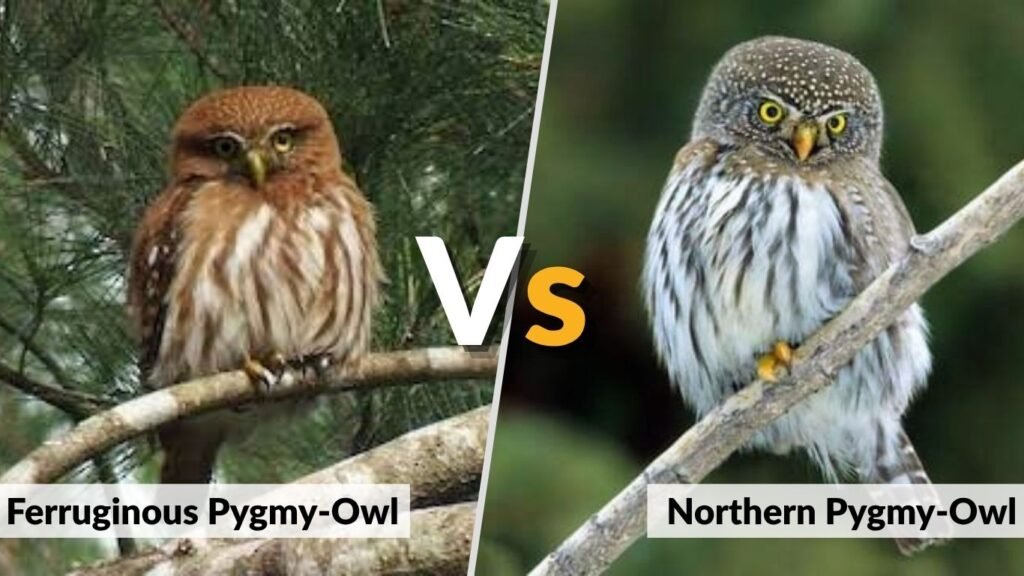
These species are similar in size and both have yellow eyes, long tails, false eyespots, daytime activity, and repeated tooting calls. Habitat and head pattern provide useful identification clues.
| Feature | Ferruginous Pygmy-Owl | Northern Pygmy-Owl |
|---|---|---|
| Scientific name | Glaucidium brasilianum | Glaucidium gnoma |
| Length | 5.5–7.1 inches | 6.3–7.1 inches |
| Crown | Pale streaks | Small white spots |
| Underparts | Strong lengthwise streaks | Brown vertical streaks |
| Color | Gray-brown or cinnamon-rufous | Mostly brown or gray-brown |
| U.S. habitat | Low desert and subtropical woodland | Western mountain forests |
| Main U.S. range | Southern Arizona and Texas | Western North America |
| Song | Faster series of about three toots per second | Slower, more widely spaced toots |
Where their ranges approach each other in Arizona, elevation is particularly useful. Ferruginous Pygmy-Owls occupy lower desert and thornscrub, while Northern Pygmy-Owls generally live in higher coniferous forests.
FAQs
Are Ferruginous Pygmy-Owls active during the day?
Yes. They hunt during daylight as well as around dawn and dusk, and they may sometimes be active at night. Their daytime habits, frequent calling, exposed perches, and the noisy groups of small birds that mob them can make them easier to locate than many owls.
How big is a Ferruginous Pygmy-Owl?
An adult is approximately 5.5–7.1 inches long, weighs 1.9–2.8 ounces, and has a wingspan near 11.8 inches. It is smaller than an American Robin but possesses large feet and talons capable of restraining birds and other surprisingly substantial prey.
Why is it called a Ferruginous Pygmy-Owl?
“Ferruginous” means rust-colored and describes the cinnamon or reddish-brown plumage visible on many individuals. “Pygmy” refers to its exceptionally small size. Not every bird looks rusty, because the species also includes grayish-brown individuals and considerable regional variation.
Is the Cactus Ferruginous Pygmy-Owl endangered?
In the United States, the subspecies is currently federally listed as threatened rather than endangered. Threatened status means it is likely to become endangered within the foreseeable future. Habitat loss, fragmentation, invasive plants, wildfire, drought, and increasing aridity contribute to its decline.
Can I use owl calls to find a Cactus Ferruginous Pygmy-Owl?
Casual repeated playback is discouraged because it can disrupt territorial, feeding, and nesting behavior. Formal surveys may require an approved call-broadcast protocol, appropriate state authorization, and compliance with federal protections. Observe quietly or contact a wildlife agency or qualified biologist when documentation is necessary.
