
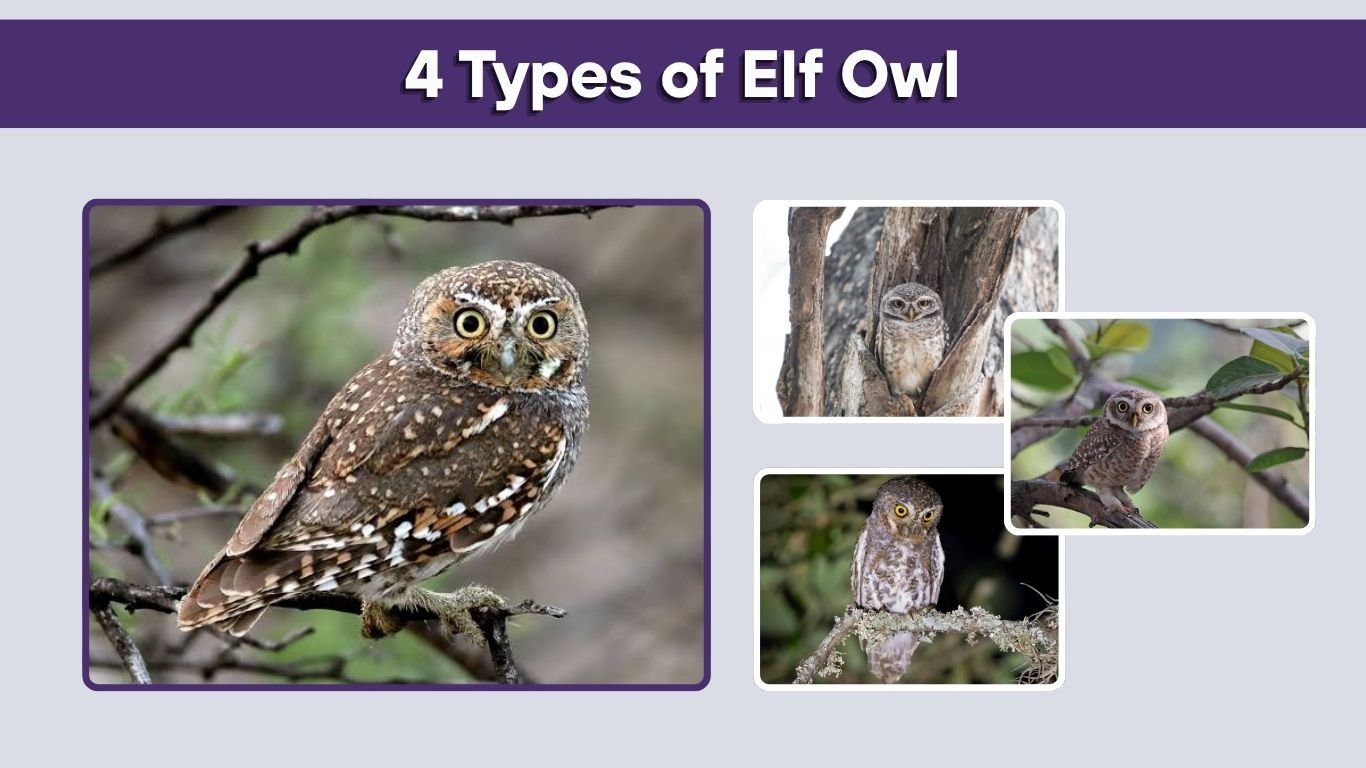
The Elf Owl is famous for being the smallest owl in the world. Measuring only about 4.75 to 5.5 inches long and generally weighing less than 1.75 ounces, it is scarcely larger than a sparrow. However, its small body hides the instincts and abilities of an effective nocturnal predator. Elf Owls hunt insects, spiders, scorpions, reptiles, and occasionally small mammals while using abandoned woodpecker cavities for shelter and nesting.
Although people sometimes search for several “types of Elf Owls,” ornithologists recognize only one living species: Micrathene whitneyi. That species has traditionally been divided into four geographic subspecies—M. w. whitneyi, M. w. idonea, M. w. sanfordi, and M. w. graysoni. The first three survive in the southwestern United States and Mexico, while the island-dwelling graysoni is considered extinct.
Elf Owl Classification
The Elf Owl belongs to the typical owl family, Strigidae. It is the only species placed in the genus Micrathene, making it evolutionarily and taxonomically distinctive among North American owls.
| Classification | Details |
|---|---|
| Common name | Elf Owl |
| Scientific name | Micrathene whitneyi |
| Genus | Micrathene |
| Family | Strigidae |
| Order | Strigiformes |
| Number of recognized subspecies | Four |
| Living subspecies | Three |
| Extinct subspecies | One |
| General range | Southwestern United States and Mexico |
| Typical length | About 4.75–5.5 inches |
| Typical weight | Less than 1.75 ounces |
The four subspecies are distinguished mainly by geography and subtle differences in size or plumage. Their general behavior, diet, nesting style, and physical structure remain very similar.
1. Whitney’s Elf Owl
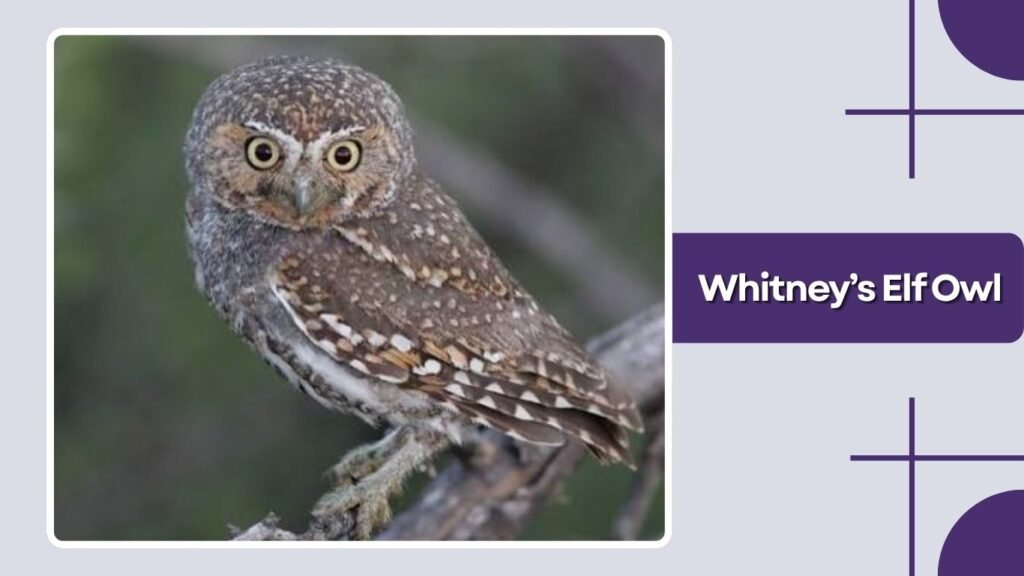
Micrathene whitneyi whitneyi is the nominate subspecies, meaning it carries the same subspecies name as the species. It is the form most commonly associated with the Sonoran Desert and the giant saguaro cacti of Arizona. Its range includes the arid southwestern United States and neighboring northwestern Mexico, particularly Sonora.
Identification
Whitney’s Elf Owl is a tiny grayish-brown bird with a rounded head and no visible ear tufts. Its plumage is patterned with pale spots and irregular streaks that help it disappear against tree bark and cactus surfaces.
Important identification features include:
- Rounded head without ear tufts
- Large yellow eyes
- Pale yellow or horn-colored bill
- White eyebrows
- Gray-brown upperparts
- Pale spotting on the head and back
- Light underparts with brown streaks
- Short tail
- Long legs for such a small owl
Male and female Elf Owls have similar plumage, although females tend to be slightly larger. The owl’s compact shape and upright posture may cause it to resemble a small songbird when seen briefly.
Habitat and Range
This subspecies occurs principally in Arizona, portions of southeastern California, southwestern New Mexico, and northwestern Mexico. Some populations migrate south after the breeding season, while others living in warmer Mexican regions may remain near their territories throughout the year.
Whitney’s Elf Owls occupy several dry and semi-dry habitats, including:
- Sonoran Desert
- Desert washes
- Saguaro cactus woodland
- Mesquite woodland
- Cottonwood and willow corridors
- Oak-lined canyons
- Dry scrub
- Open woodland
Saguaros are especially important in parts of Arizona because woodpeckers excavate holes in these giant cacti. Once the woodpeckers abandon them, Elf Owls may use the cavities for nesting.
However, the species is not completely dependent on saguaros. It also nests in cottonwoods, willows, mesquites, sycamores, utility poles, and nest boxes.
Diet and Hunting
Whitney’s Elf Owl feeds mainly on arthropods. Its diet commonly includes moths, beetles, crickets, grasshoppers, spiders, centipedes, and scorpions.
It may also capture:
- Small lizards
- Tiny snakes
- Young rodents
- Small birds
- Other large invertebrates
The owl usually hunts after sunset. It waits on a branch, cactus arm, or other elevated perch and listens or watches for prey. It may then fly down to seize an animal from the ground or catch a flying insect in the air.
Elf Owls sometimes remove a scorpion’s stinger before eating it. Their long legs and sharp talons help them handle prey without placing the face too close to defensive claws or stingers.
Nesting and Reproduction
Whitney’s Elf Owls do not dig their own nesting cavities. Instead, they rely on holes created by woodpeckers or on natural spaces in trees and cacti.
The female generally lays two to four white eggs. She performs most of the incubation, while the male hunts and brings food to the nest. After the eggs hatch, both parents contribute to feeding the growing owlets.
Nest cavities provide protection from many predators and from the intense daytime heat of desert environments. Even so, eggs and young may be threatened by snakes, mammals, larger birds, and other owls.
Behavior and Migration
This subspecies is strongly nocturnal. During daylight, it usually rests inside a cavity or in dense vegetation. Around dusk, it becomes active and may announce its presence with repeated whistling notes.
Many populations in the United States are migratory. They arrive in spring to breed and travel into Mexico during autumn. This movement is probably influenced by colder winter nights and the seasonal decline of insects in northern areas.
2. Texas Elf Owl
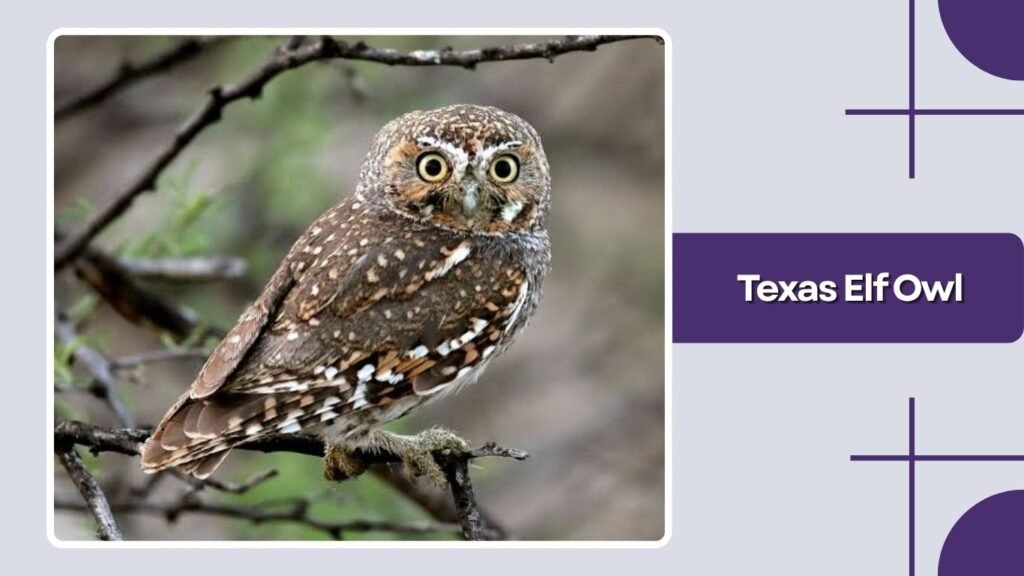
The name Texas Elf Owl is commonly used for Micrathene whitneyi idonea. Its range extends from southern Texas, particularly the Lower Rio Grande Valley, through northeastern and central Mexico.
Identification
The Texas Elf Owl closely resembles the nominate subspecies. It has a rounded, ear-tuft-free head, bright yellow eyes, pale eyebrows, and gray-brown plumage with light markings.
Differences among Elf Owl subspecies are subtle and are not normally reliable for identification in the field. Location is usually more helpful than plumage when determining the probable subspecies.
The Texas form may appear somewhat darker or warmer in color than individuals from the driest western deserts, although variation occurs among birds. Feather wear, age, sex, light, and regional conditions can also affect appearance.
Habitat and Range
In the United States, this subspecies is associated mainly with southern and southwestern Texas. It continues southward into the Mexican states of Tamaulipas, Nuevo León, and other parts of central Mexico.
Its habitats include:
- Subtropical thorn forest
- Mesquite woodland
- Riparian woodland
- Desert washes
- Oak and pine woodland
- Wooded canyons
- Dense brushland
- Mature forest near rivers
The Lower Rio Grande Valley historically supported suitable Elf Owl habitat containing native thorny woodland and cavity-bearing trees. Much of this environment has been cleared or fragmented for agriculture and urban development, making protected refuges particularly important.
At Santa Ana National Wildlife Refuge in Texas, researchers have studied the habitat use, density, and home ranges of M. w. idonea, demonstrating the subspecies’ close relationship with remaining mature woodland.
Diet and Hunting
Texas Elf Owls eat many of the same foods as other members of the species. Insects usually dominate the diet, especially during warm months when beetles, moths, grasshoppers, and crickets are abundant.
Other possible prey includes:
- Spiders
- Scorpions
- Centipedes
- Small frogs
- Lizards
- Tiny snakes
- Small rodents
They hunt at night from low or medium-height perches. Large eyes help them use limited light, while sensitive hearing allows them to detect movement among leaves, branches, and ground vegetation.
Their small size permits them to fly through dense thorn forest more easily than larger owls. Short, rounded wings provide maneuverability, allowing the birds to turn quickly between closely spaced branches.
Nesting Habits
Texas Elf Owls nest in abandoned woodpecker holes and other tree cavities. Suitable trees may include mesquite, willow, cottonwood, hackberry, and other mature native species.
The availability of cavities can limit breeding success. Young woodlands may provide food but lack the old trunks and abandoned holes needed for nesting. Protecting dead or damaged trees that do not pose a safety hazard can therefore benefit Elf Owls and other cavity-nesting birds.
Females incubate the eggs and brood the young, while males deliver prey. As the chicks grow, food demands increase, and both adults may work intensively to support them.
Conservation Concerns
Habitat loss is one of the most significant concerns for the Texas Elf Owl. Clearing subtropical thorn forest removes hunting perches, prey habitat, and nesting cavities at the same time.
Additional pressures may include:
- Pesticide use
- Removal of dead trees
- Urban expansion
- Agricultural development
- Disturbance near nests
- Declining insect populations
- Vehicle collisions
Habitat restoration, native-tree planting, and the protection of wooded corridors can improve conditions. Properly designed nest boxes may supplement natural cavities in some areas, although they cannot replace complete native habitat.
3. Sanford’s Elf Owl
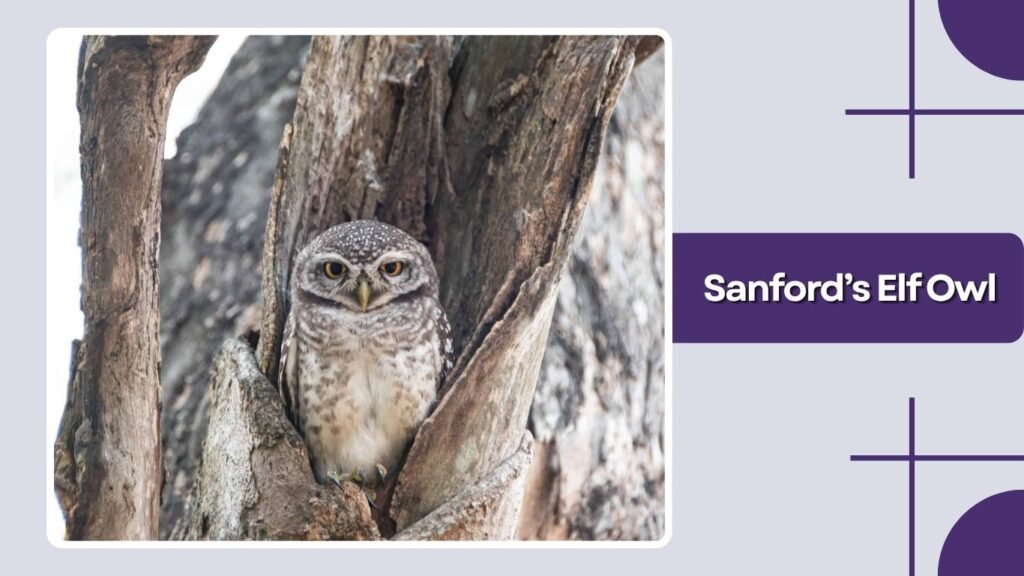
Sanford’s Elf Owl, Micrathene whitneyi sanfordi, is found at the southern end of Mexico’s Baja California Peninsula. Unlike migratory populations farther north, it is generally considered a resident of its limited geographic range.
Identification
Sanford’s Elf Owl has the same basic structure as the other subspecies: a tiny body, rounded head, yellow eyes, white eyebrows, and grayish or brownish patterned plumage.
Its feathers provide camouflage against the bark, rocks, palms, and dry vegetation of southern Baja California. When resting motionless near a trunk or inside the entrance to a cavity, the bird can be extremely difficult to notice.
As with the Texas form, identifying Sanford’s Elf Owl depends mostly on its location. The subtle physical differences used by ornithologists may require close examination, measurements, or comparison with museum specimens.
Geographic Range
This subspecies is restricted to the Cape region at the southern tip of the Baja California Peninsula. Its small distribution separates it geographically from many mainland Elf Owl populations.
The Cape region contains mountainous areas, canyons, dry tropical forest, palm groves, scrub, and patches of oak or pine woodland at higher elevations. These varied environments provide feeding and nesting opportunities.
A restricted range does not automatically mean that a bird is endangered, but it can increase vulnerability. A major hurricane, extensive habitat destruction, wildfire, introduced predator, or rapid land-use change could affect a large portion of the subspecies’ population.
Habitat
Sanford’s Elf Owls may use:
- Dry tropical forest
- Palm groves
- Desert scrub
- Wooded canyons
- Oak woodland
- Pine-oak habitat
- Streamside vegetation
- Rural landscapes with mature trees
Trees and large cacti containing cavities are essential for reproduction. The surrounding habitat must also support abundant insects.
In dry regions, temporary rainfall can produce dramatic increases in plant and insect activity. These seasonal pulses may improve feeding conditions for both adults and nestlings.
Diet and Feeding Behavior
Like other Elf Owls, Sanford’s form is primarily insectivorous. It hunts moths, beetles, crickets, grasshoppers, spiders, and other nocturnal invertebrates.
Small vertebrates may occasionally supplement the diet. These could include tiny lizards, geckos, snakes, frogs, or rodents, depending on local availability.
The owl generally begins hunting around dusk. It may fly between low perches, inspect tree trunks, or catch insects in flight. Artificial lighting can attract moths and other prey, although developed areas may also expose the birds to traffic, domestic cats, windows, and disturbance.
Breeding
Detailed information about Sanford’s Elf Owl breeding biology is limited compared with information available for mainland populations. It is believed to follow the typical Elf Owl pattern of nesting in existing cavities rather than excavating a hole.
A pair may use a cavity in a tree, palm, or cactus. The female lays white eggs and remains at the nest during much of incubation. The male delivers food and may call near the nesting territory.
Young owls leave the cavity after developing their flight feathers but may continue relying on their parents for food while learning to hunt.
Conservation Importance
Because Sanford’s Elf Owl occupies a relatively small region, local conservation has considerable importance. Protection of mature trees, palms, wooded canyons, and natural forest is vital.
Tourism development and urban expansion in southern Baja California can remove or fragment habitat. Retaining native vegetation and natural cavities around developed areas may reduce some effects, but large, connected habitat remains more valuable than isolated trees.
4. Socorro Elf Owl
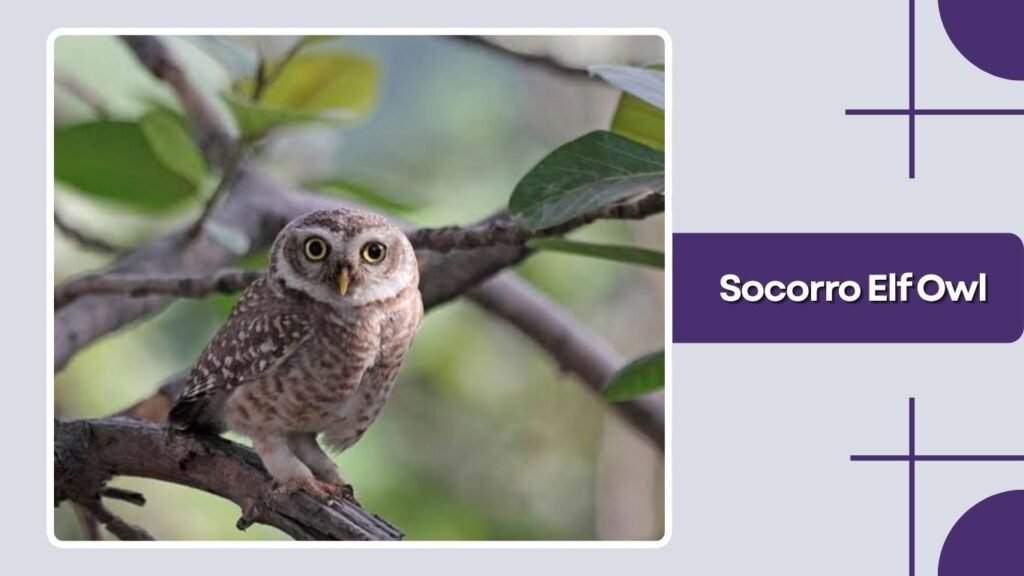
The Socorro Elf Owl, Micrathene whitneyi graysoni, was an island subspecies formerly found only on Socorro Island in Mexico’s Revillagigedo Archipelago. It is now generally regarded as extinct.
Identification and History
The Socorro Elf Owl was described as a geographically isolated form of the Elf Owl. Like its mainland relatives, it was very small, lacked ear tufts, and possessed a rounded head and patterned brownish plumage.
Because the population lived on a remote volcanic island, it had no regular connection with mainland Elf Owls. Long-term isolation allowed it to develop distinguishable characteristics that led ornithologists to recognize it as a separate subspecies.
Historical information is limited, and comparatively few observations or specimens are available. This lack of documentation makes the disappearance especially significant because much of its ecology was never studied in detail.
Former Range
The subspecies occurred only on Socorro Island, located several hundred miles off western Mexico. Socorro is the largest island in the Revillagigedo group and supports several unique plants and animals.
The owl may have occupied wooded and scrubby habitats, potentially including lower-elevation forest. It presumably relied on natural cavities or holes in trees for nesting, just as surviving Elf Owls do elsewhere.
An island range offered isolation but also created extreme vulnerability. Any severe ecological change could affect the entire global population because the bird occurred nowhere else.
Probable Diet and Behavior
There are few detailed studies of the Socorro Elf Owl’s feeding behavior. It likely consumed insects, spiders, scorpions, and small vertebrates available on the island.
Its behavior probably resembled that of mainland Elf Owls. It would have hunted at night, rested in cavities during daylight, and used whistled calls to communicate.
Island animals sometimes lose fear of predators when they evolve in environments without terrestrial mammalian hunters. Such behavior can make them particularly vulnerable when cats, rats, or other introduced mammals arrive.
Decline and Extinction
Introduced mammals caused major ecological damage on Socorro Island. Feral cats preyed upon native wildlife, while grazing animals such as sheep damaged vegetation and altered habitat. Conservation sources associate these invasive animals with the loss of the Socorro Elf Owl.
The owl was not documented during later biological surveys, and authorities now list the subspecies as extinct or very likely extinct. ITIS records M. w. graysoni as extinct.
Its disappearance demonstrates why island subspecies are exceptionally vulnerable. A species distributed across a continent may survive regional habitat loss, but an island population has nowhere else to go.
Conservation Lessons
The extinction of the Socorro Elf Owl highlights several important principles:
- Introduced predators can devastate island birds.
- Habitat degradation can affect prey and nesting sites.
- Restricted-range populations require early protection.
- Delayed surveys may allow declines to go unnoticed.
- Controlling invasive species is crucial on islands.
- Extinction can occur before a species is fully studied.
Restoration work on Socorro Island includes efforts to control or eliminate invasive mammals and allow native ecosystems to recover. Although such work cannot restore the lost owl without surviving individuals, it can protect the island’s remaining endemic wildlife.
Differences Between the Four Elf Owl Subspecies
The four recognized forms belong to the same species and therefore share many characteristics. Their most important differences involve geographic distribution, migratory behavior, and conservation status.
| Subspecies | Commonly Used Name | Main Range | General Status |
|---|---|---|---|
| M. w. whitneyi | Whitney’s Elf Owl | Southwestern U.S. and northwestern Mexico | Living |
| M. w. idonea | Texas Elf Owl | Southern Texas through northeastern and central Mexico | Living |
| M. w. sanfordi | Sanford’s Elf Owl | Southern Baja California | Living |
| M. w. graysoni | Socorro Elf Owl | Formerly Socorro Island | Extinct |
Plumage Differences
All four have grayish or brownish plumage with pale spotting and streaking. Differences in tone and pattern are subtle, so photographs alone may not allow dependable subspecies identification.
Geography is usually the strongest clue. An Elf Owl in Arizona is likely the nominate form, while a bird in the Lower Rio Grande Valley belongs to idonea. An individual at the southern end of Baja California is associated with sanfordi.
Range Differences
The nominate form has the broadest familiar range in the southwestern United States and northwestern Mexico. The Texas form occupies areas farther east and south. Sanford’s form is isolated in southern Baja California, while the Socorro form was restricted to a single offshore island.
Migration Differences
Northern populations, particularly those breeding in the United States, commonly migrate south for winter. Elf Owls living in warmer Mexican regions are more likely to remain within or near their territories throughout the year.
This difference relates partly to food. Elf Owls depend strongly on insects, which become scarce during cold northern winters.
Shared Physical Characteristics
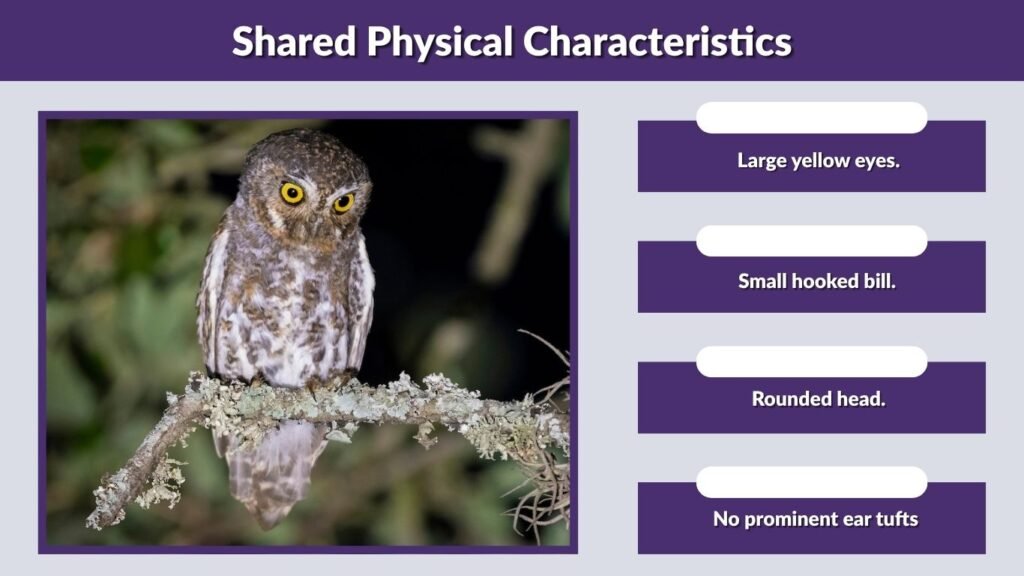
All living Elf Owl subspecies are exceptionally small. Guinness World Records identifies the Elf Owl as the smallest owl, generally measuring about 12–14 centimeters and weighing under 50 grams.
Their small size allows them to enter narrow cavities and maneuver through dense woodland. However, being tiny also means they cannot overpower the large mammals hunted by bigger owls.
Their main physical characteristics include:
- Large yellow eyes
- Small hooked bill
- Rounded head
- No prominent ear tufts
- Long legs
- Sharp talons
- Short rounded wings
- Short tail
- Gray-brown camouflage
Unlike many larger owls, Elf Owls have relatively weak facial discs. Their hearing remains useful, but they also depend heavily on vision when locating active insects.
Elf Owl Calls
The Elf Owl’s voice is often easier to detect than the bird itself. Its most familiar call is a series of high-pitched whistles, chuckles, or yapping notes.
Males vocalize to advertise territories and attract females. Pairs may also communicate near nest sites using softer calls.
The small owl can produce a surprisingly noticeable sound, especially on calm desert nights. Calls are most frequently heard around dusk and during the breeding season.
Defense Against Predators
Elf Owls face threats from snakes, larger owls, hawks, raccoons, and other predators. Their first defense is concealment. Camouflaged plumage allows them to blend into bark and shadows.
When threatened inside a cavity, an Elf Owl may remain motionless or retreat deeper into the hole. In some situations, it may pretend to be dead when handled, then escape when the predator relaxes its grip.
Pairs can also become aggressive near a nest. They may call, dive toward an intruder, or join other small birds in mobbing a predator.
Importance in Desert Ecosystems
Elf Owls help regulate populations of insects and other small animals. A breeding pair may capture large numbers of moths, beetles, crickets, and scorpions while raising its young.
The species also shows the ecological value of woodpeckers. By excavating holes in trees and cacti, woodpeckers create nesting opportunities later used by Elf Owls, flycatchers, wrens, and other cavity nesters.
Protecting an Elf Owl therefore requires more than protecting the owl alone. A healthy ecosystem needs mature vegetation, insect prey, cavity-producing woodpeckers, and safe migration routes.
How to Support Elf Owl Conservation
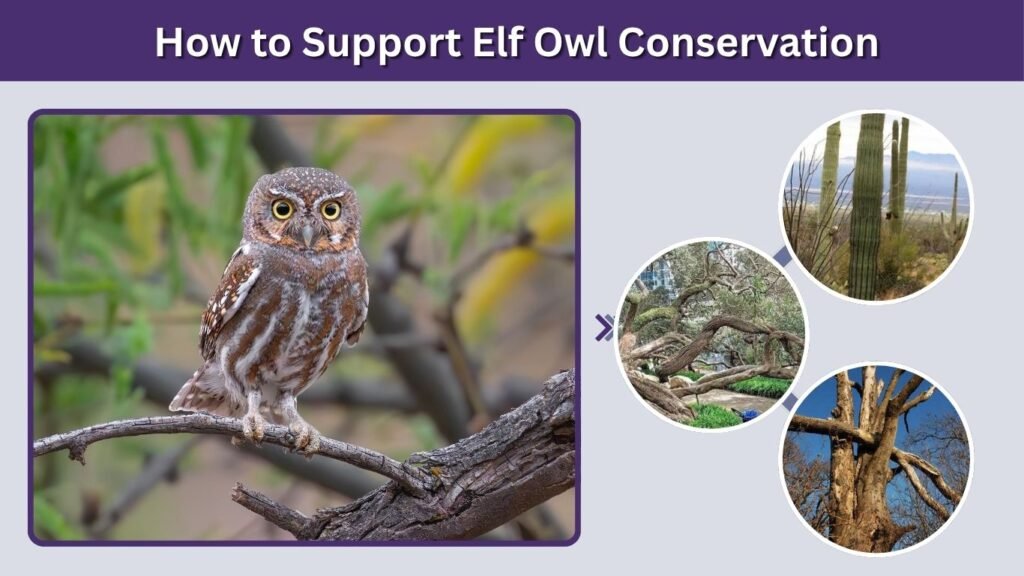
People living within the Elf Owl’s range can help by preserving native desert and woodland habitat.
Useful actions include:
- Retaining mature native trees
- Protecting saguaros and other large cacti
- Avoiding pesticides when possible
- Keeping cats indoors
- Preserving dead trees that are safe to leave standing
- Installing suitable nest boxes where natural cavities are limited
- Reducing outdoor lighting
- Avoiding disturbance near active nests
- Supporting habitat-protection organizations
Nest boxes should be designed and positioned according to regional wildlife guidance. An incorrectly sized box may attract competitors or expose owls to excessive heat.
FAQs
Are there seven types of Elf Owls?
No. Current references recognize one Elf Owl species with four subspecies. Three subspecies survive, while the Socorro Elf Owl is considered extinct. Lists describing seven Elf Owl species may be confusing Elf Owls with other small owls.
What is the most common Elf Owl subspecies?
The nominate form, Micrathene whitneyi whitneyi, is the best-known subspecies. It occurs in the southwestern United States and northwestern Mexico and is often photographed nesting in holes inside saguaro cacti.
Which Elf Owl subspecies lives in Texas?
Micrathene whitneyi idonea, commonly called the Texas Elf Owl, occurs in southern Texas and extends through northeastern and central Mexico. It inhabits subtropical thorn forest, riparian woodland, desert washes, and other wooded environments.
Is the Socorro Elf Owl still alive?
The Socorro Elf Owl has not been reliably documented for many years and is considered extinct or very likely extinct. Introduced cats and habitat damage caused by grazing mammals are associated with its disappearance from Socorro Island.
Do all Elf Owls live in deserts?
No. Although Elf Owls are strongly associated with deserts and saguaros, they also occupy riparian woodland, subtropical thorn forest, wooded canyons, dry tropical forest, oak woodland, and pine-oak habitats.
What do Elf Owls eat?
Elf Owls mainly eat insects and other arthropods, including moths, beetles, crickets, spiders, and scorpions. They may also capture small lizards, snakes, frogs, rodents, or birds when suitable prey is available.
Do Elf Owls make their own nests?
No. They usually occupy natural cavities or abandoned holes made by woodpeckers. These holes may occur in trees, utility poles, or large cacti such as saguaros.
Are Elf Owls active during the day?
Elf Owls are mainly nocturnal. They rest inside cavities or dense cover during daylight and begin hunting around dusk. They may occasionally appear during the day if disturbed or when caring for young.
Why is the Elf Owl so small?
Its small body is well suited to hunting insects, entering narrow cavities, and moving through dense desert vegetation. However, its evolutionary history is complex, and no single environmental factor fully explains its tiny size.
Are Elf Owls endangered?
The Elf Owl species is not currently considered globally endangered, but some regional populations face habitat loss and fragmentation. The isolated Socorro subspecies became extinct, illustrating that local and island populations can be much more vulnerable than the species as a whole.