
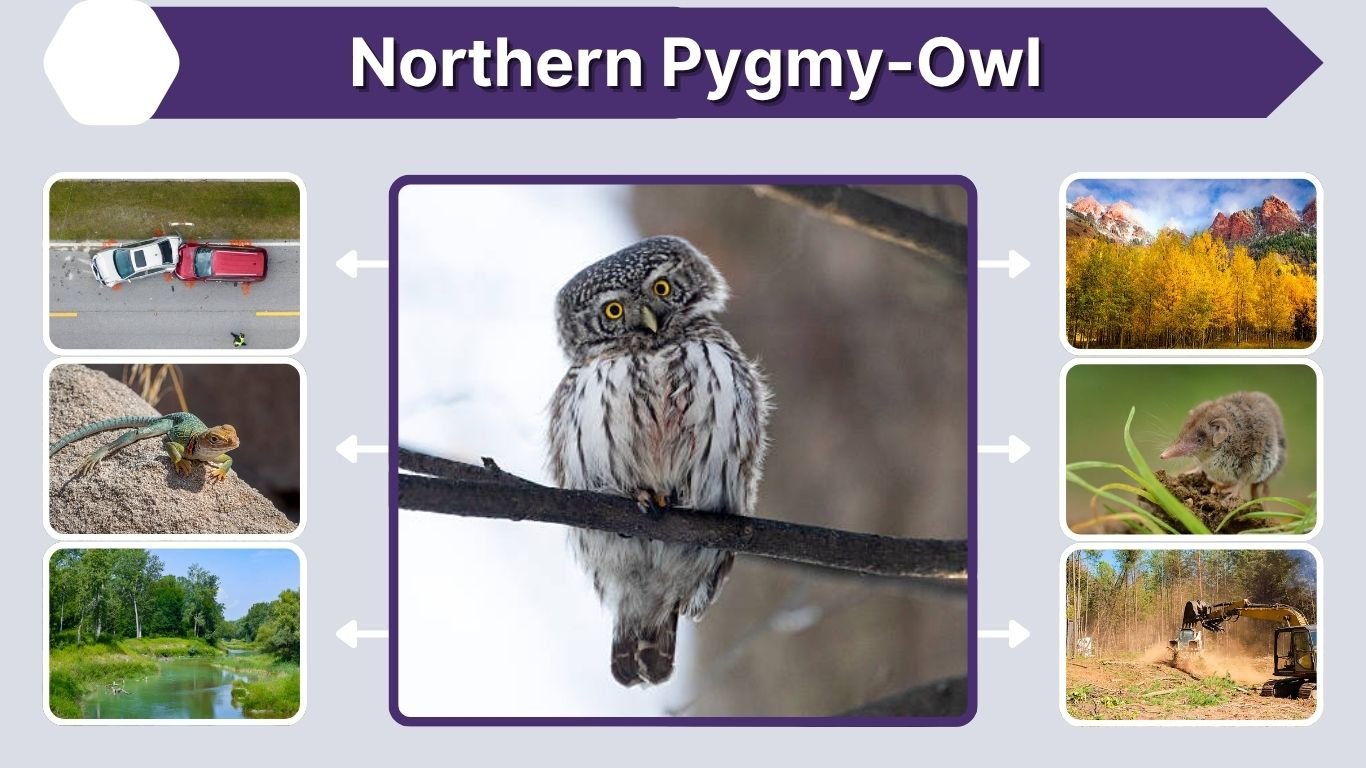
The Northern Pygmy-Owl is a tiny but powerful woodland predator found across western North America. Despite being only about the size of a large songbird, it regularly hunts mice, voles, lizards, insects, and birds nearly as large as itself. Unlike many owls, it is frequently active during daylight, making it easier to observe perched near forest clearings or high in conifer branches. Its round head, bright yellow eyes, spotted plumage, long barred tail, and false eye markings on the back of its head make it one of North America’s most distinctive small owls.
Northern Pygmy-Owl Overview
The Northern Pygmy-Owl’s scientific name is Glaucidium gnoma. It belongs to the owl family Strigidae, which includes most typical owls.
This compact species lives primarily in forests of western Canada, the western United States, Mexico, and parts of Central America. It is not a regular long-distance migrant, although mountain populations may move to lower elevations during fall and winter. (Audubon)
| Feature | Northern Pygmy-Owl |
|---|---|
| Scientific name | Glaucidium gnoma |
| Family | Strigidae |
| Length | About 6.3–7.1 inches |
| Main colors | Brown or gray-brown with white markings |
| Eye color | Bright yellow |
| Activity | Mainly daytime and twilight |
| Diet | Birds, rodents, insects, and reptiles |
| Nest type | Natural or abandoned tree cavity |
| Range | Western North America to Central America |
| Migration | Mostly resident, with seasonal wandering |
What Does a Northern Pygmy-Owl Look Like?
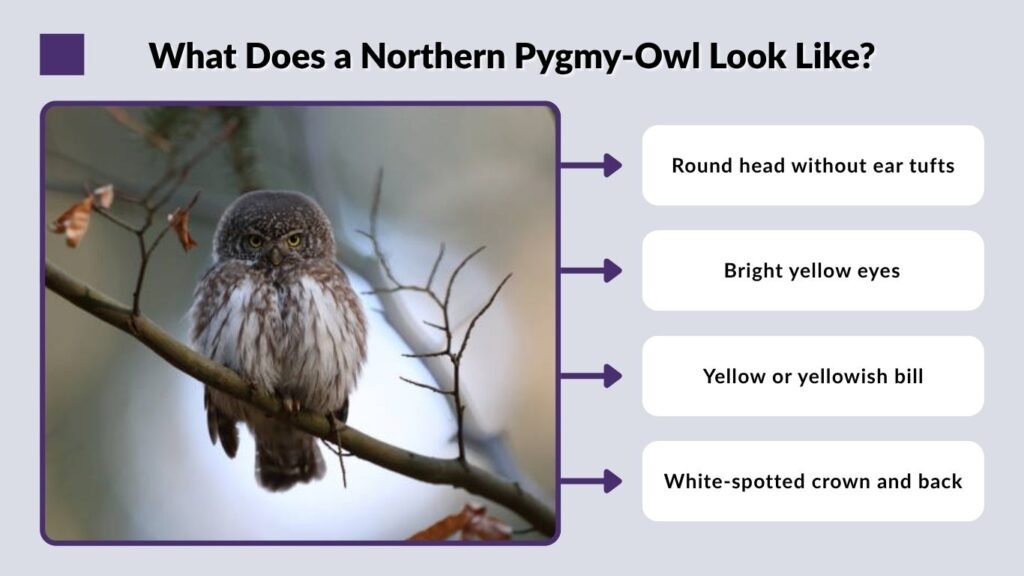
The Northern Pygmy-Owl has a small, compact body and a relatively large, rounded head. Unlike screech-owls and some larger owl species, it does not have visible ear tufts.
Its overall plumage is usually brown, gray-brown, or occasionally reddish. Fine white speckles cover the crown, while larger white spots appear across the back and wings. Its pale chest and belly are marked with dark vertical streaks.
Key Identification Features
Look for the following characteristics:
- Round head without ear tufts
- Bright yellow eyes
- Yellow or yellowish bill
- White-spotted crown and back
- White underparts with brown streaks
- Long, dark tail with pale horizontal bars
- Compact, robin-sized body
- Two dark false eye patches behind the head
The Northern Pygmy-Owl measures approximately 16–18 centimeters, or 6.3–7.1 inches, in length. Its wings are fairly short and rounded, while its tail appears relatively long for such a small owl. (All About Birds)
False Eyes on the Back of Its Head
One of this owl’s most unusual features is the pair of dark patches bordered with pale feathers on the back of its head. These markings resemble a second set of eyes.
The false eyes may confuse predators or small birds by making it difficult to determine which direction the owl is facing. They may also discourage an attack from behind. Similar false-eye patterns occur in several other pygmy-owl species.
Northern Pygmy-Owl Size
The Northern Pygmy-Owl is one of the smallest owls in North America. It is larger than the Elf Owl but smaller than the Northern Saw-whet Owl.
Although tiny, it has a sturdy body, strong feet, curved talons, and a hooked bill. Females are generally larger and heavier than males, as is common among many birds of prey.
Its small size can make it difficult to notice in a forest. From a distance, a perched individual may resemble a thrush, jay, or other medium-sized songbird. Its round head, upright posture, yellow eyes, and barred tail reveal its true identity.
Where Do Northern Pygmy-Owls Live?
Northern Pygmy-Owls occupy a broad range through western North America. They occur from Alaska and western Canada south through the western United States, Mexico, and portions of Central America.
In the United States, they may be found in states such as:
- Washington
- Oregon
- California
- Idaho
- Montana
- Wyoming
- Utah
- Colorado
- Nevada
- Arizona
- New Mexico
Their distribution is closely associated with mountainous and forested landscapes.
Northern Pygmy-Owl Habitat
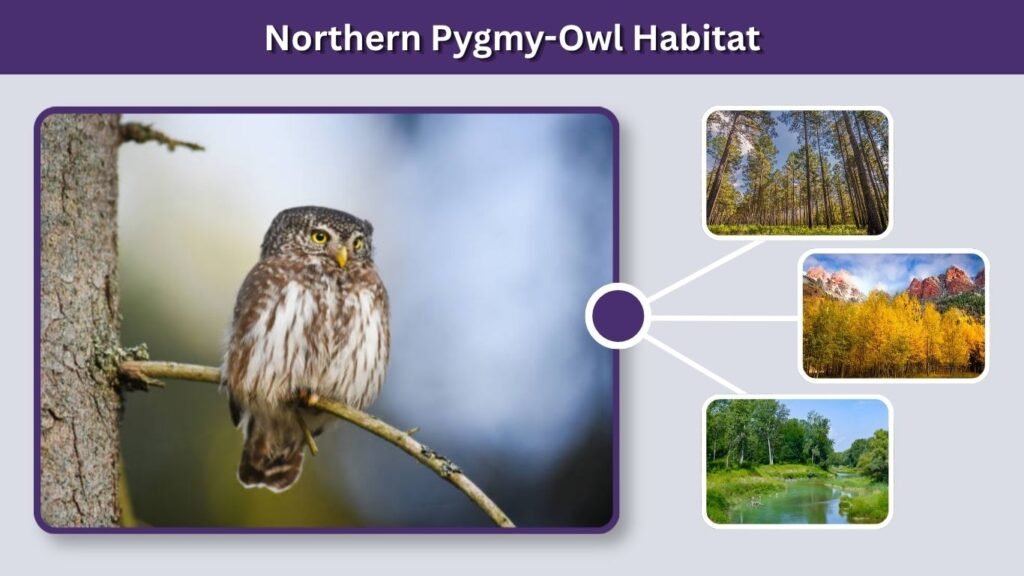
These owls live in a variety of wooded environments. They use coniferous forests, mixed forests, open woodlands, forest edges, stream corridors, and mountain valleys.
Typical habitats include:
- Pine forests
- Fir and spruce forests
- Mixed conifer-deciduous woodland
- Aspen groves
- Oak woodland
- Forest clearings
- Wooded canyons
- Riparian forests
- Suburban areas near mature trees
Northern Pygmy-Owls often hunt along forest edges, where open space allows them to detect prey. They may also appear in towns and lower-elevation woodlands during winter, especially when food becomes scarce in higher mountain forests. (All About Birds)
Mature trees are particularly important because the owls depend on existing cavities for nesting. They do not excavate their own nest holes.
What Do Northern Pygmy-Owls Eat?
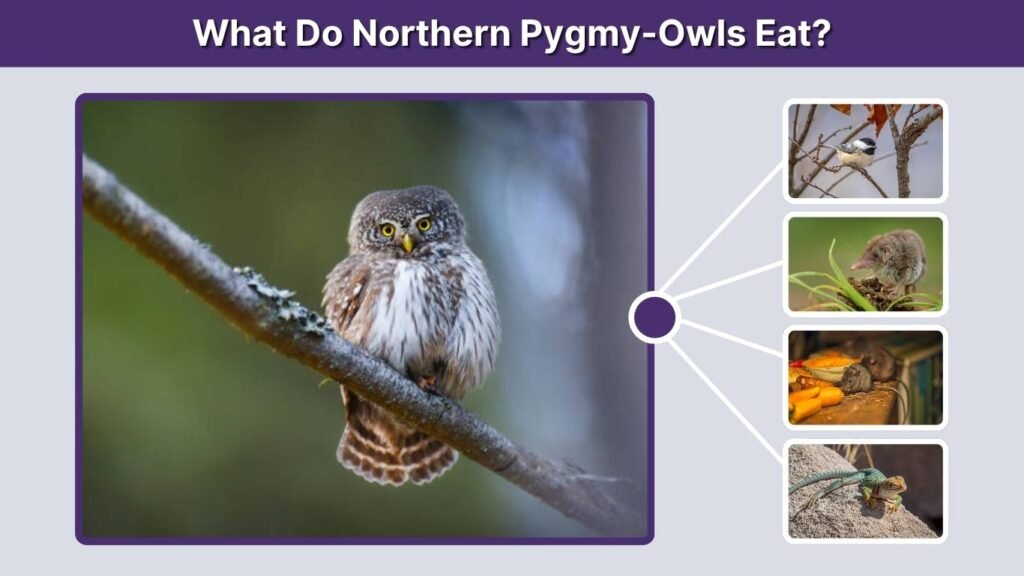
The Northern Pygmy-Owl is an opportunistic predator with a surprisingly varied diet. Small birds are especially important, but it also hunts mammals, reptiles, amphibians, and insects.
Common prey includes:
- Chickadees
- Sparrows
- Wrens
- Nuthatches
- Warblers
- Finches
- Mice
- Voles
- Shrews
- Chipmunks
- Lizards
- Large insects
Although it is very small, this owl can attack birds and mammals close to its own size. It may occasionally capture prey that appears unusually large for such a compact hunter. Cornell describes it as a fierce predator with a particular taste for songbirds. (All About Birds)
How It Hunts
The Northern Pygmy-Owl usually hunts from a perch. It watches the surrounding ground, shrubs, and tree branches before making a quick flight toward its target.
Its short, rounded wings provide maneuverability through forest vegetation. Strong feet and sharp talons allow it to grasp active prey.
Unlike many owls that rely primarily on darkness and highly sensitive hearing, the Northern Pygmy-Owl regularly uses daylight vision while hunting.
Are Northern Pygmy-Owls Nocturnal?
Northern Pygmy-Owls are primarily diurnal, meaning they are frequently active during the day. They may also hunt around dawn and dusk.
Daytime activity distinguishes them from many other North American owls. A person may see one sitting near the top of a tree, watching a clearing or listening for prey.
Being active during daylight also attracts attention from songbirds. Chickadees, nuthatches, jays, and other birds may gather around a discovered owl, calling loudly and flying close to it. This defensive behavior is known as mobbing. (All About Birds)
For birdwatchers, a noisy group of agitated songbirds can provide a useful clue that a pygmy-owl or another predator is nearby.
Northern Pygmy-Owl Call
The most familiar Northern Pygmy-Owl call is a series of clear, evenly spaced whistles or “toots.” Each note may be separated by a second or two, producing a slow, repetitive rhythm.
Different regional populations can have somewhat different calls. Some birds along the Pacific coast give slower single notes, while other populations produce paired toots or faster sequences. (All About Birds)
The owl may call from a concealed perch, making it difficult to locate even when the sound seems close. Males call most frequently when establishing territories or attracting mates.
Nesting and Reproduction
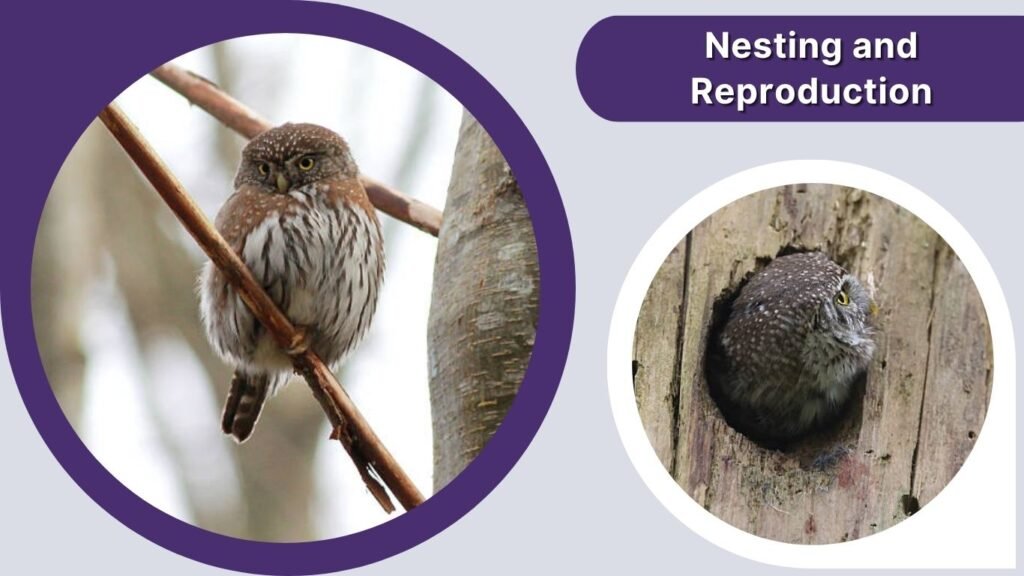
Northern Pygmy-Owls nest inside tree cavities. They may use natural hollows or holes previously excavated by woodpeckers.
Suitable nest sites may occur in:
- Dead trees
- Broken tree trunks
- Mature living trees
- Abandoned woodpecker holes
- Occasionally nest boxes of suitable dimensions
The owls do not normally build a traditional stick nest. The female lays her eggs directly on debris or wood material already present at the bottom of the cavity.
Eggs and Young
A clutch usually contains several white eggs. The female performs most of the incubation, while the male supplies food.
After hatching, the young remain in the cavity until they are sufficiently developed to leave. Both parents participate in feeding the nestlings. Newly fledged owls may stay near their parents while gradually improving their hunting and flight skills.
Because nesting depends on cavities, removing dead trees and old woodpecker habitat can reduce available breeding sites.
Behavior
Northern Pygmy-Owls are usually solitary outside the breeding season. They may sit upright on an exposed perch but can also remain hidden in thick foliage.
When alarmed, an owl may raise or lower its body feathers, move its head rapidly, or turn so its false eye markings face a potential threat.
These owls are bold predators, but they are also vulnerable to larger raptors. Hawks, larger owls, mammals, and other predators may threaten adults, eggs, or nestlings.
Northern Pygmy-Owl Migration
Northern Pygmy-Owls are generally considered permanent residents rather than true long-distance migrants. However, individuals may wander beyond their breeding territories.
Birds living at high elevations sometimes move downhill during winter. These seasonal movements may bring them into foothills, wooded neighborhoods, parks, or towns where small birds gather around feeders. (Audubon)
Food availability, snow cover, temperature, and local prey populations may all influence these movements.
Northern Pygmy-Owl vs Northern Saw-Whet Owl
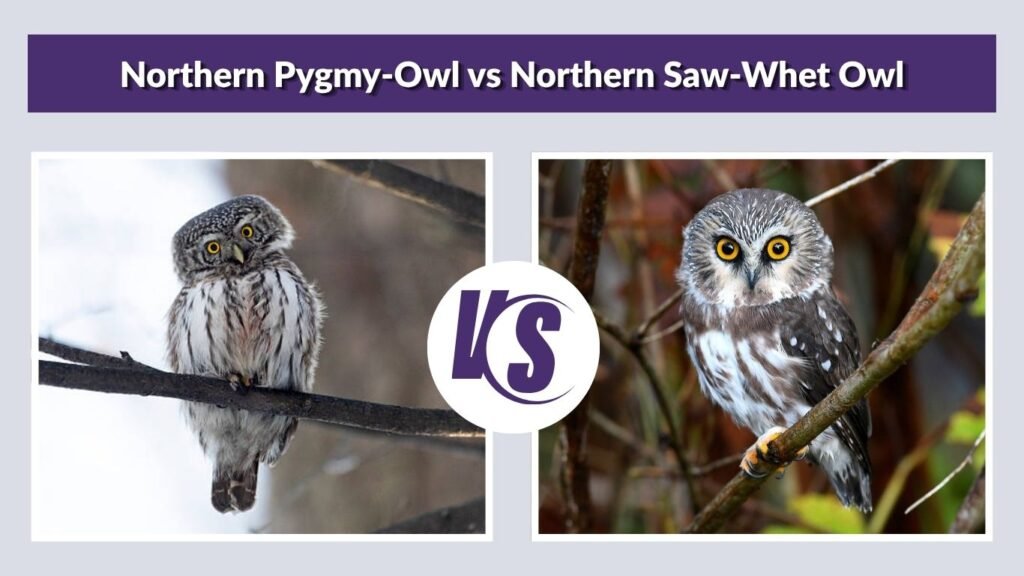
These two small owls can occur in some of the same regions, but their appearance and behavior differ.
| Feature | Northern Pygmy-Owl | Northern Saw-whet Owl |
|---|---|---|
| Head shape | Round, without a strong facial disc | Round with a clearer facial disc |
| Eyes | Yellow | Yellow |
| Plumage | Spotted crown and streaked belly | Brown with white facial markings |
| Tail | Relatively long and barred | Shorter |
| Activity | Frequently active by day | Mainly nocturnal |
| False eyes | Present behind the head | Absent |
| Hunting | Often targets small birds | Often targets small mammals |
The long barred tail and false eye patches are especially useful for identifying a Northern Pygmy-Owl.
Conservation and Threats
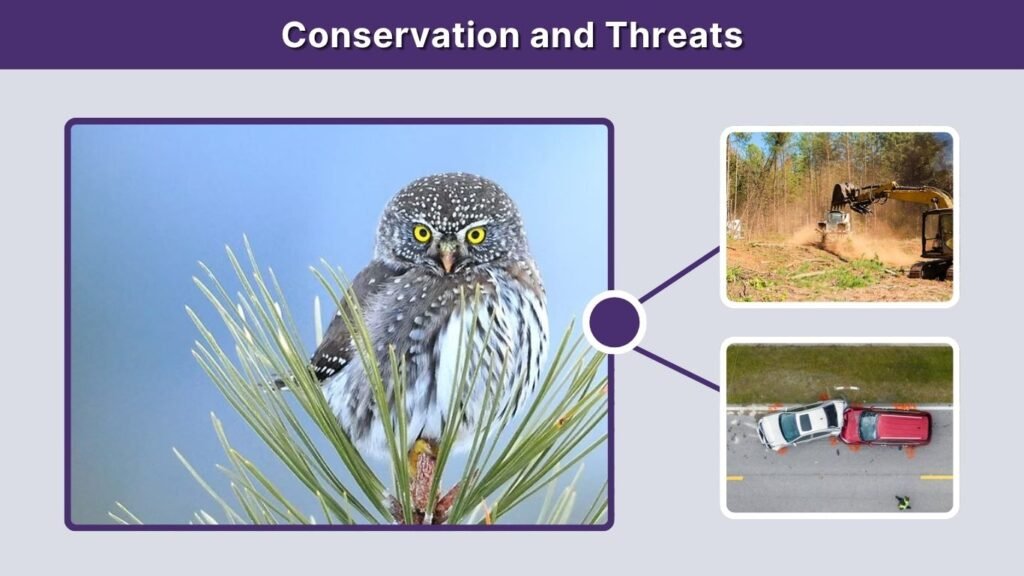
The Northern Pygmy-Owl remains widely distributed, but forest management can affect local populations. Loss of mature trees, standing dead wood, and woodpecker cavities may reduce nesting opportunities.
Other possible threats include:
- Forest clearing
- Removal of dead trees
- Habitat fragmentation
- Vehicle collisions
- Window strikes
- Rodent poison
- Changes in prey populations
- Severe wildfire or loss of forest structure
Maintaining forests with a mixture of mature trees, snags, clearings, and dense vegetation can support both nesting and hunting needs.
Interesting Northern Pygmy-Owl Facts
- It is small enough to be mistaken for a songbird.
- It often hunts during daylight.
- Small birds may gather to mob it.
- It has false eye markings behind its head.
- It can capture prey close to its own size.
- It does not build its own nest.
- It often uses abandoned woodpecker holes.
- Females are generally larger than males.
- Its call consists of repeated whistled notes.
- Mountain birds may move downhill during winter.
FAQs
Is a Northern Pygmy-Owl rare?
The Northern Pygmy-Owl is widespread but can be difficult to find because of its small size and forest habitat. It may be locally uncommon in some areas. Listening for repeated tooting calls or watching groups of mobbing songbirds can help reveal its location.
Is the Northern Pygmy-Owl dangerous to humans?
No. Northern Pygmy-Owls generally avoid people and are not considered dangerous. Like any wild raptor, they may defend themselves or a nest if handled or approached too closely. They should always be observed from a respectful distance.
Why do small birds mob Northern Pygmy-Owls?
Small birds recognize the owl as a predator. By gathering, calling loudly, and flying around it, they warn other birds and may pressure the owl to leave. Mobbing is especially common because songbirds form a major part of the owl’s diet.
Can Northern Pygmy-Owls turn their heads all the way around?
No owl can rotate its head a full 360 degrees. Like other owls, the Northern Pygmy-Owl can turn its head much farther than a human, allowing it to scan its surroundings while keeping its body still.
Do Northern Pygmy-Owls visit bird feeders?
They do not eat seeds, but they may appear near feeders because feeders attract songbirds and small rodents. During winter, an owl may perch nearby and hunt animals gathering around the feeding area.
