
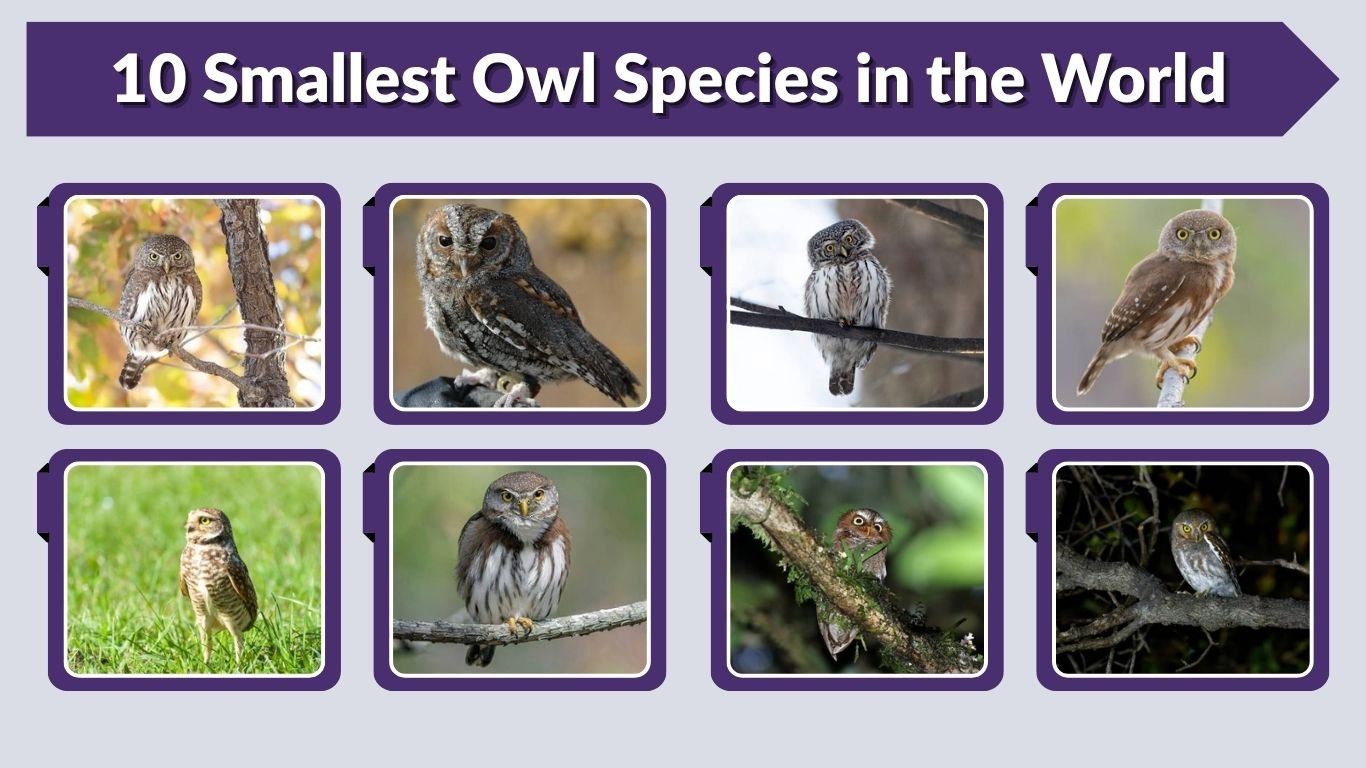
Owls come in many sizes, from powerful hunters with broad wings to tiny species scarcely larger than songbirds. The world’s smallest owls may look delicate, but they are skilled predators equipped with sharp talons, hooked bills, and excellent vision. Many hunt insects, rodents, reptiles, and small birds from hidden woodland perches. This list introduces 10 of the smallest owl species in the world, including the Elf Owl, pygmy-owls, and the secretive Long-Whiskered Owlet, with details about their size, appearance, habitat, diet, nesting habits, and behavior.
1. Elf Owl
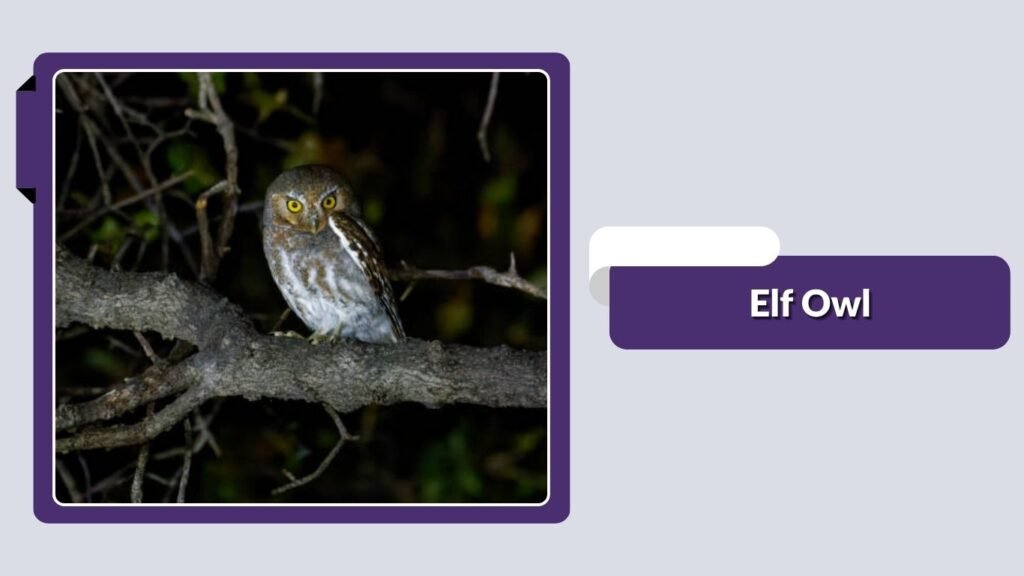
The Elf Owl is widely recognized as the world’s smallest owl. This sparrow-sized bird measures about 5 to 5.75 inches long and has a wingspan of roughly 10.5 inches. Adults commonly weigh only 1.2 to 1.9 ounces, making them remarkably light compared with most other owl species.
Identification
The Elf Owl has a rounded head without ear tufts, yellow eyes, and a small yellowish bill. Its grayish-brown plumage is covered with pale spots, while the underside has light brown streaking. White eyebrow markings give its face a distinctive appearance.
Habitat and Range
Elf Owls live in the southwestern United States and Mexico. They occupy deserts, wooded canyons, dry forests, and riverside habitats containing trees or large cacti. Saguaro deserts are especially well known for supporting these tiny owls.
Diet and Hunting
These nocturnal hunters feed mainly on insects, including moths, beetles, crickets, grasshoppers, and scorpions. They may also capture spiders, centipedes, small lizards, snakes, and occasionally tiny rodents.
Nesting and Behavior
Elf Owls nest inside natural cavities or abandoned woodpecker holes in trees and cacti. Females typically lay several white eggs. Despite their small size, pairs may boldly mob snakes, larger owls, and mammals that approach their nesting area.
2. Long-Whiskered Owlet
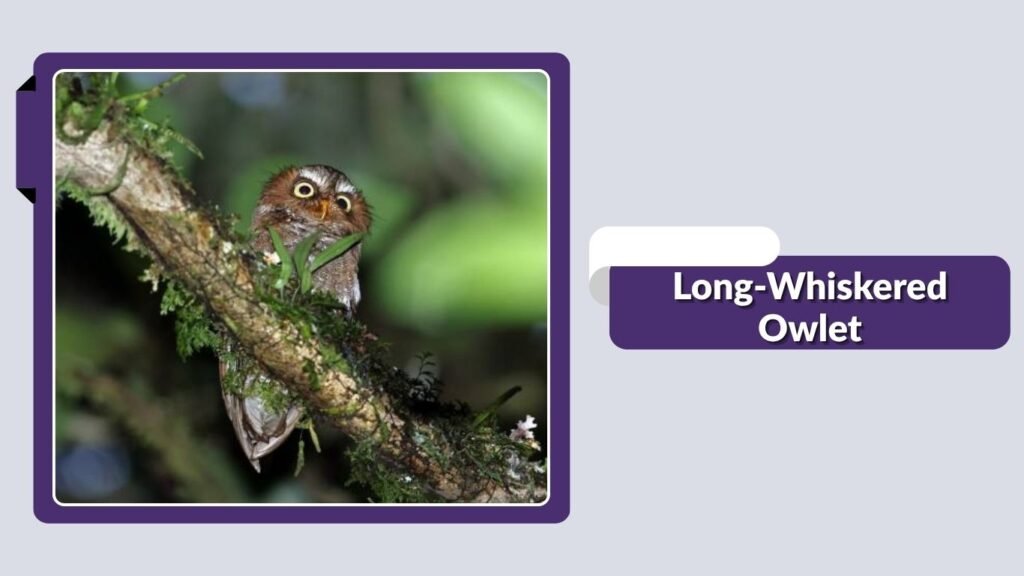
The Long-Whiskered Owlet is one of the world’s smallest and least-known owls. It measures approximately 5.1–5.5 inches long and has a compact body with a very short tail. This rare species is found only in a limited area of the cloud forests of northern Peru.
Identification
This tiny owl has reddish-brown upperparts, a pale belly, prominent whitish eyebrows, and unusually long facial feathers that resemble whiskers. It lacks visible ear tufts, and its large orange-brown eyes help it see in the dark forest understory.
Habitat and Range
Long-Whiskered Owlets inhabit dense, humid mountain forests in northern Peru. They are closely associated with cloud forests containing thick vegetation, moss, vines, bamboo, and epiphytes. Their restricted distribution makes them especially vulnerable to habitat destruction.
Diet and Hunting
The species appears to feed mainly on insects, including beetles, moths, grasshoppers, and other invertebrates. It probably hunts from low perches within dense vegetation. Much of its feeding behavior remains poorly studied because the owl is secretive and difficult to observe.
Nesting and Behavior
Very little is known about its breeding habits, nesting sites, or eggs. The Long-Whiskered Owlet is mainly nocturnal and often remains hidden near the forest floor. Its call consists of slow, slightly hoarse hoots repeated at regular intervals.
3. Tamaulipas Pygmy-Owl
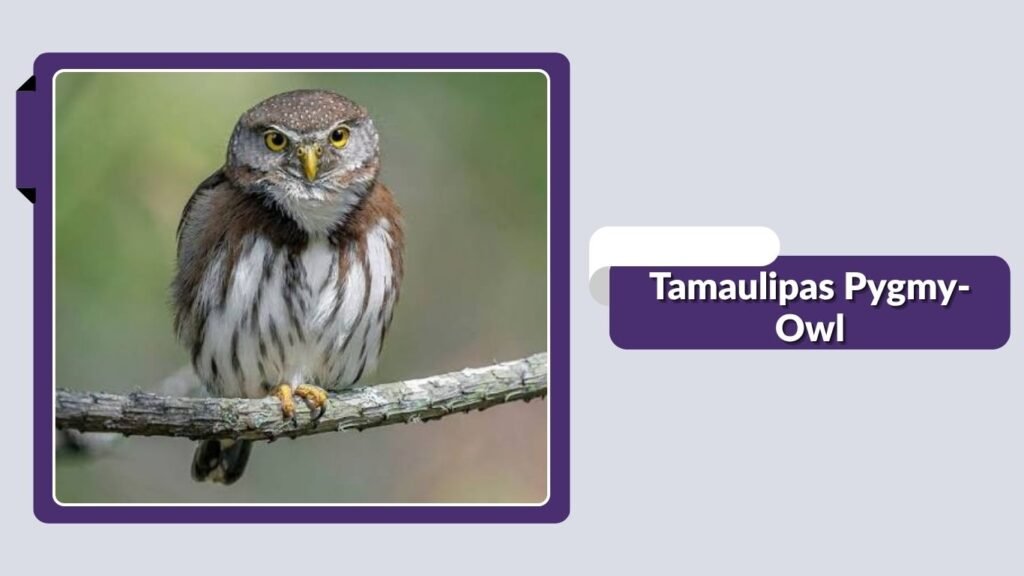
The Tamaulipas Pygmy-Owl is a tiny Mexican owl measuring approximately 5.1–7 inches long and weighing about 1.8–1.9 ounces. Females are generally slightly larger than males. Despite its small size, it is an alert predator capable of capturing insects and small vertebrates. (Oiseaux)
Identification
This owl has a rounded head, yellow eyes, and no ear tufts. Males are generally gray-brown, while females may appear more reddish-brown. Pale spots cover the crown and back, and false eye markings occur behind the head.
Habitat and Range
The Tamaulipas Pygmy-Owl is found only in northeastern Mexico. It inhabits humid evergreen mountain forests, open woodland, and forest edges, usually at middle elevations. Its limited range makes the preservation of mature forest particularly important.
Diet and Hunting
Its diet is not completely documented, but it probably feeds mainly on insects, lizards, small birds, and other small animals. It is partly active during daylight and may hunt from a concealed perch before flying quickly toward prey.
Nesting and Behavior
The owl likely nests in natural tree cavities and abandoned woodpecker holes. Females are believed to lay approximately two to four white eggs. Its call includes a series of high, hollow whistles repeated after short pauses.
4. Least Pygmy-Owl
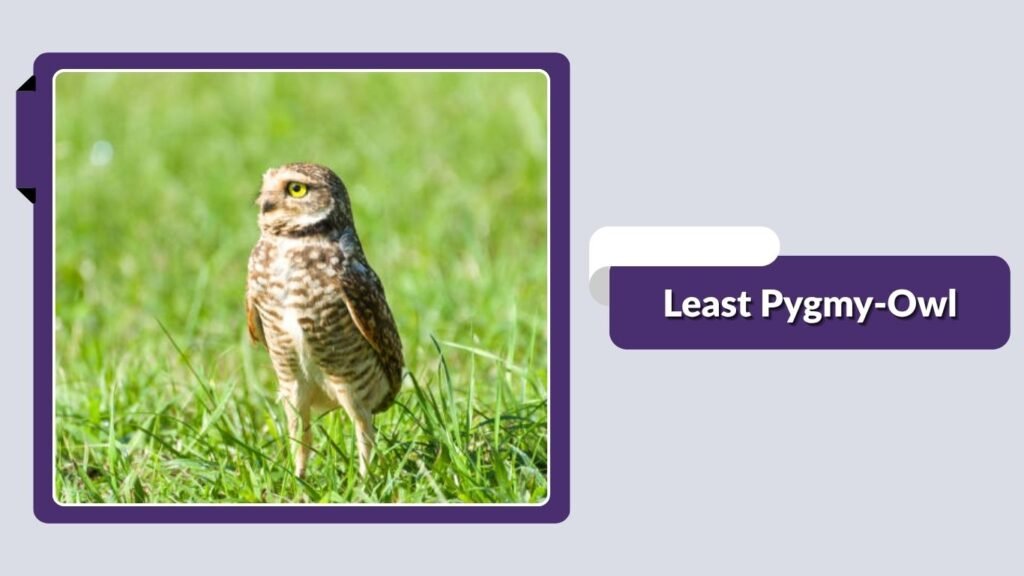
The Least Pygmy-Owl is a very small South American owl measuring around 5.5–5.9 inches long and weighing approximately 1.8 ounces. Females are usually slightly larger than males. Its compact body and rounded head allow it to move easily through dense forest vegetation. (World Species)
Identification
This owl has brown upperparts marked with small pale spots and light underparts streaked with reddish brown. Its eyes and feet are yellow, while the short dark tail displays several broken whitish bars. It does not have visible ear tufts.
Habitat and Range
Least Pygmy-Owls inhabit tropical and subtropical evergreen forests in eastern and southeastern Brazil. They occur in primary forest, secondary woodland, and forest edges, generally from lowlands to elevations of about 3,300 feet.
Diet and Hunting
Insects form most of the Least Pygmy-Owl’s diet, although it can also capture lizards, small birds, and other tiny vertebrates. It usually watches for prey from a low perch before making a rapid attack.
Nesting and Behavior
Its breeding behavior remains poorly documented. Like related pygmy-owls, it probably nests inside natural tree cavities or old woodpecker holes. It is partly active during the day but appears most active near dawn and dusk.
5. Pernambuco Pygmy-Owl
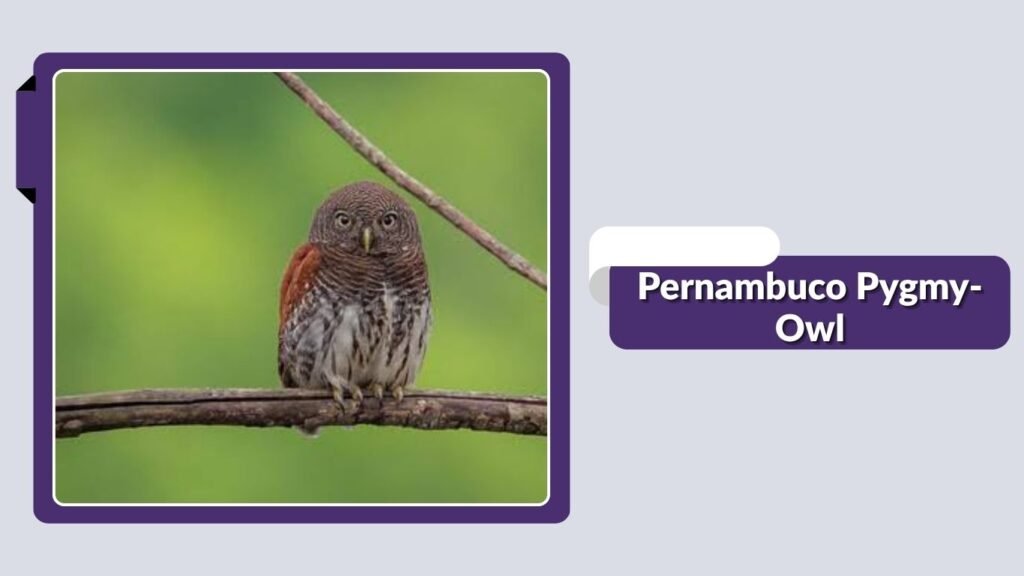
The Pernambuco Pygmy-Owl is one of the world’s smallest and rarest owls. It measures approximately 5.1 inches long and has a compact body, rounded head, and relatively short wings. This tiny species is native to northeastern Brazil and is currently listed as Critically Endangered.
Identification
The Pernambuco Pygmy-Owl has brown upperparts marked with small whitish spots. Its underparts are pale with brown or reddish streaks. It has yellow eyes, a yellowish bill, and no visible ear tufts. Dark false-eye patches appear on the back of its head.
Habitat and Range
This owl is known only from the Atlantic Forest of Pernambuco and nearby areas of northeastern Brazil. It depends on humid tropical forest with mature trees and dense vegetation. Extensive forest clearing has left very little suitable habitat within its original range.
Diet and Hunting
Its diet is believed to include insects, small birds, lizards, and tiny mammals. Like other pygmy-owls, it probably hunts from a concealed perch before making a short, rapid flight toward prey. It may be active during daylight as well as around dawn and dusk.
Conservation and Behavior
The species is known from very few records, including specimens collected in 1980 and a recorded call from 2002. Its extreme rarity and severe habitat loss have raised fears that it may already be extinct, although it remains officially classified as Critically Endangered. Protecting and surveying the remaining Atlantic Forest is essential.
6. Colima Pygmy-Owl
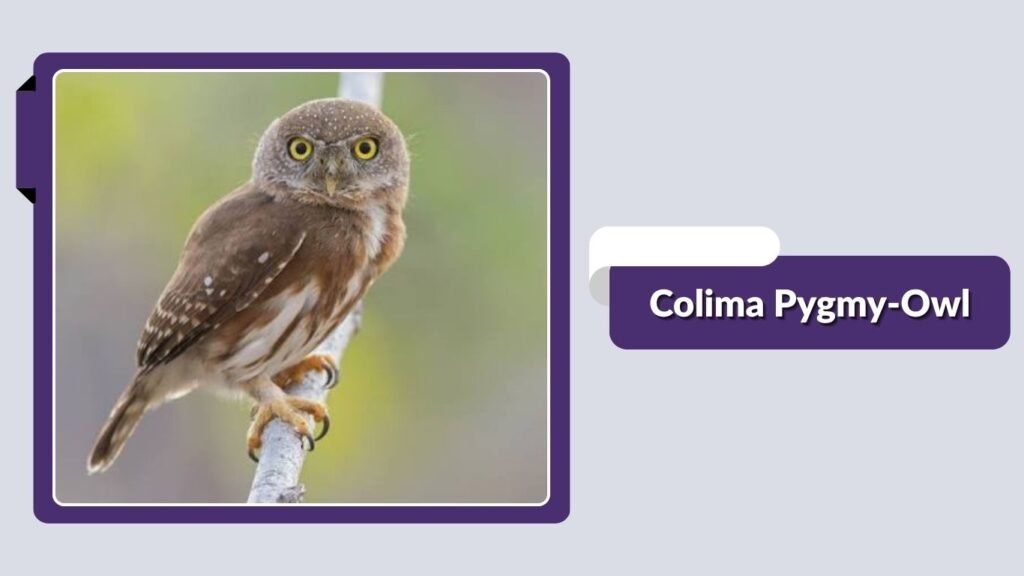
The Colima Pygmy-Owl is a tiny owl native to western Mexico. It measures approximately 5.1–5.9 inches long and commonly weighs around 1.6 ounces. Despite its compact body, it has strong feet and can capture surprisingly large prey.
Identification
This owl has a rounded head without ear tufts, yellow eyes, and yellow-orange feet. Its brown or cinnamon-colored upperparts contain small white spots, while its pale chest is marked with darker streaks. False eye patches appear behind its head.
Habitat and Range
Colima Pygmy-Owls occur only in Mexico, from southern Sonora through western coastal regions to Oaxaca. They inhabit tropical deciduous forest, thorn woodland, pine-oak forest, plantations, and other semi-open wooded environments.
Diet and Hunting
These small predators eat large insects, lizards, rodents, and birds. They may capture birds considerably larger than themselves. Colima Pygmy-Owls hunt from perches, scanning nearby vegetation before making a quick flight toward prey.
Nesting and Behavior
Colima Pygmy-Owls nest in natural tree cavities or abandoned woodpecker holes. A female generally lays two to four eggs. The species can be active at night and during parts of the day, when songbirds may gather to mob it.
7. Ferruginous Pygmy-Owl
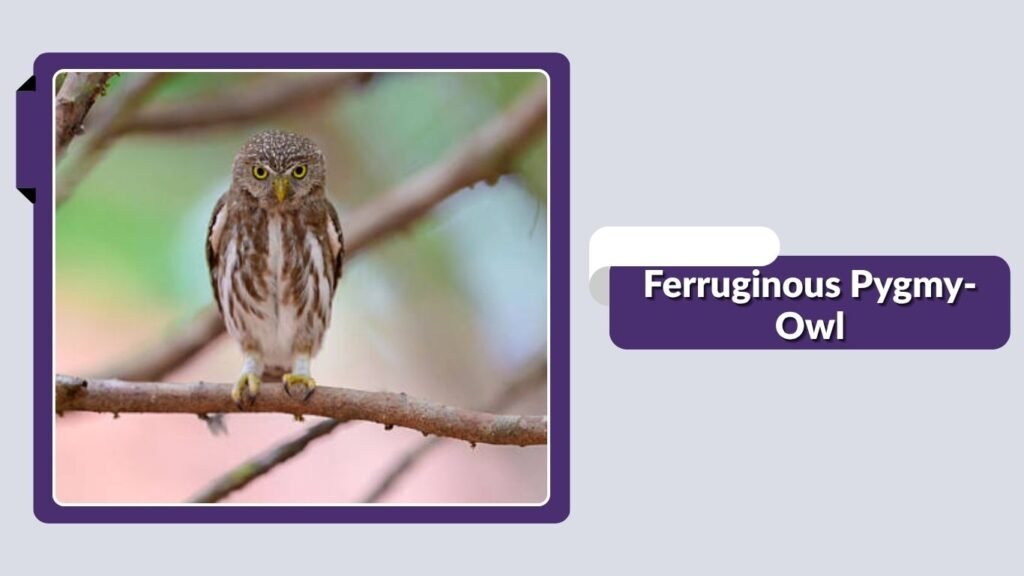
The Ferruginous Pygmy-Owl is a small, sturdy owl measuring approximately 6–7 inches long. It has a relatively long tail and disproportionately strong feet. Its name comes from its rusty or reddish-brown plumage, although some individuals appear grayer.
Identification
This owl has a rounded head, bright yellow eyes, a yellow bill, and no ear tufts. Its underparts are pale with reddish-brown streaks. Dark false eye patches bordered with white feathers are visible on the back of its head.
Habitat and Range
Ferruginous Pygmy-Owls have a wide range extending from the southern United States through Mexico, Central America, and much of South America. They occupy tropical forest, dry woodland, savanna, scrubland, plantations, clearings, and suburban areas.
Diet and Hunting
Their diet includes insects, lizards, frogs, rodents, and birds. They are fearless hunters capable of attacking birds larger than themselves. They usually watch from an exposed perch before flying directly toward their target.
Nesting and Behavior
These owls nest in natural cavities, abandoned woodpecker holes, and sometimes large cactus cavities. Females may lay two to seven eggs. Ferruginous Pygmy-Owls are frequently active during daylight, especially around dawn and late afternoon.
8. Northern Pygmy-Owl
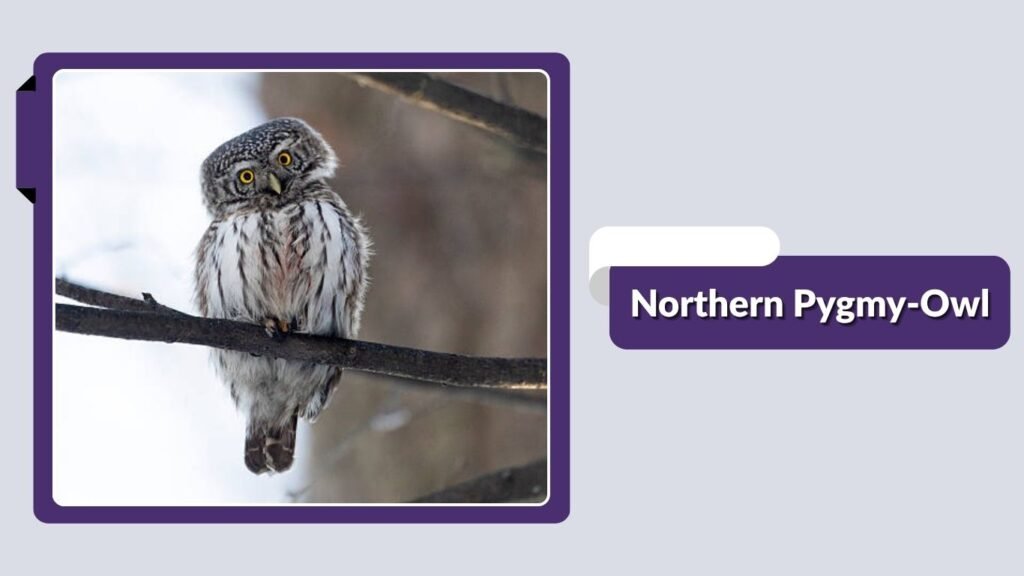
The Northern Pygmy-Owl measures approximately 6.3–7.1 inches long, making it only slightly larger than a House Sparrow. It has a compact body, rounded wings, and a comparatively long tail. Females are generally larger than males.
Identification
This owl has bright yellow eyes, a rounded head without ear tufts, and a yellowish bill. Its brown upperparts have white spots, while its pale underside contains dark vertical streaks. Two false black eyes appear behind its head.
Habitat and Range
Northern Pygmy-Owls inhabit western North America, from western Canada through the western United States and into Mexico. They favor coniferous forest, mixed woodland, mountain valleys, forest edges, and wooded areas near streams.
Diet and Hunting
They eat chickadees, sparrows, wrens, mice, voles, lizards, and large insects. Despite their size, they can capture animals several times their own weight. They hunt mainly from perches and are frequently active during daylight.
Nesting and Behavior
Northern Pygmy-Owls use natural tree cavities and old woodpecker holes. The female incubates the eggs while the male supplies food. Small birds commonly recognize this owl as a dangerous predator and mob it with loud alarm calls.
9. Flammulated Owl
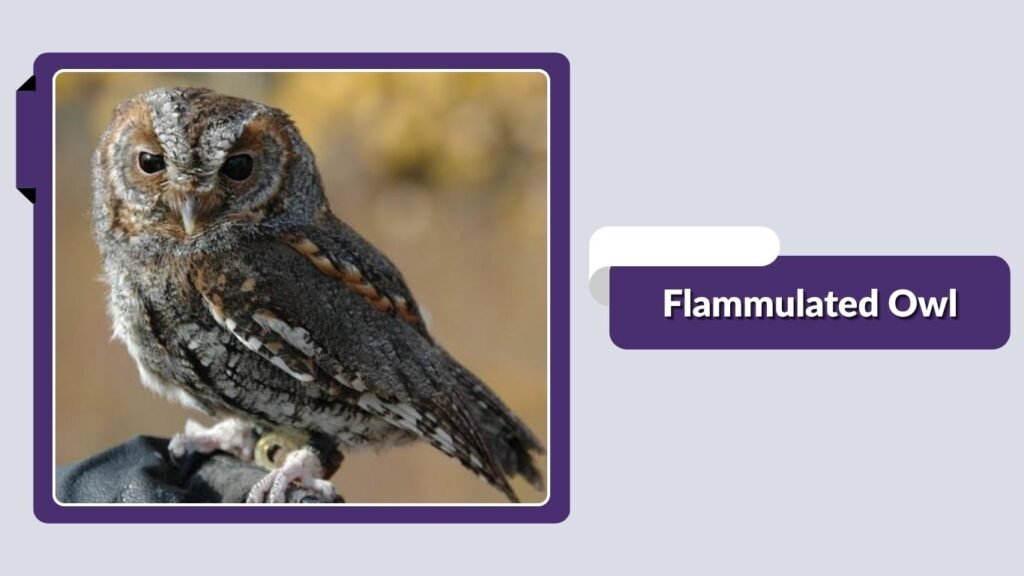
The Flammulated Owl is one of North America’s smallest owls, measuring approximately 6–7 inches long. It has a compact body, short tail, and narrow wings. Although similar in length to a Northern Pygmy-Owl, it is often lighter and more delicate in appearance.
Identification
This owl has dark eyes, small ear tufts, and gray or reddish-brown plumage. Rust-colored facial markings give it a flame-like appearance and explain the name “flammulated.” Its patterned feathers provide excellent camouflage against pine bark.
Habitat and Range
Flammulated Owls breed in mature pine and mixed-conifer forests across western North America. They prefer open forests containing large trees, grassy clearings, and old woodpecker cavities. Most migrate south to Mexico or Central America for winter.
Diet and Hunting
Unlike many owls, the Flammulated Owl feeds mainly on insects. Moths, beetles, crickets, grasshoppers, and spiders form most of its diet. It hunts at night by flying from a perch or catching insects among branches.
Nesting and Behavior
Flammulated Owls nest in abandoned woodpecker holes or natural tree cavities. Females usually lay two or three eggs. Their surprisingly low-pitched hoots make them sound much larger than they actually are.
10. Baja Pygmy-Owl
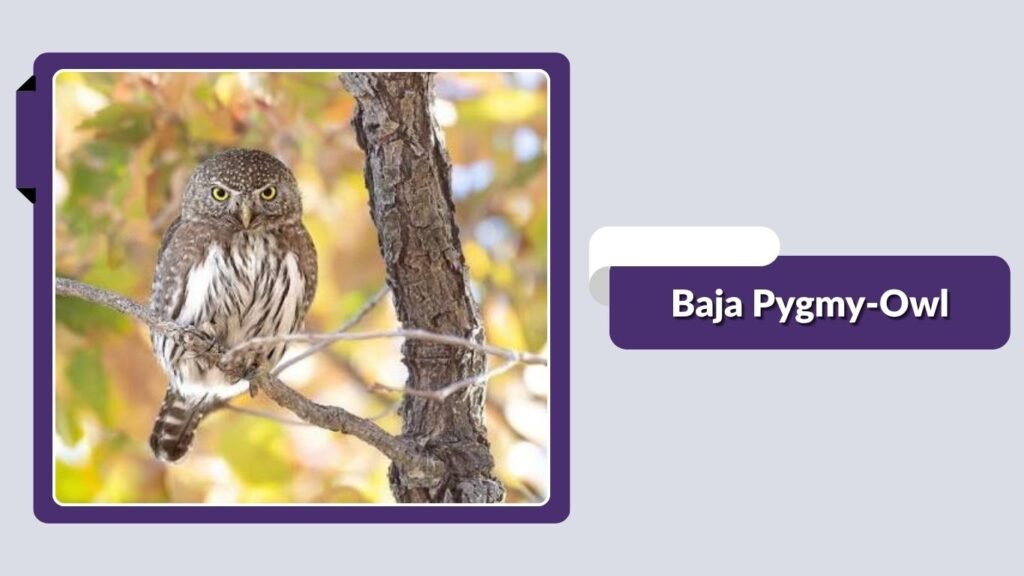
The Baja Pygmy-Owl, also called the Cape Pygmy-Owl, is a small owl measuring roughly 5.5–6.5 inches long. Its compact body, rounded head, and long barred tail are typical of pygmy-owls. Females are usually somewhat larger than males.
Identification
This owl has yellow eyes, a yellowish bill, and brown upperparts covered with pale spots. Its underparts are whitish with brown streaks. Dark false eye patches on the back of the head may confuse predators approaching from behind.
Habitat and Range
The Baja Pygmy-Owl is restricted to the southern part of Mexico’s Baja California Peninsula. It inhabits pine-oak woodland, dry forest, palm groves, wooded canyons, and other habitats containing enough mature trees for hunting and nesting.
Diet and Hunting
Its diet includes insects, small reptiles, rodents, and birds. The owl normally waits on a branch and watches the surrounding ground or vegetation before flying rapidly toward prey. It may be active during daylight and twilight.
Nesting and Behavior
Baja Pygmy-Owls probably nest in natural cavities and abandoned woodpecker holes. Like related species, they do not construct traditional nests. Their calls consist of repeated whistled notes, which help pairs communicate and defend territories.