
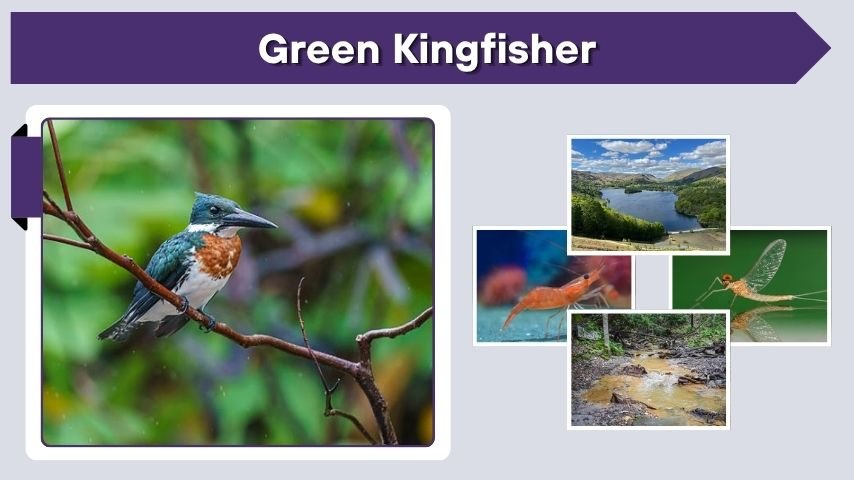
The Green Kingfisher is a small but striking bird found along quiet rivers, streams, ponds, and wetlands in the Americas. Its emerald-green back, white markings, long bill, and low waterside hunting style make it a favorite for birdwatchers. Although it can be overlooked in shaded vegetation, this kingfisher is an exciting species to spot, especially in Texas, Arizona, Central America, Costa Rica, and South America.
What Is a Green Kingfisher?
The Green Kingfisher is a small water kingfisher with the scientific name Chloroceryle americana. It belongs to the kingfisher family, Alcedinidae, and is part of the American green kingfisher group. Unlike the larger Belted Kingfisher, the Green Kingfisher is compact, quieter, and often more secretive around low vegetation near water.
This bird is strongly tied to aquatic habitats. It usually sits on low branches, exposed roots, snags, or streamside vegetation while watching the water below. When it sees prey, it dives quickly to catch small fish, shrimp, aquatic insects, or other tiny animals. Cornell describes it as a small green-and-white kingfisher with a large bill that can be easy to miss along shaded streams.
The Green Kingfisher is not the same as a green-colored kingfisher in general. It is a specific species. Searches such as “kingfisher green,” “green kingfisher bird,” and “green kingfisher Chloroceryle americana” usually refer to this species.
Green Kingfisher Quick Facts
The Green Kingfisher is best recognized by its size, green upperparts, white wing spots, and different male and female breast patterns. It is smaller and less noisy than some better-known kingfishers, but its bright plumage can look jewel-like in good light.
| Feature | Details |
|---|---|
| Common name | Green Kingfisher |
| Scientific name | Chloroceryle americana |
| Family | Alcedinidae |
| Main colors | Emerald green, white, and rufous or buff markings |
| Typical habitat | Streams, rivers, ponds, lakes, wetlands, and wooded shorelines |
| Diet | Small fish, shrimp, crustaceans, insects, and aquatic prey |
| Range | Southern Texas and southern Arizona through Central and South America |
| Conservation status | Least Concern |
The species is considered of Least Concern globally, but local populations still depend on clean water, streamside vegetation, and healthy aquatic ecosystems. BirdLife lists the Green Kingfisher as Chloroceryle americana and treats it as a species with a broad range.
Green Kingfisher Size and Appearance
The Green Kingfisher is small compared with many other kingfishers. It has a short tail, a large head, a long straight bill, and a compact body. Its shape can look slightly unusual because the bill seems oversized for the bird’s body. Audubon describes it as looking almost like a small sparrow with the bill of a heron.
Most Green Kingfishers show rich green upperparts, white spotting on the wings and tail, and pale underparts with green spotting or banding. The white collar and throat area help separate it from darker surroundings, especially when it perches in shaded streamside vegetation.
Male Green Kingfisher
The male Green Kingfisher has green upperparts, white markings, and a noticeable rufous or chestnut breast band. This rusty chest patch is one of the easiest ways to identify a male. In good light, the upperparts can shine emerald green, while the white wing spotting stands out during flight or when the bird shifts position on a perch.
Female Green Kingfisher
The female Green Kingfisher looks similar in shape and size, but her breast pattern is different. Instead of the male’s strong rusty chest, the female usually shows green spotting or green bands across the breast. Cornell notes that females have two neat green bands across the breast, while males have a rust-red chest.
Juvenile Green Kingfisher
Juvenile Green Kingfishers can look duller and less crisp than adults. Their markings may be less sharply defined, and their colors may not appear as bright. However, the small size, green back, long bill, low waterside perching, and quick diving behavior still help with identification.
Green Kingfisher Range
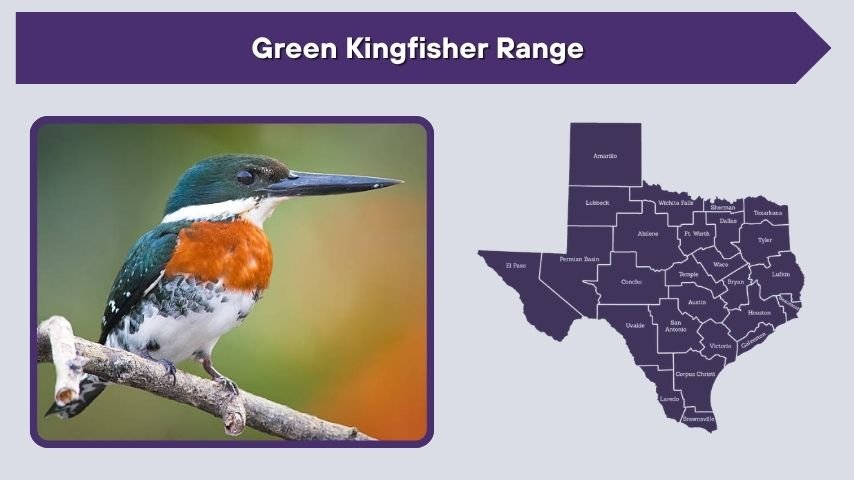
The Green Kingfisher has a wide range in the Americas. It barely enters the United States, where it is mainly associated with southern Texas and parts of southern Arizona. From there, its range continues south through Mexico, Central America, and much of South America. Cornell states that it reaches the United States in southern Arizona and Texas, then extends south through South America nearly to Patagonia.
Green Kingfisher in Texas
Texas is one of the best places in the United States to look for the Green Kingfisher. It is most often associated with the southern part of the state, especially areas near the Rio Grande, quiet streams, canals, and wooded waterways.
Birders searching for Green Kingfisher in Texas should look low along water edges. This bird does not always perch high or call loudly like a Belted Kingfisher. Instead, it may sit quietly on a branch close to the water, making careful scanning important.
Green Kingfisher in Arizona
The Green Kingfisher is much more local in Arizona than in Texas. Searches such as “AZFO Green Kingfisher,” “Green Kingfisher Tucson AZ,” or “Green Kingfisher San Pedro House” are usually related to rare or local birding interest. Because Arizona sightings can be special, birders often check recent local reports before visiting a site.
Green Kingfisher in Costa Rica
Costa Rica is a strong place to see Green Kingfishers. The country has many suitable habitats, including streams, ponds, wetlands, lagoons, and forest-edge waterways. Birdwatchers may see this species perched low over quiet water, especially in protected areas, wetland reserves, and river habitats.
In Costa Rica, the Green Kingfisher may occur alongside other kingfisher species, including Amazon Kingfisher, Ringed Kingfisher, and Green-and-rufous Kingfisher in some broader regional contexts. Careful attention to size, breast pattern, and habitat helps with identification.
Green Kingfisher in South America
The Green Kingfisher is widespread in much of South America. It occurs in many mainland countries and is tied to streams, ponds, lakes, and slow-moving waterways. Wikipedia’s species summary notes that the Green Kingfisher is found from southern Texas through Central America and in every mainland South American country except Chile.
Green Kingfisher Habitat
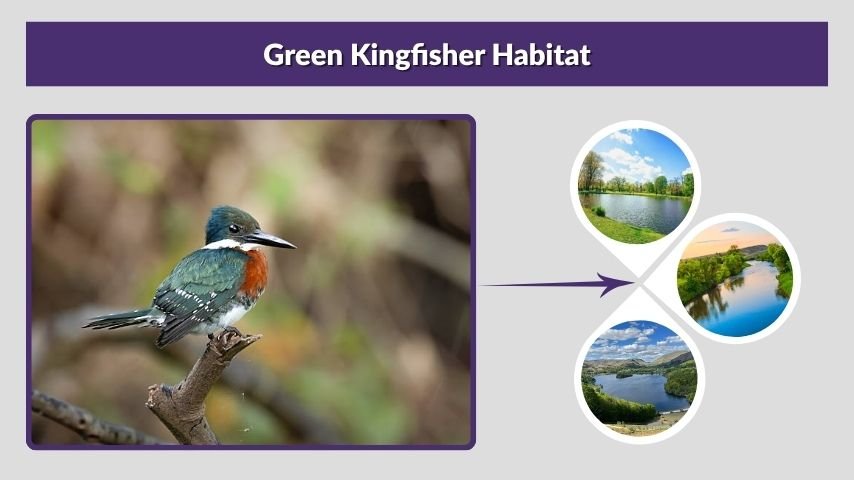
The Green Kingfisher prefers still or slow-moving water with low perches nearby. It is often found around wooded shorelines, streams, ponds, lakes, river edges, and freshwater wetlands. It does not need wide open lakes; narrow shaded streams can be excellent habitat.
Good Green Kingfisher habitat often includes:
- Slow streams or quiet river edges
- Freshwater ponds and small lakes
- Low branches, roots, snags, or shrubs over water
- Clear hunting views from shaded perches
- Earthen banks for possible nesting
- Healthy populations of small fish and aquatic prey
The species usually hunts close to the water. It may perch only a short distance above the surface, which is one reason it can be difficult to notice. Cornell and Audubon both emphasize its tendency to stay along dense or low waterside vegetation rather than calling attention to itself in open areas.
Green Kingfisher Call and Sound
The Green Kingfisher call is often described as sharp, ticking, or rattling. It is not as loud or familiar as the call of the Belted Kingfisher, but it can help birders detect the bird when it is hidden in streamside shade.
Audubon mentions sharp ticking call notes as a clue to the species. Other descriptions compare some Green Kingfisher sounds to hard clicking or pebble-like notes. Because the bird often stays low and partly hidden, learning the call is useful for field identification.
When You May Hear It
Green Kingfishers may call while moving along a stream, reacting to disturbance, or communicating near a feeding area. A birder walking beside quiet water may hear a quick, sharp sound and then see a small green bird flying low over the stream.
Listen for:
- Short ticking notes
- Harsh or buzzy scolding sounds
- Calls from low branches near water
- Quick calls during low flight along streams
What Does a Green Kingfisher Eat?
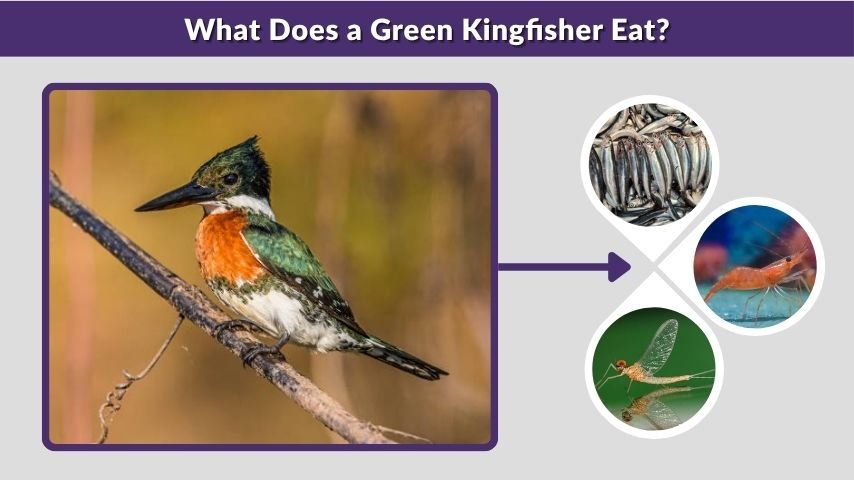
The Green Kingfisher feeds mainly on small aquatic animals. Fish are important, but the diet can also include shrimp, crustaceans, aquatic insects, and other small prey. The bird’s long bill is well suited for grabbing slippery prey after a quick dive.
Its hunting style is simple but effective. The bird perches low above the water, watches carefully, then dives toward the surface. After catching prey, it usually returns to a perch to handle or swallow it.
Common food items include:
- Small fish
- Shrimp
- Aquatic insects
- Small crustaceans
- Tiny frogs or other small water animals when available
Because it depends on aquatic prey, the Green Kingfisher benefits from clean streams, healthy wetlands, and stable shoreline vegetation.
Nesting and Breeding
Like many kingfishers, the Green Kingfisher nests in burrows. A pair usually excavates a tunnel in an earthen bank near water. The nest chamber is placed at the end of the tunnel, helping protect eggs and young from many surface predators.
Breeding timing varies by region because the species has a wide range. In tropical and subtropical areas, rainfall, water levels, and food availability can influence nesting periods.
Important nesting needs include:
- Suitable earthen banks
- Nearby fishing habitat
- Low disturbance around the nest site
- Stable water levels
- Enough small prey for adults and chicks
Protecting natural streambanks is important because heavily modified waterways may remove potential nesting sites.
Green Kingfisher vs Amazon Kingfisher
The Green Kingfisher and Amazon Kingfisher can look similar because both are green kingfishers in the genus Chloroceryle. However, the Amazon Kingfisher is noticeably larger and heavier. The Green Kingfisher is smaller, more delicate, and often found along quieter, more enclosed waters.
The male Green Kingfisher has a rufous breast band, while the female has greenish bands and spotting. Amazon Kingfishers also show green upperparts and sexual differences, but their larger size, stronger bill, and more robust shape are key clues.
Quick Comparison
- Green Kingfisher: smaller, compact, often low and quiet near streams
- Amazon Kingfisher: larger, stronger-looking, more obvious on open waterways
- Green Kingfisher male: rusty breast band
- Green Kingfisher female: green breast bands
- Best clue: size, structure, and overall heaviness
When both species occur in the same region, size comparison is usually the fastest way to separate them.
Green Kingfisher vs Belted Kingfisher
The Belted Kingfisher is much larger and more familiar across North America. It has a shaggy crest, blue-gray upperparts, and a loud rattling call. The Green Kingfisher is smaller, greener, quieter, and more limited in the United States.
A Belted Kingfisher often perches more openly and may fly with loud rattles along rivers or lakes. The Green Kingfisher usually stays lower, closer to vegetation, and may be harder to spot.
In simple terms:
- Belted Kingfisher: larger, blue-gray, noisy, widespread in North America
- Green Kingfisher: smaller, green, quieter, mostly tropical/subtropical
- Belted: often obvious and loud
- Green: often hidden and low near shaded water
Green Heron vs Green Kingfisher
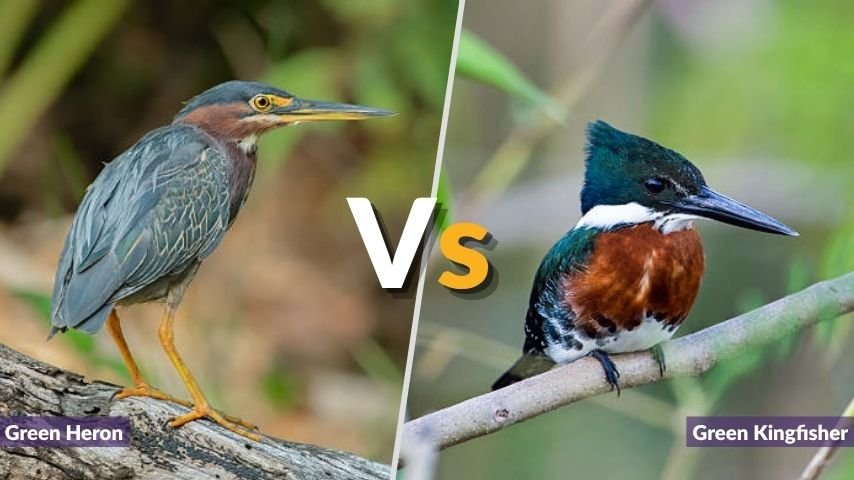
Some searches compare the Green Heron with the Green Kingfisher because both can be found near water and both may appear greenish in certain light. However, they are very different birds.
A Green Heron is a small heron with long legs, a longer neck, broader wings, and a slow stalking hunting style. It walks or stands at the water’s edge and strikes at prey.
A Green Kingfisher is much smaller, shorter-legged, and has a compact body with a long pointed bill. It catches prey by diving from a perch rather than stalking slowly like a heron.
Is There a Green Kingfisher in Australia, India, or the UK?
The true Green Kingfisher, Chloroceryle americana, is native to the Americas, not Australia, India, or the United Kingdom. Searches such as “green kingfisher Australia,” “green kingfisher India,” or “green kingfisher UK” may refer to other greenish kingfisher species, local names, colors, or mistaken identifications.
Australia has kingfishers such as kookaburras and forest kingfishers. India has several colorful kingfisher species, including some with greenish or blue-green tones. The UK’s familiar Common Kingfisher can appear blue-green in certain light, but it is not the same species as the American Green Kingfisher.
Green Kingfisher Photos and Birdwatching Tips
Green Kingfisher images are popular because the bird’s emerald upperparts can look beautiful in sunlight. However, finding the bird in the field can take patience. It is small, often quiet, and frequently hides in shaded vegetation.
For better viewing or photography:
- Walk slowly along quiet streams and ponds.
- Scan low branches, roots, and snags near water.
- Listen for sharp ticking calls.
- Watch for a small green bird flying low over the stream.
- Avoid sudden movement near likely perches.
- Visit early morning when birds are actively feeding.
- Keep a respectful distance from possible nest banks.
A perched Green Kingfisher may stay still for long periods. Careful observation is often better than fast walking.
Conservation Status
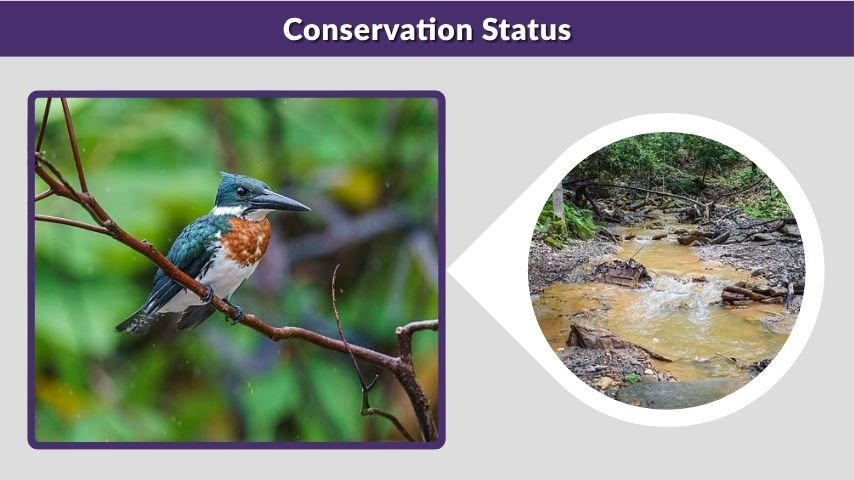
The Green Kingfisher is not currently considered globally threatened, and it has a wide range. Still, it relies on healthy freshwater habitats. Stream pollution, loss of shoreline vegetation, bank disturbance, and wetland degradation can all reduce local habitat quality.
Conservation for this bird means protecting natural waterways. Clean streams, stable banks, low vegetation, and healthy fish populations support not only Green Kingfishers but also many other birds, reptiles, amphibians, insects, and aquatic species.
FAQs
Where do Green Kingfishers live?
Green Kingfishers live near quiet rivers, streams, ponds, lakes, wetlands, and wooded shorelines. Their range extends from southern Texas and southern Arizona through Central America and much of South America. They are most common in tropical and subtropical areas with slow-moving water and low hunting perches.
What does a Green Kingfisher eat?
A Green Kingfisher mainly eats small fish, shrimp, crustaceans, aquatic insects, and other tiny water animals. It hunts by sitting on a low perch near water, watching carefully, and diving quickly to catch prey with its long pointed bill.
How can you tell a male and female Green Kingfisher apart?
Male Green Kingfishers usually have a rusty or chestnut breast band. Females lack that strong rusty chest and instead show greenish spotting or bands across the breast. Both sexes have green upperparts, white markings, and a long bill, but the breast pattern is the easiest difference.
Is the Green Kingfisher found in Texas?
Yes, the Green Kingfisher is found in Texas, especially in southern areas near quiet streams, rivers, canals, and wooded waterways. It is not widespread across the entire United States, so birders usually look for it in specific southern Texas habitats.
What is the difference between a Green Kingfisher and an Amazon Kingfisher?
The Amazon Kingfisher is larger and heavier than the Green Kingfisher. Both are green kingfishers found in the Americas, but the Green Kingfisher is smaller, more compact, and often less conspicuous. Size, bill strength, and overall body shape are the best clues.
