

The kingfisher family is one of the most colorful and widely distributed bird groups in the world. Known for their bright plumage, sharp hunting skills, and remarkable diving ability, kingfishers are found across rivers, forests, and coastal regions on every continent except Antarctica. This article explores their classification, behavior, diet, habitat, and the major types of kingfishers found around the world.
What Is the Kingfisher Family?
The kingfisher family, scientifically known as Alcedinidae, is a group of small to medium-sized birds belonging to the order Coraciiformes. Despite the name “kingfisher,” not all species live near water or eat fish. While many are expert fish hunters, others feed on insects, reptiles, and small mammals.
Kingfishers are easily recognized by their compact bodies, large heads, long pointed bills, and vivid feather colors ranging from blue and green to orange and chestnut.
Key Characteristics of Kingfishers
- Large, strong, spear-shaped bill
- Short neck and stocky body
- Bright, iridescent plumage
- Excellent vision for hunting
- Fast diving and aerial hunting skills
- Nesting in riverbanks, tree holes, or termite mounds
Classification of the Kingfisher Family
The kingfisher family is divided into three main subfamilies. Each group has different habits, habitats, and feeding styles.
Table: Major Subfamilies of Kingfishers
| Subfamily | Common Name | Habitat Type | Diet | Example Species |
|---|---|---|---|---|
| Alcedininae | River Kingfishers | Rivers, lakes, streams | Fish, aquatic insects | Common kingfisher |
| Halcyoninae | Tree Kingfishers | Forests, woodlands, savannas | Insects, reptiles, small animals | Laughing kookaburra |
| Cerylinae | Water Kingfishers | Coastal waters, rivers | Fish, crustaceans | Belted kingfisher |
Types of Kingfishers Around the World
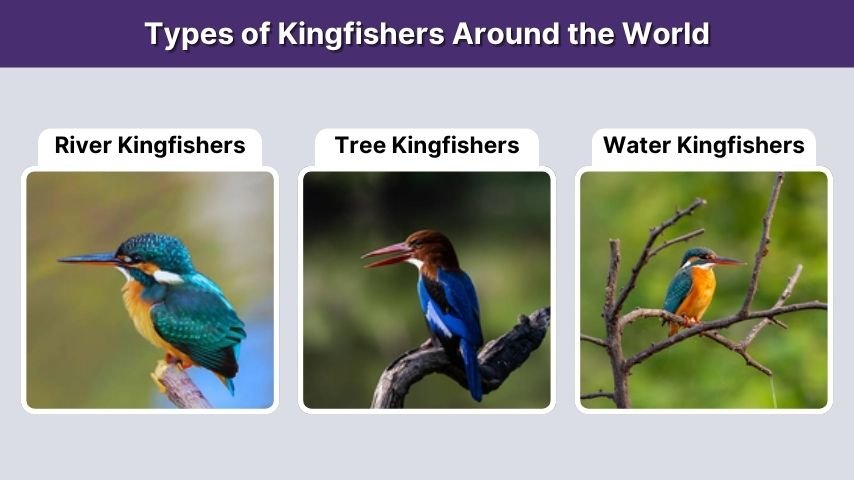
There are more than 90 species of kingfishers, each adapted to specific environments.
River Kingfishers
River kingfishers are the most traditional “fishing” kingfishers. They are usually small, brightly colored, and highly dependent on freshwater ecosystems.
Common species include:
- Common Kingfisher (Alcedo atthis)
- Blue-eared Kingfisher
- Malachite Kingfisher
These birds are often seen perched above water, waiting patiently before diving headfirst to catch fish.
Tree Kingfishers
Tree kingfishers are less dependent on water. Instead, they thrive in forests and open woodlands.
They are generally larger and more vocal than river kingfishers.
Examples include:
- Laughing Kookaburra
- Sacred Kingfisher
- Woodland Kingfisher
Unlike their fishing relatives, tree kingfishers often eat insects, frogs, and small reptiles.
Water Kingfishers
Water kingfishers are strong fish hunters often found near coastal areas, lakes, and large rivers.
One of the most well-known species is the Belted Kingfisher, commonly found in North America.
These birds are powerful flyers and can hover before diving into water to catch prey.
Habitat and Distribution
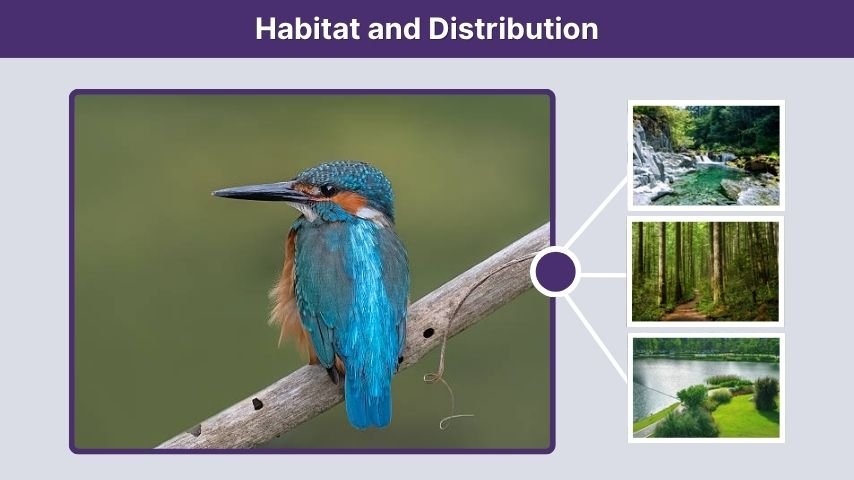
Kingfishers are found on every continent except Antarctica. They are most diverse in tropical regions such as Southeast Asia, Africa, and Australia.
Common Habitats Include:
- Rivers and freshwater streams
- Mangroves and coastal shorelines
- Forests and woodlands
- Wetlands and marshes
- Urban parks near water bodies
Each species is highly adapted to its environment. For example, forest kingfishers rely on branches and trees for hunting, while river kingfishers depend on clear water visibility.
Feeding Behavior and Diet
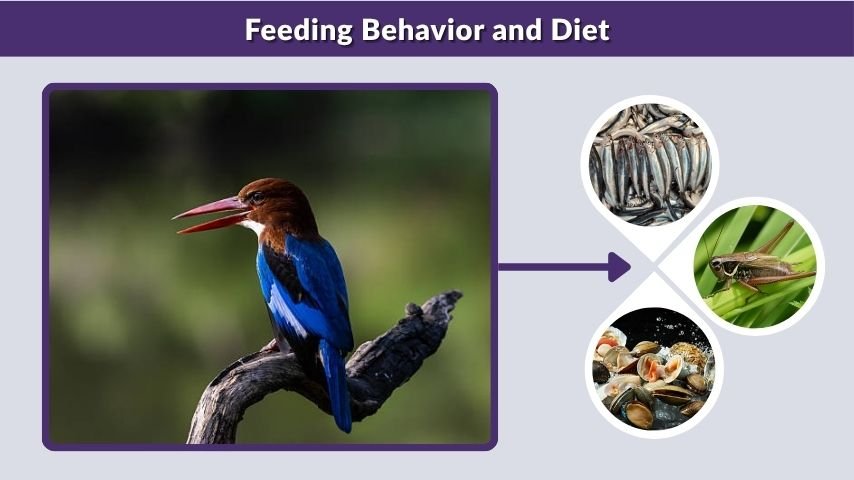
Kingfishers are carnivorous birds with highly specialized feeding techniques. Their diet varies depending on species and habitat.
Primary Diet:
- Small fish
- Insects (dragonflies, beetles)
- Crustaceans (crabs, shrimp)
- Amphibians (frogs, tadpoles)
- Small reptiles and rodents (in larger species)
Hunting Technique
Kingfishers use a “sit-and-wait” strategy. They perch quietly above water or open ground, then dive rapidly to capture prey.
Their beak acts like a spear, allowing them to strike with high precision. Some species can even hover briefly before diving.
Physical Features of Kingfishers
Kingfishers are among the most visually striking birds in the world.
Coloration
Their bright colors are not caused only by pigments but also by light reflection from microscopic feather structures. This creates an iridescent blue and green shimmer.
Bill Structure
The long, sharp bill is perfectly designed for catching slippery prey like fish.
Vision
Kingfishers have excellent binocular vision, which allows precise depth perception during dives.
Nesting and Reproduction
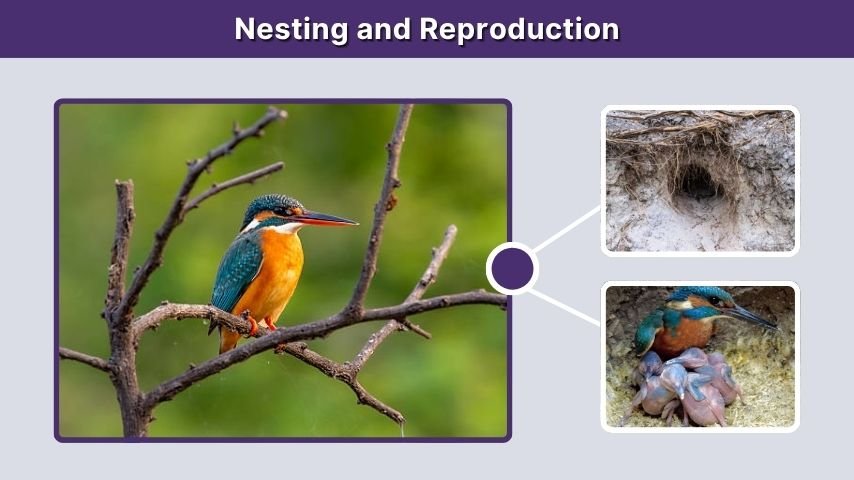
Kingfishers have interesting nesting habits that vary by species.
Nesting Sites:
- Riverbank tunnels
- Tree cavities
- Termite mounds
- Sand cliffs
Most species dig long tunnels in soft soil or riverbanks, ending in a small chamber where eggs are laid.
Reproduction Process:
- Female lays 3–7 eggs
- Both parents often share incubation
- Chicks hatch blind and helpless
- Parents feed chicks regurgitated food
Some species, like kookaburras, show cooperative breeding, where older siblings help raise chicks.
Behavior and Communication
Kingfishers are territorial birds and often defend their hunting areas aggressively.
Common Behaviors:
- Loud territorial calls
- Perching near water for long periods
- Rapid diving attacks
- Wing flicking and head movements
Tree kingfishers are especially known for their loud, laughing calls, such as the kookaburra.
Kingfisher Adaptations for Survival
Kingfishers have evolved several unique adaptations:
1. Shock-Resistant Skull
Their skull structure helps absorb impact when diving into water at high speed.
2. Specialized Vision
They can correct light refraction when viewing prey underwater.
3. Fast Flight
Kingfishers can reach high speeds in short bursts, useful for hunting and escaping predators.
4. Waterproof Feathers
Their feathers help them dry quickly after diving.
Common Kingfisher Species
Some of the most well-known species include:
- Common Kingfisher (Europe, Asia, Africa)
- Belted Kingfisher (North America)
- Laughing Kookaburra (Australia)
- Sacred Kingfisher (Pacific region)
- Pied Kingfisher (Africa, Asia)
Each species has slightly different hunting styles and habitats
Human Interaction and Cultural Importance
Kingfishers appear in many cultural stories, myths, and symbolism around the world.
Symbolism:
- Peace and prosperity in some cultures
- Patience and precision
- Connection to water and nature
In ancient mythology, kingfishers were sometimes associated with calm seas and good weather.
Threats and Conservation
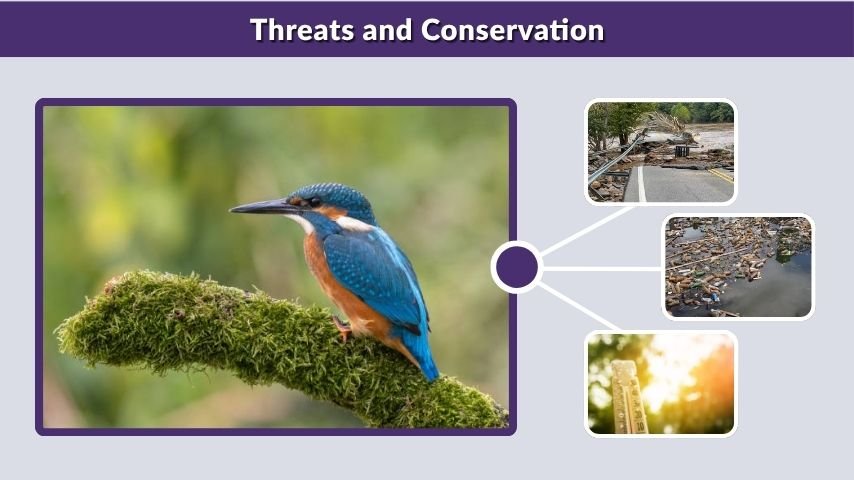
While many kingfisher species are not endangered, some populations face threats.
Major Threats:
- Habitat destruction
- Water pollution
- Deforestation
- Climate change
- Reduction in fish populations
Protecting rivers, wetlands, and forests is essential for their survival.
Interesting Facts About Kingfishers
- Not all kingfishers eat fish
- Some species live far from water
- Their feathers reflect light, not just pigment
- They can dive at high speed with great accuracy
- The belted kingfisher female is more colorful than the male in some cases
FAQs
What is the kingfisher family called scientifically?
The kingfisher family is called Alcedinidae, which includes more than 90 species of birds found worldwide.
Do all kingfishers eat fish?
No, not all kingfishers eat fish. While many species are fish hunters, others eat insects, reptiles, and small animals depending on their habitat.
Where do kingfishers live?
Kingfishers live in diverse habitats including rivers, forests, wetlands, and coastal regions across all continents except Antarctica.
Why are kingfishers so colorful?
Their bright colors come from microscopic feather structures that reflect light, creating iridescent blues and greens.
How do kingfishers hunt?
Kingfishers hunt by perching above water or ground and quickly diving to capture prey using their sharp, spear-like beaks.
