
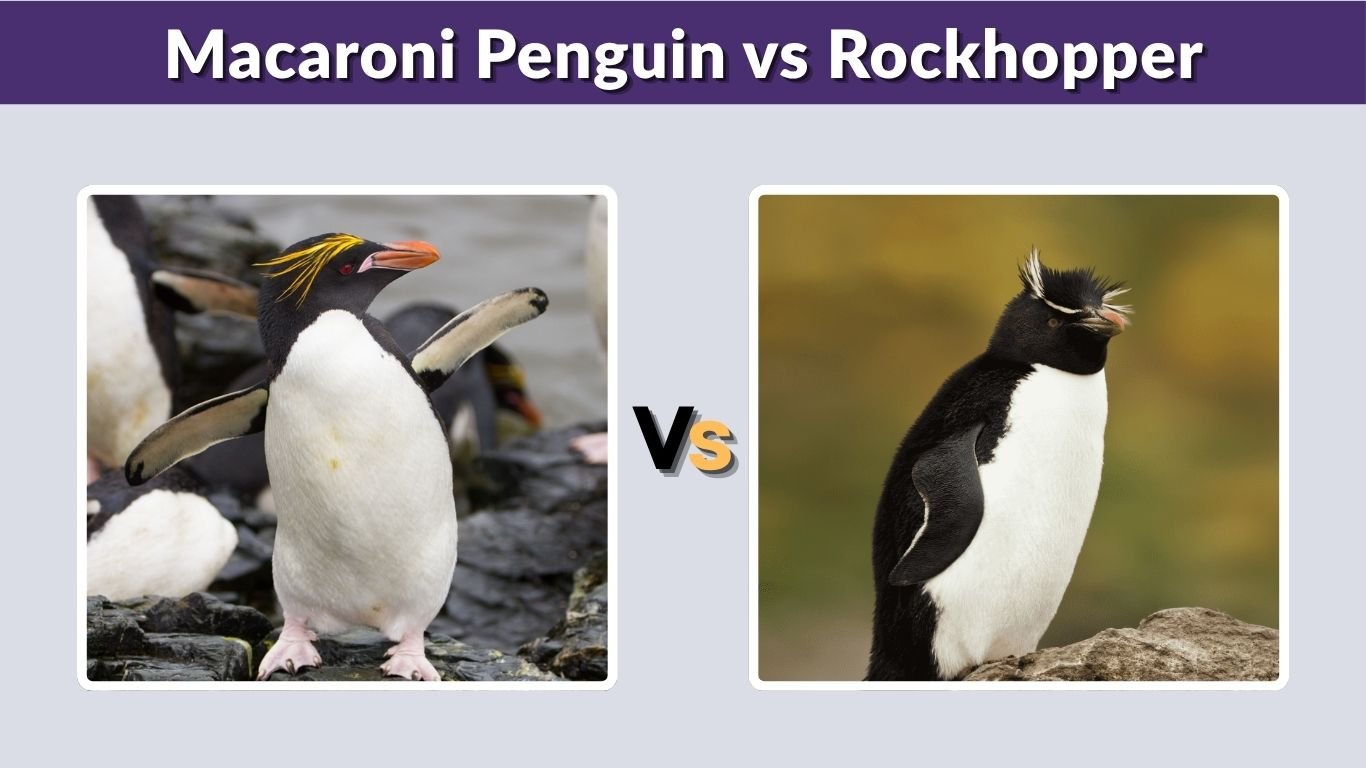
The macaroni penguin vs rockhopper penguin comparison can be confusing because both are crested penguins with black-and-white bodies, bright yellow head feathers, red eyes, and orange-red bills. However, macaroni penguins are generally larger, have fuller golden-orange crests, and occupy a somewhat different range. Rockhoppers are smaller and famous for moving across rugged terrain by hopping between rocks. This guide compares their size, appearance, habitat, diet, behavior, breeding, lifespan, and conservation status to make identification much easier.
Macaroni Penguin vs Rockhopper: Quick Comparison
Macaroni and rockhopper penguins both belong to the genus Eudyptes, meaning they are closely related crested penguins. For numerical comparisons below, “rockhopper” primarily refers to the southern rockhopper penguin (Eudyptes chrysocome). Northern rockhoppers are a separate species and differ somewhat in range and crest length.
Main Differences at a Glance
- Macaroni penguins are noticeably larger.
- Macaronis have thicker, fuller golden-orange crests.
- Rockhoppers have thinner yellow eyebrows ending in spiky plumes.
- Rockhoppers are particularly adapted to rugged rocky colonies.
- Macaroni penguins can dive considerably deeper.
- Both eat fish, crustaceans, and squid.
- Both southern rockhoppers and macaronis are currently classified as Vulnerable.
Macaroni Penguin vs Rockhopper Penguin Table
| Feature | Macaroni Penguin | Southern Rockhopper |
| Scientific name | Eudyptes chrysolophus | Eudyptes chrysocome |
| Height/length | About 70–71 cm | About 45–58 cm |
| Weight | Roughly 4–7 kg | Roughly 2–3.8 kg |
| Crest | Thick golden-yellow/orange crest | Thin yellow stripe with spiky plumes |
| Bill | Heavy, orange-red | Smaller, orange-red |
| Main habitat | Subantarctic islands | Rocky subantarctic islands |
| Diet | Krill, fish, squid | Crustaceans, fish, squid |
| Conservation status | Vulnerable | Vulnerable |
Size ranges vary among sources and according to sex and breeding conditions.
Size and Appearance Differences
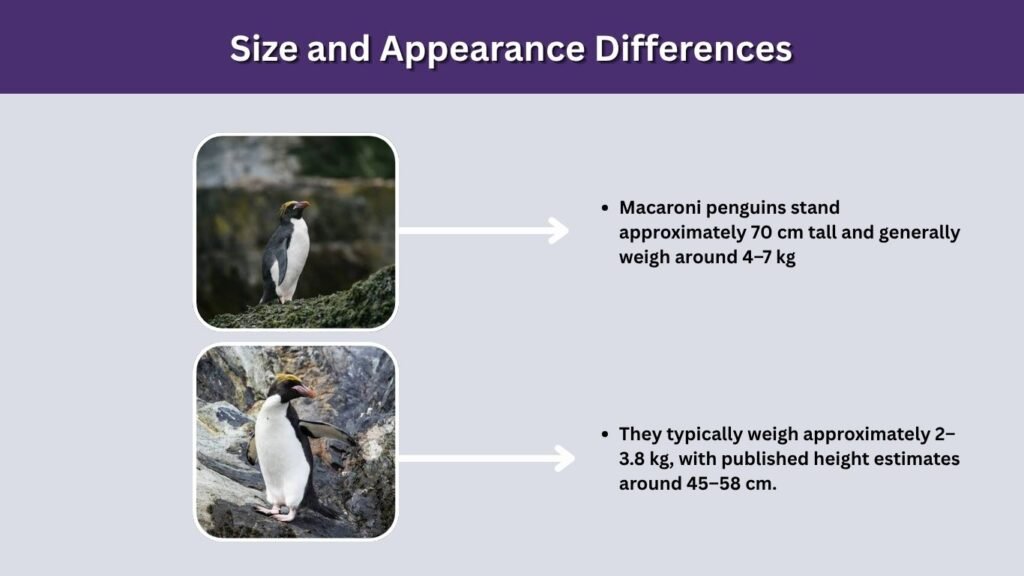
Appearance is usually the easiest way to distinguish a macaroni penguin from a rockhopper. Both have dark heads, white undersides, red-toned eyes, and colorful bills, but their proportions and crest feathers differ noticeably. Once you learn to examine body size and the shape of the yellow feathers around the forehead and eyes, identification becomes much simpler.
Macaroni Penguin Size
Macaroni penguins stand approximately 70 cm tall and generally weigh around 4–7 kg, although weight changes throughout the breeding cycle. Their bodies appear taller and heavier than those of southern rockhoppers.
They also have substantial orange-red bills and prominent yellow-orange feathers that begin around the forehead and spread backward into a thick crest.
Rockhopper Penguin Size
Southern rockhopper penguins are among the smallest crested penguins. They typically weigh approximately 2–3.8 kg, with published height estimates around 45–58 cm.
Their compact build makes the size difference fairly noticeable when the two species are viewed together. Rockhoppers also have thinner yellow eyebrow stripes that extend into distinctive spiky feathers behind the eyes.
Crest and Facial Features
The yellow crest is the feature most people notice first on both species. Despite appearing similar from a distance, the shape and thickness of these feathers provide one of the best identification clues. Macaroni penguins generally look as though they have a fuller golden crown, whereas rockhoppers have narrower eyebrow-like lines and longer separated plumes toward the sides.
Macaroni Penguin Crest
A macaroni penguin has conspicuous golden-yellow crest feathers that meet or nearly meet toward the forehead before spreading backward above the eyes.
These dense feathers produce a broad, dramatic crest. The unusual hairstyle inspired the common name “macaroni,” referencing an 18th-century fashion associated with flamboyant dress.
Rockhopper Penguin Crest
Southern rockhoppers have relatively thin yellow stripes running above each eye. These stripes continue backward into spiky yellow plumes on either side of the head.
Northern rockhopper penguins look similar but generally possess much longer crest feathers, so identifying which rockhopper species is being compared is important.
Habitat and Geographic Range
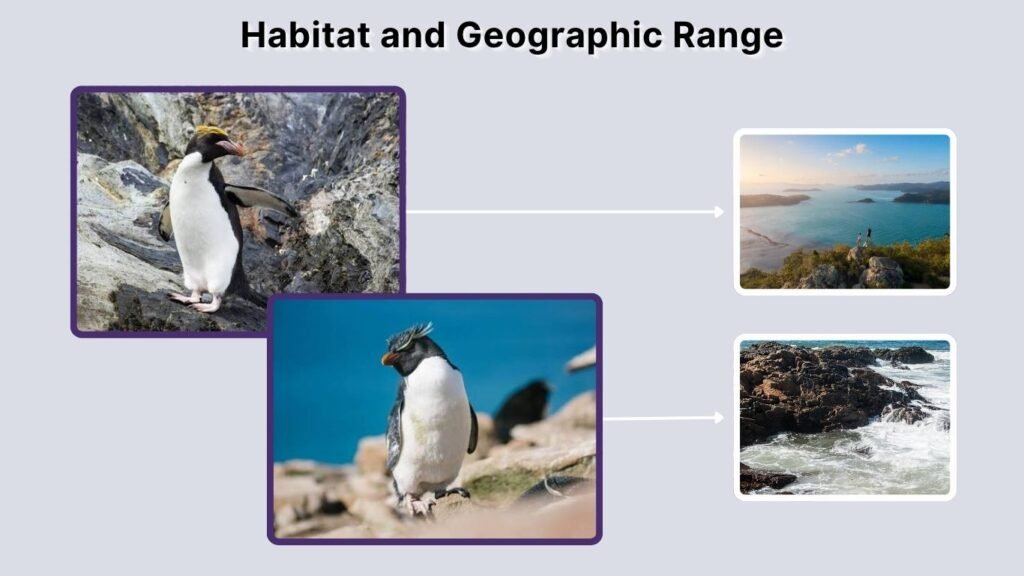
Both penguins live in the Southern Hemisphere and breed mainly on isolated islands surrounded by productive marine waters. Their distributions overlap in parts of the subantarctic region, but they do not use exactly the same breeding locations. Colonies are often situated on rugged coastlines where birds can access ocean feeding grounds while remaining relatively isolated from terrestrial predators.
Where Macaroni Penguins Live
Macaroni penguins have a broad circumpolar distribution and breed mainly on subantarctic islands. Colonies occur around places including South Georgia, Heard Island, the Crozet Islands, Kerguelen Islands, and other Southern Ocean locations.
They generally nest on rocky slopes and coastal terrain, sometimes forming extremely large colonies.
Where Rockhopper Penguins Live
Southern rockhoppers breed on islands across the South Atlantic, Indian, and Pacific oceans. Their habitat includes rocky shorelines, cliffs, offshore islands, and sometimes elevated inland nesting areas.
Their name reflects their characteristic way of navigating steep rocky landscapes: instead of simply waddling across every obstacle, they frequently hop from rock to rock.
Diet and Diving Ability
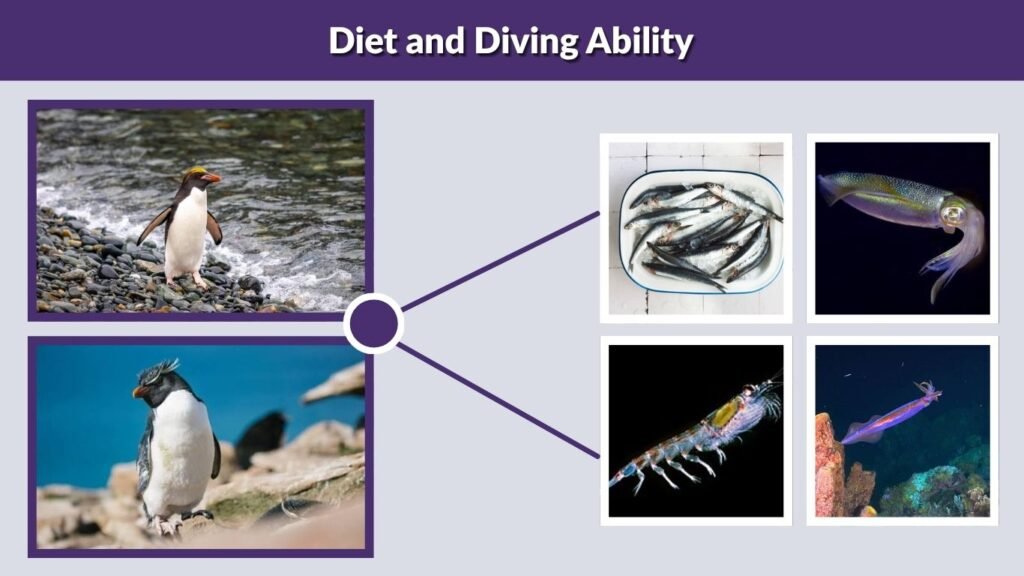
Macaroni and rockhopper penguins are carnivorous marine birds that catch their food underwater. Their diets overlap considerably because both exploit fish, crustaceans, and cephalopods. However, the proportions of individual prey species can differ according to colony, season, ocean conditions, and local food availability.
What Macaroni Penguins Eat
Common prey includes:
- Antarctic krill
- Other crustaceans
- Small fish
- Myctophid fish
- Squid and other cephalopods
Macaroni penguins usually dive between approximately 15 and 50 metres but are capable of exceeding 220 metres.
What Rockhopper Penguins Eat
Their diet includes:
- Krill and other crustaceans
- Small fish
- Squid
- Other cephalopods
Southern rockhoppers commonly make much shallower dives, averaging roughly 20–30 metres in some studies, although dives deeper than 100 metres have been recorded.
Behavior and Breeding
Both species are social birds that gather in breeding colonies and produce two eggs. Like several other crested penguins, the eggs are unequal in size, with the second egg being larger. Despite these similarities, their nesting locations, timing, and success can vary considerably across colonies and regions.
Breeding Similarities and Differences
Macaroni penguins typically:
- Breed annually in large colonies.
- Lay two eggs.
- Produce a larger second egg.
- Usually raise a chick from the second egg.
- Have chicks that fledge after roughly 60–70 days.
Southern rockhoppers also lay two differently sized eggs, incubating them for around 32–34 days. Unlike macaronis, both rockhopper eggs can sometimes hatch and survive.
Movement on Land
Rockhoppers are particularly famous for jumping across uneven rocks with both feet together. Their compact bodies and strong legs help them negotiate rugged coastal colonies.
Macaroni penguins can also climb difficult terrain, but hopping behavior is much more strongly associated with the rockhopper name and appearance.
Conservation Status and Population
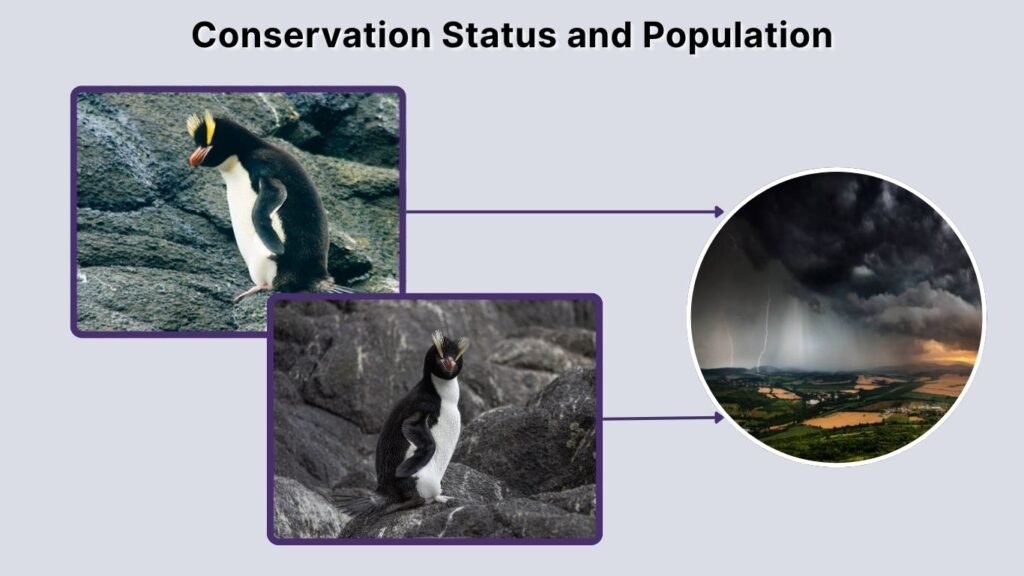
Both species have experienced population concerns despite being distributed across multiple islands. Changes in marine food availability, ocean conditions, and climate can affect how successfully adults feed themselves and their chicks. Long-term population monitoring is therefore particularly important for understanding whether colonies are recovering, stable, or continuing to decline.
Are Macaroni and Rockhopper Penguins Endangered?
Macaroni penguins are classified as Vulnerable, with the Australian Antarctic Program reporting an estimated 6.3 million breeding pairs in 2013 and evidence of substantial historical declines.
Southern rockhopper penguins are also classified as Vulnerable. BirdLife reports a decreasing population and notes major historical declines, with climate-related changes in ocean conditions and food availability among important concerns.
Which Is Easier to Identify?
Distinguishing a rockhopper penguin vs macaroni penguin becomes straightforward once body size and crest structure are considered together. Avoid relying only on yellow head feathers because all members of the crested-penguin group share similar markings. Instead, examine proportions, crest thickness, and the arrangement of the yellow plumes.
Best Identification Clues
Macaroni penguins are the better match when the bird is relatively tall and heavy with a thick golden-orange crest spreading from the forehead.
A smaller, stockier penguin with narrow yellow eyebrows and spiky side plumes is more likely a rockhopper. Rockhoppers also have particularly striking red eyes and are commonly observed moving across rugged rocky colonies.
FAQs
Are macaroni and rockhopper penguins the same?
No. Macaroni and rockhopper penguins are different species, although both belong to the crested penguin genus Eudyptes. The macaroni penguin is Eudyptes chrysolophus, while the southern rockhopper is Eudyptes chrysocome. Macaronis are generally larger and have much fuller golden-yellow crest feathers.
Which is bigger, a macaroni or rockhopper penguin?
The macaroni penguin is considerably larger. Adults are approximately 70 cm tall and may weigh 4–7 kg. Southern rockhoppers generally measure about 45–58 cm and weigh roughly 2–3.8 kg. Size is therefore one of the easiest characteristics to use when comparing adults.
What is the main difference between their crests?
Macaroni penguins have thick golden-yellow or orange-yellow crest feathers that form a broad feature across the forehead before extending backward. Southern rockhoppers have thinner yellow eyebrow stripes ending in spiky plumes on each side. Northern rockhoppers have even longer side plumes than southern rockhoppers.
Do macaroni and rockhopper penguins eat the same food?
Their diets overlap considerably. Both consume marine animals such as crustaceans, fish, and squid. Macaroni penguins consume substantial quantities of krill, while rockhopper diets vary strongly according to colony and season. Both species are active underwater predators that capture individual prey while diving.
Can macaroni and rockhopper penguins breed together?
Hybridization is possible but unusual. BirdLife notes that southern rockhopper penguins have hybridized with macaroni penguins in the Falkland Islands. The two remain distinct species with different typical appearances, sizes, and breeding populations, so hybrid individuals should not be considered evidence that the species are naturally the same.