
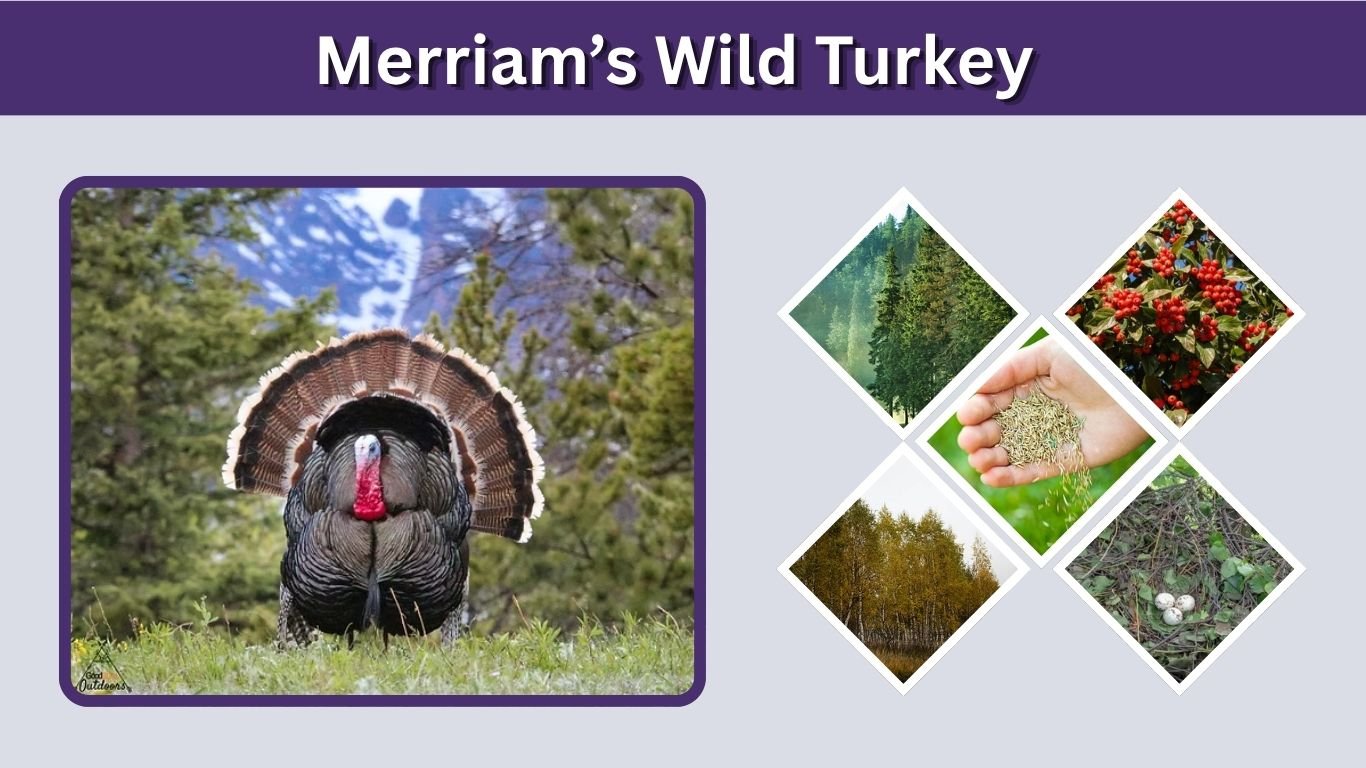
Merriam’s wild turkey is a mountain-dwelling wild turkey recognized by the pale or nearly white tips on its tail fan and lower-back feathers. Native primarily to ponderosa pine forests in Arizona, New Mexico, and Colorado, it now occurs across a much larger portion of the western United States because of successful restoration programs. These large, wary birds spend much of the day walking and feeding on the ground but fly into mature trees to roost at night. Their diet includes grasses, seeds, berries, pine nuts, acorns, insects, and other seasonally available foods.
What Is a Merriam’s Wild Turkey?
The Merriam’s wild turkey, scientifically known as Meleagris gallopavo merriami, is a subspecies of the North American wild turkey. It belongs to the order Galliformes and the family Phasianidae, alongside pheasants, grouse, and related ground-dwelling birds.
It was named after C. Hart Merriam, the first chief of the U.S. Biological Survey. Merriam’s turkeys originally occupied western mountain forests, but wildlife agencies later introduced them into suitable areas outside their historical range.
Scientific Classification
| Category | Classification |
| Kingdom | Animalia |
| Class | Aves |
| Order | Galliformes |
| Family | Phasianidae |
| Genus | Meleagris |
| Species | Meleagris gallopavo |
| Subspecies | Meleagris gallopavo merriami |
What Does a Merriam’s Wild Turkey Look Like?
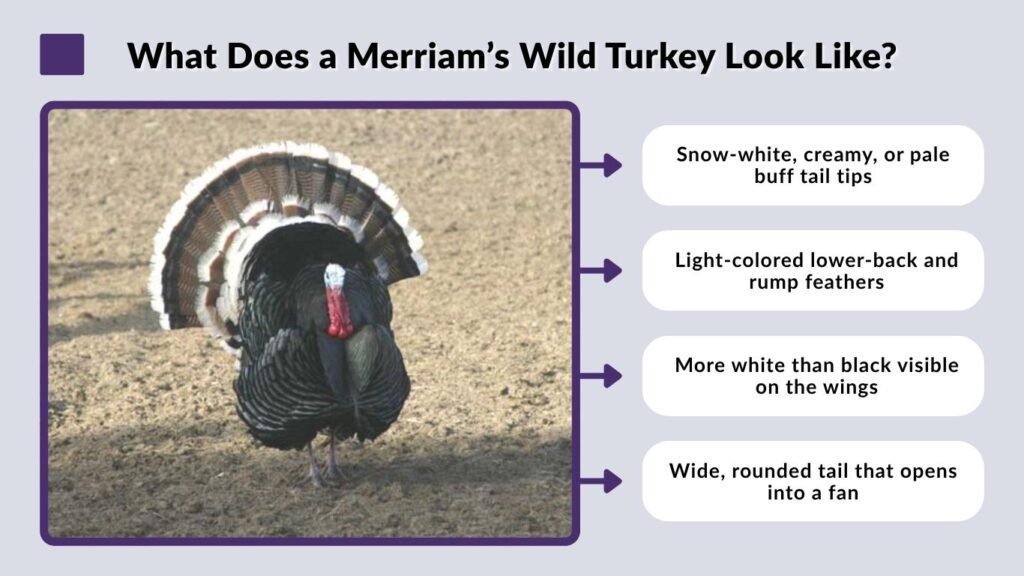
Merriam’s turkeys are large, heavy-bodied birds with long legs, wide rounded tails, long necks, and relatively small heads. Their body feathers appear dark brown or black but reflect blue, purple, green, bronze, and copper tones in sunlight.
Identification
- Snow-white, creamy, or pale buff tail tips
- Light-colored lower-back and rump feathers
- More white than black visible on the wings
- Dark body with blue, purple, bronze, and green reflections
- Wide, rounded tail that opens into a fan
- Long, powerful legs
- Small, mostly featherless head
- Red, white, blue, or gray head and neck skin
- Black-tipped breast feathers on males
- Buff-tipped breast feathers on females
The pale tail and rump create the appearance of a white rear end, especially when a male spreads his fan against a dark forest background.
Merriam’s Wild Turkey Size
Merriam’s turkeys are comparable in size to Eastern wild turkeys. Adult males, known as toms or gobblers, commonly weigh about 18–30 pounds. Adult females, called hens, generally weigh around 8–12 pounds. Large males may stand close to four feet tall when fully upright.
Males look especially large during courtship because they raise their body feathers, lower their wings, and spread their tails. Females are slimmer, less colorful, and easier to overlook against the forest floor.
Male vs. Female Merriam’s Turkey
Male and female Merriam’s turkeys share the same general feather pattern, but their size, coloring, and ornamentation differ.
Male Merriam’s Turkey
The male is larger and more iridescent. Its mostly bare head can change between red, white, blue, and gray depending on excitement and breeding condition. Males usually possess a breast beard made of modified feathers, and mature birds develop spurs on their legs.
During spring, males gobble, drag their wings, puff out their body feathers, and display their white-tipped fans. Merriam’s males are sometimes described as having a softer gobble and generally shorter beards and spurs than other major wild turkey subspecies.
Female Merriam’s Turkey
Hens are smaller and have more subdued brown coloring that provides camouflage during nesting. Their breast feathers normally have buff-colored tips rather than the black tips found on males. The pale markings on their wings can give the folded wing a noticeably whitish appearance.
A small percentage of hens may grow beards, so a beard alone does not always confirm that a turkey is male.
Merriam’s Wild Turkey Fan and Wings
The tail fan is the most distinctive part of a Merriam’s turkey. Its tail feathers end in pale cream or nearly white bands, producing a bright border around the spread fan.
Gould’s wild turkeys also have pale fan tips, but Gould’s generally show wider and cleaner white tail margins. Merriam’s tail borders are usually narrower and may have a slightly buff or pinkish tone.
The wings are dark and strongly barred with white. Compared with several other subspecies, Merriam’s turkeys display extensive white areas across their flight feathers. Their wings are powerful enough for short, rapid flights into roost trees or away from danger, although most daily movement occurs on foot.
Merriam’s Wild Turkey Habitat
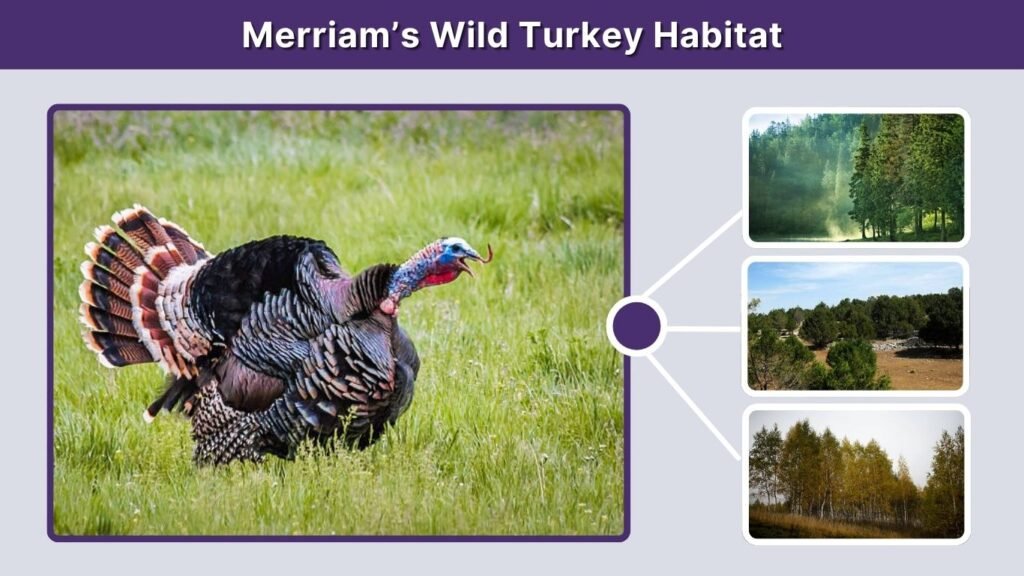
Merriam’s turkeys are strongly associated with western mountain forests. Their primary habitat includes ponderosa pine forests, pinyon-juniper woodland, foothills, and mixed mountain forests.
They require a mixture of habitat types rather than uninterrupted dense forest. Mature trees provide nighttime roosts, while meadows, burned areas, forest openings, and grassy edges supply food and brood-rearing habitat.
Important Habitat Features
A suitable landscape normally includes mature trees with sturdy horizontal branches for roosting. Open areas provide grasses, seeds, flowers, and insects, while shrubs and ground vegetation conceal nests and young poults.
Streams, springs, moist meadows, and riparian vegetation can become especially important during dry periods. Excessively dense forest, severe wildfire, long drought, overgrazing, and development can reduce food, nesting cover, and dependable roosting habitat.
Merriam’s Wild Turkey Range
The subspecies’ historical range centered on the ponderosa pine regions of Arizona, New Mexico, and Colorado. Smaller native populations also occurred in nearby portions of the southern Rocky Mountains and Southwest.
Trap-and-transfer programs expanded Merriam’s populations into parts of California, Oregon, Washington, Nebraska, South Dakota, Montana, Wyoming, and other western states. Consequently, a turkey’s location alone does not always prove its subspecies, particularly where introduced populations and hybrid zones occur.
What Do Merriam’s Wild Turkeys Eat?
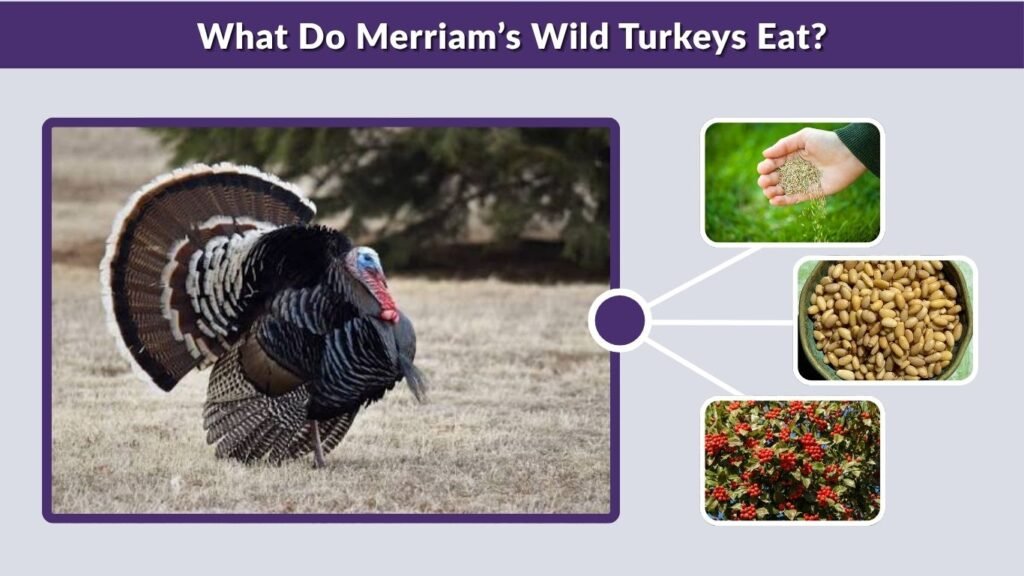
Merriam’s wild turkeys are opportunistic omnivores. Their diets change throughout the year according to local vegetation, snow cover, insect activity, and seed production.
Common Foods
Their diet may include:
- Grasses and grass seeds
- Forbs and tender green leaves
- Ponderosa pine seeds
- Pinyon seeds
- Acorns
- Manzanita fruits
- Skunkbush fruits
- Juniper berries
- Sunflower seeds
- Sedges
- Alfalfa and clover
- Oats and waste grain
- Grasshoppers, beetles, and other insects
- Spiders, snails, and other invertebrates
Plant material forms most of an adult wild turkey’s diet, while insects and other animal matter generally provide a smaller but valuable portion. Pine seeds can be an important winter food for Merriam’s populations in ponderosa pine habitats.
Diet of Young Turkeys
Young turkeys, called poults, need protein for rapid growth. They initially consume large quantities of insects and other invertebrates found in grassy, herbaceous openings.
As they mature, they gradually add more seeds, fruits, grasses, and other plant material to their diet. Habitat without enough insects may provide poor brood-rearing conditions.
Behavior and Daily Activity
Merriam’s turkeys are active during daylight. They leave their tree roosts near dawn, feed during the morning, rest or dust-bathe during warmer hours, and forage again before returning to roost in the evening.
They use powerful feet to scratch through pine needles, leaves, soil, and snow in search of seeds and invertebrates. At night, they sleep on elevated tree branches, where they are safer from many ground predators.
Outside the breeding season, turkeys commonly form flocks. Adult males may travel together, while hens and juveniles often create separate groups.
Reproduction and Life Cycle
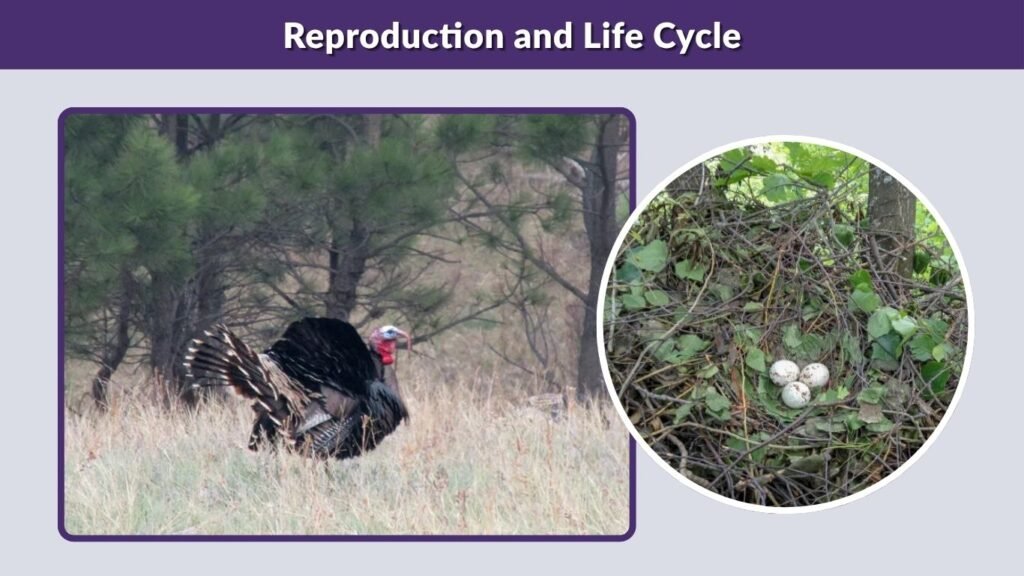
Spring courtship begins when males gobble and perform visual displays. A displaying tom spreads his tail, puffs his feathers, lowers his wings, and slowly struts near receptive females. Dominant males may mate with several hens.
Nesting and Eggs
The hen creates a shallow depression on the ground, usually beneath shrubs, fallen branches, grass, or other concealing vegetation. She commonly lays about 10–12 eggs and incubates them for approximately 28 days. The male does not participate in incubation or caring for the young.
Poults leave the nest shortly after hatching and begin following the hen to feeding areas. They cannot initially fly and remain vulnerable to cold, heavy rain, and predators. After approximately two weeks, they begin flying into low branches to roost.
Merriam’s vs. Other Wild Turkey Subspecies
Merriam’s turkeys can be separated from other major subspecies mainly by their tail, rump, wing pattern, habitat, and geographic distribution.
| Subspecies | Distinguishing feature |
| Merriam’s | Creamy-white fan tips and pale rump |
| Eastern | Chestnut-brown tail tips and dark wings |
| Rio Grande | Tan or buff tail tips |
| Osceola | Dark wings with limited white barring |
| Gould’s | Very broad, clean white tail tips and larger body |
Hybridization occurs where populations overlap, so some birds show a mixture of traits and cannot be confidently identified from one photograph.
FAQs
Can Merriam’s wild turkeys fly?
Yes. They can make powerful short-distance flights, especially when escaping danger or reaching nighttime roosts. They spend most of the day walking and feeding on the ground rather than flying continuously.
Where do Merriam’s turkeys sleep?
They usually sleep on branches in mature ponderosa pines or other large trees. Elevated roosts offer protection from coyotes, foxes, bobcats, and other ground predators.
Are Merriam’s wild turkeys aggressive?
They usually avoid people, but displaying males may act defensively during breeding season. Turkeys accustomed to receiving food can lose their natural fear and become more likely to approach or challenge people.
What is Merriam’s turkey’s scientific name?
Its scientific name is Meleagris gallopavo merriami. It is a subspecies of the wild turkey rather than a separate turkey species.
What is the easiest way to identify a Merriam’s turkey?
Examine the tail fan and lower back. Merriam’s turkeys usually have narrow creamy-white or nearly white tail tips and pale rump feathers, giving a displaying bird a distinctive white-edged appearance.
