
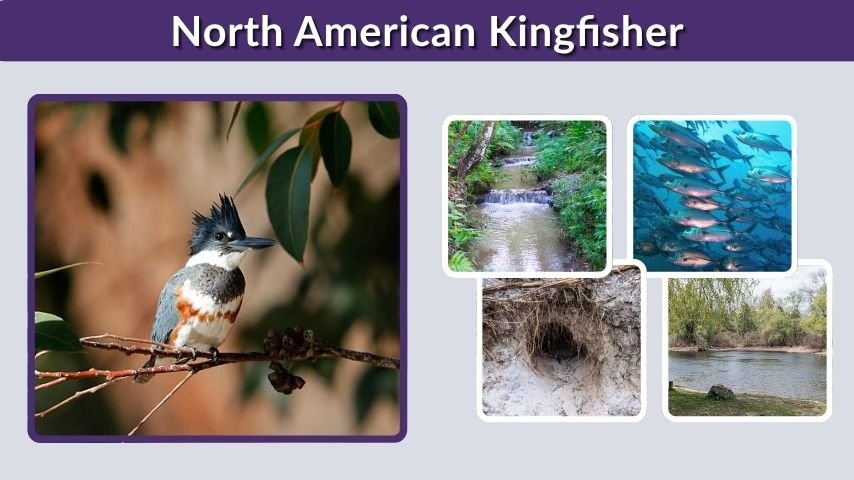
The north american kingfisher, most commonly represented by the Belted Kingfisher, is a powerful freshwater bird known for its loud rattling calls, hovering fishing dives, and unique tunnel nesting behavior along riverbanks. It is widely distributed across Canada, the United States, and parts of northern Mexico. This guide explains its species types, size, sound patterns, nesting habits, and male vs female differences in a structured and detailed way.
North American Kingfisher Species Overview
The north american kingfisher group mainly includes freshwater fishing birds adapted to rivers, lakes, and coastal habitats. While kingfishers exist worldwide, only a few species are regularly seen in North America.
This section explains the main species and their habitats, along with key behavioral traits that define them.
Main species found in North America
- Belted Kingfisher (Megaceryle alcyon), the most widespread species
- Green Kingfisher (Chloroceryle americana), found in southern regions
- Rare vagrant kingfisher species occasionally seen during migration
Habitat and distribution patterns
- Rivers and fast-moving streams
- Lakes and reservoirs with open banks
- Coastal shorelines and estuaries
- Tropical and subtropical waterways for Green Kingfisher
The Belted Kingfisher dominates most sightings, especially in the northern United States and Canada, while the Green Kingfisher is limited to warmer southern habitats.
Feeding behavior overview
- Hunts small fish as primary diet
- Uses hovering or perch hunting method
- Dives headfirst into water for prey
- Returns to perch to consume fish
North American Kingfisher Size and Identification
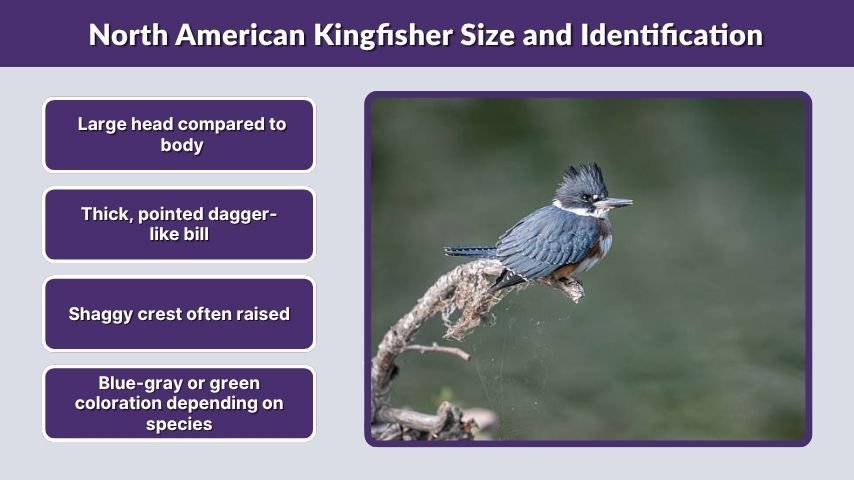
Understanding north american kingfisher size is essential for distinguishing species in the field. Size differences, along with plumage and behavior, help separate Belted and Green Kingfishers quickly.
This section breaks down physical measurements and visual identification traits used by bird watchers.
Size comparison table
| Feature | Belted Kingfisher | Green Kingfisher |
| Length | 28–35 cm | 19–22 cm |
| Wingspan | 48–58 cm | 30–35 cm |
| Weight | 140–170 g | 35–45 g |
| Build | Stocky and strong | Small and compact |
Key identification features
- Large head compared to body
- Thick, pointed dagger-like bill
- Shaggy crest often raised
- Blue-gray or green coloration depending on species
- Fast hovering flight before diving
Field behavior clues
- Perches near water edges
- Loud calls before or during flight
- Repeated diving into water surface
- Territorial behavior around fishing zones
North American Kingfisher Sound and Calls
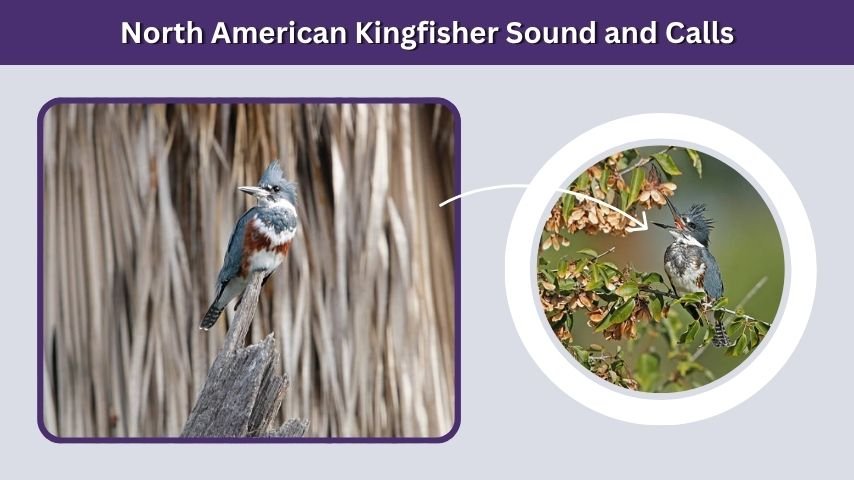
The north american kingfisher sound is one of the most distinctive natural sounds near freshwater ecosystems. It is often heard before the bird is seen due to its loud, sharp, and repetitive nature.
This section explains vocal patterns and their behavioral purpose.
Belted Kingfisher call characteristics
- Rapid rattling “kek-kek-kek-kek” sound
- Metallic and machine-like tone
- Repeated continuously during flight
- Becomes louder during territorial defense
Sound behavior patterns
- Territorial warning calls near nesting areas
- Continuous calling while patrolling rivers
- Aggressive vocal bursts during intrusions
- Softer calls between mating pairs
List of sound situations
- Flying over water: continuous rattling call
- Perched on branch: short repeated bursts
- Nest defense: fast and aggressive chatter
- Mating communication: softer repeated notes
The Green Kingfisher produces similar sounds but at a softer volume, often blending into background stream noise.
North American Kingfisher Nesting Behavior
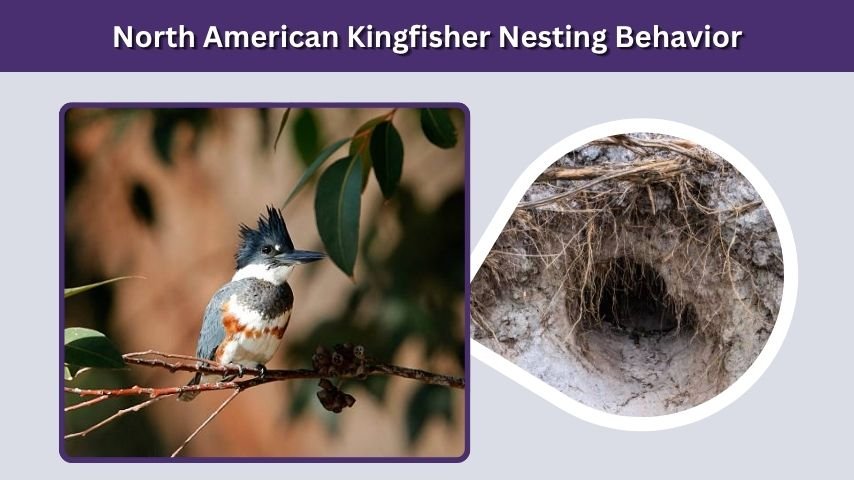
The belted kingfisher nest is one of the most unique nesting systems among North American birds. Instead of building nests in trees, they excavate tunnels in riverbanks.
This section explains nesting structure, breeding behavior, and parental roles.
Nest structure and location
- Dug into vertical soil or sand banks
- Tunnel length usually 1–2 meters
- Ends in a rounded nesting chamber
- Located near active fishing waters
Nesting process overview
- Male begins excavation using bill and feet
- Female inspects and approves nest site
- Both expand tunnel if suitable
- Nest chamber remains unlined except natural debris
Parental behavior list
- Both parents incubate eggs
- Both feed hatchlings fish
- Strong defense against predators
- Frequent nest visitation and guarding
Breeding territory behavior
- Extremely aggressive during nesting season
- Loud calling around nest entrances
- Chasing away birds and small mammals
- Returning to same nesting area annually
Male vs Female Belted Kingfisher Differences
The comparison of belted kingfisher male vs female is important because this species shows unusual sexual dimorphism, where females are more colorful than males.
This section highlights physical and behavioral differences between sexes.
Male Belted Kingfisher characteristics
- Blue-gray chest band only
- White underparts without rust color
- Slightly smaller body size
- Primary focus on territory patrol
Female Belted Kingfisher characteristics
- Blue-gray chest band plus rusty orange belly band
- More colorful and visually distinct
- Slightly larger and stronger appearance
- Often more aggressive during breeding season
Behavioral differences list
- Males begin nest digging
- Females choose final nesting site
- Both share feeding duties equally
- Females often dominate during chick feeding
- Both defend territory strongly
This reversed color pattern makes identification easier during field observation.
Green Kingfisher in North America
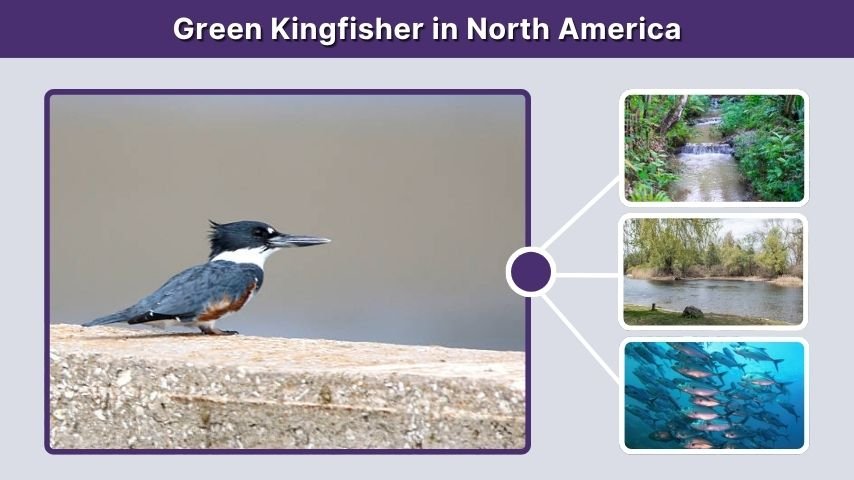
The green kingfisher is the smaller tropical representative of kingfishers in North America. It is mainly found in southern Texas and extends into Central America.
This section explains its habitat, behavior, and ecological role.
Habitat preferences
- Slow-moving tropical streams
- Dense vegetation near river edges
- Warm climates with stable water flow
- Shaded aquatic environments
Physical and behavioral traits list
- Bright green metallic back
- White spotted chest pattern
- Small compact body structure
- Quiet and subtle hunting behavior
Feeding and survival behavior
- Feeds on small fish and aquatic insects
- Uses perch-based hunting method
- Dives quickly with high accuracy
- Avoids open exposed water areas
Although less common, it plays an important role in maintaining ecological balance in tropical freshwater systems.
Ecological Importance of North American Kingfishers
North american kingfishers are important indicators of freshwater ecosystem health. Their presence often reflects clean, oxygen-rich water systems capable of supporting fish populations.
Environmental roles list
- Control small fish and insect populations
- Indicate healthy aquatic ecosystems
- Support nutrient balance in rivers
- Help monitor environmental pollution levels
Because they rely heavily on fish, any decline in their population can signal environmental degradation or habitat loss.
FAQs
1. What is the most common North American kingfisher?
The most common north american kingfisher is the Belted Kingfisher. It is widely distributed across Canada, the United States, and parts of Mexico. It is often seen near rivers and lakes, where it hunts fish and produces loud rattling calls that carry over long distances.
2. What does a North American kingfisher sound like?
The north american kingfisher sound is a loud, harsh rattling call often described as “kek-kek-kek.” It is repeated rapidly during flight or territorial defense. This sound helps the bird communicate over noisy water environments and defend its fishing territory from other birds.
3. How big is a Belted Kingfisher?
A Belted Kingfisher typically measures 28–35 cm in length with a wingspan up to 58 cm. It has a large head, thick bill, and stocky body. Compared to the Green Kingfisher, it is significantly larger and more powerful in both flight and hunting behavior.
4. How can you tell male and female Belted Kingfishers apart?
In belted kingfisher male vs female identification, males have only a blue-gray chest band, while females also show a rusty orange belly band. Females are more colorful and slightly larger, making them easier to distinguish in the field during observation.
5. Where do kingfishers build their nests?
The belted kingfisher nest is dug into steep riverbanks or sandy cliffs. These tunnels can extend over a meter and end in a chamber where eggs are laid. Both parents share incubation duties and feeding responsibilities until the chicks are ready to leave the nest.