
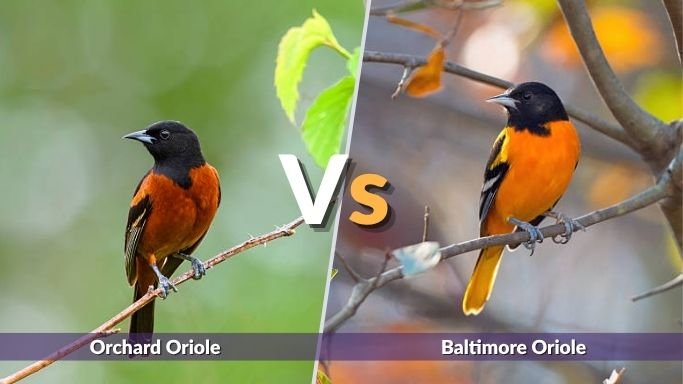
Orchard Orioles and Baltimore Orioles can look similar at first because both are slim songbirds with pointed bills, dark markings, and a love for fruit and nectar. However, they are not hard to tell apart once you know what to look for. The biggest differences are size, male color, female color, habitat choice, and song. This guide explains how to identify each bird clearly in the field.
Quick Comparison of Orchard Oriole and Baltimore Oriole
Orchard Orioles and Baltimore Orioles belong to the same bird family, but they have different body sizes, color tones, and habits. Baltimore Orioles are larger and brighter, while Orchard Orioles are smaller and often darker or more subtle in appearance. Females can be trickier to separate, but their size, color pattern, and behavior give useful clues.
| Feature | Orchard Oriole | Baltimore Oriole |
|---|---|---|
| Size | Smaller and slimmer | Larger and more robust |
| Adult male color | Dark chestnut and black | Bright orange and black |
| Female color | Yellow-green to olive-yellow | Yellow-orange to orange-brown |
| Bill | Slim, slightly curved | Longer and stronger-looking |
| Habitat | Orchards, open woods, farms, shrubby edges | Tall trees, parks, yards, forest edges |
| Nest | Hanging pouch, often in smaller trees | Hanging pouch, often high in tall trees |
| Song | Fast, rich, and varied | Clear, flute-like whistles |
Size and Shape Differences
Size is one of the best clues when comparing these two orioles. Baltimore Orioles are noticeably larger, while Orchard Orioles are more compact and delicate. This difference becomes easier to see when the bird is perched on a feeder, branch, or wire near other birds.
Body Size
The Orchard Oriole is the smaller bird. It has a slim body, shorter tail, and more delicate overall look. When perched, it may appear light and quick-moving, almost like a small blackbird with a sharp bill.
The Baltimore Oriole is larger and fuller-bodied. It often looks stronger through the chest and has a longer body profile. At feeders, it may appear more confident and easier to notice because of its size and bright color.
Bill Shape
Both species have pointed bills made for eating insects, fruit, and nectar. However, the Baltimore Oriole’s bill usually looks longer and heavier. The Orchard Oriole has a finer bill that matches its smaller body.
This difference is helpful when color is not clear, such as in poor light or when viewing females and immature birds.
Posture and Movement
Orchard Orioles often move quickly through shrubs, young trees, and orchard edges. They can seem restless and less obvious. Baltimore Orioles are also active, but they often forage higher in tall trees and are easier to spot when they visit orange halves, jelly, or nectar feeders.
Male Orchard Oriole vs Male Baltimore Oriole
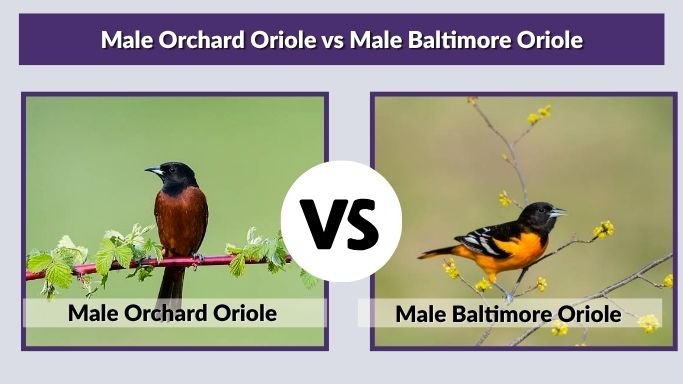
Adult males are the easiest to separate because their colors are very different. A male Baltimore Oriole is famous for its bright orange and black pattern. A male Orchard Oriole has a darker, richer chestnut color that can look almost reddish-brown.
Male Orchard Oriole Identification
A mature male Orchard Oriole has:
- Black head, throat, back, wings, and tail
- Deep chestnut or reddish-brown underparts
- Chestnut shoulder patches
- Smaller, slimmer body
- Darker overall appearance than a Baltimore Oriole
The chestnut color is the key field mark. It is not bright orange like a Baltimore Oriole. In shade, the male Orchard Oriole can look quite dark, so watch for the warm reddish-brown belly and sides.
Male Baltimore Oriole Identification
A mature male Baltimore Oriole has:
- Bright orange underparts
- Black head, throat, and upper back
- Orange shoulder patches
- Black wings with white wing bars
- Larger body and stronger bill
The bright orange color makes male Baltimore Orioles one of the most recognizable birds in eastern North America. If the bird looks bold, bright, and orange, it is more likely a Baltimore Oriole than an Orchard Oriole.
Main Male Difference
The simplest way to separate adult males is color. Baltimore Orioles are bright orange and black. Orchard Orioles are chestnut and black. If the bird is small and dark reddish-brown below, it is likely an Orchard Oriole. If it is larger and glowing orange below, it is likely a Baltimore Oriole.
Female Orchard Oriole vs Female Baltimore Oriole
Females are more confusing because they do not show the bold black-and-orange pattern of adult males. Both can look yellowish, olive, or orange-toned depending on age, season, and lighting. Still, several marks help separate them.
Female Orchard Oriole Identification
Female Orchard Orioles are usually:
- Yellow-green or olive-yellow overall
- Brighter yellow below
- Olive on the back
- Slim and small
- Plain-faced compared with female Baltimore Orioles
- Less orange than female Baltimore Orioles
A female Orchard Oriole often looks greenish-yellow rather than orange. She may remind you of a small yellow songbird with a sharp oriole bill. Her overall appearance is softer and less colorful than a female Baltimore Oriole.
Female Baltimore Oriole Identification
Female Baltimore Orioles are usually:
- Yellow-orange to orange-brown below
- Olive-brown or grayish above
- Larger and longer-bodied
- Often warmer in color than female Orchard Orioles
- Sometimes shows darker wings with pale wing bars
Female Baltimore Orioles vary more than males. Some are dull yellowish, while older females may show stronger orange tones. A warm orange wash on the breast or belly is a strong clue for Baltimore Oriole.
Best Female Field Clues
When comparing females, focus on size and color tone. A small, greenish-yellow oriole is usually an Orchard Oriole. A larger, warmer yellow-orange oriole is usually a Baltimore Oriole. Habitat can also help, especially if the bird is in a tall shade tree, park, or backyard feeder.
Habitat and Range
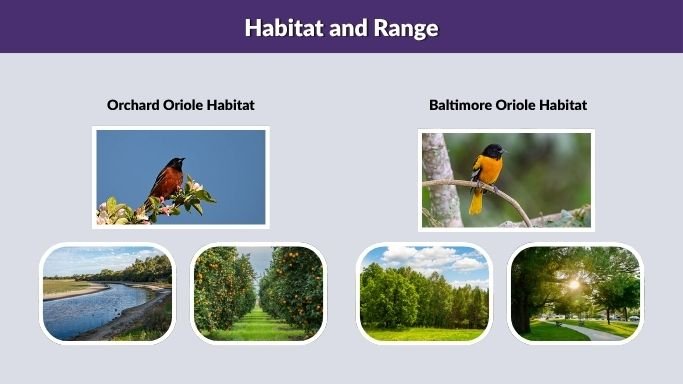
Habitat is another helpful way to compare these birds. They can overlap in some areas, but they often choose slightly different spaces. Orchard Orioles prefer more open, brushy, and orchard-like places, while Baltimore Orioles are commonly found around taller trees and wooded edges.
Orchard Oriole Habitat
Orchard Orioles often live in:
- Orchards and farms
- Open woodland edges
- Shrubby fields
- River edges
- Scattered trees near grassland
- Young trees and hedgerows
They are often lower and less obvious than Baltimore Orioles. Their name fits their behavior well because they are commonly associated with orchards, open country, and semi-open habitats.
Baltimore Oriole Habitat
Baltimore Orioles often live in:
- Deciduous forests
- Forest edges
- Parks
- Backyards with mature trees
- Shade trees near neighborhoods
- River groves and tall tree lines
They are frequent visitors to backyard feeders, especially when oranges, grape jelly, or nectar are offered. Their bright color and flute-like song make them easier to notice in spring and early summer.
Range Overlap
Both species occur in much of eastern and central North America during the breeding season. In places where both are present, habitat and size become important clues. You may see Baltimore Orioles higher in tall trees and Orchard Orioles closer to open fields, orchards, or brushy edges.
Song and Calls
Songs can help when the bird is hidden in leaves. Both species sing rich, musical songs, but the Baltimore Oriole’s song is usually clearer and more whistled. The Orchard Oriole’s song is faster and more varied.
Orchard Oriole Song
The Orchard Oriole has a fast, rolling, and varied song. It may sound hurried, sweet, and slightly jumbled. The notes can rise and fall quickly, making the song feel more complex and less flute-like than the Baltimore Oriole’s.
Orchard Orioles may also give sharp call notes when moving through trees or shrubs. Because they are smaller and less bright, sound is often the first clue that one is nearby.
Baltimore Oriole Song
The Baltimore Oriole sings clear, rich whistles. The song is often described as flute-like, with separate notes that sound smooth and carrying. It is usually easier for beginners to recognize because the notes are bold and musical.
A singing male Baltimore Oriole often sits high in a tree, making it easier to locate after hearing the song.
Feeding Behavior and Diet
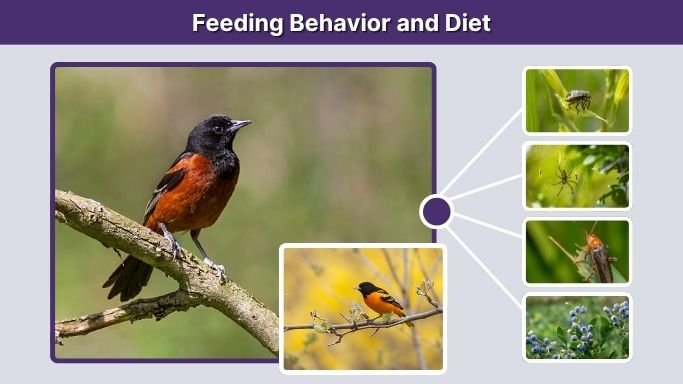
Both orioles eat insects, fruit, and nectar. Their diets are similar, but how and where they feed may differ slightly. Baltimore Orioles are more commonly noticed at backyard feeders, while Orchard Orioles may stay more hidden in natural or semi-open areas.
What Orchard Orioles Eat
Orchard Orioles feed on insects, spiders, caterpillars, berries, nectar, and soft fruits. They often forage among leaves and branches, picking insects from vegetation. During migration, they may visit flowering trees and fruiting shrubs.
They can come to feeders, but they are usually less bold and less common at feeders than Baltimore Orioles.
What Baltimore Orioles Eat
Baltimore Orioles eat insects, caterpillars, beetles, fruit, nectar, and berries. They are well known for visiting orange halves, grape jelly, and nectar feeders. In spring, feeders can be a good way to attract them.
They also help control insects by eating caterpillars and other small invertebrates during the breeding season.
Nesting Differences
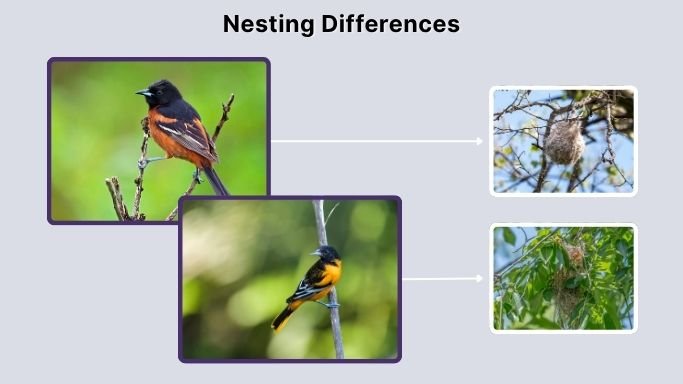
Both birds build hanging pouch-like nests, which are among the most impressive nests in the bird world. The nest is woven from plant fibers, grasses, and other thin materials. However, nest placement may differ.
Orchard Oriole Nest
The Orchard Oriole usually builds a hanging nest in a small or medium-sized tree. The nest may be placed in orchards, open woodlands, or scattered trees near fields. Because the bird is smaller, the nest may also be smaller and less obvious.
The female does most of the nest building, weaving a neat pouch that hangs from thin branches.
Baltimore Oriole Nest
The Baltimore Oriole often builds its nest high in a tall deciduous tree. The hanging pouch may be placed near the end of a branch, where it swings below the leaves. These nests can be difficult to see once the tree has full foliage.
Baltimore Oriole nests are often noticed in mature trees around parks, yards, and wooded edges.
Which Oriole Are You Seeing?
If you see an oriole and are unsure which one it is, use a step-by-step approach. Do not rely on one feature only, especially with females and young birds. Look at size, color tone, habitat, and behavior together.
Quick ID Checklist
Use these clues in the field:
- Bright orange and black male: Baltimore Oriole
- Dark chestnut and black male: Orchard Oriole
- Small greenish-yellow female: Orchard Oriole
- Larger yellow-orange female: Baltimore Oriole
- Tall trees, parks, and backyard feeders: often Baltimore Oriole
- Orchards, farms, shrubby edges: often Orchard Oriole
- Clear flute-like song: often Baltimore Oriole
- Fast, varied, rolling song: often Orchard Oriole
Common Mistakes
A young male Orchard Oriole can look yellowish like a female, which may confuse beginners. Female Baltimore Orioles can also appear dull, especially when they lack strong orange color. Lighting can make both species look different, so size and habitat should always be considered.
Another mistake is assuming every orange oriole is a Baltimore Oriole. Male Orchard Orioles are not bright orange, but their chestnut color can look warm or rusty in sunlight.
FAQs
Is an Orchard Oriole smaller than a Baltimore Oriole?
Yes, the Orchard Oriole is smaller and slimmer than the Baltimore Oriole. This size difference is one of the most useful identification clues, especially when color is unclear. Baltimore Orioles look larger, stronger, and more brightly colored, while Orchard Orioles appear more delicate and compact.
What is the easiest way to tell a male Orchard Oriole from a Baltimore Oriole?
The easiest difference is color. A male Baltimore Oriole is bright orange and black, while a male Orchard Oriole is deep chestnut and black. The Orchard Oriole also looks smaller and darker overall. If the bird has glowing orange underparts, it is probably a Baltimore Oriole.
How do you identify a female Orchard Oriole vs a female Baltimore Oriole?
Female Orchard Orioles are usually smaller and more greenish-yellow or olive-yellow. Female Baltimore Orioles are larger and often warmer yellow-orange or orange-brown below. Since females can vary, compare size, color tone, bill strength, and habitat before making a final identification.
Do Orchard Orioles and Baltimore Orioles live in the same areas?
Yes, their breeding ranges overlap in parts of eastern and central North America. However, they often prefer slightly different habitats. Orchard Orioles are common around orchards, farms, and shrubby edges, while Baltimore Orioles are often found in parks, backyards, tall trees, and forest edges.
Do both Orchard Orioles and Baltimore Orioles come to feeders?
Both can visit feeders, but Baltimore Orioles are more commonly seen at backyard feeders. They often come for orange halves, grape jelly, and nectar. Orchard Orioles may also visit, especially during migration, but they are usually less bold and less frequent around feeders.
