
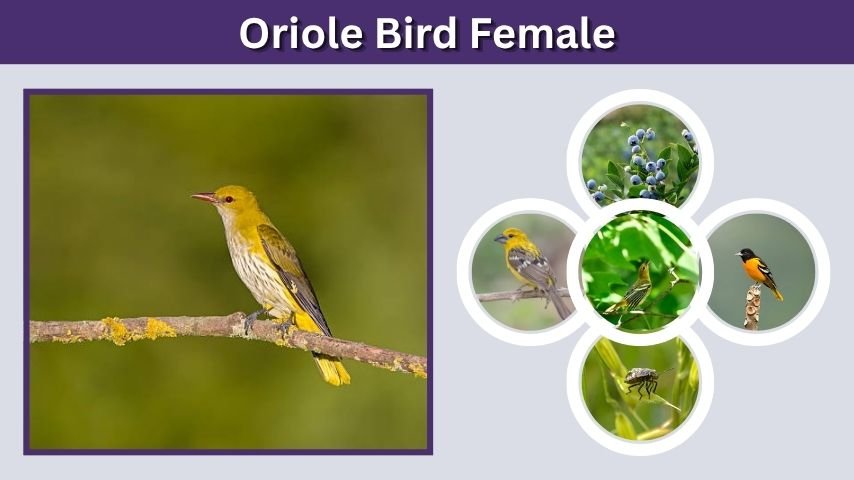
Female orioles are beautiful birds, but they are often harder to identify than males. While male orioles usually have bold black and orange plumage, females are softer in color, often showing yellow, orange, olive, brown, or gray tones. If you have seen a bright yellow-orange bird in your yard and wondered whether it was a female oriole, this guide will help you recognize its key features.
Understanding the Female Oriole Bird
Female orioles belong to the same group of birds as males, but their appearance is usually less dramatic. This difference is common in many bird species. Males often use brighter colors to attract mates, while females tend to have more subtle colors that help them stay hidden while nesting.
In North America, the most commonly searched female oriole is the female Baltimore oriole bird. However, there are several types of orioles, including Orchard Orioles, Bullock’s Orioles, Hooded Orioles, and Scott’s Orioles. Each species has slightly different female plumage, but many share a similar pattern: warm yellow or orange underparts, darker wings, and a pointed bill.
Female orioles are active, graceful, and often seen high in trees. They feed on insects, fruit, and nectar. Many people notice them at backyard feeders, especially when oranges, grape jelly, or nectar feeders are available. Baltimore Orioles are known for eating fruit and nectar as well as insects, and Cornell notes that they can be attracted to backyard feeders with these foods.
What Does a Female Oriole Bird Look Like?
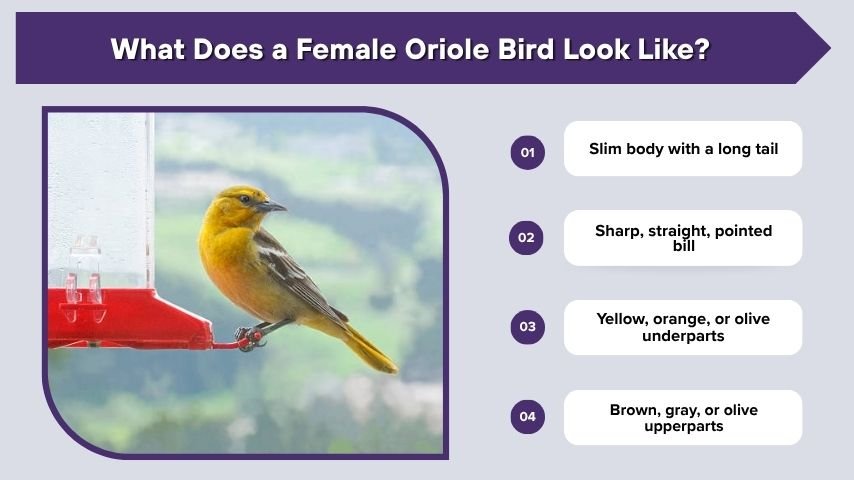
A female oriole bird usually looks slimmer and more delicate than many backyard birds. She has a sharp, pointed bill, long body, strong legs, and a medium-length tail. Her colors depend on the species, age, and season, but she is often yellowish, orange-yellow, olive, or brownish above.
A female Baltimore Oriole is typically brownish above with orange or yellow-orange below. She also has white wing bars and may show some darker markings on the head. Audubon describes the female Baltimore Oriole as brown above, orange-tinged below, with white wing bars and variable black on the head.
Here are common female oriole features:
- Slim body with a long tail
- Sharp, straight, pointed bill
- Yellow, orange, or olive underparts
- Brown, gray, or olive upperparts
- White wing bars on many species
- Active movement through tree branches
- Often seen near fruit, nectar, or flowering trees
Female orioles may look less colorful from a distance, especially in shade. In good light, however, their yellow or orange tones can be very noticeable.
Female Baltimore Oriole Bird Identification
The female Baltimore Oriole is one of the most familiar female orioles in eastern North America. She does not look exactly like the male. The male Baltimore Oriole is bright orange with a black head and black wings, while the female is softer and more blended in color.
A female Baltimore Oriole often has yellow-orange underparts, a brownish or olive-brown back, and dark wings with white bars. Some females can become brighter orange as they age, which can sometimes make identification confusing. Young males may also look somewhat like females before they develop adult male plumage.
The best way to identify a female Baltimore Oriole is to look at the full pattern, not just one color. Check the pointed bill, orange-yellow body, dark wings, white wing bars, and behavior in trees. The USGS notes that female Baltimore Orioles can be similar to other female orioles, but they tend to show a more orange breast and less gray upperparts than female Bullock’s Orioles.
Oriole Bird Male and Female Differences
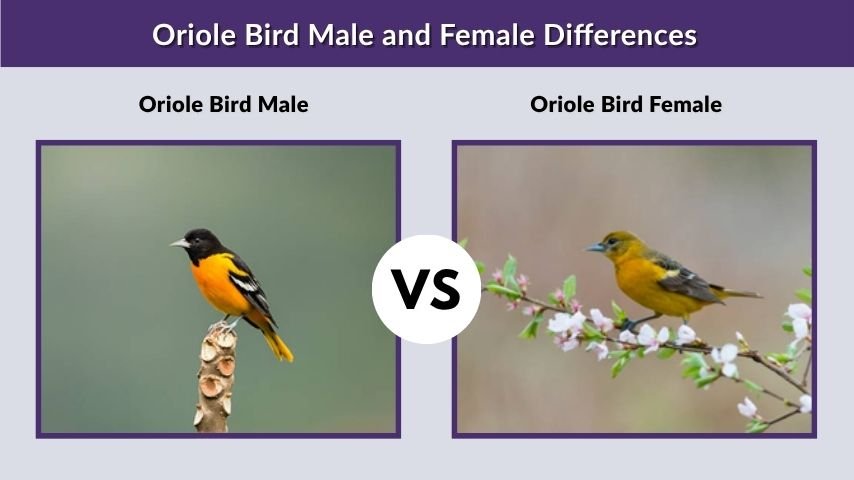
Male and female orioles can look very different. In many species, the male is brighter and easier to recognize. The female is usually duller, softer, or more yellow-green.
| Feature | Male Oriole | Female Oriole |
|---|---|---|
| Color | Usually brighter, often black and orange | Softer yellow, orange, olive, brown, or gray |
| Baltimore Oriole | Black head, bright orange body | Brownish above, orange-yellow below |
| Orchard Oriole | Black and chestnut adult male | Yellow-green female |
| Wing markings | Bold black wings with white marks | Darker wings with lighter wing bars |
| Identification difficulty | Usually easier to identify | Can be confused with young males or other species |
Male Baltimore Orioles are especially bold, with a black head and bright orange body. Female Baltimore Orioles are more subtle, but still colorful. Female Orchard Orioles are even more different from males because they are small and yellow-green rather than chestnut and black. Cornell describes Orchard Oriole males as singing to attract yellow-green females, and notes that Orchard Orioles are the smallest of North America’s orioles.
Female Orchard Oriole Bird
The female Orchard Oriole is another bird that often causes confusion. Unlike the female Baltimore Oriole, she is usually more yellow-green. She is also smaller than a Baltimore Oriole. If you see a small, slender yellow-green bird with a pointed bill and wing bars, it may be a female Orchard Oriole.
Audubon describes the female Orchard Oriole as small and all yellow-green, lacking the orange tone of female Baltimore and Bullock’s Orioles. It also notes that the Orchard Oriole is smaller than the Baltimore Oriole.
Female Orchard Orioles are often seen around open woods, orchards, river edges, parks, and scattered trees. They may feed on insects, fruit, and nectar. Because of their yellow-green color, people sometimes mistake them for warblers or other small songbirds.
Female Oriole Bird Pictures: What to Notice
When looking at female oriole bird pictures, focus on structure as much as color. Color can change depending on lighting, age, camera settings, and season. A bird in bright sunlight may look much more orange than the same bird in shade.
In pictures of female orioles, look for these details:
- Is the bill long, straight, and pointed?
- Are the wings dark with white wing bars?
- Is the body slim and slightly elongated?
- Is the bird yellow, orange-yellow, olive, or brownish?
- Is it sitting high in trees or visiting fruit or nectar?
- Does it have a longer tail than many small songbirds?
For female Baltimore Oriole bird pictures, look for warm orange or yellow-orange underparts and brownish upperparts. For female Orchard Oriole pictures, look for a smaller bird with a more yellow-green appearance.
Female Oriole Bird Call and Song
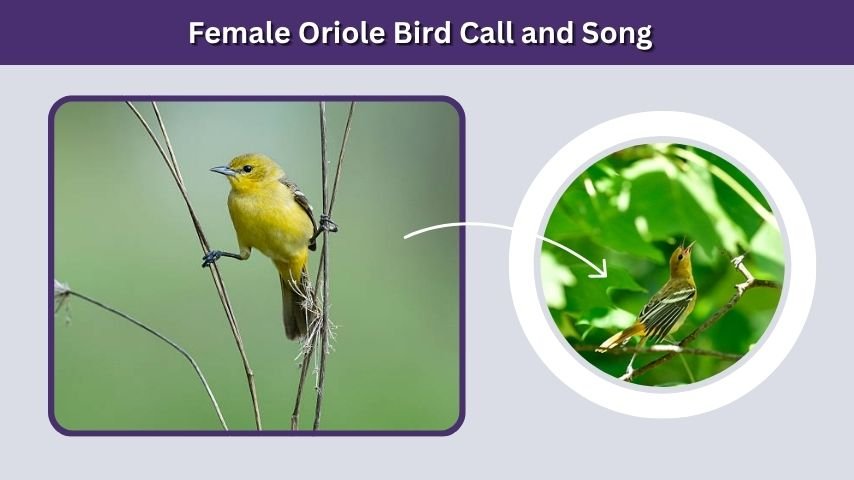
Female orioles are not silent. While male songs are often more noticeable, females can also make sounds. Baltimore Orioles are known for rich, whistling songs, and their calls include chatter and sharp notes. Cornell describes the Baltimore Oriole song as rich and whistling, often heard from treetops near homes and parks.
A female oriole bird call may be used for contact, alarm, or communication near the nest. If you hear sharp chatter or short calls coming from leafy trees during spring or summer, orioles may be nearby. Because they often stay high in foliage, sound can be one of the first clues that they are present.
To identify a female oriole by sound, listen for clear whistles, chatter, and short contact calls. Then try to spot movement in the upper branches.
Where Female Orioles Build Nests
Female orioles are famous for their hanging nests. Baltimore Orioles often build pouch-like nests that hang from thin branches high in trees. The female does much of the nest construction, weaving plant fibers, grasses, hair, and other materials into a secure hanging structure.
These nests are one reason female orioles benefit from more subtle coloring. While nesting, they need to move through trees and care for eggs or young without attracting too much attention from predators.
If you see a female oriole repeatedly visiting the same high branch with thin fibers or grasses, she may be building a nest. Avoid disturbing the area and enjoy watching from a distance.
What Female Orioles Eat
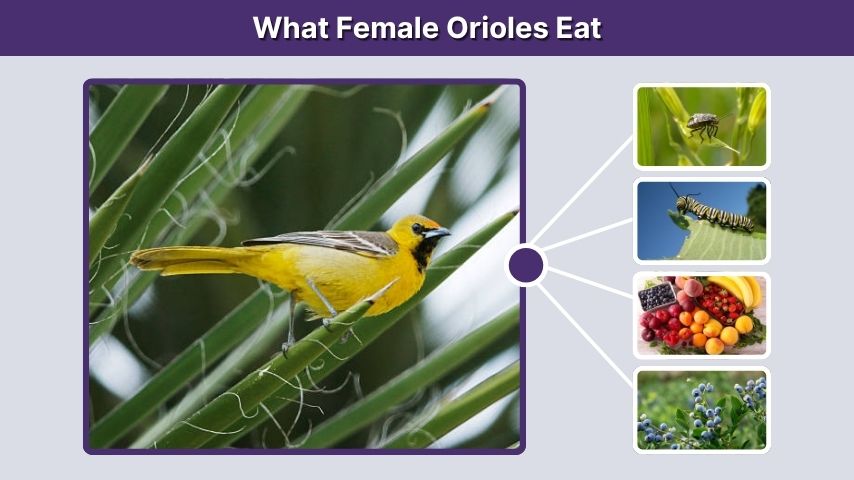
Female orioles eat a varied diet. They feed on insects, caterpillars, fruit, berries, nectar, and sometimes jelly at feeders. During nesting season, insects are especially important because young birds need protein to grow.
Backyard bird lovers often attract orioles with orange halves, grape jelly, and nectar feeders. However, these foods should be offered carefully. Keep feeders clean, replace jelly before it spoils, and avoid offering too much at once. Fresh fruit is often a better natural option.
Good foods for attracting female orioles include:
- Orange halves
- Small amounts of grape jelly
- Nectar in clean feeders
- Native berry-producing shrubs
- Flowering trees and plants
- Insect-friendly garden areas
Avoid pesticides when possible because orioles rely on insects, especially when feeding young.
How to Attract Female Orioles to Your Yard
If you want to see female orioles, create a yard that offers food, shelter, and nesting opportunities. Orioles like trees, open woodland edges, fruiting plants, and safe feeding areas.
Start by placing orange halves or a clean nectar feeder in a visible location during spring migration. Orioles often arrive hungry after migration and may visit feeders more readily early in the season. Once they find your yard, they may return if food and habitat remain suitable.
Planting native trees and shrubs is one of the best long-term ways to attract orioles. Trees provide insects, nesting places, shade, and protection. Flowering and fruiting plants can also support orioles naturally without depending only on feeders.
Birds That Look Like Female Orioles
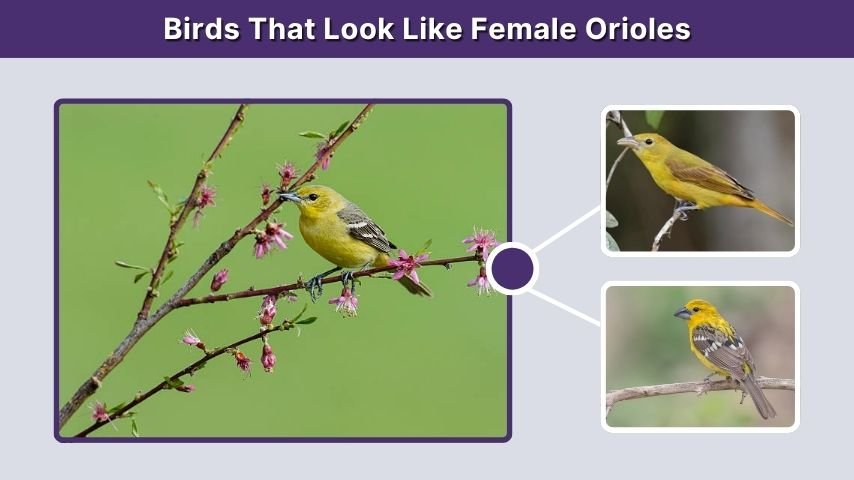
Female orioles can be confused with several other birds. Their softer colors make them harder to identify than males. Depending on your region, you might confuse them with tanagers, warblers, grosbeaks, or young male orioles.
A female Baltimore Oriole may look similar to a young male Baltimore Oriole. It may also be confused with female Bullock’s Oriole in areas where ranges overlap. Female Orchard Orioles can be mistaken for yellow-green warblers because they are smaller and less orange.
To avoid confusion, check the bill shape first. Orioles have a pointed, sturdy bill that is longer than many warbler bills. Also watch behavior. Orioles often move through trees looking for insects, nectar, or fruit and may visit orange or jelly feeders.
When Can You See Female Orioles?
Many orioles are migratory. In much of North America, they are most commonly seen during spring and summer. Baltimore Orioles breed across much of eastern North America and migrate south after the breeding season. Audubon notes that Baltimore Oriole fall migration begins early, with many birds departing in July and August.
This means the best time to look for female orioles is often spring through mid-summer. During spring migration, they may be easier to attract with oranges and nectar. During nesting season, they may spend more time in trees, especially near nests.
FAQs
What does a female oriole bird look like?
A female oriole bird usually has softer colors than the male. She may be yellow, orange-yellow, olive, brown, or grayish, depending on the species. Female Baltimore Orioles are often brownish above and orange-yellow below, with dark wings, white wing bars, and a sharp pointed bill.
What does a female Baltimore Oriole bird look like?
A female Baltimore Oriole has warm yellow-orange underparts, brownish or olive-brown upperparts, dark wings, and white wing bars. Some females may show darker markings on the head. They are less boldly colored than males but still have a slim body and pointed oriole bill.
How can you tell a male and female oriole apart?
Male orioles are usually brighter and more strongly patterned. Male Baltimore Orioles have a black head and bright orange body, while females are brownish above and orange-yellow below. Female Orchard Orioles are yellow-green, while adult males are black and chestnut.
Do female orioles sing or call?
Yes, female orioles can make calls and may also vocalize near nesting areas. Male songs are usually more noticeable, but females use sounds for communication, alarm, and contact. Listen for whistles, chatter, or sharp calls from trees during spring and summer.
Are female orioles attracted to feeders?
Yes, female orioles may visit feeders, especially during spring migration and nesting season. They are attracted to orange halves, nectar, and small amounts of grape jelly. Clean feeders often and replace food before it spoils to keep visiting birds healthy.
