
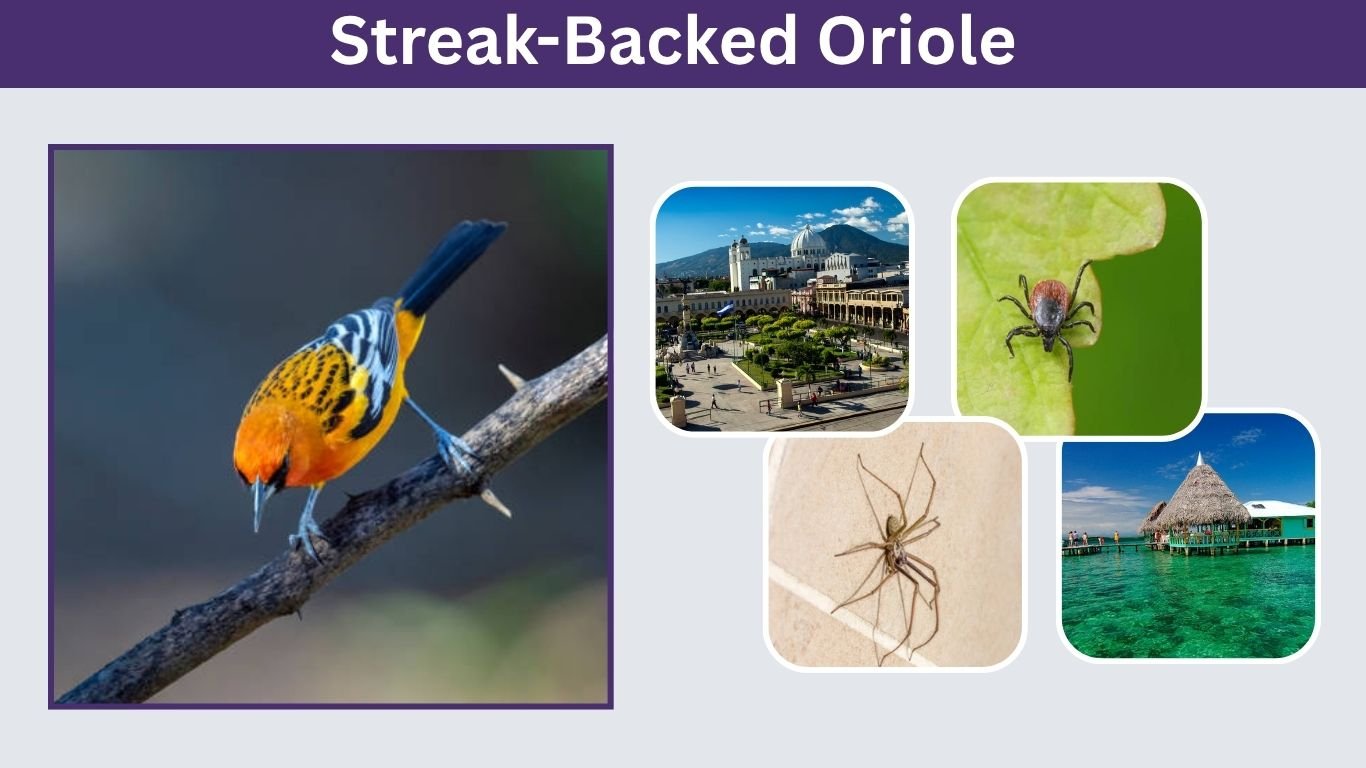
The Streak-backed Oriole is a bright orange-and-black songbird best known for the dark streaks across its back. Its scientific name is Icterus pustulatus. This oriole is mainly found in Mexico and Central America, but rare individuals sometimes appear in the southwestern United States. Birders often search for its range, call, female plumage, and differences from similar orioles such as Hooded, Bullock’s, and Altamira Orioles.
What Is a Streak-Backed Oriole?
The Streak-backed Oriole is a medium-sized New World oriole in the blackbird family, Icteridae. It is sometimes called the Scarlet-headed Oriole or Flame-headed Oriole because of its rich orange head and body. However, the common English name “Streak-backed Oriole” comes from its most useful field mark: thin dark streaks on the back.
This species is most common in western Mexico and parts of Central America. It prefers semi-open habitats, woodland edges, dry forests, thorn scrub, orchards, gardens, and areas with scattered trees. In the United States, it is considered a rare visitor, mostly reported from southern California and southeastern Arizona.
Streak-Backed Oriole Identification
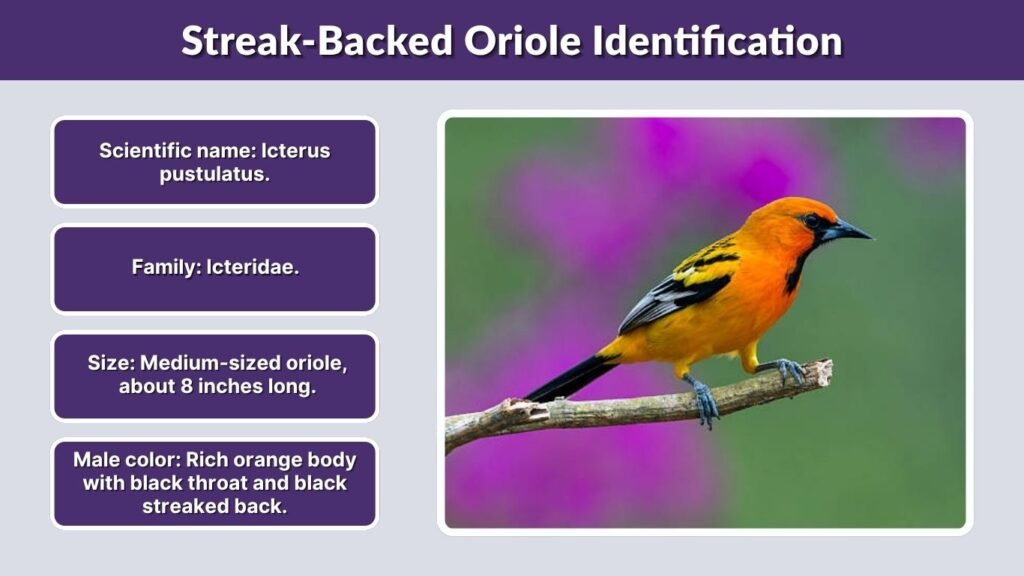
Adult male Streak-backed Orioles are striking birds. They are rich orange with a black throat, black tail, black wings, white wing markings, and narrow black streaks on the back. The bill is straight, pointed, and dark, which helps separate it from some similar orioles.
Females and young birds are duller. They may show yellowish-orange underparts, grayish or olive-brown upperparts, streaking on the back, and less intense black on the face or throat. Female identification can be difficult because some female Bullock’s Orioles may also show a streaked back.
Key Identification Signs
- Scientific name: Icterus pustulatus
- Family: Icteridae
- Size: Medium-sized oriole, about 8 inches long
- Male color: Rich orange body with black throat and black streaked back
- Female color: Duller yellow-orange with grayish-brown or olive-streaked back
- Bill: Straight, pointed, and dark
- Wings: Black with bold white markings
- Tail: Dark, often blackish
- Best field mark: Orange body with narrow dark streaks on the back
Audubon describes adult males as rich orange with a narrow black throat, much white in the wings, and narrow black streaks on the back. It also notes that females are duller and that some young females can be hard to separate from female Bullock’s Orioles.
Male and Female Streak-Backed Orioles
Male and female Streak-backed Orioles look different, but both can show the streaked-back pattern. The male is brighter and easier to identify. His orange head and body, black throat, and dark streaked back create a bold contrast.
The female is softer in color. She is usually yellowish-orange below, with a grayish-brown or olive-toned back and darker streaks. She may lack the strong black throat of the adult male or show a reduced dark area depending on age and individual variation.
Male vs Female Differences
| Feature | Male Streak-Backed Oriole | Female Streak-Backed Oriole |
|---|---|---|
| Overall color | Bright orange to orange-red | Duller yellow-orange |
| Throat | Narrow black throat | Usually paler or less boldly marked |
| Back | Dark streaks on orange or dark upperparts | Streaked grayish-brown or olive-toned back |
| Wings | Black with white wing markings | Darker wings with paler edging |
| Identification | Easier to identify | Can be confused with female Bullock’s Oriole |
Female Streak-backed Orioles require careful observation. The back pattern, bill shape, wing markings, range, and call can all help with identification.
Streak-Backed Oriole Range
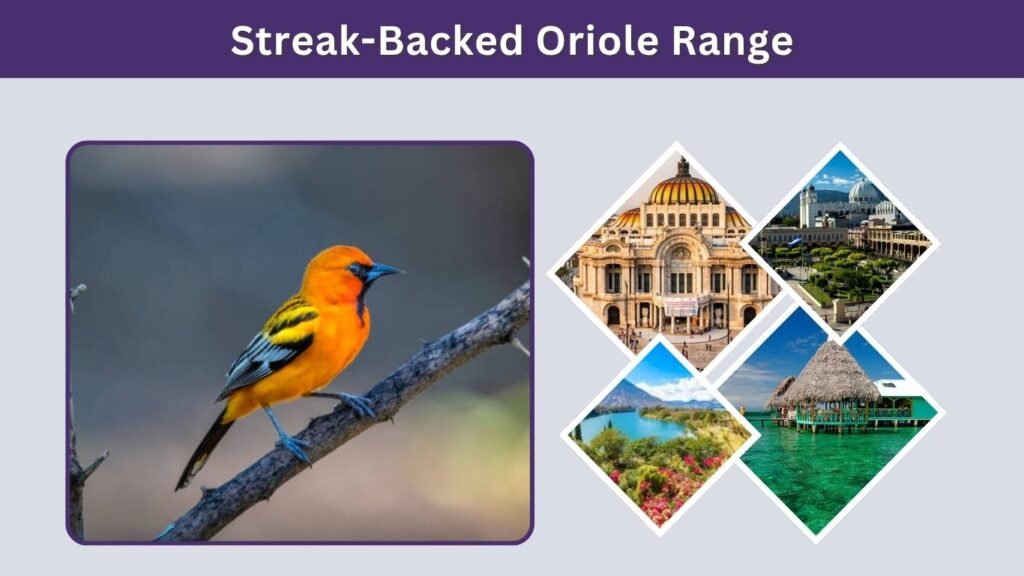
The Streak-backed Oriole ranges mainly from Mexico south into Central America. It is especially associated with the Pacific slope of Mexico and Central America, though some populations also occur in other regions of Mexico. Its range includes Mexico, Guatemala, El Salvador, Honduras, Nicaragua, and Costa Rica.
In North America, it is not a regular breeding bird in the United States. It is best treated as a rare vagrant or casual visitor. Reports from southern California, southeastern Arizona, and nearby desert border regions attract attention from birders because the species is usually much farther south.
Where It Is Found
- Western and southern Mexico
- Pacific slope of Central America
- Guatemala
- El Salvador
- Honduras
- Nicaragua
- Costa Rica
- Rarely southern California
- Rarely southeastern Arizona
- Occasionally other southwestern U.S. locations
The California Species Project describes the species as ranging from western Mexico through Central America to northwestern Costa Rica, with North American presence mainly along Mexico’s Pacific coast and Gulf coast regions.
Streak-Backed Oriole in California and Yuma
Streak-backed Oriole records in California are rare but important for birders. The first U.S. record was from San Diego County in 1931. Since then, California records have remained uncommon, often involving birds found during fall, winter, or early spring.
Birders also search for Streak-backed Oriole reports near Yuma and southeastern Arizona because the species occasionally appears as a vagrant north of Mexico. A Streak-backed Oriole in places like Yuma, Tucson, or southern California can draw birdwatchers from long distances.
These sightings are unusual and should be documented carefully with clear photos, audio, location notes, and field marks. Similar species such as Hooded Oriole, Bullock’s Oriole, and Altamira Oriole can create confusion, especially with females or immature birds.
Habitat and Behavior
Streak-backed Orioles prefer warm habitats with trees, shrubs, and open areas. They are often found in dry woodland, thorn forest, forest edges, plantations, orchards, gardens, and semi-open countryside. They may feed in flowering trees, fruiting plants, and areas with insects.
They are active birds that move through branches searching for food. Like other orioles, they may hang from twigs, inspect leaves, probe flowers, and visit fruit or nectar sources. They are usually seen in pairs, small family groups, or alone, depending on the season.
Common Habitat Features
- Dry forest
- Thorn scrub
- Woodland edge
- Semi-open countryside
- Orchards and plantations
- Gardens and parks
- Flowering trees
- Scattered tall shrubs
- Areas with insects, nectar, and fruit
Their bright plumage makes males easier to spot, but they can still disappear quickly in leafy branches.
What Do Streak-Backed Orioles Eat?
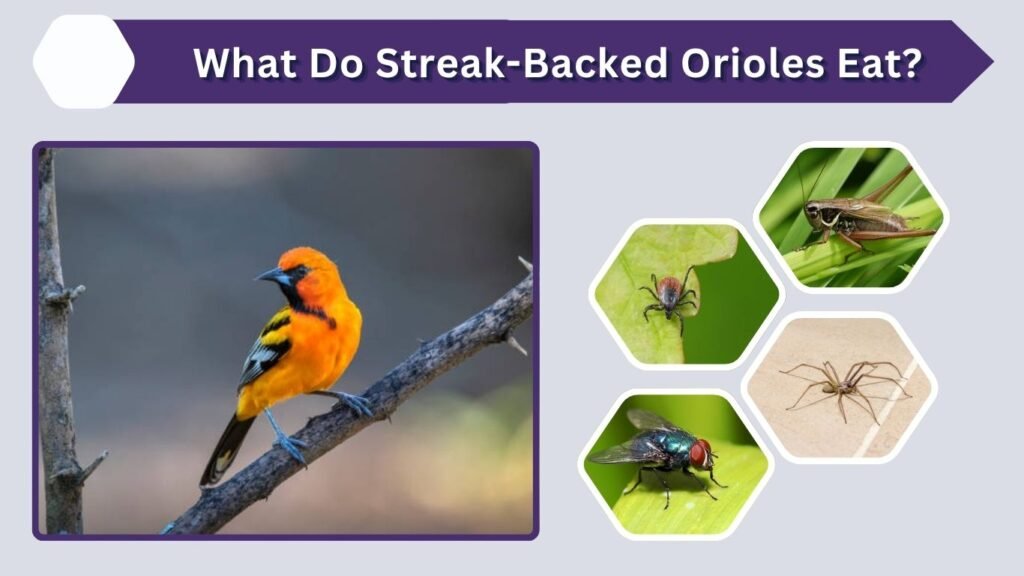
Streak-backed Orioles eat a mixed diet of insects, nectar, fruit, and other small food items. Like many orioles, they are flexible feeders. Insects provide protein, especially during the breeding season, while fruit and nectar provide energy.
They may search leaves, bark, flowers, and branches for caterpillars, beetles, spiders, and other small invertebrates. They may also visit flowering trees to drink nectar. In places where they overlap with people, they may be attracted to fruiting trees or nectar-rich plants.
Common Foods
- Insects
- Caterpillars
- Beetles
- Spiders
- Nectar
- Fruit
- Flower parts
- Soft plant material
They are not seed specialists like finches. Their pointed bill is better suited for probing, picking insects, and feeding from flowers and fruit.
Streak-Backed Oriole Song and Call
The Streak-backed Oriole has a clear, musical song typical of many orioles. Its song can include whistled notes, short phrases, and varied sounds. Calls may include nasal notes, chattering sounds, or sharp contact calls. Birders often use sound to confirm the species when the bird is partly hidden.
Xeno-canto recordings list Streak-backed Oriole songs and calls from Mexico and Central America, including songs, nasal calls, chinks, and chattering notes. Because the species can be confused visually with other orioles, audio can be useful when comparing field observations.
How to Recognize the Sound
- Clear whistled phrases
- Short musical notes
- Nasal calls
- Chink or chert-like contact notes
- Chattering during interactions
- Vocal activity from trees or woodland edges
When documenting a rare bird in the United States, recording the call or song can strengthen the identification.
Nesting and Breeding
Streak-backed Orioles build hanging nests, like many other New World orioles. The nest is usually woven from plant fibers, grasses, and other flexible materials. It hangs from a branch, often in a tree where the bird has some protection from predators.
The female likely does most of the nest-building, while both adults may help defend the nesting area and feed young. The nest is shaped like a pouch or basket, suspended from twigs or branch tips. This hanging style helps reduce access for some predators.
Nesting Features
- Hanging pouch-like nest
- Built from plant fibers and grasses
- Usually placed in trees
- Often attached to branch tips
- Eggs and young protected inside the woven structure
- Adults feed nestlings insects and soft foods
Breeding timing may vary by region, rainfall, and food availability.
Similar Birds and Look-Alikes
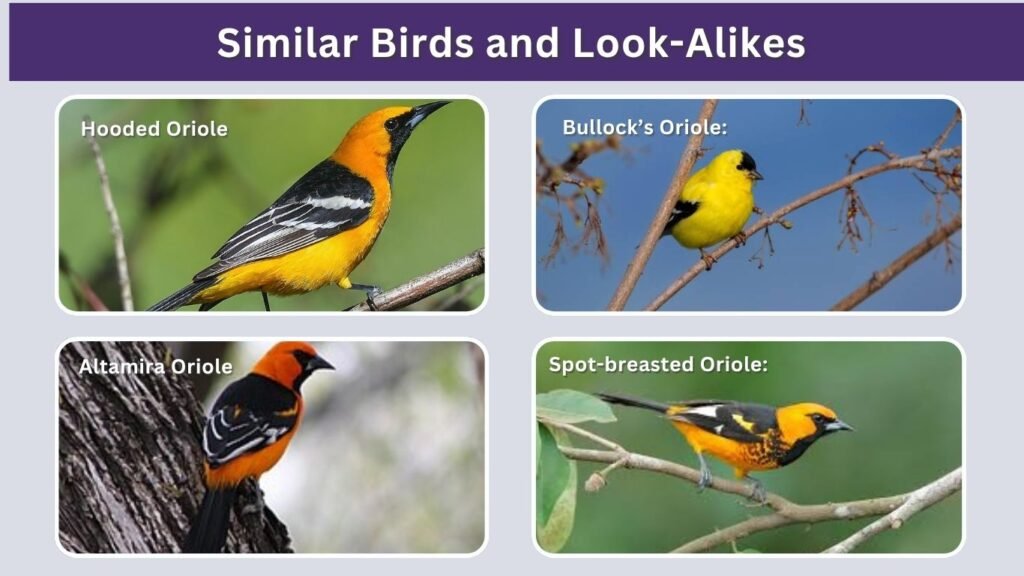
The Streak-backed Oriole can be confused with other orange and black orioles. The most common look-alikes include Hooded Oriole, Bullock’s Oriole, Altamira Oriole, and Spot-breasted Oriole. Females and immature birds are the most difficult.
The streaked back is the main clue, but it is not always enough by itself. Bill shape, wing bars, throat pattern, body color, location, and sound should all be considered.
Comparison With Similar Orioles
- Hooded Oriole: Usually lacks the same narrow black back streaking; males can look similar at first glance.
- Bullock’s Oriole: Females may show streaked backs, making them a difficult comparison.
- Altamira Oriole: Larger and has a more solid black back rather than narrow streaks.
- Spot-breasted Oriole: Has spots on the breast, not the same streaked-back pattern.
- Baltimore Oriole: Different range and pattern, with stronger black head in males.
For rare U.S. sightings, careful documentation is important because unusual orioles can be misidentified.
Conservation Status
The Streak-backed Oriole is not generally considered a highly threatened bird. BirdLife International lists it as Least Concern, with a large estimated population. Its broad range across Mexico and Central America helps support its stable status.
However, local populations may still be affected by habitat loss, pesticide use, and changes in dry forest or scrub habitats. Protecting native trees, flowering plants, and mixed woodland edges can support orioles and other birds that rely on insects, fruit, and nectar.
Streak-Backed Oriole Facts
The Streak-backed Oriole is both beautiful and useful for understanding oriole diversity. Its combination of orange plumage, black throat, white wing markings, and dark back streaks makes it one of the most distinctive orioles in its normal range.
Quick Facts
- The scientific name is Icterus pustulatus.
- It is mainly found in Mexico and Central America.
- It is rare but possible in the southwestern United States.
- Males are brighter than females.
- The streaked back is the key field mark.
- It eats insects, fruit, and nectar.
- It builds a hanging woven nest.
- It is sometimes called Flame-headed Oriole.
- It belongs to the New World blackbird family.
- Birders use both plumage and sound for identification.
FAQs
What is the scientific name of the Streak-backed Oriole?
The scientific name of the Streak-backed Oriole is Icterus pustulatus. It belongs to the family Icteridae, which includes New World orioles, blackbirds, meadowlarks, cowbirds, and oropendolas. The species is also sometimes called the Scarlet-headed Oriole or Flame-headed Oriole.
Where does the Streak-backed Oriole live?
The Streak-backed Oriole mainly lives in Mexico and Central America. Its range extends from western Mexico south through parts of Guatemala, El Salvador, Honduras, Nicaragua, and Costa Rica. It is rare in the United States, but occasional birds have been reported in southern California and southeastern Arizona.
What does a female Streak-backed Oriole look like?
A female Streak-backed Oriole is duller than the male. She usually has yellowish-orange underparts, darker wings, and a grayish-brown or olive-toned streaked back. Some females and immature birds can be difficult to separate from female Bullock’s Orioles, especially outside the normal range.
What does the Streak-backed Oriole eat?
The Streak-backed Oriole eats insects, caterpillars, beetles, spiders, nectar, fruit, and other soft foods. Insects are especially important during nesting because young birds need protein. Adults may also visit flowering trees or fruiting plants to feed on nectar and ripe fruit.
Is the Streak-backed Oriole rare?
The Streak-backed Oriole is not rare across much of its normal range in Mexico and Central America. However, it is rare in the United States. Sightings in California, Arizona, or places near the border are unusual and usually attract attention from birders.
