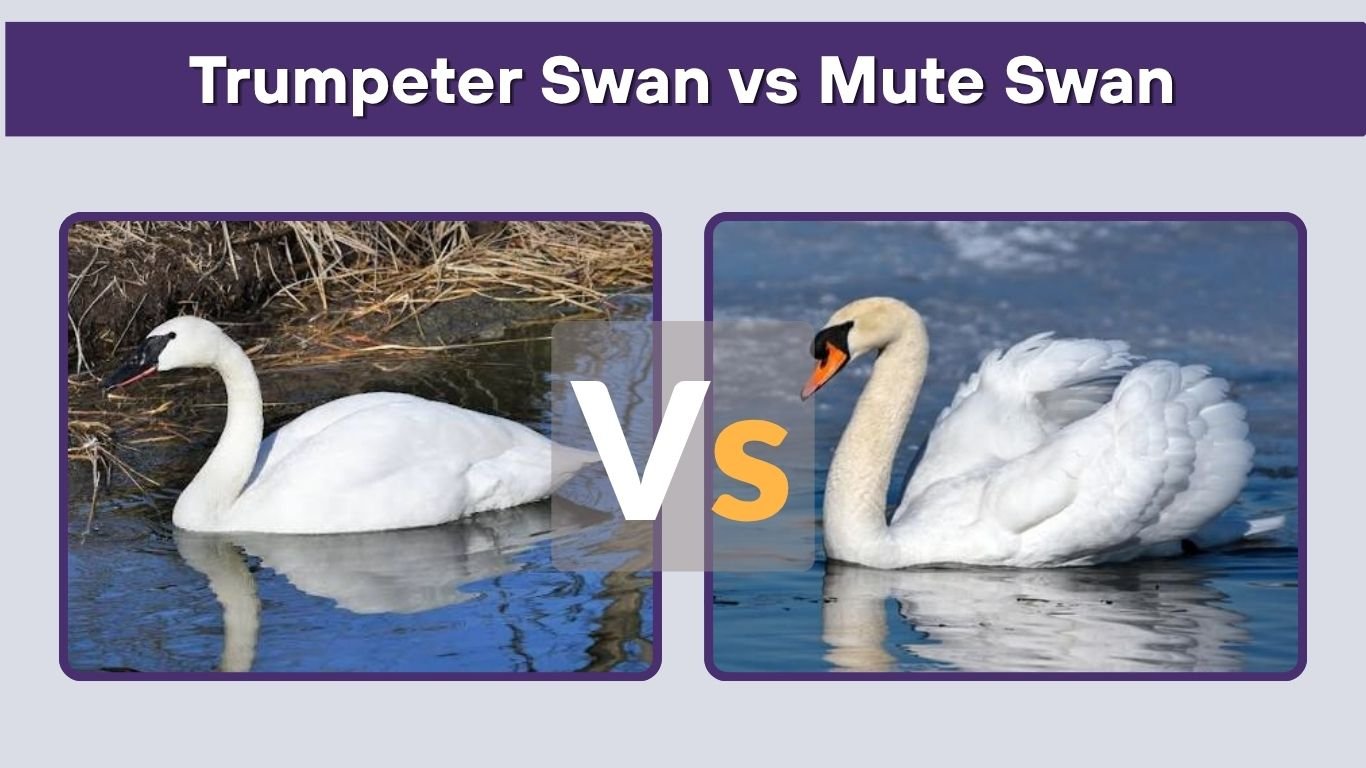
Trumpeter Swans and Mute Swans are enormous white waterbirds, but several features distinguish them. A Trumpeter Swan has a black bill and usually holds its neck straight, while a Mute Swan has an orange bill with a black knob and often curves its neck into an S shape. Their calls, origins, and behavior also differ.
If you are comparing a Trumpeter Swan vs. Mute Swan in the wild or identifying one in a photograph, this guide explains what to look for.
Trumpeter Swan vs. Mute Swan: Quick Comparison
| Feature | Trumpeter Swan | Mute Swan |
|---|---|---|
| Scientific name | Cygnus buccinator | Cygnus olor |
| Adult bill | Completely black | Orange with black base and prominent knob |
| Typical neck posture | Relatively straight | Frequently curved into an S |
| Main vocalization | Deep, resonant trumpet-like calls | Generally quieter; grunts, snorts, hisses, and occasional calls |
| Adult plumage | White | White |
| Feet and legs | Black | Black |
| Origin in North America | Native | Introduced from Eurasia |
| Common habitat | Marshes, lakes, wetlands, and open rivers | Park ponds, lakes, rivers, and coastal waters |
The bill is the fastest identification clue. Orange suggests Mute Swan; black suggests Trumpeter Swan or another black-billed species. Confirm with neck shape and location.
Appearance: How to Tell These Swans Apart
Trumpeter Swan Appearance
Adult Trumpeter Swans have white feathers, black feet, and a black bill that blends into black facial skin near the eyes. The sloping bill creates a continuous-looking forehead profile. Their long necks often appear straight while swimming.
Iron-rich water sometimes stains their heads rusty. Juveniles are grayish and can have pinkish areas on their bills.
Mute Swan Appearance
The Mute Swan’s defining feature is an orange bill with a black knob near the forehead. The knob is often larger in breeding males. Its slender neck commonly forms an S curve.
Mute Swans sometimes raise their wings like sails during territorial displays. Juveniles may be gray-brown or pale and lack an adult’s orange bill.
Both species are white as adults, so plumage color alone is not enough to distinguish them.
Trumpeter Swan vs. Mute Swan Size and Wingspan
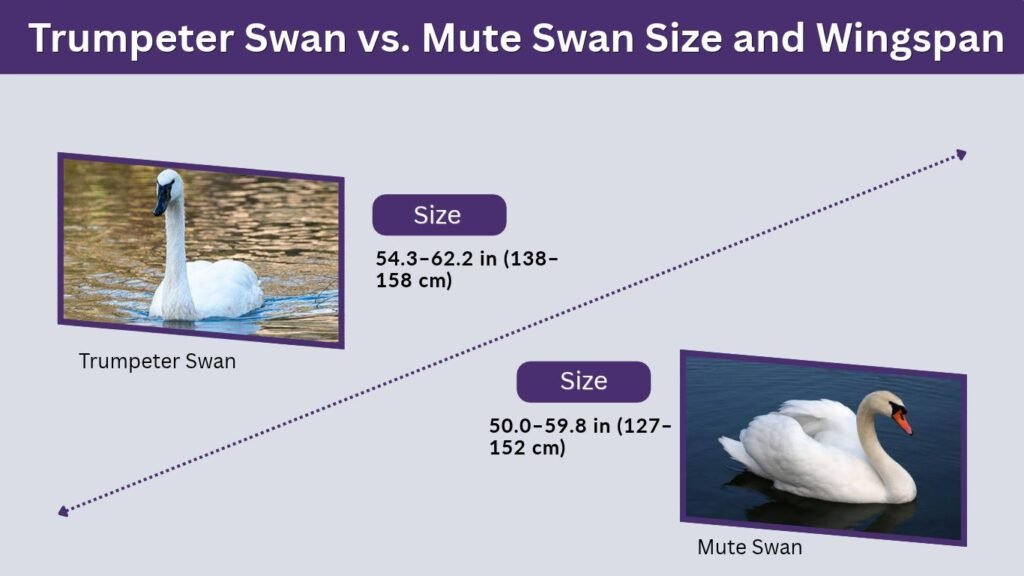
Which swan is bigger? Trumpeter Swans are generally longer-bodied, but size overlaps considerably, and Mute Swans can have a wider measured wingspan. A distant bird is difficult to identify by size alone.
| Measurement | Trumpeter Swan | Mute Swan |
|---|---|---|
| Body length | 54.3–62.2 in (138–158 cm) | 50.0–59.8 in (127–152 cm) |
| Weight | 17.0–28.0 lb (7.7–12.7 kg) | 12.1–31.5 lb (5.5–14.3 kg) |
| Wingspan | About 79.9 in (203 cm) | 81.9–93.7 in (208–238 cm) |
| Overall impression | Large, heavy-bodied, long-necked | Equally imposing, with a curved-neck silhouette |
These are species-guide ranges, and individual birds vary. The largest Mute Swan may outweigh some Trumpeters, although Trumpeters tend to be longer.
Bill color beats size unless birds are side by side.
Trumpeter Swan vs. Mute Swan Sounds
Their voices provide another strong clue, even when the birds are hidden behind reeds.
What Does a Trumpeter Swan Sound Like?
The Trumpeter Swan has a deep, trumpet-like call that carries across wetlands. Families vocalize to stay together, sound alarms, or defend territories. These notes are lower than Tundra Swan calls.
Is a Mute Swan Really Silent?
No. Mute Swans produce hisses, snorts, grunts, and softer calls, especially near nests. Their wings also create rhythmic humming sounds in flight.
A resonant bugle suggests Trumpeter Swan; a hissing bird with raised wings suggests Mute Swan. Always check the bill.
Habitat and Geographic Range
Trumpeter Swans are native to North America. They breed around wetlands and shallow lakes in Alaska, Canada, and parts of the northern United States. Many winter on ice-free rivers, lakes, or estuaries. Reintroduction programs have restored populations in several regions.
Mute Swans, native to Eurasia, were imported for North American parks and estates. Established wild populations occur in the Northeast and Great Lakes regions, among other places.
Habitat offers clues, not proof: both species use lakes, ponds, and rivers.
Diet: What Do Trumpeter and Mute Swans Eat?
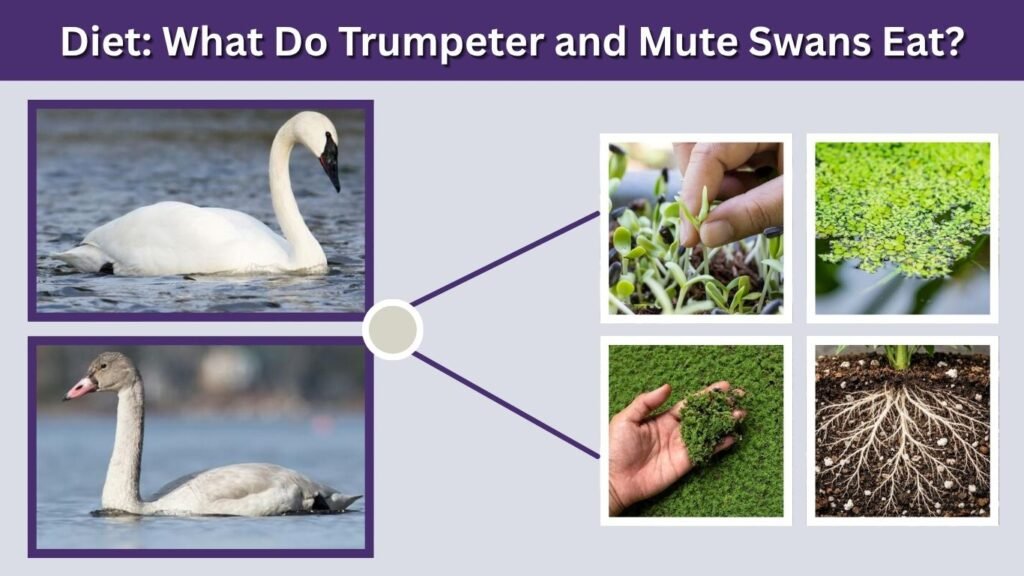
Both species mainly eat aquatic plants, reaching underwater for leaves, stems, and roots. They sometimes tip forward with their tails raised.
Trumpeter Swans eat pondweeds, sedges, rushes, duckweed, and wild rice. They also forage for leftover grain in fields. Young birds consume some aquatic invertebrates.
Mute Swans graze on submerged vegetation and sometimes uproot plants. Dense introduced populations can damage wetland plants and compete with native waterbirds.
Nesting, Mating, and Territorial Behavior
Both form long-term pair bonds and build bulky wetland nests for their young, called cygnets.
Trumpeter Swans lay four to six eggs, incubated for roughly 32–37 days. Pairs often reuse nest sites and defend their young vigorously.
Mute Swans typically lay two to five eggs according to Cornell’s species account. During breeding, adults may arch their necks, raise their wings, and hiss at intruders.
Give either species space near nests, and keep dogs away from cygnets.
Trumpeter Swan vs. Mute Swan vs. Tundra Swan
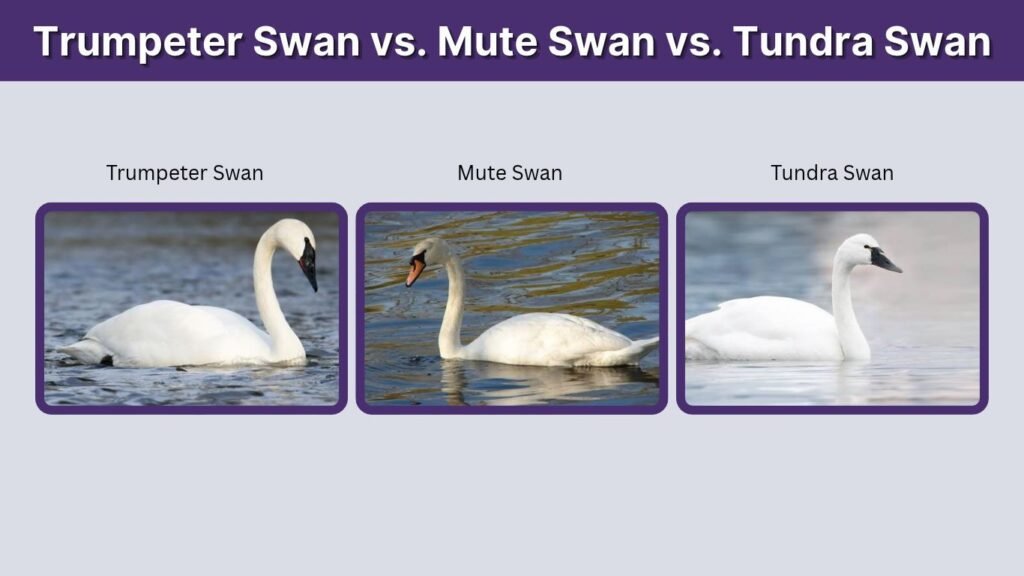
Tundra Swans are another source of confusion, especially when viewed from a distance.
| Identification Clue | Trumpeter Swan | Mute Swan | Tundra Swan |
|---|---|---|---|
| Adult bill | Black | Orange with black knob | Mostly black; often a small yellow patch near the eye |
| Neck posture | Usually straight | Often S-curved | Generally straight |
| Relative size | Usually largest by length | Very large; overlaps Trumpeter | Noticeably smaller on average |
| Call | Low, powerful trumpet | Quieter grunts and hisses | Higher, smoother bugling calls |
| North American status | Native | Introduced | Native |
| Typical breeding area | Northern wetlands and lakes | Temperate wetlands and lakes | Arctic tundra |
Not every Tundra Swan has a visible yellow spot. If its bill looks black, consider size, head profile, and voice together.
Are Mute Swans a Threat to Native Trumpeter Swans?
Introduced Mute Swan populations can displace native waterbirds and remove wetland vegetation. Some wildlife managers control these populations to protect habitat and support native swans, including Trumpeters.
This does not mean every Mute Swan attacks Trumpeters. Competition varies locally, and the concern centers on introduced populations in North America, not Mute Swans living within their native range.
Five Frequently Asked Questions
1. What Is the Main Difference Between a Trumpeter Swan and a Mute Swan?
The easiest difference is the bill. Trumpeter Swans have an entirely black bill and typically straighter necks. Mute Swans have orange bills with black knobs and often carry their necks in an S shape. Their voices also differ considerably.
2. Is a Trumpeter Swan Bigger Than a Mute Swan?
Trumpeter Swans are generally longer and are considered North America’s largest native waterfowl. However, their weight ranges overlap with Mute Swans, which may have wider wingspans. An individual Mute Swan can be heavier, so size alone is unreliable.
3. Do Trumpeter Swans and Mute Swans Have Different Leg Colors?
No. Adult Trumpeter Swans and Mute Swans both have black legs and feet. Leg color is therefore a poor way to separate the species. Look instead for the Trumpeter’s black bill or the Mute Swan’s orange bill and knob.
4. How Can I Tell a Mute Swan From a Tundra Swan?
An adult Mute Swan has an orange bill with a black knob and usually an elegantly curved neck. A Tundra Swan has a mostly black bill, sometimes marked yellow near the eye, and is generally smaller and straighter-necked.
5. Are Male and Female Mute Swans Easy to Distinguish?
Male and female Mute Swans look remarkably similar because both are white with orange bills. Males are often slightly larger and develop a more prominent black bill knob, especially during breeding, but these differences are not definitive in photographs.