
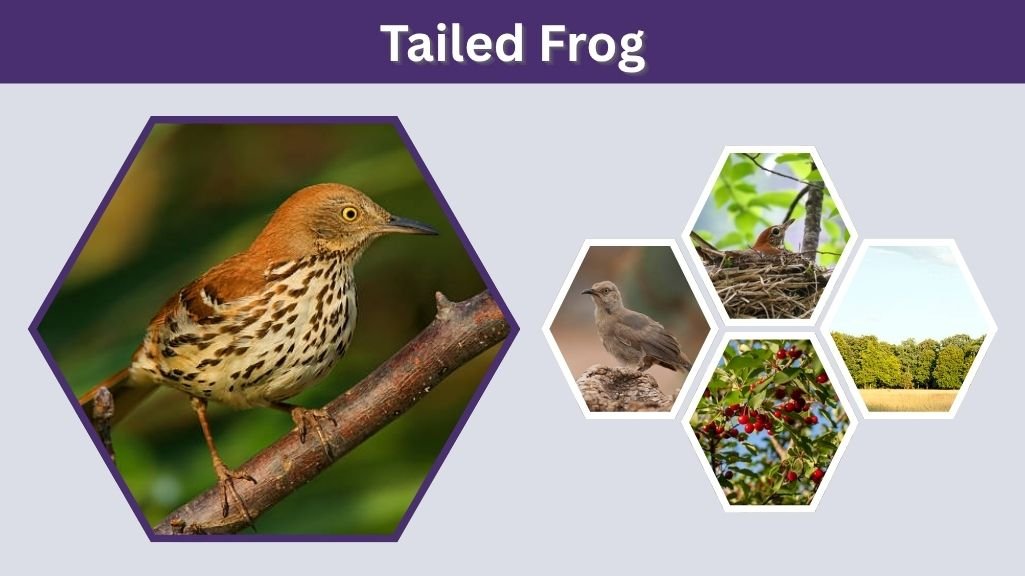
The Brown Thrasher (Toxostoma rufum) is a medium-sized North American songbird recognized by its long tail, streaked brown plumage, and slightly curved bill. Found in dense shrubs and forest edges, it is highly vocal and territorial. Often confused with Wood Thrushes or Long-billed Thrashers, identification relies on plumage, size, and song. This guide explores the Brown Thrasher’s physical characteristics, habitat, diet, breeding behavior, vocalizations, juvenile development, and seasonal movements, offering a complete overview for birdwatchers and ornithologists.
Brown Thrasher Overview
The Brown Thrasher is a medium-sized bird with a long tail and streaked brown plumage, adapted to dense shrublands and forest edges. Its slightly curved bill allows efficient foraging, and it is highly vocal, with one of the largest song repertoires of any North American bird. Males defend territory, and both sexes are attentive parents.
Physical Description
Brown Thrasher measures 23–28 cm in length, with a long tail and slender, slightly curved bill. Its upperparts are reddish-brown, while the underparts are white streaked with dark brown. Males and females appear similar, though females are slightly smaller. Juveniles are duller and less streaked, often blending with adults in dense vegetation.
Male vs Female
Males and females are nearly identical in plumage, making them difficult to distinguish visually. Females may be slightly smaller and less intensely streaked. Juveniles are brown overall with faint streaking and shorter tails, gradually acquiring adult plumage over their first year.
Vocalizations
The Brown Thrasher is known for a wide repertoire of melodic songs, often repeating phrases twice. Calls are sharp, clear “chip” notes used for alarm or communication. Observing vocalizations helps distinguish it from similar birds like the Wood Thrush or Long-billed Thrasher.
Brown Thrasher Habitat and Range
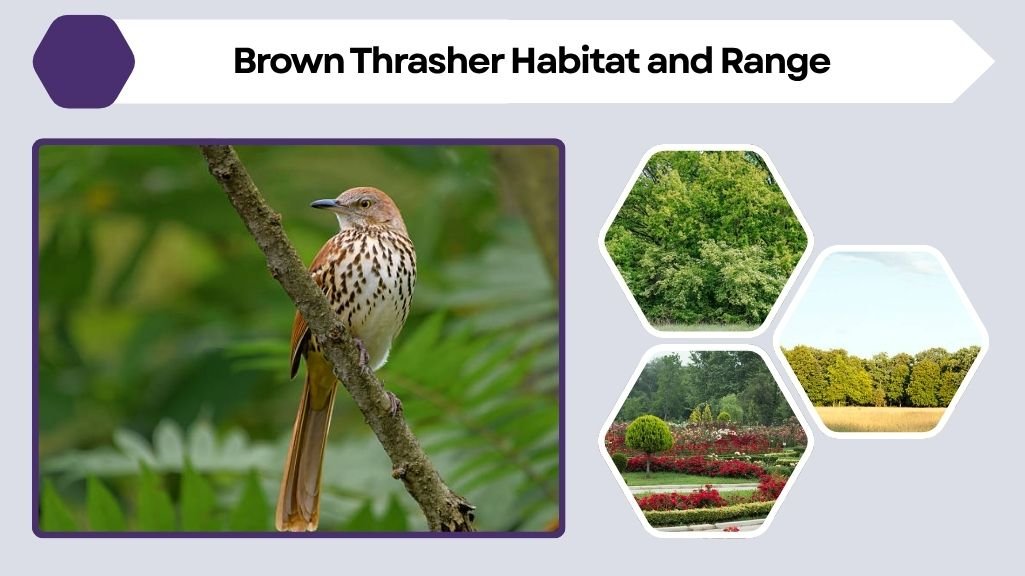
Brown Thrashers prefer dense shrublands, forest edges, and thickets across eastern and central North America. They occupy areas with ample ground cover for foraging and overhead protection. Seasonal movements are minimal, but northern populations may move south in winter to find food.
Breeding Habitat (List Items)
- Dense shrubs or low trees
- Woodland edges with thick undergrowth
- Suburban gardens with adequate cover
- Preference for areas near forest openings
Winter Habitat
In winter, Brown Thrashers remain in shrubs, thickets, and low-lying forests. They may visit backyard feeders, often joining small flocks or remaining solitary. Winter habitats favor food availability and shelter from predators.
Geographic Range
Their range spans eastern and central U.S., including Georgia, Florida, Indiana, Iowa, Maryland, and other eastern states. Rare sightings may occur outside these areas, but most populations are resident within their typical range.
Brown Thrasher Diet and Feeding Behavior
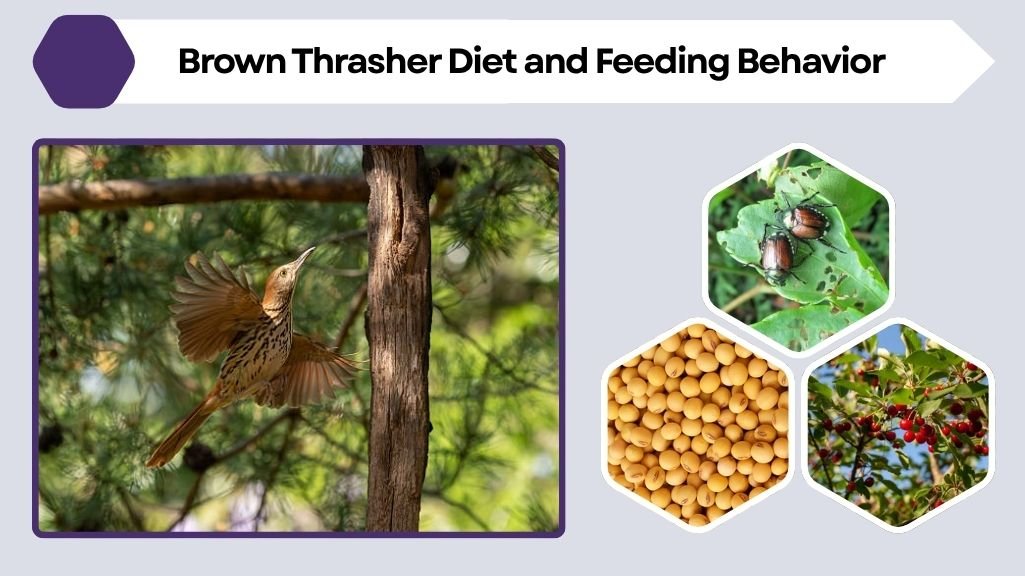
Brown Thrashers are omnivorous, feeding primarily on insects, fruits, and seeds. They forage actively on the ground, using their long bills to flip leaves and probe soil. Seasonal dietary changes occur, with insects preferred during breeding and fruits dominating in winter.
Typical Diet (List Items)
- Insects: beetles, grasshoppers, caterpillars, spiders
- Fruits: berries and small wild fruits
- Seeds: occasionally consumed
- Small invertebrates during breeding season
Foraging Behavior
They actively search on the forest floor and in shrubs. Using their long, slightly curved bills, they flip leaves and probe the soil for insects. This behavior helps distinguish them from similar birds that feed primarily in trees.
Seasonal Variations
In summer, insects supplement the diet to provide protein for chicks. In fall and winter, fruits and seeds become the main food source, supporting survival when insects are scarce.
Brown Thrasher Nesting and Breeding
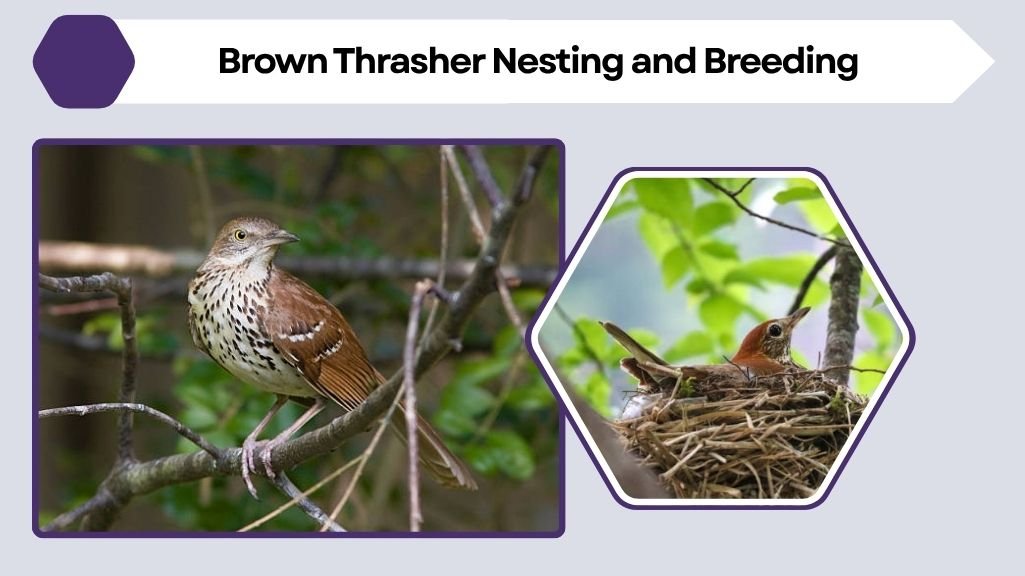
Brown Thrashers build cup-shaped nests in shrubs or low trees. Breeding occurs from spring to early summer, with 2–3 broods per year. Both parents participate in incubation and feeding young, demonstrating high parental investment.
Nest Construction (List Items)
- Cup-shaped nest made of twigs, grasses, and leaves
- Lined with softer materials such as feathers or moss
- Placed low in dense shrubs or trees for concealment
Eggs and Fledglings
Clutch size ranges from 3–5 eggs, pale with reddish-brown speckles. Incubation lasts 12–14 days, after which chicks fledge around 10–12 days later. Juveniles remain in or near the territory with parents until capable of independent foraging.
Juvenile Brown Thrasher
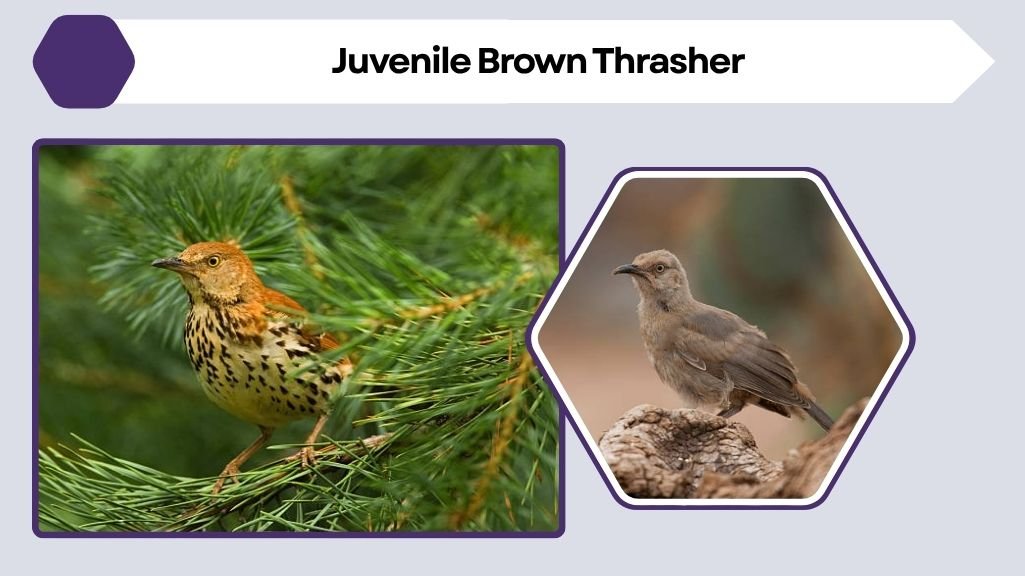
Overview: Juvenile Brown Thrashers resemble adults but are duller in coloration and have shorter tails. Observing juveniles helps birdwatchers track growth, plumage development, and behavior. Juveniles often remain near dense cover and gradually learn to forage efficiently before reaching adult size and full plumage.
Appearance and Identification
Juveniles are brown with faint streaking on their underparts. They lack the deep reddish-brown tone of adult plumage and have shorter tails. Their slightly curved bills are smaller, and their movements are less confident, making them appear more secretive than adults.
Behavior
Juveniles often follow their parents, learning foraging techniques and territorial behaviors. They may also join small flocks of other young thrashers or similar species for protection. Vocalizations are weaker than adult songs and calls.
Brown Thrasher Vocalizations and Song
The Brown Thrasher is renowned for one of the largest song repertoires of North American birds, capable of memorizing hundreds of phrases. Males use song for courtship, territory defense, and communication with mates. Calls are sharp and audible over long distances, providing key identification cues.
Song Characteristics
Brown Thrasher songs are melodious warbles with repeated phrases, often sung from exposed perches. Each male can produce 100–200 unique phrases, and songs vary between individuals. Singing is most frequent during breeding season but can occur year-round.
Calls
- Sharp “chip” or “tsk” notes for alarms
- Contact calls when moving through shrubs
- Distinctive “whit-wheet” notes in flight
Field Identification via Sound
Listening for song and call patterns helps distinguish Brown Thrashers from similar species such as Wood Thrushes, which have flute-like songs, or Long-billed Thrashers, which produce harsher warbles.
Brown Thrasher Behavior and Social Life
Overview: Brown Thrashers are mostly solitary or found in pairs during breeding. They are territorial, actively defending nesting sites, and secretive, often staying within dense cover. Observing behavior, including foraging, territorial disputes, and flight patterns, aids identification.
Territorial Behavior
Both males and females defend territories aggressively, chasing intruders and singing from perches. Territory size varies depending on food availability and population density.
Flight and Movement
Brown Thrashers have short, low flights between shrubs and trees. They hop and run on the ground, using their long tails for balance. Flight displays may include slight wing flicking and vocalizations.
Foraging
They forage primarily on the ground, flipping leaves and probing soil for insects, invertebrates, and seeds. Opportunistic feeding includes small fruits and berries, especially in fall and winter.
Brown Thrasher vs Similar Birds
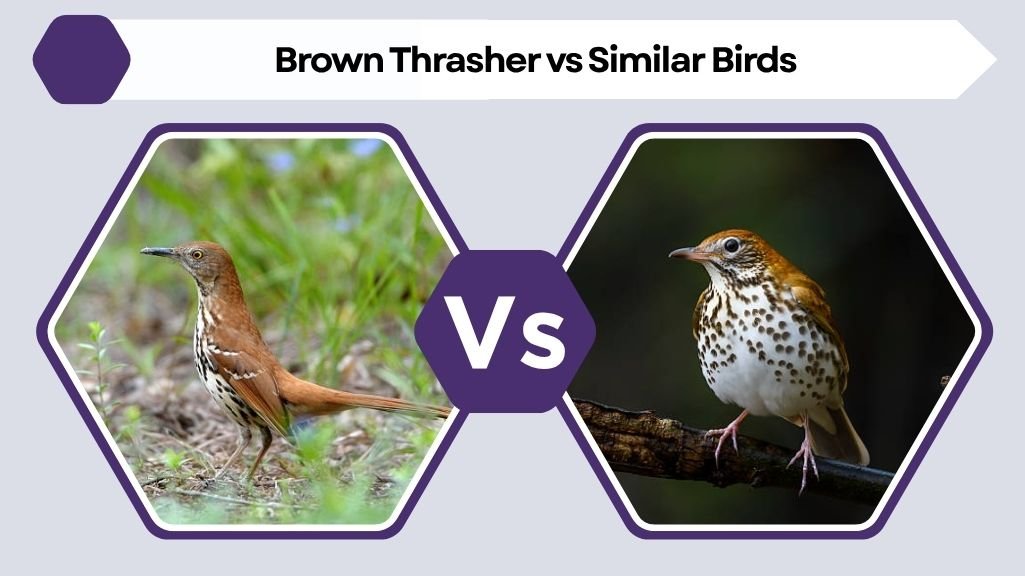
Brown Thrasher can be confused with Wood Thrushes, Long-billed Thrashers, and other streaked songbirds. Key differences include size, plumage, bill shape, and song. Observing these characteristics in the field allows accurate identification.
Comparison Table
| Feature | Brown Thrasher | Wood Thrush | Long-billed Thrasher |
| Size | Medium (23–28 cm) | Smaller | Larger (26–31 cm) |
| Plumage | Brown streaked, reddish upperparts | Olive-brown, spotted | Brown, uniform |
| Bill | Long, slightly curved | Short, straight | Longer, strongly curved |
| Tail | Long, broad | Medium, rounded | Long, pointed |
| Song | Large repertoire, repeated phrases | Flute-like warbles | Harsh warbles, less musical |
| Habitat | Shrublands, edges | Forest interiors | Dense brush, southern U.S. |
Field Identification Tips
- Males: Brown Thrasher males are more reddish-brown than Wood Thrush.
- Females: Subtle differences in streaking and tail length.
- Vocalizations: Listening to song helps distinguish species more reliably than plumage alone.
Seasonal Movements
Brown Thrashers are largely resident, but northern populations may move south in winter. They prefer lower-elevation habitats with shrubs, thickets, and abundant food sources. Observing these movements helps predict sightings and understand population distribution.
Migration
- Partial migrants in northern U.S. and southern Canada
- Move to southern U.S. states in winter, including Georgia and Florida
- Winter territories often overlap with resident populations of House Finches or similar species
Flocking
- Usually solitary or in pairs
- Sometimes forms small winter groups for foraging efficiency
Interesting Facts
Brown Thrasher is the state bird of Georgia and is recognized for its intelligence and extensive song repertoire. It exhibits problem-solving abilities, highly territorial behavior, and distinctive courtship displays, making it a favorite among birdwatchers.
Notable Facts (List Items)
- Georgia state bird
- Can memorize 200+ song phrases
- Uses long bill to forage efficiently
- Aggressive territorial behavior during breeding
- Juveniles learn songs from parents and neighboring males
FAQs
What does a Brown Thrasher look like?
The Brown Thrasher is a medium-sized songbird with long tail, reddish-brown upperparts, and heavily streaked white underparts. Both males and females appear similar, though females are slightly smaller. Juveniles are duller and less streaked, making them harder to identify in dense shrubs or forest edges.
Where does the Brown Thrasher live?
Brown Thrashers inhabit dense shrubs, forest edges, and thickets across eastern and central North America. They prefer areas with overhead cover for protection and abundant ground cover for foraging. Northern populations may move south slightly in winter, but most remain within their established range year-round.
What does a Brown Thrasher eat?
Brown Thrashers are omnivorous. Their diet includes insects such as beetles, grasshoppers, and caterpillars, as well as berries, small fruits, seeds, and occasionally other invertebrates. During the breeding season, insects and protein-rich foods are especially important for feeding chicks.
How can you distinguish a Brown Thrasher from similar birds?
Brown Thrashers can be confused with Wood Thrushes or Long-billed Thrashers. Key differences include size, plumage streaking, tail length, bill shape, and song. Brown Thrashers are larger, reddish-brown, heavily streaked below, with long tails, whereas Wood Thrushes are smaller, olive-brown with spotted underparts.
How does the Brown Thrasher sing and communicate?
The Brown Thrasher is known for an extensive song repertoire, often repeating phrases twice. Songs are melodious warbles used in courtship and territory defense. Calls include sharp “chip” notes for alarms and contact calls. Males use vocalizations to defend territories, while both sexes communicate within dense vegetation.
